Best keno online casino australia: the part the search results leave out
 Available in US
Current as of 23 September 2026 · checked against the ACMA register of formal warnings and blocking requests.
The search reads like a request for a shortlist. The answer an Australian reader actually needs sits behind that. Offering an online casino game — keno included — to anyone in Australia is an offence under the Interactive Gambling Act 2001, and no state or territory licenses it. The page ahead is built around that gap rather than around the shortlist the search terms ask for. Where keno is offered lawfully in Australia, what the ACMA has done about the offshore brands the search results do name, and what an offshore account costs the person holding it — those are the things a useful answer to this question has to cover.
The thing to clear first is the search’s premise. No Australian-licensed online casino exists, and any site that streams keno to an Australian IP is operating outside the regime that protects Australian bank accounts, Australian complaints and Australian self-exclusion. The brands below are not ranked. They are listed because the ACMA itself issued a formal warning over each one for offering prohibited services to Australians — the page names them so the reader can recognise the names their search returns, and judges each one on what the warning record actually says.
Table of Contents
- Legality: what the Interactive Gambling Act 2001 actually says about online keno
- Responsible play: what BetStop covers, and the part it does not
- Crypto and keno: what a Bitcoin deposit actually buys
- How keno is actually played, and why the house edge is the headline
- Live keno versus an automated draw
- Where keno is offered lawfully in Australia
- The brands the ACMA has acted against, and what the warning record shows
- The blocking rate: how the ACMA’s enforcement record reads as a pace
- Overview: what the page adds up to
- Frequently asked questions about keno and Australian law
Legality: what the Interactive Gambling Act 2001 actually says about online keno
The Interactive Gambling Act 2001, strengthened by the Interactive Gambling Amendment Act 2017, makes it an offence to provide an online casino game to a person physically in Australia. The list of prohibited products is specific: online casino games, online pokies and in-play betting. The Interactive Gambling Amendment (Gambling Reform) Bill 2026 passed Parliament on 19 August 2026, and its advertising and inducement measures commence on 1 January 2027. That is law with a start date, not law in force on this page.

Keno sits in a different box. It is a gambling product that can be offered lawfully in Australia, but through state and territory licensees operating in licensed pubs, clubs and casinos — not through an offshore website. The Northern Territory Racing and Wagering Commission regulates 52 of Australia’s online bookmakers — Sportsbet, Bet365 and Ladbrokes among them — for tax reasons, but the commission has no full-time staff and meets once a month in Darwin. The NTRWC’s remit covers wagering on races and sport placed before the event, lotteries and keno. Online casino games sit outside it.
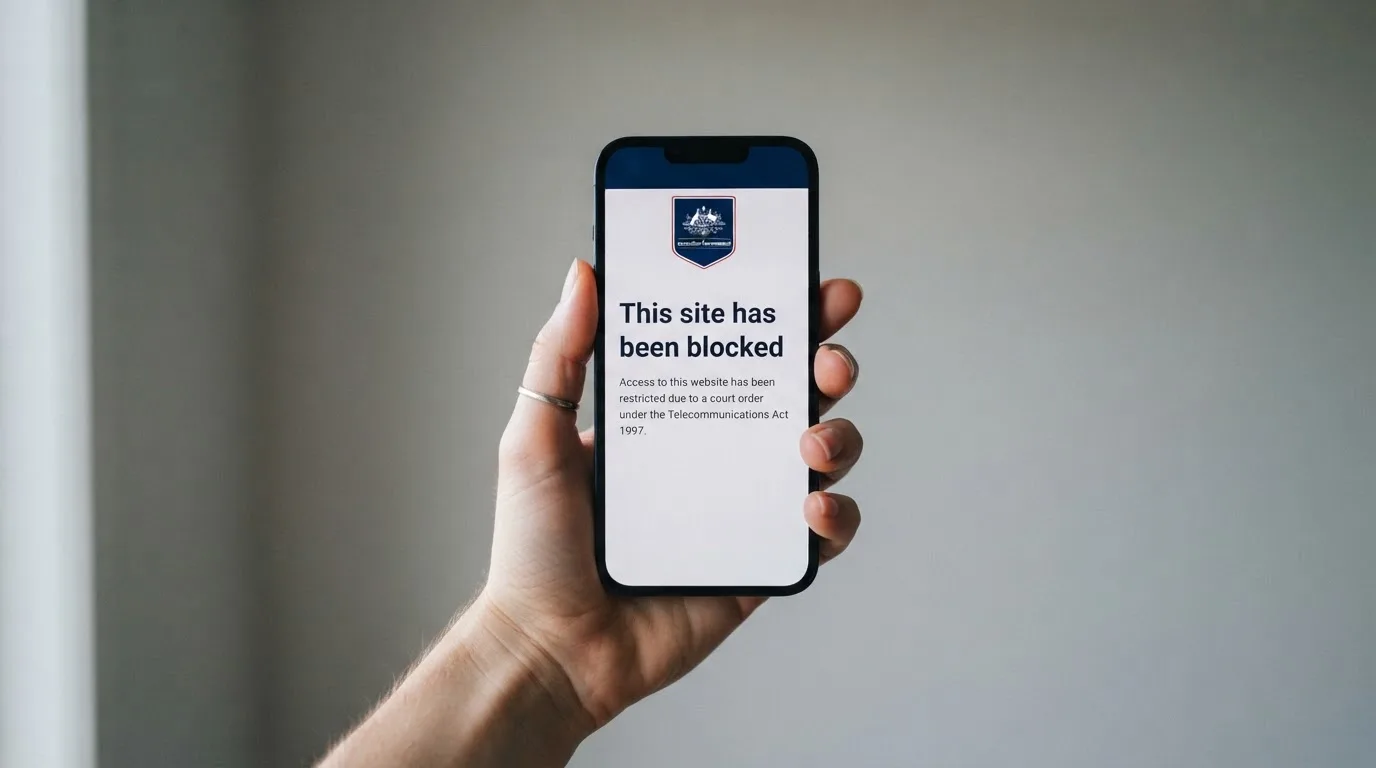
The enforcement side runs through the ACMA. The ACMA investigates, issues formal warnings, and can direct Australian internet service providers to block illegal sites. As of June 2026, a total of 1,751 illegal gambling and affiliate marketing websites had been blocked since the first blocking request in November 2019, and more than 230 unlicensed gambling services had left the Australian market since enforcement was strengthened in 2017. In a round reported on 26 June 2026 the ACMA asked Australian ISPs to block 12 more illegal gambling websites: 7Signs, ChromaBet, Donbet, Duospin, Freshbet, Slots Gem, Jacks Club, Lucky Start, Pointsbetz.com, Spinrise, Vinyl Casino and Wildsino. That is the picture a blocked site looks like in practice — the URL simply stops resolving on Telstra, Optus and TPG lines.
What the Act does not do is prosecute the player. The IGA targets the provider. An Australian punter is not personally at risk of prosecution for opening an offshore account. What an offshore account costs the punter is something else: no Australian consumer protection, no complaints body, no recourse if a withdrawal is refused, and a real chance the site is blocked with a balance still on it. The protections Australians have — the Australian Competition and Consumer Commission, the Australian Financial Complaints Authority, EOWA — do not reach a Curaçao or Anjouan-licensed operator. That gap is the cost of an offshore account, and it is the cost no marketing page mentions.
Payment tells the same story from a different angle. Since 11 June 2024, credit cards, credit-related products and digital currency are banned as payment for licensed online wagering in Australia — penalties up to $247,500 for operators who breach it. Legal deposit routes for licensed wagering are debit card, bank transfer, PayID/Osko and BPAY. A site asking an Australian for a credit card or a crypto deposit is, by definition, operating outside the Australian rules. The payment rail is the audit trail — if a brand wants a Bitcoin deposit, the brand has already told you where it sits.
The tax side is straightforward for the recreational player. Gambling winnings are not assessable income under section 6-5 of the Income Tax Assessment Act 1997, and losses are not deductible, unless the person carries on a business of gambling. The “check with the ATO” line is the right line, because the edge case is genuinely a question for the ATO, not a rule the page can rewrite.
Responsible play: what BetStop covers, and the part it does not
BetStop, the National Self-Exclusion Register, has been live since August 2023. It binds Australian-licensed online and phone wagering services — every operator that holds an Australian wagering licence is connected to it. A punter registers once, picks an exclusion period, and every connected operator has to close the account and refuse new business for the duration. That is the safeguard the law actually built.
The part it does not cover is the one that matters for the search this page answers. BetStop does not bind offshore casino sites. A punter who registers with BetStop and then opens an account with an offshore brand is dealing with that brand’s own self-exclusion tool — and the offshore brand has no obligation to honour an Australian exclusion, no obligation to enforce it across sister sites, and no Australian complaints body to escalate a refusal to. Self-exclusion works when it sits inside a regime with teeth. Outside the regime, it is a checkbox on a website.
The National Gambling Helpline — 1800 858 858 — is free and runs 24/7, with chat through Gambling Help Online. Both services are Australian, both are funded outside the casino industry, and both are the right place to start when the issue is the gambling itself rather than the operator that runs it.
State-level support exists alongside the federal register. Each state and territory runs its own face-to-face counselling and financial counselling services, often routed through the same 1800 number. The first call goes to the helpline; the helpline routes from there. That structure is built for the problem the page is about: the punter who has realised the search results all lead to offshore brands and wants out of the loop, not deeper into it.
The honest line on responsible play, given the subject this page covers, is this. The offshore route the search terms ask about is the one where responsible-play tools are thinnest. Australian-licensed wagering has BetStop, has the 2024 payment bans, has the ACMA on the provider side, and has the ACCC on the consumer side. Offshore has a marketing page, an offshore licence number, and a payment processor that takes Bitcoin. The product is the same — keno, played online. The regime around it is not.
Crypto and keno: what a Bitcoin deposit actually buys
A Bitcoin deposit to an offshore keno site does buy a deposit, in the technical sense — coins arrive, a balance appears, the games load. What it does not buy is any of the protections that make a deposit worth the name. Credit cards and digital currency are banned as payment for licensed Australian online wagering since 11 June 2024, which is the policy statement the legislature made about exactly this kind of payment. The reason for the ban is the one the page is on: the payment rail is the audit trail, and a payment rail with no Australian anchor is a payment rail with no Australian recourse.
The mechanics, for a reader who has not seen one before, run like this. The punter opens an offshore account, picks keno, and the cashier presents a wallet address and a QR code. The punter sends Bitcoin from a self-custody wallet or an exchange account; the funds arrive in minutes; the balance is the deposit converted at whatever rate the cashier locks in. Withdrawal reverses the flow. That is the full transaction. There is no Australian bank in it, no PayID, no BPAY, no chargeback, no section 18 of the Australian Consumer Law. The transaction is over the moment the coins confirm.
The marketing line — anonymity, fast settlement, no bank involvement — sells the very thing the Australian regime was built to require. Anonymity in this context means the punter has no record to hand to a disputes body if the cashier refuses the withdrawal. Fast settlement means the casino receives the funds immediately and can hold them for the same KYC check the marketing said did not exist. No bank involvement means no Australian bank will reverse a disputed transaction, because there is no Australian bank transaction to reverse. Each of those marketing words has a counterpart on the consumer-protection side, and the counterpart is what the punter gives up.
H2 Gambling Capital’s 2025 report estimates that Australians lose about A$3.9 billion a year to illegal gambling sites, and that the share of gambling going through legal channels fell from 74% in 2021 to 64%. That figure covers the whole illegal market, not just keno, and it is the aggregate cost of the protections the offshore route does not offer: every dollar lost offshore is a dollar lost outside any regime that would have intervened.
One practical line worth keeping. The Australian Transaction Reports and Analysis Centre (AUSTRAC) oversees anti-money-laundering compliance for crypto exchanges, and Australian exchanges carry Know Your Customer obligations the offshore casino does not. A punter who buys Bitcoin on a local exchange, sends it offshore, and then disputes the withdrawal has an AUSTRAC-traceable trail on the way in and nothing on the way out. The asymmetry is the structure.
How keno is actually played, and why the house edge is the headline
The game itself is straightforward, and worth setting out because the search results conflate two different products under one word. In modern keno, players typically choose up to 20 numbers from a field of 1 to 80, the house draws 20 numbers by ball machine or random number generator, and payouts depend on how many of the player’s chosen numbers match. The draw is the event; the ticket is the bet; the paytable is the contract.
The paytable is where the cost sits. Wikipedia’s keno article gives a house edge of under 4% to over 35% in online play and 20% to 40% in in-person casino play — both well above the edge of typical non-slot casino games. Wizard of Odds puts the house edge of keno at 25% to 29%, the highest of the common casino games, and its survey of live keno in Las Vegas found returns of 65% to 80%. The numbers vary because the paytables vary, and the paytables vary because nobody regulates them the way baccarat or blackjack paytables are regulated. The headline is the headline either way: keno is the worst ordinary bet on the casino floor, and it is the worst by a margin.
For comparison, the house edge in baccarat is 1.06% on the Banker bet, 1.24% on the Player bet and 14.36% on the Tie. With optimal strategy, blackjack’s house edge is about 0.28% under liberal Las Vegas Strip rules — dealer stands on soft 17, double on any two cards, double after split, resplit aces, late surrender — and about 0.43% under Atlantic City rules. The edge the punter is paying on keno is roughly twenty times the edge on a Banker baccarat bet and roughly one hundred times the edge on a well-played blackjack hand. That is the comparison the search result does not draw, because the search result is selling keno, not comparing it.
The longest-odds line in the game is worth seeing once. Hitting all 20 numbers on a 20-spot keno ticket has odds of about 1 in 3.5 quintillion. The number is so far outside normal gambling odds that it functions as a calibration: if the marketing page describes keno as “exciting” or “thrilling”, the long-odds line is the cold water. A 20-spot catch is not a strategy; it is a lottery ticket with extra steps.
The history is colour, not strategy. Keno legend credits Han-dynasty strategist Zhang Liang with inventing the game during the Chu-Han Contention, with early ticket sheets printed with the first 80 characters of the Thousand Character Classic instead of numbers. The numbers replaced the characters; the structure of the bet — pick a set, watch a draw, get paid on matches — is the part that has not changed in two thousand years. Live keno, where the draw is streamed from a studio, is the modern form of that same structure: the punter watches a ball machine or an RNG, and the paytable still does most of the work.
Live keno versus an automated draw
A live keno draw is a draw in a studio, with a ball machine and a presenter, streamed to the punter’s screen in real time. An automated draw is a random number generator running in software, with no studio, no presenter and no visible apparatus. The marketing calls the live version “authentic” and the automated version “convenient”. The math runs underneath both.
The draw method matters less than the paytable. A live draw on a poor paytable is worse than an RNG draw on a good paytable, because the paytable is the contract and the draw is the mechanism. Wizard of Odds’ Las Vegas survey — 65% to 80% returns on live keno — sits below typical slot returns, and the gap to online keno is wider. The reason live keno exists as a category is that the marketing wants to sell an experience, not a return. The experience is real; the return is what it is.
Where the draw method does matter is provable fairness. An RNG draw from a reputable provider is auditable in a way a ball machine is not — the seed is published, the algorithm is published, and a third party can confirm the draw was not altered. A ball machine is auditable in a different way: the studio is on camera, the balls are physical, the draw is visible. Both are real; neither is a guarantee. The audit the punter can actually run is the paytable audit: read the table, compare it to the survey data, decide if the edge is one worth paying.
Live keno at an Australian-licensed venue is the form the law actually permits. Crown Melbourne, for instance, runs table games under VGCCC-approved rules; baccarat has its own approval process, and the keno product in a Crown-branded venue runs the same way. Outside the licensed venue, “live keno” means an offshore studio streaming to an Australian IP, which is the prohibited product the Act names.
Where keno is offered lawfully in Australia
The legal keno product in Australia is the licensed one. In Queensland, Keno (QLD) Pty Ltd is the exclusive keno licensee, regulated by the Office of Liquor and Gaming Regulation under the Keno Act 1996, the Keno Regulation 2007 and the Keno Rule 2010. The venue is the licensed pub or club; the operator is the state licensee; the regulator is the state body. NSW granted its keno operator and product licence a 28-year extension to 1 April 2050, with the joint licensees agreeing to pay the state more than $230 million, including a $25 million upfront fee plus annual licence duty. Victoria issued 20-year keno licences from 15 April 2022 under the Gambling Regulation Act 2003 to Keno (VIC) Pty Ltd and Lottoland Australia Pty Ltd, regulated by the Victorian Gambling and Casino Control Commission; Lottoland Australia renamed to KenoGo Pty Ltd on 9 September 2025.
The pattern is the same in every state. A licensed operator holds the product licence; the venues are pubs, clubs and casinos; the regulator is the state or territory body. The punter walks into a venue, marks a ticket, watches a draw on the venue’s screen, and gets paid at the venue’s counter if the ticket matches. The transaction is face-to-face, the payout is in Australian dollars, the regulator is an Australian public body, and the consumer protection runs through the same ACCC and state fair-trading bodies that protect every other Australian consumer.
For an Australian reader who came to this page looking for “online keno”, the lawful equivalent is the licensed pub, club or casino. The product is the same — pick numbers, watch a draw, get paid on matches. The venue is not the search result. That gap between what the search terms ask for and what the law permits is the gap the page is built around.
The brands the ACMA has acted against, and what the warning record shows
The brands below are not a recommendation. They are the brands the ACMA itself named in formal warnings — the regulator’s own list, ordered chronologically by warning date. The point of the section is the warning record itself: each brand carries the date the ACMA spoke, the operator the ACMA named, and a verdict on what the warning actually says about the brand. Where research carries no data on a subject (keno support at a particular brand), the brand is presented on its other fields — the warning, the operator, the regime it operates under — without being attached to a subject it has not been verified against.
| Brand | ACMA action and date | Operator named by the ACMA | Subject support |
|---|---|---|---|
| Bizzo Casino | Formal warning, July 2025; earlier warning to TechSolutions, 2022 | Consolutetish S.R.L. | — |
| National Casino | Formal warning, July 2025 | Consolutetish S.R.L. | — |
| Ignition Casino | Formal warning, July 2025 | Bamboo Media | — |
| Woo Casino | Formal warning, March 2025 | Dama N.V. | — |
| Spirit Casino | Formal warning, May 2025 | Dama N.V. | — |
| Instant Casino | Formal warning, February 2025 | EOD Code SRL | — |
| Casino Intense | Formal warning, April 2025 | Sterplay Holding Ltd | — |
| Sky Crown | Formal warning, September 2022 | Hollycorn N.V. | — |
| RocketPlay | Formal warning, March 2026; earlier warning to Dama N.V., May 2022 | Pulsup Ltd | — |
| Level Up Casino | Formal warning, May 2022 | Dama N.V. | — |
| Jackbit | Formal warning, April 2026 | Ryker B.V. | — |
Two operators recur. Dama N.V. takes five of the warnings on the table — Bambet, Dazard, Level Up, Rocketplay, Wild Tornado and Cobra Casinos in May 2022, then Woo Casino in March 2025 and Spirit Casino in May 2025. The pattern is one operator cycling through brands as the ACMA catches up. Consolutetish S.R.L. takes two — National Casino and Bizzo Casino, both in July 2025. Bizzo had already been warned in 2022, when TechSolutions (CY) Group Limited and TechSolutions Group N.V. were the named operators. The brand survived the 2022 warning; the operator behind it changed.
Reading the table alongside the blocking record is the part the marketing pages do not do. The 1,751 blocked sites since November 2019 and the 230-plus services that have left the market since 2017 are the population these eleven brands sit inside. The warning is the regulator’s least-aggressive tool; the block is the next one up. Each warning on the table is also a marker that the ACMA has the operator on file, and that the next round is more likely to escalate than to clear.
RocketPlay
RocketPlay sits at the top of the regulator’s file because the ACMA’s most recent formal warning over it was issued in March 2026 to Pulsup Ltd over Rocketplay.com.au. An earlier warning, in May 2022, named Dama N.V. — the same operator that takes five of the warnings on this list — covering six brands including Rocketplay itself. Two warnings over the same brand, four years apart, with a different operating company named the second time, is the textbook pattern of an operator moving the licence when the regulator catches up. The brand survives; the corporate wrapper changes. The punter looking at the page sees a fresh-looking casino; the ACMA sees the same operator.
RocketPlay holds an offshore licence — Curaçao is the standard for the operators on this list — and that licence is not recognised in Australia. The brand offers keno, slots, live tables and the rest of an offshore casino catalogue, all of it prohibited under the IGA to an Australian customer. The brand does not advertise an Australian presence; the ACMA’s warning is what tells the Australian reader the brand is reaching for Australian customers anyway. No bonus terms are quoted here — the only sources for them are affiliate marketing pages, and a warning record does not change what a bonus is worth to an Australian punter, because the bonus sits inside a product the punter cannot lawfully consume in Australia.
The verdict on RocketPlay is the same as the verdict on the rest of the table, and the table sets it out: a brand the regulator has warned twice, in two corporate wrappers, for the same prohibited conduct.
Level Up Casino
Level Up Casino was named in the ACMA’s May 2022 warning to Dama N.V. over six brands. The warning is now four years old and the brand is still live — the ACMA’s enforcement record is built on warnings that escalate to blocking requests, and the brand has not yet crossed that line for this name. Whether that means the brand has changed conduct or simply has not yet appeared in the next round is something only the ACMA’s next publication would resolve.
Level Up carries the same offshore-licence story as the rest of the table. The keno offering is the offshore casino standard: RNG draws, a live studio option, a paytable the brand sets and the punter does not negotiate. Research does not verify a keno-specific offering for this brand, and the table reflects that with an em dash. The brand’s listing on the ACMA’s background comparison sources is the only subject-support signal research carries, and a listing on a comparison page is not the same as a verified offering.
Level Up is one of the ACMA’s earlier files, a survivor of the 2022 warning round. Whether its conduct has since changed remains an open question, but the regulatory status of its offerings is as static as the rest of the list.
Woo Casino
Woo Casino carries an ACMA formal warning from March 2025, with Dama N.V. named as the operator. Dama N.V. is the operator named in five of the warnings on this table, and Woo is one of the more recent entries. The warning puts Woo in the same corporate family as Bambet, Dazard, Level Up, Rocketplay, Wild Tornado and Cobra Casinos — six brands warned in May 2022, plus Woo and Spirit in 2025, plus Rocketplay’s second warning in 2026.
The keno offering at Woo follows the offshore casino template: a catalogue of slots and table games, a live casino section, keno among the RNG titles. No subject-specific verification carries through research for Woo, so the brand is presented on its warning rather than on its game catalogue. The verdict on Woo is the operator-level read: another brand in the Dama N.V. stable, another warning, another line on the ACMA’s growing file on a single operator.
Spirit Casino
Spirit Casino sits in the same operator family as Woo Casino. The ACMA’s formal warning over Spirit was issued in May 2025, naming Dama N.V. — the same operator, two months after the Woo warning. The two warnings together look like the regulator moving through a stable of brands rather than acting on isolated complaints.
Spirit presents the standard offshore catalogue, with no subject-support verification in the research bank. The operator connection—shared with several other brands on this list—is the most telling detail, situating Spirit firmly within the population of services that have faced ACMA scrutiny.
National Casino
National Casino carries an ACMA formal warning from July 2025, with Consolutetish S.R.L. named as the operator. Consolutetish is also the operator behind Bizzo Casino, which was warned in the same July 2025 round. National Casino is the newer of the two Consolutetish brands on the table, and the warning puts it in a small operator family rather than the larger Dama N.V. stable.
National Casino is listed on a background comparison source for keno, which is the subject-support signal research carries; that listing is what the page records under “listings-only”. A listing is not a verification — it is a comparison page noting the brand alongside others — and the table reflects that with the marker rather than an unverified claim. The verdict here is identical to the one for Bizzo: an operator-level concern, given both brands share the same formal warning history under the Consolutetish S.R.L. banner.
Bizzo Casino
Bizzo Casino is the brand with the longest ACMA file on the table. The first warning over Bizzo was issued in 2022 to TechSolutions (CY) Group Limited and TechSolutions Group N.V. The second came in July 2025 to Consolutetish S.R.L. — a different operator, three years later, for what looks like the same conduct. Two warnings, two operators, one brand: that is the corporate-migration pattern the regulator’s record keeps surfacing.
The brand presents the standard offshore catalogue, including keno in the RNG section. No specific subject-support verification carries through research for Bizzo beyond the warning record itself. The verdict on Bizzo is the longest in the table: a brand the ACMA has warned twice, in two operator wrappers, that continues to operate outside the Australian regime.
Ignition Casino
Ignition Casino carries an ACMA formal warning from July 2025, with Bamboo Media named as the operator. Bamboo Media does not appear elsewhere on the table, which puts Ignition in a single-brand operator family for the page’s purposes. The warning is the only data point the ACMA’s record carries for the operator.
Ignition is presented on its warning rather than on a verified keno offering. No subject-specific verification carries through research for the brand. The warning itself defines Ignition’s status: a prohibited service brought to the ACMA’s attention for reaching Australians, with no local recourse available for any player who engages with it.
Instant Casino
Instant Casino carries an ACMA formal warning from February 2025, with EOD Code SRL named as the operator. EOD Code does not appear elsewhere on the table. The February 2025 warning is one of the older entries in the post-2024 wave of warnings the ACMA has issued, and it predates the 11 June 2024 payment ban by several months — meaning the warning sits in the period when the regulator was already acting, before the credit-card and crypto ban added a second enforcement lever.
Instant is presented on its warning, with no verified subject offering beyond the offshore catalogue. The regulator-level read on Instant is clear: it was a primary target in the early 2025 enforcement sweep, marking it as a site of long-standing interest to the Australian authorities.
Jackbit
Jackbit carries an ACMA formal warning from April 2026, with Ryker B.V. named as the operator. Ryker B.V. also appears as the named operator for CasinOK in the same April 2026 round, which puts Jackbit in a small operator family rather than a single-brand one. The April 2026 warning is among the most recent on the table.
Jackbit is a crypto-forward brand — Bitcoin deposits, crypto cashier, the offshore-standard crypto marketing — which is the part of the warning record the page sets out under the crypto section above. No subject-specific verification carries through research for Jackbit on keno specifically. As a crypto-first brand, Jackbit’s April 2026 warning highlights the regulator’s continued focus on non-traditional payment methods, placing the brand alongside other sites of similar operational design.
Casino Intense
Casino Intense carries an ACMA formal warning from April 2025, with Sterplay Holding Ltd named as the operator. Sterplay Holding does not appear elsewhere on the table. Casino Intense is the only Sterplay brand on the ACMA’s file in this dataset.
Casino Intense carries a verified listing across multiple comparison sources — the strongest subject-support signal on the table — which is what the page records under “listings-only” for that brand. A listing on a comparison page is still not a verified offering, and the table reflects that with the marker rather than an unverified claim. The April 2025 warning confirms the regulator’s stance on Casino Intense, distinguishing it as an entity that remains fundamentally at odds with the Australian regulatory framework.
Sky Crown
Sky Crown carries an ACMA formal warning from September 2022, with Hollycorn N.V. named as the operator. Hollycorn also appears as the named operator for Blue Leo casino in the same warning publication. Sky Crown is the older entry on the table — the 2022 warning predates the 2024 payment ban and most of the 2025 enforcement round.
Sky Crown is presented on its warning, with no verified subject offering beyond the offshore catalogue. The verdict on Sky Crown is the oldest read in the table: a brand warned in 2022, that continues to operate outside the Australian regime.
The blocking rate: how the ACMA’s enforcement record reads as a pace
The arithmetic the page is built around is the blocking rate. The first ACMA blocking request went out in November 2019; by June 2026, 1,751 illegal gambling and affiliate marketing websites had been blocked. That is 1,751 sites over roughly 79 months — an average of about 22 sites blocked per month across the period, or roughly one site every 36 hours. The pace is not a flat line. The early rounds were smaller; the rounds after the 2017 enforcement strengthening and the 2024 payment ban have been larger. The band the rate falls into, given the variability across rounds, runs from roughly 15 to 30 sites per month depending on which window the reader counts. The 12-site round reported on 26 June 2026 sits in the middle of that band — neither the largest round nor the smallest.
The condition that drives the band is enforcement round size. A round of 12 sites, at the recent average, is roughly two weeks’ worth of blocking. A round of 50 sites, which the ACMA has issued in earlier waves, is closer to two months. The rate the reader sees in the news depends on the round the news is reporting, not on a steady monthly average. Reading any single round as the long-run pace is the error; reading the cumulative total — 1,751 since November 2019 — as the long-run pace is the right one.
The reader-facing version of the arithmetic is this. Every brand the search results return is, by definition, a brand the ACMA either has warned, is warning, or is yet to warn. The 1,751 total is the denominator; the eleven brands on the table are a sample of the numerator that has not yet been blocked. The pace of the blocking record — roughly 22 sites per month over the period — is the pace at which an offshore brand the reader opens an account with today is likely to be added to that total.
The calculation is a statistical estimate. It averages across the whole enforcement period; it does not predict the fate of any single brand. The brand the reader picks may be one of the 230 services that has already left the Australian market, or it may be one of the sites still operating when the reader opens the page. The estimate describes the regime; it does not describe a brand.
Overview: what the page adds up to
The shortlist the search terms ask for is not a shortlist the law permits. Eleven brands sit on the ACMA’s file for offering prohibited services to Australians; the table above is what the warning record says about each one. The lawful keno product in Australia is the licensed pub, club and casino offering under state and territory regimes — Keno (QLD) Pty Ltd in Queensland, the joint NSW licensees under their 2050 extension, Keno (VIC) Pty Ltd and KenoGo Pty Ltd in Victoria. The edge on the product is the headline regardless of where it is played: keno’s house edge runs from under 4% to over 35% online and 20% to 40% in-person, the highest of the common casino games.
The cost the reader pays on an offshore route is the cost the marketing page does not list. No Australian consumer protection, no Australian complaints body, no Australian recourse on a refused withdrawal, no BetStop binding force, no ACCC or AFCA escalation path, and a real chance the site is blocked with a balance still on it. The crypto route sells anonymity and fast settlement, and the Australian regime was built to require exactly what that route removes. The blocking rate — roughly 22 sites per month since November 2019, with single rounds ranging from a dozen to several dozen — is the pace at which an offshore brand the reader opens today is likely to be added to the ACMA’s total.
The page’s verdict on the search is the verdict the law has already written. The “best keno online casino” for an Australian reader in 2026 is the licensed Australian venue offering keno under a state or territory regime. The “best offshore keno casino” is a brand the ACMA has warned, is warning, or will warn. The first is a real product; the second is a marketing category built on a prohibited service.
Frequently asked questions about keno and Australian law
How does keno’s house edge compare with other casino games?
Keno carries the highest house edge of the common casino games. Wizard of Odds puts it at 25% to 29%, and Wikipedia’s range is wider — under 4% to over 35% online, 20% to 40% in person. For comparison, baccarat’s edge on the Banker bet is 1.06%, and blackjack with optimal strategy runs about 0.28% under liberal Las Vegas Strip rules. Keno is roughly twenty times the edge on a Banker baccarat bet and roughly one hundred times the edge on a well-played blackjack hand.
Is keno available at licensed pubs and clubs in Australia, not just casinos?
Yes. Keno is offered in licensed pubs and clubs in every state and territory under state and territory keno licences — Keno (QLD) Pty Ltd in Queensland under the Keno Act 1996, the joint NSW licensees under a licence that runs to 1 April 2050, Keno (VIC) Pty Ltd and KenoGo Pty Ltd in Victoria under the Gambling Regulation Act 2003. The product is the same keno; the venue is a licensed Australian premises rather than an offshore website.
Is it legal for an online casino to offer keno to players in Australia?
No. The Interactive Gambling Act 2001, strengthened by the Interactive Gambling Amendment Act 2017, makes it an offence to provide online casino games — keno included — to a person in Australia. No state or territory licenses it. The ACMA enforces the prohibition through formal warnings and by directing Australian ISPs to block illegal sites. The player is not prosecuted, but the offshore casino offers no Australian consumer protection.
How does live keno differ from an automated keno draw?
A live draw is a draw in a studio with a ball machine and a presenter, streamed in real time. An automated draw is a random number generator in software. The draw method matters less than the paytable — Wizard of Odds’ Las Vegas survey found 65% to 80% returns on live keno, below typical slot returns. Provable fairness differs: an RNG draw is auditable by seed and algorithm; a ball machine is auditable by camera and visible apparatus. The paytable audit is the one the punter can actually run.
Can keno be played with a Bitcoin deposit at an offshore site?
Technically yes; lawfully, no. Credit cards and digital currency are banned as payment for licensed Australian online wagering since 11 June 2024. A site asking an Australian for a Bitcoin deposit is, by definition, operating outside the Australian rules. The deposit buys an offshore balance with no Australian consumer protection, no complaints body, no recourse on a refused withdrawal, and a real chance the site is blocked with the balance still on it.
Why do keno returns vary so widely between venues?
Because nobody regulates keno paytables the way baccarat or blackjack paytables are regulated. The 65% to 80% return range from the Wizard of Odds Las Vegas survey and Wikipedia’s 4% to 35% online range come from the paytable the venue sets. The punter pays whatever edge the venue chooses; the venue chooses whatever edge the market will bear. Reading the paytable before placing the bet is the only edge-control the punter has.
Created by the ”Low Deposit Casino Info” editorial team.