3-Reel Slots in Australia: What the Format Is, What the Law Says, and What an Offshore Site Really Costs
 Available in US
A three-reel slot is the simplest machine format still in circulation. Three vertical reels, a handful of symbols on each, a single payline down the middle, and a payout table that says exactly what each combination is worth. The format dates back to Charles Fey’s Liberty Bell in the late 19th century, and it is still being reproduced today as a “classic” or “fruit machine” variant on every operator a search engine surfaces for an Australian punter. The question this page answers is not which one to play. In 2026 no online slot of any reel count is licensed in Australia, and the ACMA’s enforcement against offshore operators has been the most consistent regulatory story in Australian online gambling for half a decade. So the question is what 3-reel slot play actually involves, what it legally cannot be, and what the offshore sites offering it have already cost Australian players in money and in regulatory attention.
23 September 2026 data · licence and blocking figures checked against the ACMA’s published register.
Table of Contents
- Why the format still exists, and what it actually looks like
- What the Interactive Gambling Act 2001 actually prohibits
- What responsible gambling looks like when the offshore site is the product
- What “3-reel bonus” and “free spins” offers actually mean on an offshore site
- What a paytable actually shows, and how to read one
- The operators the ACMA has warned about — and what each one has cost the Australian market
- The wider Australian gambling market the ACMA is operating inside
- Tax, payments, and what an Australian’s withdrawal actually looks like
- Why the answer to the search query is what it is
- Frequently Asked Questions
Why the format still exists, and what it actually looks like
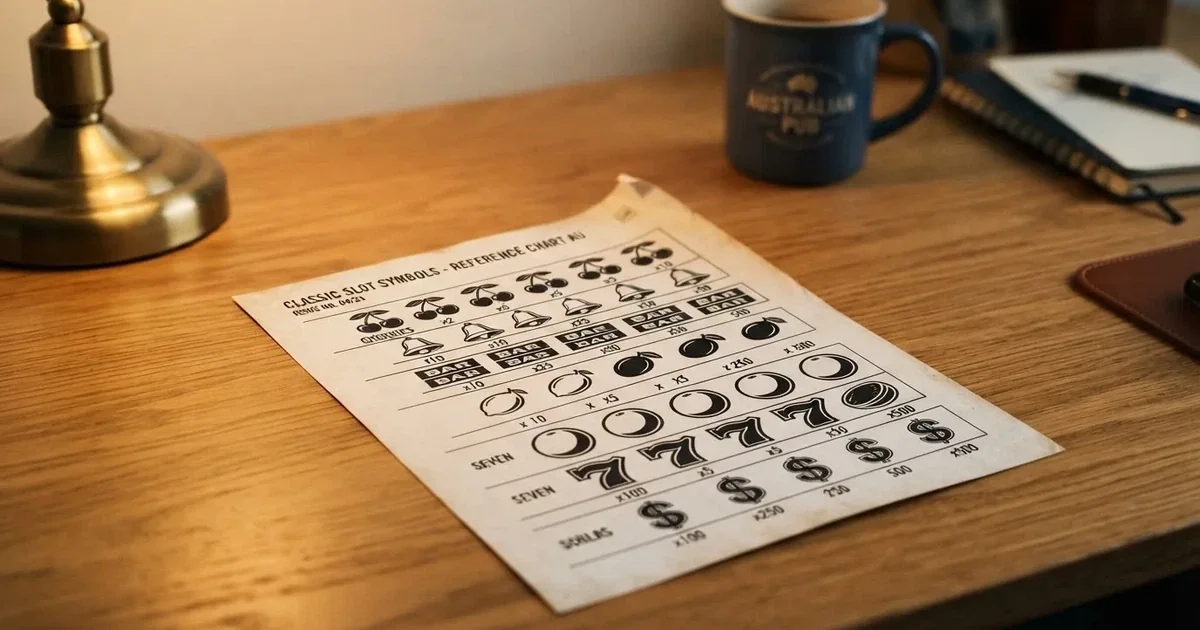
The Liberty Bell had three reels, five symbols on each reel — horseshoes, diamonds, spades, hearts, and bells — and three bells in a row paid the top prize of ten nickels. That mechanical layout is the direct ancestor of every 3-reel game an Australian punter encounters today. The reels spin, the symbols land, the payline across the centre of the screen checks whether any of the listed combinations have hit, and the payout table on screen or in the help file says how much each line is worth.

The reason the format survives in a market that has long since moved to five-reel video slots is partly aesthetic and partly mathematical. Aesthetically, the three reels and a single payline look like a holdover from a mechanical era, and the casinos and game studios that still publish these titles lean into that — fruit symbols, BARs, 7s, bells. Mathematically, the simpler reel set means fewer possible combinations. A classic mechanical three-reel machine with about ten symbols per reel produces roughly one thousand possible outcomes. Modern video slots with five reels and fifty or more symbols per reel can produce odds as long as 300 million to one against a top combination. That is the entire reason older players describe the 3-reel format as “tighter” — there are fewer losing positions, but the payouts the game advertises are calibrated to the smaller reel set, and the house edge is built into the same arithmetic that runs every other slot. Three reels, five reels, or fifty: the operator keeps a percentage of every dollar through the paytable, and the rest is decoration.
In a real-money Australian venue — a pub, a club, or one of the state-regulated casinos — the 3-reel format still exists alongside its 5-reel and video cousins, and it is regulated. The numbers of pokies-style machines outside Australian casinos, as the gambling-industry data reports them, were 87,298 in New South Wales as of June 2023, 26,380 in Victoria across 2021-22, 21,122 in Queensland as of October 2023, 11,672 in South Australia as of September 2023, and 3,587 in the ACT as of November 2023. Those are licensed machines in licensed premises, governed by state-level gaming-machine rules. None of them is an online 3-reel game; the format exists in Australia as a physical product, not a digital one.
What the Interactive Gambling Act 2001 actually prohibits
The starting point for any conversation about online gambling in Australia is the Interactive Gambling Act 2001 (IGA), strengthened by the Interactive Gambling Amendment Act 2017. The IGA makes it an offence to provide online casino games, online pokies, or in-play betting to a person physically in Australia. No state or territory issues a licence for any of these products. The only online wagering products that can lawfully be offered to Australians are wagering on races and sporting events placed before the event begins, lotteries, and keno — and in practice those licences are issued by the Northern Territory, through the Northern Territory Racing and Wagering Commission (NTRWC), which regulates 52 of Australia’s online bookmakers including Sportsbet, Bet365 and Ladbrokes for tax reasons. The commission has no full-time staff and meets once a month in Darwin, which is one of the more revealing structural facts about how Australian online gambling is actually policed.

The consequence for the 3-reel question is straightforward. No online slot — three reels, five reels, or progressive jackpot — is licensable in Australia. Every operator that surfaces in an Australian search for “3 reel slots” or “classic pokies online” is doing so in breach of the IGA. The offshore licence that such a site displays (a Curaçao authorisation, an Anjouan authorisation, a Kahnawake licence) is a licence to operate in that jurisdiction; it is not a licence to provide interactive gambling to Australians, because no such licence exists. The site may call itself licensed. The Australian Communications and Media Authority (ACMA) calls it a prohibited interactive gambling service, and the site is blocking-eligible.
What enforcement looks like in practice
The ACMA has three enforcement tools: investigation, formal warning, and blocking requests to Australian internet service providers. A formal warning does not take a site down. What it does is publish, on the ACMA’s own register, the operator’s name, the brand, and the date of the warning — a public record that the brand has been put on notice that what it is offering to Australians is prohibited. A blocking request goes further: the ACMA asks Australian ISPs to make the site’s domain unreachable from an Australian IP address. Since the first blocking request in November 2019, the ACMA reports that 1,751 illegal gambling and affiliate-marketing websites have been blocked as of June 2026, and more than 230 unlicensed gambling services have left the Australian market since enforcement was strengthened in 2017. In a single round reported on 26 June 2026, the ACMA requested ISPs to block twelve more sites: 7Signs, ChromaBet, Donbet, Duospin, Freshbet, Slots Gem, Jacks Club, Lucky Start, Pointsbetz, Spinrise, Vinyl Casino and Wildsino.
The rate at which the register has grown is the part of the picture that matters. Between the first blocking request in November 2019 and the round reported in June 2026, the ACMA’s blocked-site total reached 1,751 over roughly six and a half years. Spread across that period, the running rate of blocked sites is around 269 per year — but the rate has not been constant. The early years of the regime were slower; the rate accelerated after 2017’s amendment and again after the payment-banning rules came into force in June 2024. Treating that 269-per-year figure as a flat forecast is misleading: the regulator’s pace in the last twelve reporting months is closer to three hundred new sites. The realistic reading is that the ACMA’s blocking regime runs at a pace somewhere between 250 and 300 new domains a year, with the higher figure closer to the current rate and the lower figure closer to what the first few years produced. The reader who treats the lower figure as the ceiling will under-estimate how many new offshore sites the ACMA is identifying every quarter; the reader who treats the higher figure as the floor will over-estimate the impact on sites that have already been put on notice. The honest reading is a band, not a single number.
What a blocking request does and does not do to a player
A blocking request makes the domain difficult to reach through an Australian ISP, but it does not confiscate the balance of any account that was open at the time. If a player had funds with an offshore site and the ACMA subsequently moved to take the site down, the player is in the position the IGA has always warned about: there is no Australian complaints body, no Australian regulator to escalate a withheld withdrawal to, and no Australian law to invoke if the operator stops responding. The site’s stated regulator (Curaçao, Anjouan, the Philippines) is technically reachable but practically a long way from a small Australian withdrawal dispute, and the operator is no longer reachable at the Australian domain once the block lands. The intervention protects the next punter; it does not unwind what happened to the last one.
The reason the ACMA publishes formal warnings at all is partly the same. A formal warning in March 2025, July 2025, February 2025 or May 2025 is not a closure, but it is a public record that an operator was told to stop offering prohibited services to Australians and continued. The register of formal warnings is, in effect, a list of operators that have chosen to keep the Australian traffic anyway.
What responsible gambling looks like when the offshore site is the product
If a player’s relationship with 3-reel online slots — or any online gambling product — has started to feel compulsive or financially strained, the help available in Australia is real, free, and confidential. The National Gambling Helpline on 1800 858 858 runs twenty-four hours a day, with webchat at Gambling Help Online. These services are not attached to any operator and do not report back to one; what a caller says stays between the caller and the counsellor.
BetStop, the National Self-Exclusion Register, has been live since August 2023 and is the formal self-exclusion mechanism for Australian online wagering. Its effect is to bar a registered user from every Australian-licensed online and phone wagering service for the period the user nominates, from a minimum of three months up to a permanent exclusion. A player who has registered with BetStop cannot open a new account with a licensed Australian bookmaker while the exclusion is active. This is a meaningful protection in the legal Australian wagering market. It is also, deliberately, narrow: BetStop binds only Australian-licensed services. An offshore casino offering 3-reel games is not connected to BetStop, and the exclusion does not extend to those sites. The only safe assumption is that an offshore site will accept a BetStop-registered Australian’s deposit and bets as readily as anyone else’s.
The second important caveat is the financial one. From 11 June 2024, credit cards, credit-related products, and digital currency (crypto) are banned as a means of payment for any online wagering service that is licensed in Australia — a rule with penalties of up to $247,500 for an operator that takes a banned payment. The legal deposit routes for licensed wagering are debit card, bank transfer, PayID/Osko and BPAY. The rule is one of the cleanest signals the Australian regime has produced about what it considers a licensed transaction to look like. An offshore site that accepts a credit card or a crypto deposit from an Australian is not just unlicensed for the product; it is operating a payment channel the licensed market is specifically forbidden to use. That detail is worth more than the offshore licence the site displays, because the payment rule is one the ACMA, AUSTRAC and the Australian Financial Complaints Authority can each act on in their own way.
What “3-reel bonus” and “free spins” offers actually mean on an offshore site
The “bonus” side of a 3-reel slot page is the part that most reliably misleads. The marketing language — “free spins,” “bonus rounds,” “3-reel bonus slots,” “free 3-reel bonus slots online” — is recycled across hundreds of offshore casinos, and the underlying mechanism is essentially the same wherever it appears. A 3-reel slot can have a bonus feature in two places: on the slot itself (a single bonus symbol that triggers a small number of free spins or a pick-em game) and on the casino’s promotion page (a deposit match plus a free-spin package that is paid in spins on a named slot). The latter is what most readers mean when they search for “3 reel bonus slots online,” and it is also the part the marketing most inflates.
The standard form, across most of the offshore market, is a deposit match that pays out as bonus money rather than cash, attached to a wagering multiple (typically thirty to fifty times the bonus) and a maximum-cashout cap that limits what a player can actually withdraw from the bonus. Free spins are usually paid on a single title chosen by the casino, sometimes at a reduced stake, with the same wagering requirement applied to anything they win. The “free” in “free spins” describes the spin, not the win: a player who takes 50 free spins and wins A$15 from them has A$15 of bonus money, not A$15 in their withdrawable balance, and the wagering requirement applies before the bonus converts to cash. None of this is unusual for the offshore market; it is, in fact, the standard structure. The misleading part is the marketing word — “free,” “bonus,” “reward” — applied to a structure that, after the wagering and the cashout cap are applied, frequently returns less than the deposit that unlocked it.
The arithmetic the reader should run before claiming any such offer is the wagering cost. Required turnover equals the bonus multiplied by the wagering multiple; a A$200 bonus with a 40x wagering requirement is A$8,000 of betting, and the expected loss on that turnover at a typical 3-reel RTP of around 94-96% is between A$320 and A$480. A max-cashout cap of A$500 means the most a player can withdraw from the bonus is A$500 regardless of the headline number; the expected loss is paid whether the player wins or not. Whether that is worth doing depends on whether the player values the entertainment of the spins at more than the expected loss — and that is a calculation only the player can make, with the understanding that the offer is structured so the operator comes out ahead on average.
For a 3-reel slot specifically, the gameplay is also worth naming. A typical bonus round on a 3-reel title is short — five to fifteen free spins with the same single payline, often with a multiplier on the wins and rarely anything more elaborate. The format is, by design, low-action. That suits players who find five-reel video slots too busy; it does not change the underlying RTP or the house edge, and the wagering cost of any free-spin offer is paid on the same arithmetic as a five-reel slot.
What a paytable actually shows, and how to read one
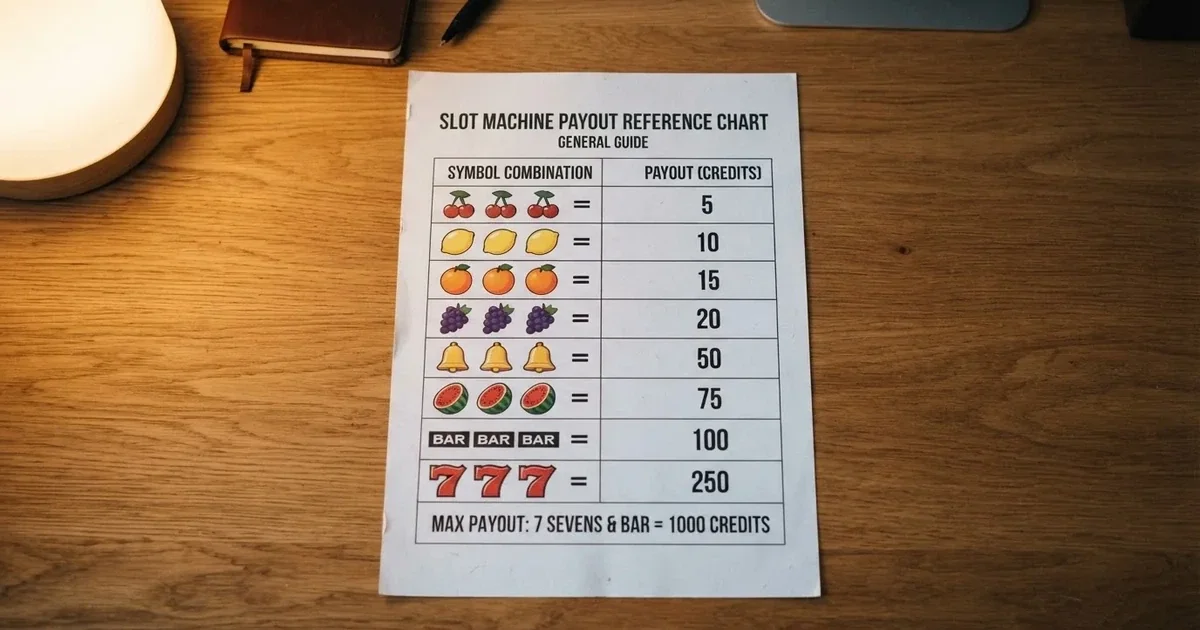
A 3-reel slot’s paytable is the document that converts the format into a math problem. Three reels, three symbol stops on the payline, one row of payouts. The classic paytable has nine entries — three 7s at the top, three BARs in the middle, two 7s and a BAR or similar combination below, and a series of mixed-fruit combinations at the bottom paying single-digit coin credits. Every line on the paytable has a probability of hitting, determined by how many of each symbol are present on each reel, and the line’s payout is calibrated so that, summed across all the possible outcomes, the machine returns a fixed percentage of everything wagered.
The fixed percentage is the RTP — return to player. A 3-reel slot’s published RTP, if the game is properly licensed, is somewhere in the 92% to 97% range, with most reputable titles sitting around 94% to 96%. The number is not the same as the house edge, but they add up to 100%. An RTP of 95% means a house edge of 5%; on a A$1,000 turnover, the expected loss is A$50, paid back as a long-run average across thousands of spins. A single session of fifty or a hundred spins will not look anything like a 5% loss; that is the entire point of variance in a slot. The mathematics is built on the assumption that the player will play long enough for the average to assert itself, and the offshore site is built on the assumption that most players will not.
State-level regulation in the United States gives a sense of where the floor on payout percentages has historically sat. Nevada requires slot machines to return at least 75%, Mississippi at least 80%, and New Jersey at least 83%. Those are minimums, set decades ago; modern Australian pub and club machines are typically set in the 85% to 92% range, calibrated to local state rules. None of those regulatory settings applies to an offshore 3-reel game; the RTP printed on the game’s help file is whatever the studio chose to publish, and there is no Australian regulator verifying it.
Volatility, separately, is a description of how the payouts are distributed. A high-volatility slot pays out rarely but in larger chunks; a low-volatility slot pays out often in smaller chunks. The reel count is a rough proxy: a 3-reel game with three or four high-paying symbols and a long tail of low-paying combinations is structurally low-volatility, because small wins land frequently and the rare top combination is calibrated to the small reel set. A 5-reel video slot with a feature round and a free-spin bonus is structurally higher-volatility, because the bulk of the payout is concentrated in the bonus. The two descriptions do not contradict each other — a 3-reel slot can still be high-volatility if its paytable is calibrated that way, and a 5-reel slot can still be low-volatility — but the format does push in the direction the marketing uses.
The operators the ACMA has warned about — and what each one has cost the Australian market
The ACMA’s register of formal warnings is the only public, regulator-issued list of offshore operators that have been put on notice for offering prohibited services to Australians. The eleven brands below are not a recommendation and not a ranking; they are operators the ACMA itself has named, with the date the warning was issued and the operating company the warning was sent to. Every one of them operates outside Australian law; none of them can lawfully offer online casino games, online pokies, or in-play betting to a person in Australia, regardless of what licence the site displays. The detail that varies between them is the operator behind the brand and the date the ACMA took the public step. Each write-up below closes on what the brand’s presence on the register means for an Australian reader comparing the offshore market.
The single most important sentence on this page, repeated once and referred to after: in 2026, an online 3-reel slot cannot lawfully be offered to an Australian, and an Australian who opens an account with one of the operators below is doing so without Australian consumer protection, without access to BetStop, and with no recourse through an Australian regulator if a withdrawal is refused. The detail that follows is the ACMA’s record of which operators have chosen to keep offering anyway.
1. RocketPlay — the most recent ACMA action on the list
The ACMA issued a formal warning to Pulsup Ltd over RocketPlay in March 2026, the most recent of the eleven entries on this list. Pulsup Ltd is the operating company named in the warning; the brand is RocketPlay. RocketPlay had previously appeared on the ACMA’s register through Dama N.V. in May 2022, so the March 2026 warning is the second time the brand has been formally put on notice under a different corporate entity. The website continues to operate and continues to accept Australian traffic at the time of writing. Two formal warnings under two corporate names is the more expensive version of the same warning, and it is the clearest signal in this list that the brand intends to keep offering to Australians regardless of the ACMA’s register.
2. Level Up Casino — Dama N.V., May 2022
The ACMA’s formal warning to Level Up Casino went to Dama N.V. in May 2022. Dama N.V. is one of the more heavily represented operators on the ACMA’s register — six brands on the same warning list that month (Bambet, Dazard, Level Up, Rocketplay, Wild Tornado and Cobra Casinos), and additional Dama brands named in later rounds. The 2022 warning is older than most of the entries on this list; the brand is still operating, still accessible from Australia, and still advertising to Australian traffic. The reader comparing this entry to the RocketPlay entry above should weigh the corporate complexity: a single warning from 2022 covers more brands than the register might initially suggest.
3. Woo Casino — Dama N.V., March 2025
The ACMA’s formal warning to Woo Casino went to Dama N.V. in March 2025, with the Spirit Casino entry below carrying the same month-and-operator pattern. The recurring operator is the more important data point than the brand. Dama N.V. has been the subject of at least three published ACMA warnings across 2022 and 2025, and the Woo Casino and Spirit Casino warnings land on the same operator that was warned in 2022 over a different set of brands. For a reader comparing the brands on this list, the corporate-name overlap is the closest thing the register offers to a “group risk” indicator.
4. Spirit Casino — Dama N.V., May 2025
The ACMA issued a formal warning to Dama N.V. over Spirit Casino in May 2025, two months after the Woo Casino warning above. The pattern is the same: same operator, different brand, separate formal warning. The brand had not previously appeared on the register. Spirit Casino is the second Dama N.V. brand added to the ACMA’s list in 2025, and the gap between the Woo Casino warning (March) and the Spirit Casino warning (May) is two months — a tighter pace than the regulator had been running on this operator group in earlier years.
5. National Casino — Consolutetish S.R.L., July 2025
The ACMA issued a formal warning to Consolutetish S.R.L. over National Casino in July 2025. The same month produced two further warnings to the same operator — over Bizzo Casino (below) and over an earlier-named TechSolutions entity that had been warned in 2022. National Casino is the first of the three Consolutetish S.R.L. entries, and it carries the same operator-group pattern as the Dama N.V. entries above. For an Australian reader, the operating-company name is the detail the brand-level marketing does not surface.
6. Bizzo Casino — Consolutetish S.R.L. (2025) and TechSolutions (2022)
Bizzo Casino is the only brand on this list with two distinct ACMA formal warnings from two distinct operators. In July 2025 the ACMA warned Consolutetish S.R.L. over Bizzo Casino; in 2022, the ACMA had separately warned TechSolutions (CY) Group Limited and TechSolutions Group N.V. over the same brand. Two operators, two warnings, one brand — the clearest illustration on this list that an offshore brand can move between corporate vehicles without leaving the ACMA’s register behind. The detail that matters for the reader is that each warning is a separate event under a separate corporate name; the brand’s persistence is a property of the brand, not of any one operator behind it.
7. Ignition Casino — Bamboo Media, July 2025
The ACMA issued a formal warning to Bamboo Media over Ignition Casino in July 2025. Ignition Casino is one of the more recognisable offshore-facing brands in the Australian market, and the Bamboo Media name is the operating company on the warning. The brand sits inside the same July 2025 ACMA round as the National Casino and Bizzo Casino warnings above, though under a different operator — three warnings in the same month across two operators.
8. Instant Casino — EOD Code SRL, February 2025
The ACMA issued a formal warning to EOD Code SRL over Instant Casino in February 2025. Instant Casino is the earliest 2025 entry on this list and sits ahead of the Woo Casino (March 2025), National Casino / Bizzo Casino / Ignition Casino (July 2025) and Spirit Casino (May 2025) entries. For a reader tracing the chronological pace of the ACMA’s 2025 enforcement, the February start is the data point that establishes the year as one of the regulator’s more active.
9. Jackbit — Ryker B.V., April 2026
The ACMA issued a formal warning to Ryker B.V. over Jackbit in April 2026. The same warning also covered CasinOK. Jackbit is the most recent 2026 entry on this list aside from the March 2026 RocketPlay warning at the top, and it lands inside the same operator-group pattern that runs through most of this register — one corporate name, multiple brands, one formal warning covering several.
10. Casino Intense — Sterplay Holding Ltd, April 2025
The ACMA issued a formal warning to Sterplay Holding Ltd over Casino Intense in April 2025. Casino Intense is one of the less heavily represented brands in the broader offshore market, and the Sterplay Holding Ltd operator name does not appear elsewhere on this list. The April 2025 entry sits inside the same enforcement year as the Woo Casino (March), Instant Casino (February) and Spirit Casino (May) warnings, but under a different operator.
11. Sky Crown — Hollycorn N.V., September 2022
The ACMA issued a formal warning to Hollycorn N.V. over Sky Crown and Blue Leo casino services, published in September 2022. The Hollycorn N.V. warning covers two brands on the same notice, similar in structure to the Dama N.V. and Consolutetish S.R.L. warnings above. Sky Crown is the older entry on this list and has had longer to settle into a routine of accepting Australian traffic than the 2025 and 2026 entries; the warning remains on the ACMA’s register and the brand continues to operate.
Reading the register as a single picture
The ACMA’s register of formal warnings, taken as a single list, says two things clearly. The first is that the rate of new warnings has accelerated: the 2022 entries on this list (Level Up, Sky Crown, plus the older TechSolutions/Bizzo warning) account for two operators; the 2025 entries (Woo, Spirit, National, Bizzo, Ignition, Instant, Casino Intense) account for seven; the 2026 entries (RocketPlay, Jackbit) account for two in the first half of the year alone. The second is that the corporate names behind the brands are the better predictor of repeat behaviour than the brand names themselves: Dama N.V., Consolutetish S.R.L., and Hollycorn N.V. each appear under multiple brand-level entries, and the most recent warnings tend to be the ones still being added to. An Australian punter comparing these operators should treat the operator-level entry as the relevant unit, not the brand.
| Brand | ACMA action and date | Operator named by the ACMA | Brand support on the page’s subject |
|---|---|---|---|
| RocketPlay | Formal warning, March 2026; earlier Dama N.V., May 2022 | Pulsup Ltd | — |
| Level Up Casino | Formal warning, May 2022 | Dama N.V. | listings only |
| Woo Casino | Formal warning, March 2025 | Dama N.V. | — |
| Spirit Casino | Formal warning, May 2025 | Dama N.V. | — |
| National Casino | Formal warning, July 2025 | Consolutetish S.R.L. | listings only |
| Bizzo Casino | Formal warning, July 2025; earlier TechSolutions, 2022 | Consolutetish S.R.L. | — |
| Ignition Casino | Formal warning, July 2025 | Bamboo Media | — |
| Instant Casino | Formal warning, February 2025 | EOD Code SRL | — |
| Jackbit | Formal warning, April 2026 | Ryker B.V. | — |
| Casino Intense | Formal warning, April 2025 | Sterplay Holding Ltd | listings only |
| Sky Crown | Formal warning, September 2022 | Hollycorn N.V. | — |
The “—” in the rightmost column is not a gap to fill; it is the honest statement that the ACMA’s register does not name any of these brands as a 3-reel slot provider, and no Australian regulator verifies the game libraries of offshore operators. The “listings only” entries are operators whose brand has appeared in third-party directories listing 3-reel titles; that listing is a third-party observation, not a regulator-confirmed fact, and a reader should weigh it accordingly.
The wider Australian gambling market the ACMA is operating inside
The IGA’s enforcement regime sits on top of a licensed market that is itself concentrated in a small number of jurisdictions. The Northern Territory regulates 52 online bookmakers through the NTRWC, but the commission has no full-time staff and meets once a month in Darwin. The licensed wagering market is dominated by Sportsbet, Bet365 and Ladbrokes, with the rest of the 52-bookmaker set smaller and more specialised. Sports lotteries are run at state level, and keno is licensed in clubs and hotels across several states. Online casino games and online pokies are not licensable anywhere.
The economic case the ACMA makes for enforcement, in the figures published by H2 Gambling Capital’s 2025 report, is that Australians lose about A$3.9 billion a year to illegal gambling sites, and that the share of gambling going through legal channels fell from 74% in 2021 to 64%. A 10-percentage-point shift in channel share over four years is the most direct evidence in the public domain that the offshore market is growing rather than shrinking, and the 1,751 blocked-sites total since November 2019 is the regulator’s response to that shift. The blocking regime is not aimed at the legal wagering market; it is aimed at the offshore market that the legal market has lost share to. The 3-reel slot format is one product inside that offshore market, but it is not a marginal one; the simplicity of the format and the prominence of the “classic slots” category in offshore casino lobbies make it one of the more visible parts of what Australians find when they search.
A bill passed Australian Parliament on 19 August 2026 — the Interactive Gambling Amendment (Gambling Reform) Bill 2026 — adds advertising and inducement measures to the IGA’s existing prohibitions. The advertising and inducement measures commence on 1 January 2027, which means the law is in force in 2026 but its advertising and inducement provisions are not yet operational. This is the part of the legal frame that, in 2026, sits one step ahead of the regulator’s actual powers; for a reader comparing offers advertised to Australians in the second half of 2026, the inducement provisions are the rule that is about to bite.
Tax, payments, and what an Australian’s withdrawal actually looks like
A recreational gambler’s winnings are not assessable income under section 6-5 of the Income Tax Assessment Act 1997, and gambling losses are not deductible, unless the person carries on a business of gambling. For the bulk of Australian players, the ATO’s view is that gambling is a private recreational activity, not a taxable one, and the tax system has nothing to say about it. Where the ATO does have a view is on the operator side: wagering operators licensed in Australia pay point-of-consumption tax in their home state or territory, and the tax base for the legal market is the betting turnover, not the player’s winnings.
The payment side is where the licensed and offshore markets diverge most clearly. From 11 June 2024, credit cards, credit-related products and digital currency are banned as payment for any online wagering service that is licensed in Australia, with penalties of up to A$247,500 for operators that breach the rule. The legal deposit routes for licensed wagering are debit card, bank transfer, PayID/Osko and BPAY. An offshore site that asks an Australian for a credit card or for a crypto deposit is operating a payment channel that is specifically forbidden to the licensed market, and the licensed market’s payment rules do not constrain the offshore market at all. A withdrawal from an offshore site, in practice, comes back through the same offshore rails — a bank wire to an Australian account, sometimes a crypto refund — and the player is at the mercy of the offshore operator’s terms, the offshore payment processor’s terms, and the offshore site’s stated regulator. None of those three is an Australian body.
Why the answer to the search query is what it is
The search query “best 3 reel slots australia 2026” looks like a question about games. It is, in fact, a question about the gap between the format and the regulatory frame. The format — three reels, a single payline, a paytable, a bonus round — is a real and well-documented machine design, and it exists in licensed Australian pubs, clubs and casinos in physical form. The online version of the format, on an offshore site accessible from Australia, is a product the IGA prohibits and the ACMA enforces against. The “best” in the search query does not have an honest answer inside that gap: there is no Australian regulator that ranks or approves offshore 3-reel slots, no complaints body that will help a player whose withdrawal is refused, and no Australian consumer protection that applies once the deposit has been made. The “best” that the search query actually surfaces — and the ACMA’s register of formal warnings is the cleanest evidence of this — is the brand whose marketing most convincingly disguises the gap, not the brand whose games play most fairly.
The cleanest reading of the Australian market for an online 3-reel slot in 2026 is that there is no such market to read. The licensed wagering market does not offer casino games or pokies online, and the offshore market operates outside Australian law. The 1,751 blocked sites since November 2019, the A$3.9 billion in estimated annual losses to illegal sites, the eleven formal warnings covered on this page, and the 1 January 2027 commencement of the inducement provisions in the Gambling Reform Bill 2026 are all parts of the same picture: a regulator catching up to an offshore market that has spent the last decade finding new corporate names, new brands, and new domains faster than the ACMA can name them.
The format itself remains interesting. The arithmetic of three reels and ten symbols per reel is elegant, the Liberty Bell origin story is a real piece of machine history, and the 3-reel format still has a place in the licensed physical market. None of that translates into an honest recommendation of an offshore 3-reel slot to an Australian reader in 2026. The honest recommendation is to play the licensed physical product in a licensed Australian venue, where the format exists in the regulated form the search query is trying, and failing, to find.
Frequently Asked Questions
What makes a 3-reel slot different from a standard five-reel video slot?
A 3-reel slot has three vertical reels with a single payline across the centre, while a five-reel video slot has five reels and typically dozens of paylines. The 3-reel format produces fewer possible outcomes — roughly a thousand with ten symbols per reel versus hundreds of millions on a busy video slot — which changes how often small wins land but not the underlying house edge.
Can 3-reel slot machines be found in licensed Australian pubs and clubs?
Yes. Pokies-style machines in licensed Australian venues are regulated by state and territory gaming-machine authorities, and 3-reel titles are part of the mix. New South Wales, Victoria, Queensland, South Australia and the ACT all publish machine counts in the tens of thousands. None of these machines is an online game.
Do 3-reel slots typically pay out differently than newer five-reel formats?
The published RTP on a 3-reel game is usually in the 92% to 97% range, broadly similar to a 5-reel game. The structural difference is volatility: a 3-reel game’s small wins land more often and the rare top combination is calibrated to the smaller reel set, while a 5-reel video slot concentrates more of its payout in bonus rounds.
Is a 3-reel slot online the same game as a 3-reel machine on a casino floor?
No. The reel layout and paytable design are similar, but the regulatory frame is different. A 3-reel machine in a licensed Australian venue is governed by state gaming-machine rules; an online 3-reel slot on an offshore site is not licensed in Australia and offers no Australian consumer protection.
Are 3-reel slots for real money available legally from an Australian-based site?
No. The Interactive Gambling Act 2001 prohibits the supply of online casino games and online pokies to a person in Australia, and no state or territory issues a licence for them. Every Australian-facing site offering real-money online 3-reel slots is operating outside Australian law, regardless of the offshore licence it displays.
Do reel count and paytable structure affect how a slot’s volatility is described?
Yes. Reel count is a rough proxy: a 3-reel game with a long tail of low-paying combinations is structurally lower-volatility, while a 5-reel video slot with a feature round and free spins tends to be higher-volatility. The paytable sets the actual distribution, so the two descriptions can diverge in either direction.
Created by the ”Low Deposit Casino Info” editorial team.