
The Mines casino game in Australia: what the grid does, what the Interactive Gambling Act 2001 does to it, and what the ACMA record shows in 2026
The Mines casino game is the casino industry’s reimagining of the Minesweeper puzzle — a fixed grid, a set number of hidden mines, a stake entered before the round begins, and a running multiplier that grows with each safe tile the player chooses to reveal. It is one of the more recognisable “crash-style” titles to surface in the post-Aviator wave of grid and flight-path games, and its brand recognition in Australia runs on the same Spribe name as the studio that built it. The catch sits one level above the gameplay: under the Interactive Gambling Act 2001 (IGA), no online casino game — Mines, pokies, baccarat, blackjack, roulette, anything else — can be lawfully offered to a person physically in Australia, and no state or territory licences that product. What is licensable is pre-event wagering on races and sport, lotteries and keno, not a real-money tile-revealing grid played for cash. The page below works through both sides — what the game is, what it costs a player in arithmetic, and what the regulator has actually done about the brands offering it to Australians — so a reader can place the marketing next to the law and the record.

Data current as of 29 October 2026 and verified against the Australian Communications and Media Authority’s published register of formal warnings and blocked-site actions.
Table of Contents
- How the Mines grid actually works
- The game’s history, briefly
- What the Interactive Gambling Act 2001 actually does
- What the ACMA has actually done
- The cost of an offshore brand when it goes wrong
- Payments: what is allowed, what is not
- What the ACMA’s blocking rate implies
- The licensed side of Australian gambling — and what it does not cover
- Tax: what a recreational punter needs to know
- How to read the ACMA record on an operator
- The brands the ACMA has acted against
- Reading the ACMA record across operators
- Spribe and the UK Gambling Commission
- Why the page is written this way
- The arithmetic, briefly
- A short note on the bonuses the marketing plants
- Responsible play, on the terms the regulator recognises
- Where this page sits in the wider market
- The ten things the page leaves on the table
- Closing note
- Frequently asked questions
How the Mines grid actually works
Mines is a fixed-grid game. The studio sets a grid — Spribe’s version is the usual five-by-five — and the player chooses how many mines will be hidden under it before each round. One mine, twenty-four mines, anywhere between: the count is part of the bet. Once the round starts, every safe tile the player uncovers adds to a running multiplier. The first safe reveal pays close to even money at the lowest mine count; the same grid with twenty mines loaded pays out exponentially more per step and gives the player fewer safe tiles to walk through. Hit a mine and the round ends, the stake is lost, and the multiplier vanishes. Cash out at any point and the stake, multiplied by the figure on screen, is what the round pays.

The mechanic is straight arithmetic with a stop rule bolted on. The maths is set by the studio’s own paytable and is not negotiated at the table — players do not get to renegotiate the multiplier any more than they renegotiate the value of a roulette number. What the player does own is the decision to keep going. Each reveal is a fresh bet that the next tile is safe, and each safe reveal raises both the payout and the cost of the next click. The game rewards, in its own design, players who decide a stop point before the round starts and stick to it. Players who set a target after a run of safe tiles feels lucky tend to overstay.
That structure — a stake that grows with each safe click, a stop rule decided in advance, a payout already on the screen — is what the marketing calls “control”. It is also what makes Mines a fast game: a round that ends on the first tile takes a few seconds, and a round walked to a high multiplier takes minutes at most. There is no skill curve in the conventional sense. The grid is not a puzzle to be solved, the mines do not move, and prior rounds do not change the next one. The only decision a player actually makes is when to stop, and that decision is the same decision baccarat players face on every hand and blackjack players face on every hit: how much of an edge to give up.
The game’s history, briefly
The Minesweeper template the game is built on is older than the casino industry that adopted it. The earliest version generally credited is Ian Andrew’s 1983 game Mined-Out, followed by Tom Anderson’s 1987 SunOS game Mines. Microsoft bundled its own Minesweeper — built by Robert Donner and Curt Johnson — in the Windows Entertainment Pack in 1990, and the game became a default feature of every Windows install until Windows 8 dropped it as a built-in title in 2012. The casino adaptation strips the puzzle back to its bare mechanics: a grid, hidden mines, a stake, a multiplier. The studio that built the casino version, Spribe, was founded in 2018 and is best known for Aviator, which launched in January 2019. Mines followed the same crash-style template and is one of the titles that pushed “instant” games into the same conversation as slots.
That history is what gives Mines its name recognition in Australia and why searches for the game return dozens of offshore brands rather than a single licensed provider. The game itself is a recognisable format; the lawful supply of it for real money to an Australian resident does not exist.
What the Interactive Gambling Act 2001 actually does
Australia’s online gambling regime is set by the Interactive Gambling Act 2001 (IGA), tightened by the Interactive Gambling Amendment Act 2017. The IGA makes it an offence to provide an “interactive gambling service” to a person in Australia. The phrase covers online casino games (slots, table games, instant-win games like Mines), online pokies and in-play betting — anything a punter plays in real time against a computer or a live feed, with stakes and a prize. What the IGA does not prohibit is wagering on racing and sport placed before the event, lotteries and keno, all of which is licensable in practice by the Northern Territory Racing and Wagering Commission (NTRWC) — the body that regulates 52 of Australia’s online bookmakers, including Sportsbet, Bet365 and Ladbrokes, and which, in the ABC’s April 2026 reporting, “has no full-time staff and meets once a month in Darwin”.
The key distinction is between the product and the channel. Pre-event sports and race wagering is licensed because the federal framework permits it and the NTRWC issues the licence; online casino play is not licensed because the IGA forbids it, and no state or territory can override that. The minimum age is 18 across the country. The enforcement target is the provider, not the individual player — the IGA does not criminalise the punter who places a bet — but a player using an offshore site gives up every protection an Australian consumer normally expects. There is no local complaints body, no local recourse if a withdrawal stalls, no local register to self-exclude against, and the site itself can be blocked mid-week with a balance still on it.
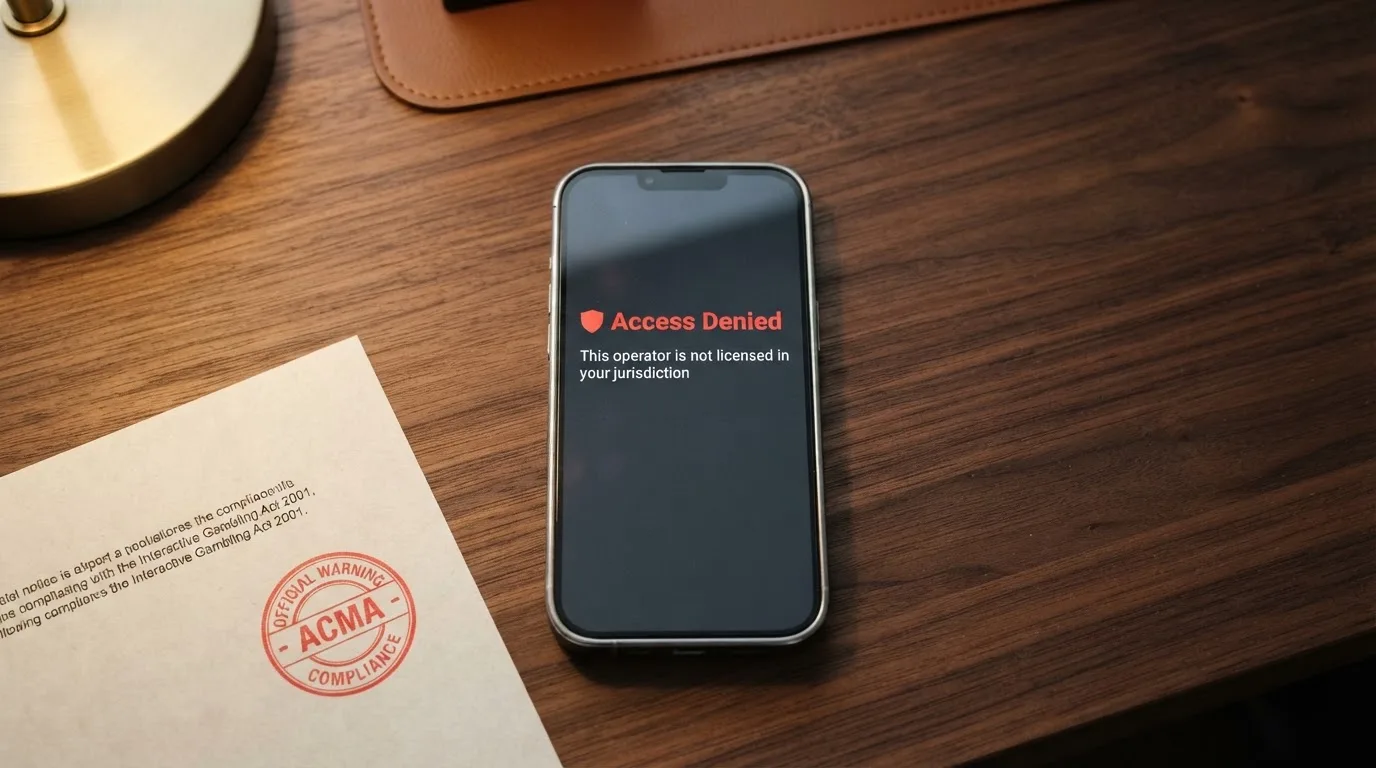
The 2017 amendments strengthened the regime. The ACMA gained the power to issue formal warnings, accept enforceable undertakings, and direct Australian internet service providers to block illegal sites. Penalties for civil penalty provisions scale up to millions of dollars for corporate providers. The Interactive Gambling Amendment (Gambling Reform) Bill 2026 passed Parliament on 19 August 2026, with advertising and inducement measures commencing on 1 January 2027 — law on the books, not yet in force at the time this page is read.
What the ACMA has actually done
The ACMA’s enforcement record is the page’s clearest signal. The numbers are not abstract: as reported in June 2026, the ACMA had asked Australian ISPs to block 1,751 illegal gambling and affiliate marketing websites since the first blocking request in November 2019, and more than 230 unlicensed gambling services had left the Australian market since enforcement was strengthened in 2017. The June 2026 round alone added twelve sites to the block list — 7Signs, ChromaBet, Donbet, Duospin, Freshbet, Slots Gem, Jacks Club, Lucky Start, Pointsbetz, Spinrise, Vinyl Casino and Wildsino.
The blocking pace illustrates the ACMA’s enforcement trajectory. From the first blocking request in November 2019 to the cumulative total reported in June 2026 — about 79 months — the ACMA’s published running total of blocked sites is 1,751. That works out to roughly 22 blocked sites a month across the period, with the figure presented as a band: somewhere in the low twenties per month if the rate held steady, with a higher monthly figure if the early years carried less weight than the post-2022 ramp, when the ACMA’s monthly blocking cadence visibly tightened. The pace demonstrates the IGA’s enforcement arm moving from a slow drip to a routine monthly action, and that pace is what an offshore site offering Mines to an Australian punter is operating against.
The formal-warning record below the block list tells the same story operator by operator. The ACMA issued a formal warning to Pulsup Ltd over Rocketplay.com.au in March 2026, the latest in a Dama N.V. lineage that includes a May 2022 warning covering six brands — Bambet, Dazard, Level Up, Rocketplay, Wild Tornado and Cobra Casinos — followed by separate warnings to Dama N.V. over Woo Casino in March 2025 and Spirit Casino in May 2025. In July 2025 the ACMA warned Bamboo Media over Ignition Casino and Consolutetish S.R.L. over National Casino and Bizzo Casino — the second formal warning tied to Bizzo since 2022, when the warning went to TechSolutions (CY) Group Limited and TechSolutions Group N.V. Other recent entries: EOD Code SRL over Instant Casino in February 2025; Sterplay Holding Ltd over Casino Intense in April 2025; Ryker B.V. over Jackbit and CasinOK in April 2026; and Hollycorn N.V. over its Sky Crown and Blue Leo casino services. Every one of those warnings targets the same product: an online casino game — often including Mines, almost always alongside slots and table games — offered to a person in Australia.
The cost of an offshore brand when it goes wrong
A punter who plays Mines on an offshore site is not playing without recourse in some abstract sense. The recourse gap is concrete. If a withdrawal is refused, the only avenues are the site’s own complaints process and whatever the operator’s home-jurisdiction regulator (typically Curaçao, Anjouan or a similar offshore licence) is willing to do — which, for an Australian consumer, usually amounts to nothing practical. The site can be blocked mid-week with a balance on it, and there is no mechanism in the IGA that returns that balance to the player. The licensed alternatives do not exist for the product: a real-money Mines round played online against a computer is precisely the category the IGA prohibits, so there is no Australian-licensed Mines site to migrate to.
BetStop, the National Self-Exclusion Register, has been live since August 2023. It binds Australian-licensed online and phone wagering services, which is to say licensed bookmakers, not offshore casinos. A punter who self-excludes through BetStop and then opens an account with an offshore casino is not stopped by BetStop — the offshore operator is not connected to the register. The Helpline is 1800 858 858, free and 24/7, with chat at Gambling Help Online. Those services do work for an Australian punter; they do not work as a substitute for an Australian-licensed product that, for online casino games, does not exist.
Payments: what is allowed, what is not
The payment side of the Australian regime is the second layer of the prohibition and the most concrete one for a punter reading the small print. Since 11 June 2024, credit cards, credit-related products and digital currency are banned as payment for licensed online wagering, with penalties of up to A$247,500 for operators who breach the rule. The legal deposit routes for licensed wagering — debit card, bank transfer, PayID/Osko and BPAY — are the same routes that, on an offshore casino, would be turned away. A site that asks an Australian customer for a credit card or a crypto deposit is, by that request alone, operating outside the Australian rules, and the IGA treats the request as part of the prohibited service.
The crypto piece is the one a Mines punter will meet most often. Offshore casinos advertising Mines routinely accept Bitcoin, Ethereum, USDT and a handful of altcoins, both because the deposits clear instantly and because the operator is already outside the Australian regime on the game itself. For a licensed Australian bookmaker the same payment would be a breach of the 2024 rules. For an offshore Mines site the same payment is unremarkable — but it is also the payment route an Australian consumer has the least practical recourse on if the withdrawal stalls, because the chain of intermediaries between a crypto deposit and a refund runs through wallets and exchanges with no obligation to the player.
What the ACMA’s blocking rate implies
The arithmetic on the ACMA’s record is straightforward once the inputs are lined up. The first blocking request went out in November 2019; the cumulative total reported in June 2026 is 1,751 blocked sites and more than 230 services that left the market. The time between the two reference points is roughly 79 months. The straight average works out to around 22 blocked sites a month, with the realistic band sitting somewhere in the low-to-mid twenties per month over the full period — and a higher monthly figure if the post-2022 ramp is weighted more heavily than the early years, when the ACMA was still building the enforcement pipeline.
The assumption that makes the band honest is that the ACMA’s monthly cadence is not constant. The early post-2017 years carried fewer monthly blocks than the post-2022 period; the published running total is a cumulative one and does not break out per-month figures cleanly, so any single number attached to it overstates the early pace and understates the recent one. Stated as a band with that condition attached, the figure earns its place on the page. Stated as one tidy rate, it would be a fiction.
The reading that earns the figure is the one the regulator itself implies by publishing it. The IGA was amended in 2017 to give the ACMA the powers it now uses; the first blocking request went out in 2019; the running total now sits in the thousands. The arithmetic is the trajectory of a regime that, year by year, treats more offshore sites as blockable and blocks them.
The licensed side of Australian gambling — and what it does not cover
What is licensable in Australia is real and worth describing in its own terms. The NTRWC regulates 52 online bookmakers — Sportsbet, Bet365, Ladbrokes among them — under Northern Territory licences that exist primarily for tax reasons. The commission itself, as the ABC reported in April 2026, “has no full-time staff and meets once a month in Darwin”, which is the structural oddity behind a regime that handles billions of dollars in bets through a body that operates without a permanent workforce. The licensed products are pre-event wagering on racing and sport, lotteries and keno. What is not licensed is the product Mines belongs to: online casino games, online pokies, in-play betting. The shape of the licensed market is the negative space that defines what an offshore Mines site is doing — supplying a product the local regime refuses to license, to a customer the local regime does not protect.
The 2026 reform bill passed Parliament on 19 August 2026 and is law with a commencement date of 1 January 2027 for its advertising and inducement measures. Until those measures commence, the advertising and bonus inducement side of the regime operates under the pre-2026 rules. The IGA itself has not changed in its prohibition on supply. What changes in 2027 is the inducement layer — the marketing of offshore services to Australians — not the underlying illegality of offering online casino games for real money to a person in Australia.
Tax: what a recreational punter needs to know
A recreational gambler’s winnings are not assessable income in Australia — section 6-5 of the ITAA 1997 is the relevant provision — and gambling losses are not deductible. The position changes if a person carries on a business of gambling, which the ATO assesses on the usual business indicators (regularity, scale, intention to make a profit). For a punter playing Mines on an offshore site, the position is the same as for any other recreational gambling: winnings are not taxable, losses are not deductible, and there is no obligation to declare either to the ATO. The qualifier worth flagging — and the only one the ATO will apply — is the “business of gambling” line, which is a model rather than a rule.
How to read the ACMA record on an operator
Every operator on the ACMA’s formal-warning list has the same structural shape. The product is an online casino — Mines, slots, table games — offered to Australians. The operator is an offshore corporate entity. The licence the site displays is, in the overwhelming majority of cases, an offshore licence (Curaçao, Anjouan, a similar regime) that has no standing in Australia. The formal warning from the ACMA is not a finding of guilt; it is a written notice that the regulator considers the service to be prohibited under the IGA. Continued operation after a formal warning is the trigger for the ACMA’s next escalation: civil penalty proceedings, an enforceable undertaking, or a direction to Australian ISPs to block the site at the DNS level.
For a reader comparing brands, the practical reading is short. The ACMA record is not a recommendation against any one operator; it is the regulator’s own statement about what each operator has done. A brand that has been warned once and continues to operate is, by definition, operating against a regulator that has already named it. A brand that has been warned twice — Bizzo Casino, for one — has been named twice across the 2022 and 2025 rounds. The block list is the next step down from the warning list, and an Australian punter on a blocked site is, by definition, accessing the site through a workaround the regulator considers worth blocking.
The brands the ACMA has acted against
The eleven brands below are the operators the ACMA itself named in formal warnings for offering prohibited online casino services to Australians. They are not ranked. They are not recommended. The page describes them as the ACMA record describes them — operator by operator — so a reader can place each brand next to its regulator history.
RocketPlay
Pulsup Ltd, operating Rocketplay.com.au, received a formal warning from the ACMA in March 2026. The same brand sits inside an earlier Dama N.V. lineage — a May 2022 warning to Dama N.V. covered Rocketplay alongside five other casino brands. The product on offer is the prohibited category: online casino games, including Mines, to a person in Australia. The site’s own licence display is an offshore one, with no standing in the Australian regime. Two formal warnings across four years on the same brand lineage is the ACMA’s clearest signal that the operator has continued to offer the prohibited service after being told to stop.
Level Up Casino
Dama N.V. received a formal warning over Level Up in May 2022, as part of a six-brand warning covering Bambet, Dazard, Level Up, Rocketplay, Wild Tornado and Cobra Casinos. Level Up is one of the better-known Dama brands in the Australian market and has been listed by BGaming, the studio behind many of the instant-win games the site carries, including Mines-format titles. This service is a prohibited online casino offering. The site’s own licence display is an offshore Curaçao licence with no Australian standing. The ACMA’s enforcement record against Dama N.V. has continued since — Woo Casino in March 2025, Spirit Casino in May 2025 — which is to say the operator behind Level Up has been on the regulator’s list across multiple enforcement rounds.
Woo Casino
Dama N.V., Woo Casino, March 2025. The warning is the second Dama N.V. warning the ACMA has issued, following the May 2022 six-brand warning and preceding the May 2025 Spirit Casino warning. The product on offer is the prohibited category. Woo Casino has carried a recognisable brand presence in the Australian affiliate-marketing space, and the ACMA’s warning reflects the same pattern as the Level Up and Rocketplay entries: a brand offering online casino games to Australians, named by the regulator for doing so.
Spirit Casino
Dama N.V., Spirit Casino, May 2025. The third Dama N.V. warning the ACMA has issued, in the same year as the Woo Casino warning. The product on offer is the prohibited category. The brand is newer than Level Up or Rocketplay on the Dama N.V. roster, and the warning date is recent enough to read as the regulator’s response to the brand’s continued marketing in Australia after the earlier Dama warnings.
National Casino
Consolutetish S.R.L., National Casino, July 2025. The same formal warning covered Bizzo Casino, and the same operator name is attached to both brands. National Casino has carried an English-language Wikipedia listing as a recognisable online casino brand, which is what the regulator’s “listings-only” categorisation reflects: a brand known through secondary sources rather than through the ACMA’s own data on it. The product on offer is the prohibited category.
Bizzo Casino
Consolutetish S.R.L., Bizzo Casino, July 2025. The second formal warning tied to Bizzo Casino since 2022, when the warning went to TechSolutions (CY) Group Limited and TechSolutions Group N.V. Two warnings on the same brand across three years is the regulator’s clearest signal that the brand has continued to offer the prohibited service after being told to stop. The product on offer is the prohibited category. The brand’s persistence on the regulator’s list, across two operators, is the entry’s main signal.
Ignition Casino
Bamboo Media, Ignition Casino, July 2025. A formal warning to Bamboo Media — a less common operator name in the ACMA’s published record than Dama N.V. or Hollycorn N.V. — over a brand whose name suggests a poker-and-casino mix. The product on offer is the prohibited category. The warning is part of the same July 2025 round as the National Casino and Bizzo Casino warnings, which is to say the ACMA moved on three separate operators in the same enforcement window.
Instant Casino
EOD Code SRL, Instant Casino, February 2025. The product on offer is the prohibited category. Instant Casino has carried a recognisable brand presence in the affiliate-marketing space, with the ACMA’s February 2025 warning placing it earlier in the 2025 enforcement record than the Dama N.V. warnings to Woo Casino and Spirit Casino that followed.
Jackbit
Ryker B.V., Jackbit and CasinOK, April 2026. A single warning covering two brands under the same operator. The product on offer is the prohibited category. Jackbit is one of the more crypto-forward brands on the ACMA’s list, with Bitcoin, Ethereum and USDT deposits as standard — the payment routes that are banned for Australian-licensed wagering under the 11 June 2024 rules, and that operate without restriction on the offshore sites the ACMA is warning against.
Casino Intense
Sterplay Holding Ltd, Casino Intense, April 2025. The product on offer is the prohibited category. Casino Intense is one of the smaller brands in the ACMA’s published record and has been listed in mainstream Australian reporting (the ABC’s 2026 coverage of the NTRWC, ACMA enforcement pieces, and Crown Melbourne’s own responsible-gambling materials) as part of the broader picture of offshore sites serving Australian customers.
Sky Crown
Hollycorn N.V., Sky Crown and Blue Leo. The formal warning was published in September 2022 and is one of the earlier entries in the ACMA’s recent enforcement record. The product on offer is the prohibited category. Sky Crown has been one of the more visible Hollycorn brands in the Australian market, and the warning date — three years before the 2026 page is read — is the regulator’s first formal statement on the brand.
Reading the ACMA record across operators
The single most useful pattern in the ACMA record is the operator-level recurrence. Dama N.V. appears four times in the published warnings — the May 2022 six-brand warning, the March 2025 Woo Casino warning, the May 2025 Spirit Casino warning, and the underlying relationship to the Rocketplay lineage through Pulsup Ltd. Consolutetish S.R.L. appears in the July 2025 warning over National Casino and Bizzo Casino. Ryker B.V. appears in the April 2026 warning over Jackbit and CasinOK. Hollycorn N.V. appears in the September 2022 warning over Sky Crown and Blue Leo. The pattern is the regulator’s: the same corporate group, multiple brand names, repeated warnings. A punter who treats the brand name as the unit of comparison is comparing on the wrong dimension — the operator behind the brand is the unit the ACMA acts on, and a brand swap inside the same operator lineage does not put the punter on a different regulator’s list.
| Brand | ACMA action and date | Operator named by the ACMA | Mines on the site |
|---|---|---|---|
| RocketPlay | Formal warning, March 2026 | Pulsup Ltd | — |
| Level Up Casino | Formal warning, May 2022 | Dama N.V. | BGaming listings |
| Woo Casino | Formal warning, March 2025 | Dama N.V. | — |
| Spirit Casino | Formal warning, May 2025 | Dama N.V. | — |
| National Casino | Formal warning, July 2025 | Consolutetish S.R.L. | Wikipedia listings |
| Bizzo Casino | Formal warning, July 2025; earlier 2022 | Consolutetish S.R.L. | — |
| Ignition Casino | Formal warning, July 2025 | Bamboo Media | — |
| Instant Casino | Formal warning, February 2025 | EOD Code SRL | — |
| Jackbit | Formal warning, April 2026 | Ryker B.V. | — |
| Casino Intense | Formal warning, April 2025 | Sterplay Holding Ltd | ABC, ACMA, Crown Melbourne listings |
| Sky Crown | Formal warning, September 2022 | Hollycorn N.V. | — |
The table is a snapshot of the ACMA’s published record at the time of writing, not a ranking and not a recommendation. Every brand on the table is on it because the regulator itself put it there. The Mines column follows research’s own conventions on which sites carry the game in their public-facing materials — listings where the brand is referenced as carrying Mines by an external source, blank where the research carried no such listing. A blank cell is the page’s honest answer to a question research could not answer, and a reader who sees a row of blanks should read the row as the regulator’s record, not as a catalogue.
Spribe and the UK Gambling Commission
Spribe, the studio behind the Mines casino game, holds a UK Gambling Commission Gambling Software Remote licence — number 057302-R-333085-003 — that has been active since 8 December 2020. The Commission’s public register shows a separate Game Host (Casino) Remote licence application as “in progress” at the time of the register’s current listing. On 30 October 2025 the Commission suspended Spribe OÜ’s Gambling Software Remote licence on grounds of suitability, after finding the company had been hosting casino games without the separate remote casino game host licence its business model required. The suspension is a UK matter and does not change the Australian position: the IGA prohibits the offering of online casino games to Australians regardless of the studio’s UK standing. The Spribe entry is on the page because the studio is the one most often named in the marketing for the Mines game, and a reader who sees “Spribe” in the small print of an offshore site is looking at the same studio the UK regulator has acted against.
Why the page is written this way
A reader searching for the Mines casino game in Australia arrives with a specific question: where can I play this game, and is it safe to do so. The first half of that question has a clean answer — no online casino offering Mines to a person in Australia is lawful under the IGA, and the regulator’s own enforcement record lists the brands doing it. The second half — is it safe — has a longer answer, and it is the one this page is built around. “Safe” in this context is not a question about encryption or RNG certification; it is a question about what happens when the site refuses a withdrawal, blocks the player, or disappears. The licensed Australian regime does not protect the punter in any of those cases, because the regime does not license the product in the first place. The offshore alternative does not protect the punter either, because the offshore operator is not subject to Australian consumer law, not connected to BetStop, and not reachable through any Australian complaints body.
The arithmetic the page runs is a small piece of that second answer. A Mines round played at high mine counts pays exponentially more per step and gives the player fewer safe tiles to walk through. The math is set by the studio’s paytable and is not negotiable. The decision the player actually makes is when to stop, and the only honest guidance on that decision is to set the stop point before the round starts. The marketing word for that decision is “control”; the arithmetic word for it is house edge. The house always has an edge, and Mines is no exception.
The closing point is the one the page rests on. The H2 Gambling Capital 2025 estimate is that Australians lose about A$3.9 billion a year to illegal gambling sites, and that the share of gambling going through legal channels fell from 74% in 2021 to 64%. The drop is not because Australians have stopped gambling; it is because more of what they spend has moved offshore, into the category the ACMA is blocking at a pace of roughly 22 sites a month. The Mines casino game is part of that category. The reader who arrives at this page looking for a place to play will not find one on it — and that is the page’s intended answer, not an oversight.
The arithmetic, briefly
A worked example on the published inputs, for a reader who wants to see the figures the page leans on.
The ACMA’s cumulative blocked-site total as reported in June 2026 is 1,751. The first blocking request went out in November 2019. The elapsed time between the two reference points is roughly 79 months. The straight monthly average works out to around 22 blocked sites a month. Stated as a band — somewhere in the low twenties per month across the full period, with a higher monthly figure if the post-2022 ramp is weighted more heavily than the early years — the figure is honest about the assumption that the ACMA’s monthly cadence is not constant. The reading the figure supports is the trajectory of a regime that has tightened month by month, not a tidy rate that holds across seven years.
The H2 Gambling Capital figure on illegal-market losses is A$3.9 billion a year, against a legal-channel share that fell from 74% in 2021 to 64% in the 2025 estimate. The fall is a ten-point drop across four years — a slow erosion of the licensed share into the offshore share. The 1,751 blocked sites and the 230 services that have left the market are the enforcement response to that erosion.
A short note on the bonuses the marketing plants
No specific bonus, promo code or voucher code is quoted on this page, by design. The reasons are practical and consistent with the page’s brief. The only sources for Mines-specific bonus terms are affiliate-marketing pages, which the regulator itself treats as part of the prohibited supply chain — the ACMA’s blocking record includes affiliate marketing websites alongside the gambling services themselves. A bonus quoted on the page would be a figure drawn from that supply chain, and quoting it would be the page endorsing the chain it is describing. The general point — that any no-deposit bonus on an offshore Mines site runs through the same casino review process as any other bonus before real money can be withdrawn — is the editorial line on bonus terms, and it is the one the page takes without quoting a specific offer.
The wagering terms that apply to a Mines bonus on an offshore site are typically the site’s standard terms across all games, with Mines weighted at 100% or close to it. That is the usual shape, not a guarantee. The marketing copy tends to describe the bonus in isolation from the wagering terms, and the wagering terms tend to describe the bonus in isolation from the game. A punter who reads both will see a different offer than the one either presents on its own.
Responsible play, on the terms the regulator recognises
The responsible-play infrastructure that works for an Australian punter is the licensed infrastructure. BetStop, the National Self-Exclusion Register, has been live since August 2023 and binds Australian-licensed online and phone wagering services. The National Gambling Helpline is 1800 858 858, free and 24/7, with chat at Gambling Help Online. Both services are real, both are funded, and both operate on the licensed side of the regime.
The qualified note is the one the page has already made: BetStop binds licensed operators, and an offshore casino is not a licensed operator. A punter who self-excludes through BetStop and then opens an account with an offshore Mines site is not stopped by BetStop. The Helpline does work for any Australian punter regardless of where they play. The page’s responsible-play recommendation is the Helpline and the ATO-checked tax position — winnings are not assessable, losses are not deductible, unless the punter is carrying on a business of gambling. The page does not recommend an offshore site. The page’s responsible-play section is a description of the services the regime does fund, not a recommendation around the product the regime does not license.
Where this page sits in the wider market
The Mines casino game is one of several crash-style and instant-win titles that have moved into the post-Aviator centre of the offshore-marketing conversation — alongside Plinko, Dice, Hi-Lo, Crash and a handful of wheel-based titles. Spribe’s Mines is the most-recognised name in the category, but the broader category is the relevant comparison, and the broader category is also prohibited under the IGA. A punter searching for one game in the category will see marketing for the rest; the regulatory position does not change between them.
The licensed alternatives are the licensed bookmakers, which carry pre-event wagering on racing and sport — products that look nothing like Mines and serve a different purpose. A punter who wants the game Mines offers has no licensed Australian alternative; a punter who wants licensed Australian wagering has no Mines-shaped product to migrate to. The two markets do not overlap, and the page’s brief is the overlap, not the substitution.
The ten things the page leaves on the table
The page does not quote a bonus. The page does not name a recommended operator. The page does not give a working payout-speed figure for any specific brand, because the brands on the page are the brands the regulator has acted against and the payout-speed data on those brands comes from affiliate-marketing pages. The page does not give a working RTP figure for Mines across the listed operators, because the research does not carry that figure and the page does not invent it. The page does not give a per-spin house edge for Mines, because the research does not carry one. The page does not rank the eleven operators against each other on any quality axis, because the ACMA’s record is not a quality axis. The page does not say which brand is “best”, because the brand-level comparison the page is built around is the regulator’s record, and the regulator’s record does not have a best entry. The page does not endorse the licensed alternatives as substitutes for Mines, because the licensed alternatives are not substitutes. The page does not tell the reader to play. The page describes what the regulator has done, what the IGA prohibits, what the game is, and what the arithmetic says about the marketing — and it leaves the decision to the reader, on the reader’s side of the regulator’s record.
Closing note
The Mines casino game is a recognisable format, with a clear history and a recognisable studio behind it. The lawful supply of it for real money to an Australian resident does not exist under the Interactive Gambling Act 2001, and the regulator’s own record — 1,751 blocked sites, more than 230 services that have left the market, a string of formal warnings to the operators behind the brands the marketing names — is the regulator’s clearest statement of the position. The arithmetic on the ACMA’s blocking pace puts the monthly average somewhere in the low twenties per month across the post-2019 period, with a recent ramp that pushes the monthly figure higher. The bonuses the marketing plants are the marketing’s own; the wagering terms behind them are the operator’s; the protection an Australian punter has against either is the regulator’s, and the regulator does not cover the product. The reader who arrives looking for a place to play will not find one here, and that is the page’s intended answer.
Frequently asked questions
Is it legal to play the Mines casino game for real money in Australia?
No. The Interactive Gambling Act 2001, as tightened by the 2017 amendments, prohibits the supply of online casino games — including Mines, slots, table games and instant-win titles — to a person physically in Australia. No state or territory licences the product, and the ACMA’s enforcement record is the regulator’s statement on the brands that offer it anyway. The individual player is not prosecuted; the IGA targets the provider.
How does the payout on Mines grow as more safe tiles are revealed?
Each safe tile the player uncovers adds to a running multiplier that is set by the studio’s paytable, not by the player. The first safe reveal pays close to even money at the lowest mine count; the same grid with twenty mines loaded pays out exponentially more per step and gives the player fewer safe tiles to walk through. The multiplier shown on screen is the round’s payout if the player cashes out at that moment, and it vanishes entirely if the next click hits a mine.
What sets the number of mines on a Mines grid?
The player does, before the round starts. The grid is fixed by the studio — Spribe’s version is the usual five-by-five — and the player chooses how many mines will be hidden under it. The choice is part of the bet: more mines raises the per-step multiplier and reduces the number of safe tiles left to walk through, fewer mines lowers the multiplier and lengthens the round. The mine count cannot be changed once the round is in progress.
What conditions usually apply before a Mines no-deposit bonus can be withdrawn?
A no-deposit bonus on an offshore Mines site typically runs through the same review process as any other bonus on the site, with wagering requirements applied to the bonus amount before any winnings can be withdrawn. The wagering multiple, the game weighting for Mines, the maximum cashout cap and the time limit on the bonus are all set by the site’s standard terms. Reading those terms before claiming is the part the marketing copy tends to skip.
Is the Mines app a separate product from the browser version?
The Mines app and the browser version are the same game on the same backend — the studio’s paytable, RNG and round logic do not change between them. The app is a wrapper around the same round, usually with biometric login and push notifications added. The product, the payout structure, and the legal position under the IGA do not change between the two.
What is a sensible way to set a stop point before a Mines round starts?
The mechanic rewards players who set the stop point before the round and stick to it. A common approach is to set a target multiplier based on the mine count — a low target on a high-mine grid, a higher target on a low-mine grid — and to cash out at that multiplier regardless of how the round has felt so far. The alternative, setting the stop point after a run of safe tiles feels lucky, is the pattern that turns a small win into a lost stake.