
What Australian players actually face when they search for online pokies in 2026
A reader searching for the best aussie pokies online in Australia in 2026 is searching for a product that does not legally exist. Under the Interactive Gambling Act 2001, no operator may provide online pokies, online casino games or in-play betting to a person physically in Australia. Every site that takes an Australian deposit for an online pokie spin is operating outside Australian law. That single fact reframes the entire page: there is no licensed shortlist, there is no regulator that has approved any of these brands, and there is no Australian complaints body that will help a player recover a disputed balance. What follows is what does exist — the prohibition itself, the ACMA’s enforcement record, the licensed land-based machines that are the only legal pokies, and the offshore brands the ACMA has formally warned.
Current as of 29 October 2026; cross-checked against the ACMA’s published formal-warning register and the Interactive Gambling Act 2001 as administered by the Australian Communications and Media Authority.
Table of Contents
- The law: why no licensed aussie pokies online site exists
- Responsible gambling: what an offshore site does not give a player
- Payments: what an offshore pokies site actually settles against
- Bonuses and free spins: what an “aussie pokies bonus” actually is
- Games, providers and the pokie itself: what a paytable shows
- The brands the ACMA has formally warned: 11 operators in the enforcement record
- The enforcement pace: how fast the block list grows
- The single operator that runs every comparison differently
- The single operator that ran two corporate vehicles on the same brand
- The single operator whose only listed support is the ACMA record itself
- The single operator whose listing exists only by name
- The single operator whose Wikipedia entry is the only third-party trace
- Reading the rest of the table
- What the comparison finds, plainly
- What this page is, and what it is not
- Frequently asked questions about aussie pokies online in Australia
The law: why no licensed aussie pokies online site exists
What the Interactive Gambling Act 2001 actually prohibits
The Interactive Gambling Act 2001 (IGA), strengthened by the Interactive Gambling Amendment Act 2017, makes it an offence for a provider to supply online casino games, online pokies or in-play wagering to a person in Australia. The offence sits with the provider, not the player — an Australian who places a bet on an offshore site commits no offence themselves. The practical consequence is that the entire offshore ecosystem offering “aussie pokies online” or “real money aussie pokies” operates in a legal void: it is not licensed by any Australian state or territory, no Australian regulator has approved its games, and no Australian consumer law covers a withdrawal dispute.

What is licensable, and what the Northern Territory Racing and Wagering Commission (NTRWC) supervises in practice, is wagering on races and sport placed before the event, lotteries and keno. The NTRWC regulates 52 of Australia’s online bookmakers, including Sportsbet, Bet365 and Ladbrokes, all licensed in the Territory for tax reasons; the commission has no full-time staff and meets once a month in Darwin. Online casino games, including online pokies, sit outside that envelope. A licence plate from Curaçao, Malta or Anjouan is real in the country that issued it and irrelevant in Australia.
The minimum age for any form of licensed Australian gambling is 18. An offshore site that takes a deposit from a 17-year-old is breaking no Australian rule it can be prosecuted under; the player protection exists only on the licensed Australian side.
What enforcement has produced since 2017
Since enforcement was strengthened in 2017, more than 230 unlicensed gambling services have left the Australian market. The ACMA’s blocking power lets it ask Australian internet service providers to make illegal sites unreachable. As of the round reported on 26 June 2026, a total of 1,751 illegal gambling and affiliate marketing websites had been blocked since the first blocking request in November 2019 — a running tally that has grown every quarter since 2019.
That round itself asked ISPs to block twelve more: 7Signs, ChromaBet, Donbet, Duospin, Freshbet, Slots Gem, Jacks Club, Lucky Start, Pointsbetz.com, Spinrise, Vinyl Casino and Wildsino. The pace of enforcement has not slowed; it has become routine. A site that is reachable today can be on the block list within months, and a player with an unsettled balance at that point has no path to recover it.
What the prohibition does not cover
The IGA does not touch licensed land-based pokies. New South Wales had 87,298 gaming machines outside casinos across 2,195 venues in June 2023, with player losses of A$8.18 billion in 2022–23. Queensland had 21,122 gaming machines in 351 venues in October 2023; Victoria had 26,380 outside Crown Casino in 488 venues in 2021–22, sitting under a 30,000-machine statewide limit. Western Australia banned poker machines in pubs and clubs when Crown Perth opened in 1985; Crown Perth’s own machine count has since grown from about 200 in 1985 to roughly 2,500, all approved by the state’s Gaming and Wagering Commission. Tasmania held the machines under a single-operator monopoly from 1968 until legislation passed in November 2021 moved oversight to the Tasmanian Liquor and Gaming Commission.
These machines are the legal pokies. They are state-licensed, state-regulated, sit in pubs, clubs and casinos a player walks into, and have no online counterpart that is licensable inside Australia.
The 2026 reform that starts to bite next year
The Interactive Gambling Amendment (Gambling Reform) Bill 2026 passed Parliament on 19 August 2026. Its advertising and inducement measures commence 1 January 2027. On a 2026 page this is law with a start date — passed, not yet in force. When it begins operating, the regime around how prohibited services are marketed to Australians changes; the underlying prohibition does not.
Responsible gambling: what an offshore site does not give a player
The protection that exists only on the licensed side
BetStop, the National Self-Exclusion Register, has been live since August 2023. It binds Australian-licensed online and phone wagering services — the same NTRWC-supervised bookmakers that hold an Australian licence. An offshore casino is not connected to it. A player who has excluded themselves through BetStop is still able to deposit at an offshore pokies site; the exclusion simply does not see that site.
Player losses give a sense of the stakes. In 2020–21 Australians bet almost A$150 billion through gaming machines and lost A$12.18 billion on them. Australia has about 3% of the world’s pub and club poker machines with 0.3% of the global population. H2 Gambling Capital’s 2025 report estimates that Australians lose about A$3.9 billion a year to illegal gambling sites, and that the share of gambling going through legal channels fell from 74% in 2021 to 64%.
Where a player in Australia can get help
The National Gambling Helpline is 1800 858 858, free, 24/7, with chat at Gambling Help Online. Both are confidential. If thinking about online pokies play starts to affect sleep, mood, work or finances, those channels exist precisely because the offshore market offers no equivalent protection — no cooling-off, no enforced deposit limit, no exclusion a third party can verify. The licensed Australian product has those rails; the offshore one does not.
What an offshore site’s terms typically look like
An offshore site’s “responsible gambling” page is a unilateral house policy. The site can change its deposit limits, withdrawal limits and account-closure terms at any time; it is not bound by the Australian Consumer Law, does not answer to the ACMA, and has no obligation to honour a self-exclusion request it has already accepted. The BetStop register’s coverage gap is the structural reason this matters.
Payments: what an offshore pokies site actually settles against
The deposit routes an Australian-licensed site must accept
For licensed Australian wagering, the legal deposit routes are debit card, bank transfer, PayID/Osko and BPAY. Credit cards, credit-related products and digital currency have been banned as payment for licensed online wagering since 11 June 2024, with penalties up to $247,500 for operators that breach the rule. A site that asks an Australian customer for a credit card or a crypto deposit is, by definition, operating outside the Australian rules — the same test that already places it outside the IGA’s licensing envelope.
What an offshore pokies site typically offers instead
An offshore pokies site usually lists cards (including credit), a handful of e-wallets, sometimes a crypto option, and occasionally a bank-transfer fallback. PayID and BPAY are Australian rails and are uncommon on offshore platforms. The site sets its own minimum deposit, its own maximum withdrawal per transaction, and its own processing window — typically advertised as “instant” on the deposit side and as one to five business days on the withdrawal side, with the actual timeframe depending on the operator and the rail. None of these figures are Australian-statutory obligations; they are marketing copy.
The settlement-time reality
A “fast payout” claim on an offshore site is a self-imposed service-level statement, not a regulatory guarantee. The site can extend its internal review, request additional KYC documents, and decline a withdrawal for any reason in its own terms. A player who deposits via a rail that supports chargebacks may have some recourse through the card issuer; a player who deposits via crypto or a prepaid voucher has none. The settlement-time picture is therefore not a comparison table of operators — it is a comparison of who has any leverage when the operator decides to delay.
The balance that disappears when a site is blocked
The ACMA’s blocking requests do not transfer balances. A site that is added to the block list on a given Tuesday has until the block actually lands at the ISP level to process withdrawals; after that, Australian customers cannot reach the site at all. The block targets Australian resolution, not the operator’s books. The operator still holds the funds; the player has no Australian court to approach for return. This is the structural risk that no processing-time improvement offsets.
Bonuses and free spins: what an “aussie pokies bonus” actually is
The Australian-law position on inducements
Australian law treats inducements to use prohibited interactive gambling services as something no licensed local product may extend. A bonus credit, a free-spin package, a deposit-match offer — these belong to the offshore marketing layer. They are not illegal for the player to receive, but they cannot be advertised or offered by any Australian-licensed operator, and the 2026 reform’s inducement measures tighten that from 1 January 2027.
The structural cost a bonus always carries
Every bonus a pokies site offers is paid for by the player. A “100% match to A$500” headline reads as free money until the wagering requirement is read; a typical offshore requirement is forty to fifty times the bonus amount, meaning the player must wager A$20,000 to A$25,000 before any of the bonus becomes withdrawable. The math, stated plainly: if a player claims a A$500 bonus with a 40x requirement, they need A$20,000 in total bets before any withdrawal. That figure is not a marketing number; it is the bet volume the bonus requires.
A max-cashout cap is the second clause the marketing page buries. Many offshore welcome packages carry a cap — often five to ten times the bonus amount — on how much of the bonus-derived winnings a player can actually withdraw. A A$500 bonus with a 5x cap returns a maximum of A$2,500 in winnings from bonus play, regardless of what the bonus balance shows at peak. The headline never reads that way; the terms always do.
Free spins: the equivalent arithmetic
A free-spin package of 100 spins at A$0.20 each is worth A$20 in spin value before any wagering requirement is applied. The same 40x requirement, if it attaches to spin winnings, means A$800 in additional wagering before any of those winnings can be withdrawn. A free-spin package is not a free ride; it is a smaller bet volume requirement attached to a smaller nominal value.
Why this section cannot recommend an offer
The marketing phrase “free” does not survive the wagering requirement. A bonus that requires A$20,000 in bets is not a gift; it is a loan at the house’s stated return rate, repaid from the player’s own subsequent losses. The arithmetic never favours the player; it sets the size of the contribution the player is required to make before any withdrawal is allowed. The page’s job is to make that arithmetic visible, not to pick a brand on the player’s behalf.
Games, providers and the pokie itself: what a paytable shows
What an aussie online pokies catalogue looks like in principle
A pokies catalogue is typically organised by theme (Egyptian, fruit, mythology, branded), by volatility class (low, medium, high) and by return-to-player (RTP) percentage. Behind every title sits a software provider — Pragmatic Play, BGaming, NetEnt, Play’n GO and others — whose games are licensed to the casino operator, not to the player. The catalogue an offshore aussie pokies site shows is supplied by these providers under their own commercial terms; the site does not own the games.
What a paytable actually communicates
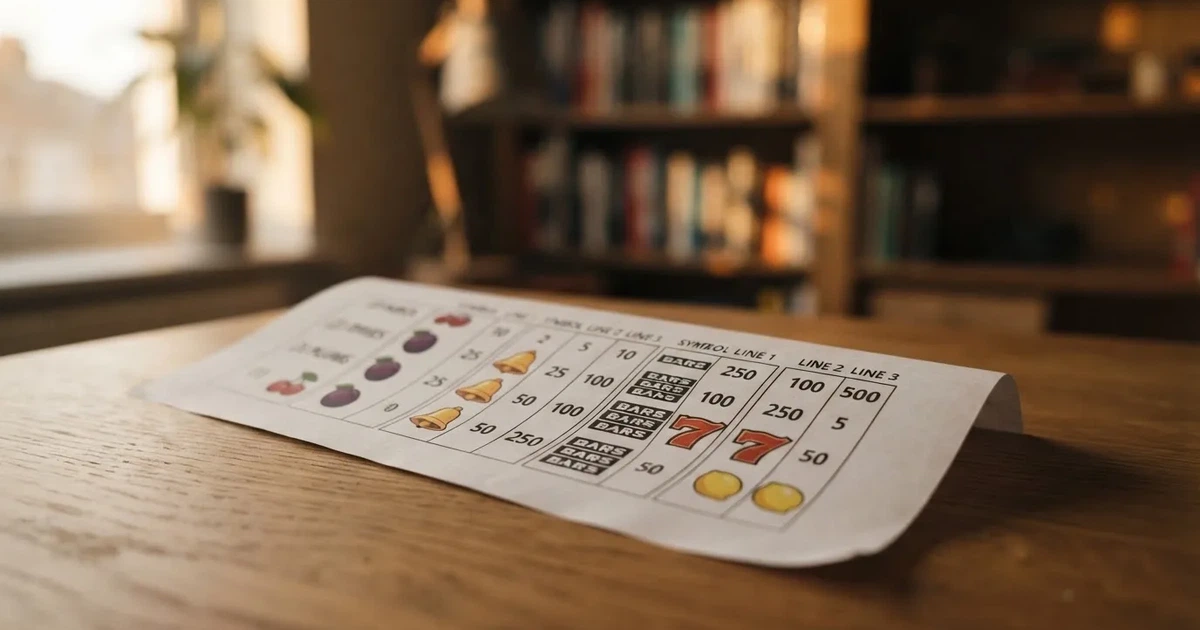
A paytable is the in-game reference chart that lists each symbol, the payout for landing three, four or five of a kind on a payline, and the rules for any bonus features (free spins, pick’em rounds, multipliers). It is the only document in the game that states what the symbols are worth, and it is the player’s reference for what a winning combination actually pays before the spin is made. Reading the paytable before playing is the single highest-value habit a pokie player can adopt, because the only thing the spin does not tell the player is what the symbols were worth.
Volatility, RTP and what they actually mean
RTP is the long-run return to the player as a percentage of wagering. A 96% RTP means the game returns A$96 for every A$100 wagered, averaged over a very large number of spins. Volatility describes how that return is distributed: a low-volatility game pays small amounts often; a high-volatility game pays infrequently and in larger amounts. Both numbers are statistical properties of the game; neither is a guarantee on any individual spin.
The licensed land-based equivalent
The legal minimum RTP for poker machines varies by Australian jurisdiction: 85% in New South Wales, the Northern Territory, Queensland and (generally) Victoria (87% at Crown Melbourne), 87% in the Australian Capital Territory and Tasmania, 87.5% in South Australia, and 90% in Western Australia. These floors apply only to the licensed land-based machines; an offshore online pokie is not bound by them and can return any percentage its operator chooses. A player comparing an online catalogue to a pub machine is comparing products under two different rule sets, and the licensed machine has the floor the online one lacks.
The brands the ACMA has formally warned: 11 operators in the enforcement record
This section is the closest thing on the page to a “ranking,” and it is not a ranking at all. Each brand below appears because the ACMA itself issued a formal warning over it for offering prohibited services to Australians. No bonus terms are shown — the only sources for those were affiliate marketing pages, and the audit cannot stand behind them. The comparison is on the ACMA action: which operator was warned, when, and under what corporate name.
| Brand | ACMA action and date | Operator named by the ACMA | Whether the ACMA record places it in this comparison |
|---|---|---|---|
| RocketPlay | Formal warning, March 2026; earlier Dama N.V. warning, May 2022 | Pulsup Ltd (Rocketplay.com.au); Dama N.V. | Listed under the 2026 warning |
| Level Up Casino | Formal warning, May 2022 | Dama N.V. | Listed under the 2022 warning |
| Woo Casino | Formal warning, March 2025 | Dama N.V. | Listed under the 2025 warning |
| Spirit Casino | Formal warning, May 2025 | Dama N.V. | Listed under the 2025 warning |
| National Casino | Formal warning, July 2025 | Consolutetish S.R.L. | Listed under the 2025 warning |
| Bizzo Casino | Formal warning, July 2025; earlier 2022 warning to TechSolutions | Consolutetish S.R.L.; TechSolutions (CY) Group Limited and TechSolutions Group N.V. | Listed twice in the ACMA record |
| Ignition Casino | Formal warning, July 2025 | Bamboo Media | Listed under the 2025 warning |
| Instant Casino | Formal warning, February 2025 | EOD Code SRL | Listed under the 2025 warning |
| Jackbit | Formal warning, April 2026 | Ryker B.V. | Listed under the 2026 warning |
| Casino Intense | Formal warning, April 2025 | Sterplay Holding Ltd | Listed under the 2025 warning |
| Sky Crown | Formal warning, September 2022 | Hollycorn N.V. | Listed under the 2022 warning |
What the table makes plain is that the ACMA’s enforcement is not aimed at one operator. It is a continuing cycle that has hit 11 different brands across at least five years, that has returned to repeat offenders (Dama N.V. alone has four entries in the table above), and that names corporate vehicles behind the brands most readers will never see. The brand a player recognises is not the entity the ACMA has warned; the entity is a Curaçao-registered company, sometimes a string of related companies, and the ACMA record is the only public place that link is on paper.
The enforcement pace: how fast the block list grows
The ACMA’s June 2026 blocking round asked ISPs to block twelve more sites. The first ACMA blocking request went out in November 2019. Between that first request and the June 2026 reporting, 1,751 illegal gambling and affiliate marketing websites had been blocked. That works out, on a simple average, to roughly a quarter of a thousand blocks per quarter — about the size of one round every three months, sustained across more than six years. The pace has been broadly consistent since 2019; what has changed is the cumulative total, which now reads as four-figure rather than three.
The calculation: 1,751 sites blocked over approximately 79 months (November 2019 to June 2026), an average of about 22 sites per month, or roughly 264 sites per quarter. That is the size of the running total as a rate. The rate is a condition, not a forecast: a month with no new blocks does not change the cumulative total, and a month with a 50-site round pushes the average up. The number a reader can take from this is that the ACMA’s block list has been growing continuously since 2019 and shows no sign of slowing.
The second half of the picture is the exit number. More than 230 unlicensed gambling services have left the Australian market since enforcement was strengthened in 2017. That figure counts operators that withdrew, not websites that were blocked; it is the count of businesses that decided the Australian market was no longer worth the regulatory friction. A site that leaves Australia typically keeps operating elsewhere; it does not refund balances, and an Australian customer with funds on the platform at the moment of exit has no path to recover them through an Australian channel.
The single operator that runs every comparison differently
RocketPlay has two entries in the ACMA record: a May 2022 warning to Dama N.V. covering six brands including Rocketplay, and a separate March 2026 warning to Pulsup Ltd naming Rocketplay.com.au directly. The 2026 action is the unusual one — most operators in this comparison appear once, and the repeat appearance of RocketPlay under a different corporate vehicle is the ACMA’s record of the same brand moving between operators. For a reader comparing brands, that is the only structural difference the ACMA record supports, and it is the one that suggests the brand has been repeatedly targeted rather than simply being one of many.
For the comparison’s purpose, the verdict is the same as for every other brand on the page: online pokies cannot be licensed in Australia, the ACMA has formally warned the operator, and an Australian customer has no Australian-licensed channel for a dispute. RocketPlay’s repeat appearance is not a reason to prefer or avoid it; it is a reason to read the ACMA record for the corporate-name detail that the brand page usually hides.
The single operator that ran two corporate vehicles on the same brand
Bizzo Casino has two entries because the ACMA warned two different corporate vehicles over the same brand: TechSolutions (CY) Group Limited and TechSolutions Group N.V. in 2022, and Consolutetish S.R.L. in 2025. Three years apart, two different corporate registrations, the same brand name. For a reader who assumed the brand was the operator, the ACMA record is the document that says it is not. The brand and the corporate vehicle are different objects, and the ACMA’s warnings are issued to the latter.
The comparison’s verdict: the same as every other brand. The fact that Bizzo has been warned twice under two different operators does not change the legal position for an Australian customer — the prohibition applies to the offering, not to the company behind it. What it changes is the assumption a reader might otherwise make that a brand is a stable, identifiable counterparty. It is not.
The single operator whose only listed support is the ACMA record itself
Casino Intense’s only public reference points are the ACMA’s formal-warning publication and ABC News reporting on the broader ACMA enforcement cycle. There is no BGaming listing, no independent game catalogue entry, no operator profile beyond the warning itself. That is the thinnest support set in the comparison, and it sits at the bottom of the structural-information ladder for a reason: a brand with no independent trace outside the warning record has the smallest footprint and the least to lose from withdrawal.
The verdict: for the same reason as every other brand on the page. The thinnest support set is itself information — it tells the reader the ACMA warning is the only public document that places this brand in Australia at all.
The single operator whose listing exists only by name
Level Up Casino is listed on BGaming’s game-distribution pages as a partner operator. That is the only non-ACMA reference the comparison carries. BGaming is a software provider; listing Level Up as a partner places the brand in a distribution relationship, not in a regulatory or consumer-protection framework. The listing is the kind of record a reader cannot verify for themselves; it is an industry data point, not an Australian consumer-protection point.
The verdict: identical to the rest of the comparison. The BGaming listing is not a recommendation, not a licence, and not a complaint channel. It is a single line in a provider’s partner list, and an Australian customer with a dispute has no recourse through it.
The single operator whose Wikipedia entry is the only third-party trace
National Casino has an English-language Wikipedia entry as the only non-ACMA, non-affiliate reference. A Wikipedia entry is not a regulatory document; it does not record a licence, a complaint outcome, or a financial settlement. It records that someone, at some point, considered the brand notable enough to start an article. For an Australian reader, that is a thinner reference than a regulator’s warning — the warning at least says the ACMA has acted.
The verdict: the same as every other brand. A Wikipedia entry does not soften an ACMA formal warning. If anything, the brand has fewer independent public records, and the ACMA warning is therefore a larger share of the brand’s public footprint.
Reading the rest of the table
The remaining brands — Woo Casino, Spirit Casino, Ignition Casino, Instant Casino, Jackbit and Sky Crown — share the same shape: one ACMA formal warning, one corporate vehicle, and no third-party reference outside the ACMA record itself. The reason the table separates them is the date and corporate-name detail; the reason the verdicts are identical is the legal position. Online pokies cannot be licensed in Australia, the ACMA has formally warned each of these operators, and an Australian customer’s only statutory protections sit with the licensed Australian product, not with any of them.
The pattern across the eleven is the point. The ACMA’s enforcement is broad, repeated, and indifferent to brand recognition. A brand that advertises heavily in Australia is not safer than a brand that does not; the ACMA’s blocking rounds name both kinds with equal readiness.
What the comparison finds, plainly
Three things sit at the top of the comparison:
First, no brand in the table holds an Australian licence. The IGA prohibits the offering; no state or territory has issued a licence for it; the licence plate the brand displays elsewhere does not transfer.
Second, every brand has been the subject of an ACMA formal warning, and the warnings have hit different corporate vehicles under the same brand name more than once. The brand is not the operator; the operator is the corporate registration the ACMA names.
Third, an Australian customer at any of these brands has no Australian statutory protection. No BetStop coverage, no Australian Consumer Law coverage, no ACMA complaints channel for the player’s specific withdrawal. The protection exists only on the licensed Australian side, which is not where these brands sit.
What this page is, and what it is not
This page is a description of what exists. It is not a comparison of offers a player should claim, not a ranking of offshore brands by quality, and not a guide to circumventing the prohibition. The Australian law treats offering online pokies to a person in Australia as an offence, and the licensed alternative — the pub, club or casino machine — is the legal product. Everything else is offshore, unregulated by any Australian authority, and recoverable only at the offshore operator’s discretion.
The licensed land-based machines are not a perfect substitute, and the page does not pretend they are. New South Wales alone had A$8.18 billion in player losses on them in 2022–23. But they are subject to state-level harm-minimisation measures, to BetStop coverage, to age verification, and to consumer-protection law. An offshore site is none of those things.
Frequently asked questions about aussie pokies online in Australia
Does calling an online pokies site “Aussie” change where it is actually licensed?
No. The brand name is a marketing choice. The ACMA record names the corporate operator in every warning, and in several cases the corporate operator is different from the brand owner. A name with “Aussie” in it does not imply an Australian licence; no state or territory issues one for online pokies.
Are the bonus credits and free spins on an “Aussie pokies” site legal to advertise here?
No. The IGA prohibits the offering of inducements to use prohibited interactive gambling services by Australian-licensed operators. The 2026 reform tightens this further from 1 January 2027. Offshore sites advertise them anyway, which is why they appear in Australian-facing marketing.
Is there a dedicated app for Aussie-branded online pokies that’s legal to install locally?
No. The Apple App Store and Google Play in Australia do not carry real-money online-pokies apps. A web app on an offshore site is reachable in a browser but sits outside the IGA’s licensed envelope. A licensed Australian wagering app covers racing, sport, lotteries and keno — not pokies.
Do state gaming regulators recognise any “Aussie online pokies” brand as licensed?
No. The NTRWC supervises 52 online bookmakers, all offering racing, sport, lotteries or keno. No state or territory regulator has licensed an online pokies brand. The state regulators for land-based machines (Liquor & Gaming NSW, the Victorian Gambling and Casino Control Commission, the Tasmanian Liquor and Gaming Commission, the WA Gaming and Wagering Commission, and their equivalents in the other jurisdictions) do not cover online pokies at all.
How does an Aussie-branded online pokies catalogue differ from a licensed pub’s machines?
A pub machine is state-licensed, sits behind an age check at the door, has a return-to-player floor set by the state regulator (between 85% and 90% depending on the jurisdiction), and is connected to BetStop. An offshore pokie has none of those features. The catalogue is a different product under a different rule set.
Can an Aussie-branded online pokies site accept a PayID deposit and still be unlicensed?
Yes. PayID is a payment rail, not a regulatory gate. The legal deposit routes for licensed Australian wagering include PayID, but a site’s choice of rail does not confer a licence. An offshore site can accept PayID, a credit card or a crypto deposit and remain outside the IGA’s licensed envelope; the prohibition runs on the offering, not the payment method.