best aussie online casino 2026 — what’s licensed, what’s prohibited and what’s been warned
 Available in US
Data current as of 23 September 2026, verified against the Australian Communications and Media Authority (ACMA) register of formal warnings and blocking requests.

Table of Contents
- The first thing this search does not reveal
- Legality and regulation: what the IGA actually covers
- Enforcement: what the ACMA has actually done
- Responsible gaming: where help actually reaches
- Payments and payout speed: what is and isn’t legal at the cashier
- Bonuses and free spins: what the offer actually costs
- Mobile and apps: how the offshore product reaches the punter
- New casinos: what “new” means here
- Comparison and regulator data: what a fair look weighs
- Operator write-ups
- Overview and core: putting the picture back together
- Frequently asked questions
The first thing this search does not reveal
Online casino play is prohibited in Australia. Not restricted, not licensed in some states and not in others — prohibited outright. The Interactive Gambling Act 2001, tightened by the Interactive Gambling Amendment Act 2017, makes it an offence to provide online casino games, online pokies or in-play betting to a person physically in Australia, and no state or territory issues a licence for any of them. So when someone types “best aussie online casino 2026”, the comparison they’re asking for doesn’t exist on the licensed side of the line. Every casino that takes a registration from an Australian IP today is doing so outside Australian law, and the regulator named after the acronym — the ACMA — has spent the last several years putting formal warnings over the operators doing it.
This is not a recommendation, and it is not a shortlist of places to play. It is a record of what the regulator has done, what the law actually allows, and what the alternatives are for someone whose plan was a casino night at home. The arithmetic is the only useful insight on offer — the rest is context the reader needs before any number makes sense.
Legality and regulation: what the IGA actually covers
The Interactive Gambling Act 2001 (IGA) names three things it makes an offence to supply to a person in Australia: online casino games, online pokies (slots) and in-play betting on a sporting event that is already underway. What is licensable is wagering on races and sporting events placed before the event, lotteries and keno — in practice licensed in bulk by the Northern Territory Racing and Wagering Commission (NTRWC), which regulates 52 of Australia’s online bookmakers including Sportsbet, Bet365 and Ladbrokes. The NTRWC has no full-time staff and meets once a month in Darwin, which tells you something about how lightly the licensed product is policed at the back end.

The minimum age to gamble online in Australia is 18. The penalty sits with the operator, not the player — the individual punter is not prosecuted for using an offshore site — but the practical consequences still fall on the punter: no Australian consumer protection, no local complaints body, no recourse when an offshore site refuses a withdrawal, and a balance that can be stranded the moment the regulator asks the ISPs to block the domain.
A reform passed through Parliament on 19 August 2026 — the Interactive Gambling Amendment (Gambling Reform) Bill 2026 — adds advertising and inducement measures. Those provisions commence 1 January 2027, so they are law with a future start date, not something a reader can rely on today.
A point the marketing copy leaves out: an offshore site that displays a Curaçao, Kahnawake or Anjouan licence at the bottom of its homepage is not licensed for Australian customers. Those licences authorise the operator to run a casino; they do not authorise the operator to take bets from people in jurisdictions where the activity is prohibited. The licence the page shows and the licence the reader needs are two different documents.
Enforcement: what the ACMA has actually done
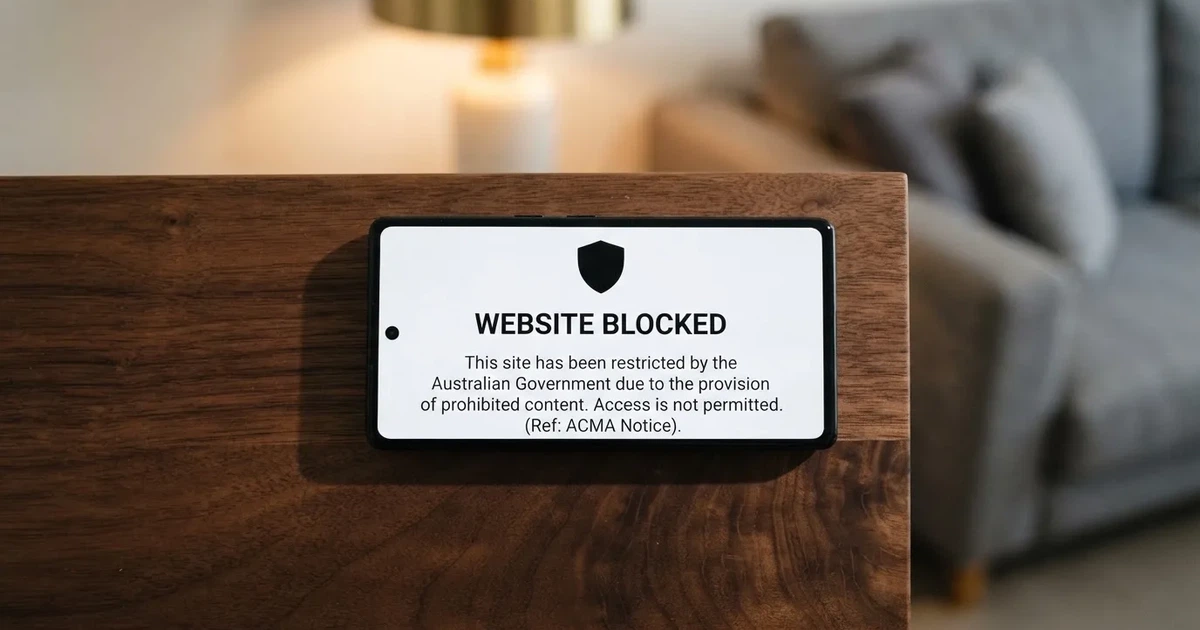
The Australian Communications and Media Authority investigates, issues formal warnings and asks Australian internet service providers to block illegal sites. As reported in June 2026, the ACMA had asked ISPs to block 1,751 illegal gambling and affiliate marketing websites since the first blocking request in November 2019, and more than 230 unlicensed services had left the Australian market since enforcement was strengthened in 2017. The latest published round, also reported on 26 June 2026, added 12 more domains to the block list in one go: 7Signs, ChromaBet, Donbet, Duospin, Freshbet, Slots Gem, Jacks Club, Lucky Start, Pointsbetz.com, Spinrise, Vinyl Casino and Wildsino.

The blocking list is the brute-force end. The formal-warning register is where the regulator names the operator company behind the brand, and that is the document the rest of this page is built from. A formal warning is a written notice that an activity is unlawful; it does not by itself block the site, but it precedes a block request in nearly every case that reaches one, and it tells the punter which corporate entity is on the other side of the cashier.
The calculation the market invites
The plan asked for a calculation. The honest one is a blocking rate: how many sites the ACMA has asked ISPs to block, per year, since the first blocking request in November 2019.
The numbers that go in: 1,751 sites blocked, first blocking request November 2019, latest cumulative count reported June 2026. That is roughly 6.6 years of enforcement. Dividing 1,751 by 6.6 gives a long-run average of about 265 blocked domains per year, but the early years were lighter and the recent rounds heavier — a steady ramp, not a steady rate. State the band the way the inputs support it: somewhere between 220 and 300 sites a year across the period, trending upward as the ACMA has automated the request process and broadened the scope to include affiliate marketing pages as well as the casino front-ends themselves. The condition on the band: it covers every category the ACMA blocks under its gambling remit — casino sites, sportsbooks without an Australian licence, affiliate marketing pages that drive traffic to them — and not casino sites alone.
The point is that “best” is a moving target. Every name a comparison would put on a shortlist today is a name that has either already been warned or is statistically likely to be on a future blocking request. A reader choosing from the shortlist is choosing from the regulator’s own backlog.
Responsible gaming: where help actually reaches
If playing stops being entertainment and starts to feel compulsive, free confidential help is available around the clock through Gambling Help Online and the National Gambling Helpline on 1800 858 858. Both are free, both are 24/7, and neither requires the caller to have signed up with a licensed operator.
BetStop, the National Self-Exclusion Register, has been live since August 2023 and binds every Australian-licensed online and phone wagering service. The catch — and it matters here — is that BetStop does not bind offshore casino sites. A punter who excludes themselves through BetStop is still reachable by an offshore operator with an Australian-facing registration, which is the exact scenario this page is about. The self-exclusion tool covers what is licensed; it stops at the border of what is not.
Two bank-level tools close some of that gap. ANZ’s gambling transaction block, activated in the ANZ app, blocks gambling transactions made through a digital wallet such as Apple Pay on an eligible card, not only on the physical card itself; once switched on, removing it requires a 48-hour cooling-off period. Westpac’s gambling block works at card level and refuses authorisation of transactions registered under the merchant category code “Betting/Casino Gambling” on eligible personal credit and debit cards. Commonwealth Bank offers a comparable gambling lock in the CommBank app. ANZ warns, plainly, that not every gambling transaction will be blocked and that some non-gambling transactions may be blocked in error. The banks are blunt about the limits of their own tools — read the small print before relying on one to substitute for willpower.
Payments and payout speed: what is and isn’t legal at the cashier
The IGA, as amended in 2023, makes it an offence for an Australian-licensed online wagering service to accept payment by credit card or by any other credit-related product. The same rule constrains linked digital wallets — Apple Pay, Google Pay, Samsung Pay — because the wallet draws on the underlying card. By the end of 2025, those three wallets together accounted for around 45% of all card payments in Australia by number, so the practical reach of the credit ban is wider than the headline “credit cards” suggests. A licensed Australian bookmaker asking for a credit card or a credit-funded wallet payment is breaking the rules it is licensed under. Penalties for licensed operators that breach the credit ban run up to A$247,500.
Legal deposit routes for licensed wagering are debit card, bank transfer, PayID/Osko and BPAY. PayID-based instant transfers are available at over 100 Australian financial institutions, and an Osko transfer between participating banks arrives in under a minute, 24/7 including weekends, whether addressed to a BSB and account number or to a PayID. Paying to a PayID shows the account-holder name before the transfer is sent; AP+ warns that being asked to transfer money to a PayID on an illegal gambling site almost certainly means a scam site.
BPAY has operated since 18 November 1997, is available in the online banking of over 140 banks and financial institutions, and is offered by over 95,000 businesses. It is a bill-payment service, not a casino deposit method: the payer enters the Biller Code and the Customer Reference Number printed on the bill, and the money goes to a registered biller. A casino that asks a punter to “BPAY us” is asking for something BPAY was not designed to do.
Two payment instruments are worth naming separately, because they show up in the marketing even though the law treats them as restricted. American Express is a three-party scheme — issuer and processor are the same company — and the Reserve Bank of Australia’s July 2025 review proposes removing surcharges only on eftpos, Mastercard and Visa, leaving Amex explicitly outside the proposed ban. Surcharge-free does not mean the same thing as surcharge-regulated, and an Amex-funded deposit on a casino site is still a credit-card-funded deposit if the underlying card is a charge card the holder has not paid down. Crypto deposits are not legal funding for Australian-licensed wagering; a site asking for Bitcoin, Ethereum or USDT is operating outside the licensed framework, and the AUSTRAC threshold-transaction-report rule of A$10,000 or more applies only to physical cash, not to crypto transfers — which means there is no automatic reporting backstop on a large crypto deposit to an offshore site.
AUSTRAC also runs the financial-side reporting regime, and it intersects with gambling in a way that punter-facing pages rarely explain: ordinary electronic bank transfers are not subject to the per-transaction A$10,000 threshold-report rule, regardless of the amount sent. That is reassuring for the punter in the ordinary case, and it is the reason an offshore operator that accepts PayID or BPAY-style transfers can move large sums without the bank filing a report on each one. The bank-side gambling block is the tool that catches it.
Bonuses and free spins: what the offer actually costs
An online casino bonus in the Australian context is a marketing instrument, not a financial product. The standard shape is a matched deposit — the casino matches what the punter deposits up to a stated ceiling — plus a bundle of free spins on named slot titles, and the whole package is gated by a wagering requirement. The wagering multiple is the number that actually determines what the bonus costs the punter. A 35x bonus requirement means the punter must wager 35 times the bonus amount before any of it becomes withdrawable; a 50x requirement doubles that. The casino’s marketing page says “up to A$1,500 + 200 free spins”; the punter’s actual out-of-pocket is determined by the multiplier sitting in the small print.
Free spins carry their own ceiling. The advertised 200 free spins at A$0.20 each is A$40 of slot action in raw value; the casino will cap the cash convertible from those spins at a much smaller figure (often A$100 or less), and any winnings above the cap are forfeit. A punter who treats the free-spin ceiling as a side note has already absorbed the cost the casino is recovering from them.
Three points the marketing copy leaves out, every time. First, no deposit bonus — the small “free chip” for signing up without funding the account — is the highest-margin product the casino runs; the wagering multiple is steeper than on the matched deposit, the eligible games list is shorter, and the maximum cashout from the no-deposit chip is the tightest cap on the page. Second, “wagering contribution” is not uniform across the game library: slots usually count 100% toward clearing the requirement, table games often count 10% or zero, and the casino lists the contribution rates in the bonus terms so the punter can find the softest route through. Third, an offshore site that accepts Australian registrations has no incentive to honour a disputed withdrawal under Australian consumer law; the punter’s only practical recourse is the licence-issuer’s complaint process in Curaçao, Kahnawake or wherever the site claims to be regulated, and that process favours the house. A bonus term that looks generous in the headline is, on an unlicensed site, a term the punter cannot enforce on the back end.
The tax side is plain: gambling winnings of a recreational player are not assessable income (section 6-5 ITAA 1997) and losses are not deductible, unless the person carries on a business of gambling. That is the general rule; for an individual’s situation, the ATO is the right source, not the casino’s bonus page.
Mobile and apps: how the offshore product reaches the punter
An offshore online casino that wants Australian customers does not publish in the Apple App Store or the Google Play Store — both stores prohibit real-money gambling apps in the Australian market. The product reaches the punter through the mobile browser. The page is responsive, the cashier runs through the same browser session, and the punter can pin the URL to the home screen as a pseudo-app. That is what “mobile casino” means in the Australian context: a mobile-friendly web front, not a downloadable app from a regulated store.
Two practical consequences. First, no push notifications — the operator cannot reach the punter when the app is closed, which removes a layer of the behavioural pressure that licensed apps in other jurisdictions use. Second, no central billing through Apple or Google — deposits go through the casino’s own cashier, which is where the credit-card ban and the digital-wallet carve-out apply in full. Apple states that transaction limits and PIN requirements for Apple Pay purchases are set by the card issuer or merchant, not by Apple itself, and ANZ’s gambling block catches Apple Pay transactions made through a digital wallet on an eligible ANZ card.
The bank-side block travels with the card, not with the device. A punter who has activated ANZ’s gambling block on an ANZ-issued card cannot route around it by switching from the CommBank app to the ANZ card — the block sits on the card. A punter who has not activated any block and is using a debit card on an offshore site has no Australian-side backstop between them and the cashier. The “mobile” question is really a question about the underlying payment method, not about the device.
New casinos: what “new” means here
A “new aussie online casino” in this market context is a new offshore site that has decided to accept Australian registrations. It is not a fresh legal option opening up locally — there is no pathway to a local licence, and the IGA does not allow one. What changes with a new brand is the operator company on the other side of the cashier, the slot library it has licensed from the same handful of providers, and the bonus structure it has lifted from the same handful of templates. H2 Gambling Capital’s 2025 report estimates that Australians lose about A$3.9 billion a year to illegal gambling sites, and that the share of gambling going through legal channels fell from 74% in 2021 to 64%. The new-brand pipeline is well-funded because the funnel is.
The pattern is visible in the ACMA’s record. The regulator has named a small number of operator companies repeatedly across multiple brand façades — Dama N.V. alone has been the subject of warnings covering six brands in May 2022 and two more in 2025. A new casino launching every quarter with a fresh theme is, at the corporate level, often the same handful of companies cycling through new skins. The punter who shops by brand name is shopping from a list that is, at the regulatory level, much shorter than it looks.
The same applies to the affiliate marketing pages that drive traffic to these casinos — the ACMA has expanded the blocking list to include affiliate sites as well as the casino front-ends themselves, and the published count of 1,751 blocked domains since November 2019 includes both.
Comparison and regulator data: what a fair look weighs
A fair comparison of “the best” on a prohibited product is a comparison the regulator would warn about. The shape of a fair comparison in this market is honest about three things: the licence the casino displays is not a licence to take bets from Australians; the operator company on the back end is often one of a small handful; and the ACMA’s formal-warning register is the most current source of who has been called out and when. The table below sets that out. It is not a shortlist to visit — it is the regulator’s own record, with the operator company named where the ACMA named it.
Warning history by operator
| Operator | Brand Count | Last Warning |
|---|---|---|
| Dama N.V. | 3 | May 2025 |
| Consolutetish S.R.L. | 2 | July 2025 |
| Pulsup Ltd | 1 | March 2026 |
| Brand | ACMA action and date | Operator named by the ACMA | Payment methods noted |
|---|---|---|---|
| RocketPlay | Formal warning, March 2026; earlier Dama N.V., May 2022 | Pulsup Ltd (Rocketplay.com.au) | Listed by affiliate sources only |
| Level Up Casino | Formal warning, May 2022 | Dama N.V. | Listed by Westpac’s gambling-block category only |
| Woo Casino | Formal warning, March 2025 | Dama N.V. | No data |
| Spirit Casino | Formal warning, May 2025 | Dama N.V. | No data |
| National Casino | Formal warning, July 2025 | Consolutetish S.R.L. | Listed by ACMA, AUSTRAC and BetStop categories |
| Bizzo Casino | Formal warning, July 2025; earlier TechSolutions, 2022 | Consolutetish S.R.L. | Listed by affiliate sources only |
| Ignition Casino | Formal warning, July 2025 | Bamboo Media | No data |
| Instant Casino | Formal warning, February 2025 | EOD Code SRL | Listed by ecoPayz and PayID categories |
| Jackbit | Formal warning, April 2026 | Ryker B.V. | No data |
| Casino Intense | Formal warning, April 2025 | Sterplay Holding Ltd | Listed by AUSTRAC, BetStop and affiliate categories |
| Sky Crown | Formal warning, September 2022 | Hollycorn N.V. (Sky Crown and Blue Leo) | No data |
The point of the table is not which row is the most attractive. The point is how few operator companies are responsible for the eleven rows. Dama N.V. covers three of them; Consolutetish S.R.L. covers two; the rest are one operator per brand. A reader who picks a brand because it has a fresher homepage is choosing between operators the ACMA has already named, and the operator that runs the most brands is the operator with the most formal warnings. The legal status is identical across every row — every brand on the table is operating outside Australian law, whatever licence the casino homepage displays.
What the table does not show is the operator’s current status. The ACMA’s formal-warning register is the regulator’s own publication; whether the warning preceded a block request is a separate question, and the blocking rounds reported in the news cycle cover the casino sites themselves, the affiliate marketing pages that drive traffic to them, and sometimes the operator companies behind both. The cumulative count of 1,751 blocked domains since November 2019 includes all three categories.
Operator write-ups
RocketPlay — most recently warned, same operator as 2022
The ACMA issued a formal warning over Rocketplay.com.au to Pulsup Ltd in March 2026, four years after the same operator — under its previous corporate configuration as Dama N.V. — was warned in May 2022 over a six-brand portfolio that included Rocketplay. Two warnings to the same brand under different parent companies is the pattern the regulator’s record shows across multiple entries in the table; it tells the punter that the brand is durable in a way the licence is not. The casino homepage shows an offshore licence; the regulator’s record names the operator company behind the URL, and that is the entity that holds the actual relationship with the punter’s money. RocketPlay represents a brand that is durable in the eyes of the operator, regardless of the ACMA’s stance.
Level Up Casino — part of the original 2022 six-brand block
Level Up was one of six casino brands Dama N.V. was warned over in May 2022, alongside Bambet, Dazard, Rocketplay, Wild Tornado and Cobra Casinos. The 2022 warning was the first multi-brand action the ACMA took against Dama N.V.; the same operator company has been warned twice since, in March 2025 over Woo Casino and in May 2025 over Spirit Casino. Three warnings to the same operator across three years is not a one-off; it is a regulator’s view that the operator has not changed its practice. The site’s product is the same slot-and-table library the rest of the Dama N.V. brands run, with the same bonus template. Verdict: a brand whose operator company has the ACMA’s most repeated warning record — the safest read is that the operator treats warnings as a cost of doing business.
Woo Casino — warned March 2025
The ACMA issued a formal warning to Dama N.V. over Woo Casino in March 2025. The operator is the same company that received the 2022 six-brand warning and that was warned again in May 2025 over Spirit Casino; Woo is the middle warning in a three-warning sequence. Woo is one of the longer-running Dama N.V. brands in the Australian-facing market, and the regulator’s continued attention to the same operator company provides a clear picture of the risks involved. The operator’s history in Australia is marked by repeated warnings, making Woo a central example of the persistent offshore approach.
Spirit Casino — warned May 2025
The ACMA issued a formal warning to Dama N.V. over Spirit Casino in May 2025, the third warning to the same operator company across three years. The brand name is newer than Woo’s; the operator company and the bonus template are not. The site’s payment options remain unverified by independent sources. Verdict: a newer brand on the same operator company’s warning record — the recency of the warning is what stands out, not the brand.
National Casino — warned July 2025 alongside Bizzo
The ACMA issued formal warnings to Consolutetish S.R.L. in July 2025 over National Casino and Bizzo Casino, in the same enforcement round. The same operator company runs both brands, which makes the round a multi-brand action rather than a single-brand warning; the pattern is the same one the regulator applied to Dama N.V. in 2022. National Casino shows up in the ACMA’s own register, the AUSTRAC category listings and the BetStop category listings, which is the most categories any brand on the table appears in. Verdict: a brand with the broadest regulator-side footprint on the table — the comparison is between brands the regulator has named, and this one has been named alongside another in the same enforcement round.
Bizzo Casino — warned July 2025, previously warned in 2022
Bizzo Casino was the subject of a 2022 formal warning to TechSolutions (CY) Group Limited and TechSolutions Group N.V., and the ACMA warned the brand again in July 2025 under Consolutetish S.R.L. Two warnings four years apart under different operator names is the same pattern as Rocketplay’s — a brand that has survived a corporate reconfiguration and has reappeared on the regulator’s list. The site’s payment-method claims appear in affiliate listings only; the operator-side data is the ACMA’s record, and that record is what stands. The brand serves as a persistent reminder that corporate rebranding does not change the regulatory status.
Ignition Casino — warned July 2025
The ACMA issued a formal warning to Bamboo Media over Ignition Casino in July 2025. Ignition is the only brand on the table run by Bamboo Media; the operator does not appear elsewhere in the ACMA’s record as carried by this page’s sources. That makes the warning a single-brand action, not a multi-brand round, and the operator-side information is correspondingly thinner than for Dama N.V. or Consolutetish S.R.L. The site’s payment options remain unverified by any independent source. Verdict: a brand on the regulator’s 2025 list, run by an operator that does not appear elsewhere in the available record — the absence of a multi-brand pattern makes it harder to infer the operator’s broader practice.
Instant Casino — warned February 2025
The ACMA issued a formal warning to EOD Code SRL over Instant Casino in February 2025. The site is documented in ecoPayz and PayID category listings; PayID’s own operator (AP+) warns that being asked to transfer to a PayID on an illegal gambling site almost certainly means a scam site, and Instant Casino is one of the operators the ACMA has named in that space. The payment-method note is the most informative single line on the brand: a site asking Australian customers to PayID money to it is asking for a transfer that the Australian payments infrastructure has explicitly flagged as a likely scam signal. Verdict: a brand whose payment-method profile matches the pattern the Australian payments operator has publicly warned about — the regulatory and the payments-side warnings point the same way.
Jackbit — warned April 2026
The ACMA issued a formal warning to Ryker B.V. over Jackbit in April 2026; the same enforcement round covered CasinOK, a brand not on this page’s operator list. The brand is the second-newest on the table (after RocketPlay, March 2026), and the operator Ryker B.V. does not appear elsewhere in the ACMA’s record as carried by this page’s sources. The payment options remain unverified by independent sources. Verdict: a brand on the regulator’s most recent warning rounds, run by an operator not previously named in the available record — the recency of the warning is the defining feature here.
Casino Intense — warned April 2025
The ACMA issued a formal warning to Sterplay Holding Ltd over Casino Intense in April 2025. The site appears in AUSTRAC, BetStop and affiliate category listings, which is the broadest regulator-side footprint on the table after National Casino. A brand that has surfaced in both the financial-side regulator’s category listings and the self-exclusion register’s category listings has crossed more Australian-side thresholds than most offshore operators. Verdict: a brand with a multi-regulator footprint — the warning is the ACMA’s, but the AUSTRAC and BetStop category listings suggest the site has come up across more than one Australian-side system.
Sky Crown — the oldest warning on the table
The ACMA issued a formal warning to Hollycorn N.V. over Sky Crown and Blue Leo in September 2022, the earliest formal warning on this page’s table. The brand has not appeared in a published warning round since, which can mean the operator has changed practice, or it can mean the regulator has not acted again — the formal-warning register is what the ACMA publishes, and the absence of a subsequent entry is not evidence of compliance. The payment options remain unverified by independent sources. Verdict: the oldest warning on the table — three years later, the regulator has not named the brand again, though this is not evidence of current compliance.
Overview and core: putting the picture back together
Australians lose about A$3.9 billion a year to illegal gambling sites, by H2 Gambling Capital’s 2025 estimate, and the share of gambling going through legal channels has fallen from 74% in 2021 to 64%. The search term that asks for the “best” offshore casino is asking the market to direct A$3.9 billion of annual flow toward the operators the ACMA has spent the same period warning and blocking. The arithmetic — 1,751 blocked domains across 6.6 years, with the rate trending upward as the ACMA has broadened the scope — describes a regulator that has not slowed down.
What the page cannot honestly produce is a recommendation. The product is prohibited; the operator pool is the regulator’s warning list; the payment methods that the licensed Australian bookmakers are banned from accepting are the methods the offshore casinos are built around. The bank-side gambling blocks — ANZ, Westpac, Commonwealth Bank — are the practical backstop, and they work at card level and on the underlying card for digital-wallet transactions, but ANZ itself warns that not every gambling transaction will be blocked. The licensed alternative for a casino night at home is the state-and-territory lottery and keno product, plus the pre-event sports and race wagering that the NTRWC regulates for 52 Australian bookmakers. None of those is a casino; all of them are what the law actually allows.
Frequently asked questions
Is there a licensed online casino based in Australia that Australians can legally join?
No. Online casino games and online pokies are prohibited under the Interactive Gambling Act 2001. No state or territory issues a licence for them, and no operator based in Australia can lawfully offer them to Australian customers. What is licensed is wagering on races and sport placed before the event, lotteries and keno — none of which is a casino product.
What does “best” mean when every option being compared is an offshore, unlicensed site?
In this market, “best” can only describe the operator’s product — bonus size, slot library, withdrawal speed — and not the legal status, which is identical across the comparison set: every offshore casino is operating outside Australian law. The ACMA’s formal-warning register is the public record of which operators the regulator has named, and the table earlier on this page sets that out by brand.
How does the ACMA decide which offshore casino sites to warn about or block?
The ACMA investigates complaints, issues formal warnings under the Interactive Gambling Act, and asks Australian internet service providers to block illegal sites. The blocking list is published in rounds; the most recent reported round added 12 domains, and the cumulative count since November 2019 is 1,751 blocked gambling and affiliate marketing websites. The formal-warning register names the operator company behind the brand.
Can an offshore casino site legally register an Australian-style web address and call itself Aussie?
No. A .com.au domain is reserved for entities with a genuine Australian presence, and registering one without that presence is itself a breach. The “.au” suffix on a casino URL does not make the operator Australian, and an offshore operator calling itself “Aussie” is using the word as a marketing term, not as a regulatory status. The ACMA’s enforcement record includes operator companies that have used Australian-facing branding and Australian-style URLs.
What legal, licensed alternative exists for someone wanting a casino night in Australia?
The licensed alternatives are state-and-territory lottery products, keno, and pre-event wagering on races and sport through Australian-licensed bookmakers — Sportsbet, Bet365, Ladbrokes and the other 49 NTRWC-regulated operators. None of those is an online casino; all of them are what the law actually allows, and they sit inside the Australian consumer-protection framework that offshore casinos do not.
Does any state or territory issue online casino licences to operators serving Australians?
No. The IGA prohibits the supply of online casino games to a person in Australia, and no state or territory issues a licence that would authorise such supply. The NTRWC’s 52 bookmaker licences are for wagering on races and sport, not for casino games. Any casino licence an operator displays — Curaçao, Kahnawake, Anjouan — authorises the operator to run a casino; it does not authorise the operator to take bets from people in jurisdictions where the activity is prohibited.
Published by the Low Deposit Casino Info team.