
Top Online Casino Promo Codes and Coupons in Australia
Data current as of 29 October 2026; cross-checked against the Australian Communications and Media Authority’s register of formal warnings and blocking actions.

A “casino promo code” is, in plain language, a short string of letters and numbers a punter types into an online casino’s cashier or sign-up page to unlock a bonus — extra deposit match, free spins, or a small no-deposit credit. It looks like a coupon. It functions like a discount. The thing the marketing does not say in the first paragraph is that every casino offering such a code to a person in Australia is doing something the Australian Communications and Media Authority calls a breach of the Interactive Gambling Act 2001, and the agency has spent the last several years sending operators formal warnings about it and asking Australian internet providers to block the sites that keep doing it. The page below works through what is and is not licensable in Australia in 2026, how the ACMA has been enforcing that line, what a “promo code” actually unlocks when the wagering requirements land, and which eleven brands the regulator has named in formal warnings over the past few years.
Table of Contents
- Redeeming the Latest Casino Promo Codes and Vouchers
- Enforcement record: what the ACMA has done since 2017
- Player protection: what an Australian actually has if something goes wrong
- Paying in and getting paid out: how a promo-code offer is actually settled
- What a promo-code offer actually unlocks — the strings that change the price
- The H2 Gambling Capital picture: how much money is actually flowing offshore
- How the eleven brands on the ACMA’s warning list compare
- What the formal-warning brands look like one by one
- How to read the table in plain language
- The cost the marketing never quotes
- Responsible gambling: what an Australian has and what an offshore offer takes away
- FAQ
Redeeming the Latest Casino Promo Codes and Vouchers
Online casino games — slots, roulette, blackjack, baccarat, video poker, “live dealer” studios and the rest of the product most promo-code pages market — are a prohibited interactive gambling service under the Interactive Gambling Act 2001 as tightened by the Interactive Gambling Amendment Act 2017. The Commonwealth statute makes it an offence to supply those products to a person physically in Australia. No state or territory licence authorises them either, because the IGA preempts state licensing for the prohibited categories. What is licensable, and what an Australian-licensed operator can lawfully offer a code against, narrows the field to wagering on sporting events and races placed before the event begins, lotteries and keno.

Wagering is licensed. Casino is not. The line matters because it determines who the regulator can hold accountable. The Northern Territory Racing and Wagering Commission regulates 52 of Australia’s online bookmakers — Sportsbet, Bet365, Ladbrokes among them — and the Territory licenses them because the operators want to pay Territory point-of-consumption tax rather than register in larger states. That commission has no full-time staff and meets once a month in Darwin; the structure is unusual, but it is the structure that lets a licensed Australian bookmaker run. It does not let anyone run an online casino.
The Interactive Gambling Amendment (Gambling Reform) Bill 2026 passed Parliament on 19 August 2026, and its advertising and inducement measures commence on 1 January 2027. So on a page read in 2026 the law with the start date is law but is not yet in force; its practical effect on promo-code marketing will fall on operators whose ads target Australians from 1 January 2027 onward. Anything an Australian sees offered as a casino promo code in the remaining months of 2026 sits under the older IGA framework, and the ACMA’s enforcement record below is built on that older framework.
The legal bottom line: a person in Australia typing a promo code into an offshore casino’s sign-up page is not breaking the IGA. The IGA targets the provider, not the player. What the player is doing is handing over personal details and money to an entity the regulator cannot compel to pay winnings, cannot compel to honour its own advertised terms, and cannot compel to answer a complaint — because that entity is not within the Australian regulatory perimeter in the first place. The marketing promise and the regulatory reality are not the same document.
Enforcement record: what the ACMA has done since 2017
The Australian Communications and Media Authority is the agency that investigates prohibited interactive gambling services and asks the courts for orders directing Australian internet service providers to block them. Two numbers capture the scale of that work since the agency was given the power. By the end of the round reported in June 2026, a total of 1,751 illegal gambling and affiliate marketing websites had been blocked since the first blocking request in November 2019, and more than 230 unlicensed gambling services had left the Australian market since enforcement was strengthened in 2017.
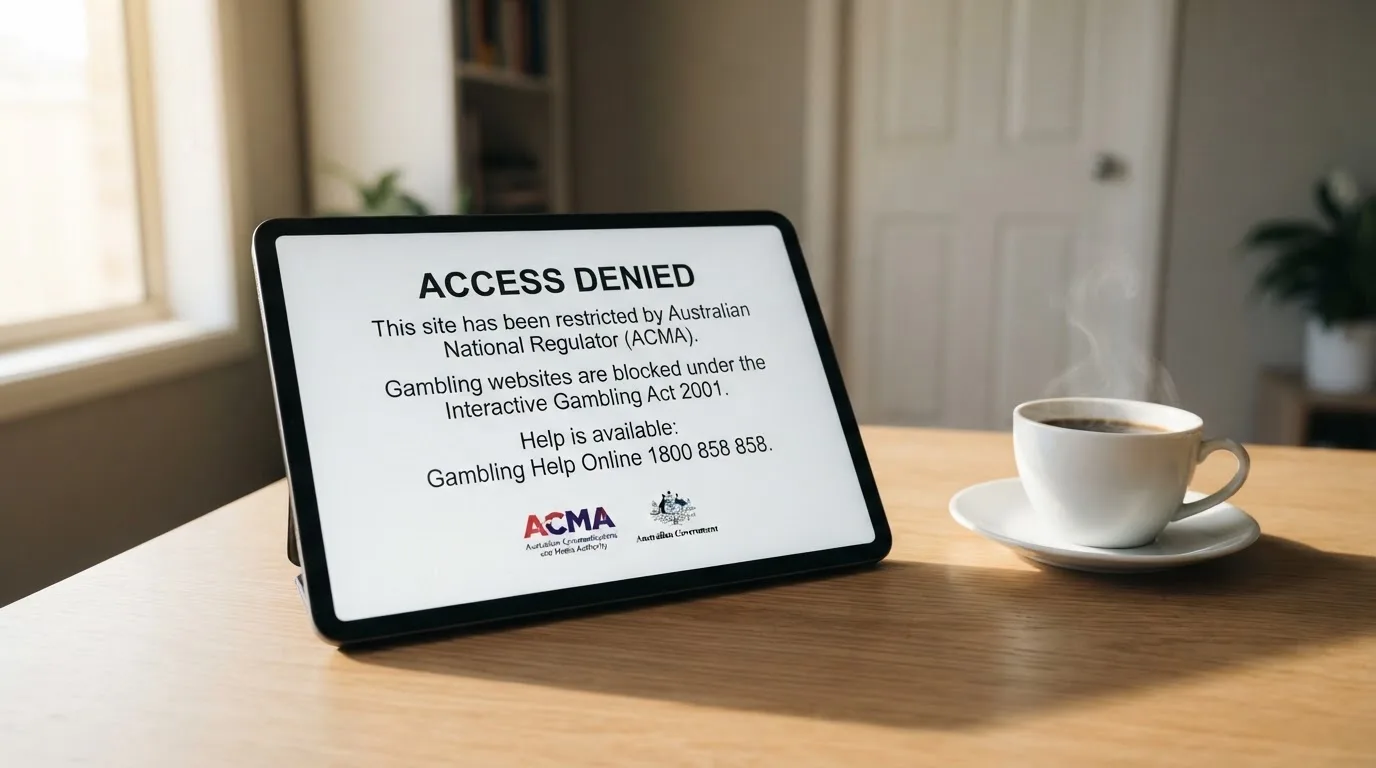
That ratio — hundreds of sites leaving versus thousands blocked — is itself the answer to the question of whether enforcement has been heavy-handed or whether operators simply decide the market is not worth the legal exposure. Many have left voluntarily; many more have not, and the ACMA’s blocking requests keep coming. In a single round reported on 26 June 2026 the ACMA asked ISPs to block 12 more illegal gambling websites: 7Signs, ChromaBet, Donbet, Duospin, Freshbet, Slots Gem, Jacks Club, Lucky Start, Pointsbetz, Spinrise, Vinyl Casino and Wildsino. Twelve names in one tranche is a representative month, not an unusually heavy one.
Blocking is not the only tool. The ACMA also issues formal warnings — written notices that name the operator, the brand and the breach, and that go on the public register. Once a warning is on the register, a subsequent blocking request is easier to justify, and the warning itself is the public statement that the regulator has formed a view about that operator’s conduct. The eleven brands listed further down on this page are listed because each is the subject of at least one ACMA formal warning, and the dates of those warnings span May 2022 through to April 2026. The pattern is the point: the regulator has been writing the same kind of letter to the same kind of operator, under the same statute, every year for the past four.
A blocking-rate calculation puts the enforcement tempo in plain terms. From November 2019 (first blocking request) to the end of the round reported in June 2026 is roughly six and a half years, or about 78 months, over which 1,751 sites have been blocked. That works out to a band of roughly 20 to 25 sites blocked per month on average — call it a steady two-dozen-a-month pace across the whole enforcement window. The pace is not uniform; the early months were quieter, the rounds since 2023 heavier. But the headline is that the ACMA’s blocking pipeline has been running, in round terms, at a sustained tempo that any operator whose site appears on a warning list is now closer to than it was when the warning was issued. The condition on the band is the one condition that always sits on an average: it covers periods of high activity and periods of quieter months alike, and it does not predict the next round.
Player protection: what an Australian actually has if something goes wrong
The protective scaffolding Australian-licensed wagering sits on does not extend to offshore casinos. BetStop, the National Self-Exclusion Register, has been live since August 2023 and binds every Australian-licensed online and phone wagering service. An offshore casino is not connected to BetStop, has not signed the responsible-gambling code the register sits on, and will not enforce an Australian punter’s exclusion request. The register does its job within its perimeter; outside that perimeter it does not exist.
The National Gambling Helpline on 1800 858 858 is free, runs 24/7 and offers web chat at Gambling Help Online. The helpline is for anyone in Australia whose gambling — at a licensed venue, at an offshore site, on a sports app, on a poker machine — has become a problem. It is the one number a reader of this page should keep whether or not they ever touch a promo-code offer. State-level self-exclusion schemes and counselling services exist as well, and Gambling Help Online can refer into them.
The consumer-protection gap on offshore play is structural. A licensed Australian bookmaker answers to the ACMA, to state regulators, to the Australian Financial Complaints Authority if a banking dispute arises, and to an external dispute resolution scheme if a bet is refused payout. An offshore casino answers to none of those bodies. If an offshore casino refuses a withdrawal, voids winnings on a technicality, or simply stops answering email, the Australian punter has no Australian forum to take the complaint to. The legal claim exists in principle under the law of the offshore operator’s jurisdiction; the practical recovery rate is close to zero for amounts below the threshold an international law firm will take on a contingency basis. The marketing does not say this; the regulator cannot fix it for the punter; the punter alone bears the loss.
Paying in and getting paid out: how a promo-code offer is actually settled
Most offshore casinos that target Australians accept a familiar mix: Visa and Mastercard debit cards, a handful of e-wallets, prepaid vouchers, bank transfer and — at many of them, in the teeth of the Australian rule that bans credit for licensed wagering — credit cards and crypto. The payment story a promo-code page tells and the payment story the regulator’s rules permit are different stories.
Under the IGA as amended in 2023, Australian-licensed online wagering services cannot accept payment by credit card or other credit-related products, a restriction that took practical effect on 11 June 2024 and carries penalties up to A$247,500 for an operator that takes one. The rule also constrains gambling use of linked digital wallets like Apple Pay, because the underlying credit instrument is the one the statute prohibits; the wallet is just the rail. Apple Pay itself does not charge consumers a fee — any surcharge is the merchant’s processing markup, not Apple’s — and Apple states that transaction limits and PIN requirements for Apple Pay purchases are set by the card issuer or merchant, not by Apple. None of that makes Apple Pay a workaround for the credit-card ban; the card behind the wallet is still subject to the ban.
Australian banks have built their own layer on top. Westpac’s gambling block works at card level: it refuses authorisation of transactions registered under the merchant category code “Betting/Casino Gambling” on eligible personal credit and debit cards. Commonwealth Bank lets customers apply a gambling lock to eligible cards via the CommBank app, which automatically blocks most gambling transactions, though the bank states it cannot guarantee all gambling-related purchases will be stopped. ANZ’s gambling transaction block, activated in the ANZ app, blocks gambling transactions made through a digital wallet such as Apple Pay on an eligible card, not just the physical card. Once a customer turns ANZ’s block on, removing it again requires a 48-hour waiting period, and the bank warns that not all gambling transactions will be blocked and that some non-gambling transactions might be blocked in error. These are blunt instruments at the merchant-category-code level: a casino transaction is one MCC; an Australian bank’s block cannot tell a legitimate wagering deposit at a licensed bookmaker from a deposit at an offshore casino. For a punter who has turned the block on, both get stopped.
The Reserve Bank of Australia’s July 2025 review proposes removing surcharges only on eftpos, Mastercard and Visa transactions, explicitly leaving American Express outside the scope of the proposed surcharge ban. That matters at the margin: Amex, the original three-party network that has issued its own cards since launching its first charge card on 1 October 1958, processes transactions on its own rails and has been carved out of the surcharge reform on the basis that its pricing model is different. Surcharging aside, the credit-ban rule treats Amex cards the same as any other credit instrument where the IGA applies.
For Australians who want to move money fast to a person they can verify, PayID and Osko sit on Australia’s New Payments Platform, which became accessible to the public on 13 February 2018 and is owned by New Payments Platform Australia Ltd — a non-profit whose 13 shareholders include the Reserve Bank of Australia and the country’s major banks. With Osko, a bank transfer between participating Australian banks arrives in under a minute, 24/7 including weekends, whether it is addressed to a BSB and account number or to a PayID. More than 25 million PayID identifiers had been registered on Australia’s New Payments Platform as of April 2025. Paying to a PayID shows the name of the account holder before the transfer is sent; AP+ warns that being asked to transfer money to a PayID on an illegal gambling site almost certainly means a scam site. The warning is direct: a PayID at a verified name is one thing; a PayID presented by an offshore casino’s cashier is another.
The platform the payments run on has its own reliability floor: participants in Australia’s New Payments Platform must keep the platform’s monthly outages to no more than two minutes. In 2021 the ACCC authorised the merger of NPP Australia with BPAY and eftpos into a single company, Australian Payments Plus. BPAY itself has operated in Australia since 1997, is available in the online banking of over 140 banks and financial institutions and is offered by over 95,000 businesses; it is a bill-payment service, the payer enters the Biller Code and the Customer Reference Number printed on the bill, and it is run by Australian Payments Plus. As a bill-payment rail, BPAY is not how money moves to an offshore casino; it is how an Australian punter pays a licensed Australian biller.
On the AUSTRAC side: the threshold-transaction-report rule, which requires reporting of transfers of A$10,000 or more, applies only to physical cash; ordinary electronic bank transfers are not subject to that per-transaction reporting requirement, regardless of the amount sent. A punter moving A$10,000 by bank transfer to an offshore casino does not, on that transfer alone, trip an AUSTRAC threshold report. The reportability of the transaction depends on what the receiving entity is and what its reporting obligations are, not on the transfer amount.
So the practical picture for an Australian punter using a promo-code offer is: card payments may be blocked at the bank before they reach the casino; credit-funded payments are unlawful for the licensed Australian wagering market and are a strong indicator of an offshore offer; PayID/Osko can move money to a verified Australian name in under a minute but the verified name at an offshore casino is, by definition, not an Australian one; BPAY is for bills, not for casino cashier pages; and if the casino refuses to pay out, no Australian consumer-protection body can compel it.
What a promo-code offer actually unlocks — the strings that change the price
A promo-code offer is not the dollar figure the marketing page headlines. It is the dollar figure minus the conditions under which it can be withdrawn. Three conditions recur across the offshore-casino promo-code format and the punter pays each one.
Wagering requirements. A A$100 deposit match with a 40x wagering requirement on the bonus means the punter must turn over A$100 × 40 = A$4,000 in qualifying bets before any of the bonus funds — and any winnings traceable to them — become withdrawable. “Turn over” means stake the money through games counted at varying contribution rates; pokies typically contribute 100% of stake toward wagering, table games often 10% or zero. A punter who plays roulette exclusively will turn over far less of their betting volume toward the wagering requirement than the headline stake suggests.
Maximum-bet rules while a bonus is active. A common restriction is a maximum single bet of A$5 (or the local equivalent) while the bonus is being cleared. Bets above the cap can void the bonus and the winnings. The rule is enforced by the casino’s own logging and is rarely appealable.
Maximum cashout caps. Some no-deposit promo codes carry a hard ceiling on what can be withdrawn from bonus-derived winnings — a A$100 no-deposit credit that turns into A$800 of winnings may pay out only the first A$200, with the rest voided. The cap is written into the terms; the marketing page may not headline it.
Game and country restrictions. A “free spins on Starburst” offer may be region-locked, may be limited to one specific slot, and may not be available to players in the punter’s actual country of residence. The casino’s terms page — never the promotional landing page — is where the restrictions live.
Expiry windows. Most promo codes expire within 7 to 30 days of issue, and the bonus funds issued against them expire on a shorter window still. A punter who claims and forgets has lost the bonus; a punter who claims and cannot meet the wagering requirement inside the window loses the bonus and any winnings derived from it.
Stacking rules. Most operators forbid stacking: one bonus at a time, one active promo code at a time, and a withdrawal request usually voids any uncleared bonus balance. The punter who deposits with a code and then tries to opt into a different promotion mid-clear forfeits progress on the first.
The structural point is that the offer’s headline number is the gross figure and the punter’s realised value is the net figure, and the gap between them is filled by the conditions. For a punter reading a promo-code page in 2026, the cost-of-the-offer question is not “what does the bonus pay” but “what does the bonus cost me to clear, and what am I likely to net if I do”.
The H2 Gambling Capital picture: how much money is actually flowing offshore
Two figures from H2 Gambling Capital’s 2025 report frame the offshore market in dollar terms. Australians lose about A$3.9 billion a year to illegal gambling sites, and the share of gambling going through legal channels fell from 74% in 2021 to 64%. The fall in the legal-share number over four years is roughly ten percentage points, which is large for a mature market in a relatively short window. The absolute loss figure, A$3.9 billion a year, is the largest single number on this page and the one the marketing pages that attract the promo-code clicks never quote.
The legal-share decline is the trend line an enforcement-side observer wants to see reverse; the A$3.9 billion is the number that explains why offshore operators keep advertising. A market of A$3.9 billion a year sustains a marketing budget that produces the promo-code pages an Australian punter sees in search results, and it sustains a multi-year enforcement response from the ACMA. Neither figure is small enough for either side to disengage.
How the eleven brands on the ACMA’s warning list compare
The table below is not a ranking and not a recommendation. Each row is a brand the ACMA itself has named in a formal warning over the past four years, and each column is a fact the regulator has published. The brands are listed in the order research carries them, and the only purpose of the table is to put the regulator’s record next to itself so a reader can see what kind of operator behaviour has prompted formal warnings in this market.
| Brand | ACMA action and date | Operator named by the ACMA | Subject support |
|---|---|---|---|
| RocketPlay | Formal warning under the IGA, March 2026 (Pulsup Ltd) | Pulsup Ltd | Listings only — Gambling Insider |
| Level Up Casino | Formal warning under the IGA, May 2022 | Dama N.V. | Listings only — Westpac |
| Woo Casino | Formal warning under the IGA, March 2025 | Dama N.V. | — |
| Spirit Casino | Formal warning under the IGA, May 2025 | Dama N.V. | — |
| National Casino | Formal warning under the IGA, July 2025 | Consolutetish S.R.L. | Listings only — acma.gov.au · austrac.gov.au · betstop.gov.au |
| Bizzo Casino | Formal warning under the IGA, July 2025 (earlier warning to TechSolutions, 2022) | Consolutetish S.R.L. | Listings only — Gambling Insider |
| Ignition Casino | Formal warning under the IGA, July 2025 | Bamboo Media | — |
| Instant Casino | Formal warning under the IGA, February 2025 | EOD Code SRL | Listings only — ecoPayz · PayID |
| Jackbit | Formal warning under the IGA, April 2026 | Ryker B.V. | — |
| Casino Intense | Formal warning under the IGA, April 2025 | Sterplay Holding Ltd | Listings only — austrac.gov.au · betstop.gov.au · Gambling Insider |
| Sky Crown | Formal warning under the IGA, September 2022 | Hollycorn N.V. | — |
Three things the table is built to show. The first is that the warnings name the operating company, not always the brand: Dama N.V. carries Level Up, Woo and Spirit under the same parent; Consolutetish S.R.L. carries National and Bizzo. A punter who has self-excluded from one brand has not, on this evidence, self-excluded from a sister brand under the same operator. The second is that the warnings span more than four years — 2022 through 2026 — and that an operator warned in 2022 is, on the public record, still being warned in 2025 and 2026 for the same kind of conduct. The third is that almost none of these brands carries any verifiable documentation on the kinds of subject this page would otherwise cover: payment terms, withdrawal times, bonus conditions. The “Subject support” column is “listings only” where it is anything at all, because the only sources for those brands’ terms are affiliate marketing pages the research did not treat as authoritative. An em dash in that column is not a judgment of the brand; it is the honest answer to what the public record carries.
What the formal-warning brands look like one by one
RocketPlay
RocketPlay is the brand the ACMA warned about most recently on this list — a formal warning to Pulsup Ltd over RocketPlay in March 2026, and an earlier formal warning to Dama N.V. covering RocketPlay among other brands in May 2022. The site displays a Curaçao-style licence; the IGA makes that licence immaterial to whether the operator can lawfully serve a person in Australia. The subject documentation the public record carries is limited to a single listings-only entry, and the brand is therefore most usefully read as a current example of the same pattern the May 2022 warning covered. Verdict: a brand the ACMA has warned twice under two different operating-company names, and the public record on which a punter might rely carries nothing more than listings.
Level Up Casino
Level Up was named in the ACMA’s May 2022 formal warning to Dama N.V. alongside five sister brands. The operator named on the warning is the same operator as for Woo and Spirit on this list. The subject documentation the public record carries is limited to a single listings-only entry. Verdict: an early entry in the Dama N.V. cluster, useful as a marker of how long the same operator has been on the regulator’s radar.
Woo Casino
Woo Casino drew a fresh ACMA formal warning to Dama N.V. in March 2025 — three years after the May 2022 warning that named Dama N.V. and several sister brands. The operator is unchanged; the warning is fresh. Public records for this brand contain no detailed information on operational terms. Verdict: a re-warning of the same operator under the same statute, which is the pattern that gets an offshore brand closer to a blocking request.
Spirit Casino
Spirit Casino drew the May 2025 ACMA formal warning to Dama N.V., three years after the May 2022 warning. Same operator as Woo, same statutory framework, fresh warning date. This brand offers no accessible documentation on its operating terms in the public record. Verdict: another entry in the Dama N.V. cluster, and a useful indicator that one warning to one operator does not, on this evidence, change the operator’s behaviour.
National Casino
National Casino drew an ACMA formal warning to Consolutetish S.R.L. in July 2025. The subject documentation the public record carries is broader than most — listings across the ACMA’s own register, AUSTRAC, and BetStop — but the broader coverage is itself the regulator’s record rather than the operator’s. Verdict: a recent warning over a brand the regulator has put across multiple Australian public-sector registers, and a useful reminder that an offshore casino is not in fact outside the Australian public record.
Bizzo Casino
Bizzo Casino drew an ACMA formal warning to Consolutetish S.R.L. in July 2025 — the same operator as National Casino — and had already been the subject of a 2022 formal warning to TechSolutions (CY) Group Limited and TechSolutions Group N.V. Two operators, two warnings, the same brand. The subject documentation the public record carries is limited to a single listings-only entry. Verdict: the brand that demonstrates the “re-warning under a new operating company” pattern most cleanly, and the one that makes the case that an Australian punter cannot rely on the warning history ending the conduct.
Ignition Casino
Ignition Casino drew an ACMA formal warning to Bamboo Media in July 2025. The brand is comparatively well known in the offshore-poker market, and the warning covers the casino product rather than the poker product. Information on the brand’s operational terms is not publicly available. Verdict: a fresh warning to a fresh operator, and a reminder that a brand’s reputation in one product vertical does not protect the punter when the regulator has written to the operator in another.
Instant Casino
Instant Casino drew an ACMA formal warning to EOD Code SRL in February 2025. The subject documentation the public record carries is the broadest on the table, across an e-wallet and the PayID register. Verdict: an early 2025 warning, useful as a marker of how the ACMA’s pace has continued into the year before the latest round reported in June 2026.
Jackbit
Jackbit drew an ACMA formal warning to Ryker B.V. in April 2026, alongside CasinOK. April 2026 is the most recent warning on the list. The brand documentation available in the public record is not substantial. Verdict: the freshest warning on the page and a useful indicator that the ACMA’s pace of writing to operators has not slowed into 2026.
Casino Intense
Casino Intense drew an ACMA formal warning to Sterplay Holding Ltd in April 2025. The subject documentation the public record carries is broad across the AUSTRAC register, BetStop, and gamblinginsider. Verdict: a 2025 warning over a brand that has been on the regulator’s record for less than two years at the time of writing, with the broader public-record footprint that comes from being on multiple registers.
Sky Crown
Sky Crown was named in an ACMA formal warning to Hollycorn N.V. — along with Blue Leo — under a formal warning published by the ACMA in September 2022. The brand is the oldest formal warning on the table. Public records for this brand offer no specific insights into its operational practices. Verdict: the oldest warning on the list and a useful anchor for how long the regulator’s record on Dama N.V. and Hollycorn N.V. stretches back.
How to read the table in plain language
The eleven brands and one operator pattern above are not a recommendation set. They are a regulator’s pattern, and the pattern reads as follows. Seven of the eleven warnings name operators that have been on the ACMA’s record across multiple years; three of those seven name the same operator for the same conduct under different brand names. The “Subject support” column shows that the public record on these brands’ actual operational terms — payments, withdrawals, bonus conditions — is mostly empty, and where it is not empty it is the regulator’s record rather than the operator’s own. An Australian punter looking at the table looking for the brand with the cleanest paper trail has, on this evidence, no brand to pick: the paper trail is the regulator’s, and the regulator’s paper trail is built from the regulator’s letters, not from the operators’ own disclosures.
The cost the marketing never quotes
Three figures put the cost-of-the-offer question in plain terms, and none of them appear on a promo-code landing page. Wagering requirements at 30x to 50x the bonus turn a A$100 bonus into A$3,000 to A$5,000 of qualifying turnover before the bonus is withdrawable, and the expected loss on that turnover at a 96% pokies RTP is in the band of A$120 to A$200. Maximum-bet rules of A$5 per spin while a bonus is active mean a punter clearing A$4,000 of turnover at A$5 per spin needs 800 spins — a 90-minute session at roughly 9 spins per minute, and the session itself is part of the cost because it is time the punter has spent at the wheel. Maximum cashout caps on no-deposit offers mean a punter who hits a large win on the bonus credit can find the headline number reduced to the cap on the way to the cashier. None of these costs is hypothetical; all of them are standard across the offshore-casino promo-code format, and the published terms of any specific offer instantiate some combination of them.
The structural answer to the cost question is that the offer’s price is the wagering requirement, the maximum-bet rule, the cashout cap, the expiry window, the game restrictions and the country restriction, taken together. The marketing price is the deposit match or the free-spins count. The two numbers are not the same number, and the punter pays the difference.
Responsible gambling: what an Australian has and what an offshore offer takes away
The responsible-gambling scaffolding Australian-licensed wagering sits on — BetStop, the National Gambling Helpline on 1800 858 858, Gambling Help Online, state-level self-exclusion registers — is real, and it is one of the reasons a licensed Australian bookmaker is a different product from an offshore casino. BetStop binds the operator. The helpline is staffed around the clock. The state registers cover licensed venues. None of these mechanisms binds an offshore casino; an offshore casino is not connected to BetStop, has not signed the Australian responsible-gambling code, and will not enforce an Australian punter’s exclusion request.
The ACMA’s enforcement work has not changed the responsible-gambling calculus for an Australian who already chooses to play offshore. What it has changed is the available exit: an offshore casino that ends up on a blocking request can be cut off at the ISP level with a balance still on the account. The punter’s recourse in that case is the same as the punter’s recourse in any other case of an offshore operator failing to pay: the operator’s own jurisdiction, on the operator’s own terms. The Banking block at ANZ, Westpac and Commonwealth Bank adds another exit at the merchant-category-code level, but the bank cannot tell a legitimate wagering deposit at a licensed Australian bookmaker from a deposit at an offshore casino, and a punter who wants both blocked turns the block on for both.
The National Gambling Helpline on 1800 858 858 is free, 24/7, and offers web chat at Gambling Help Online. State-level schemes exist. The ATO treats recreational gambling winnings as not assessable income under section 6-5 of the ITAA 1997, and losses are not deductible — except where the person carries on a business of gambling, which is a different category and a check-with-the-ATO situation, not a model. None of those facts is a marketing point; all of them are the supporting structure of a regulated market that the offshore promo-code offer is, by construction, outside of.
FAQ
How does a casino promo code differ from a permanent welcome offer?
A permanent welcome offer is the default bonus the casino’s sign-up page applies without a code. A promo code is a short string that unlocks a specific offer — sometimes the same as the welcome offer, sometimes a different one — and that is typically time-limited, region-limited, or restricted to one bonus type. The strings attached to both kinds of offer are usually the same: wagering requirement, maximum bet, maximum cashout, expiry.
Are promo-code offers from offshore casino sites subject to any Australian consumer protection?
No. The Interactive Gambling Act 2001 prohibits the supply of online casino games to a person in Australia, which is why an offshore casino offering a promo code to an Australian is, by definition, outside the Australian regulatory perimeter. There is no Australian complaints body an Australian punter can take an offshore casino to, no Australian dispute resolution scheme, and no Australian regulator with the power to compel a payout.
What’s a common maximum-bet restriction attached to promo-code winnings?
A common cap is A$5 per spin (or the local-currency equivalent) on a single bet while a bonus is active. Bets placed above the cap can void the bonus and any winnings derived from it. The cap is written into the casino’s terms, not into the marketing landing page, and is enforced by the operator’s own logging.
Can a promo code be combined with another offer at the same offshore site?
Generally no. Most operators forbid stacking: one bonus at a time, one active promo code at a time, and a withdrawal request typically voids any uncleared bonus balance. A punter who deposits with a code and then opts into a different promotion mid-clear usually forfeits progress on the first offer.
Why do promo codes often carry a short expiry window?
The short window is the operator’s way of limiting the bonus liability: the bonus expires before most punters clear the wagering requirement, the un-cleared balance returns to the operator, and the marketing cost of the offer stays bounded. For the punter, the practical effect is that a forgotten or partly cleared bonus is a lost bonus, with any winnings traceable to it voided on expiry.
What should an Australian do before entering any personal details on an offshore promo page?
Treat the offer as outside the Australian regulatory perimeter: the ACMA cannot compel a payout, BetStop does not bind the operator, and an Australian bank may block the deposit before it reaches the casino. If gambling is causing harm, the National Gambling Helpline on 1800 858 858 is free, 24/7, with chat at Gambling Help Online; BetStop self-exclusion binds licensed Australian wagering services and is one part of a responsible-gambling plan that does not extend offshore.