
Best Pokies in Brisbane: The Land-Based Reality Behind the Online Marketing
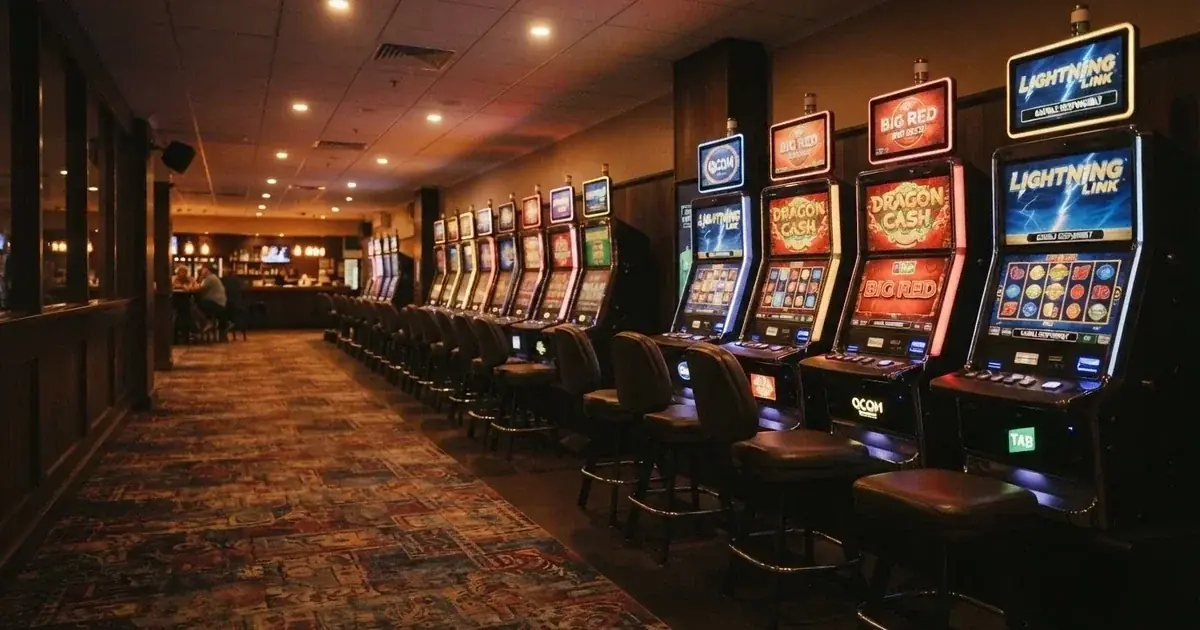
A punter searching for “best pokies in Brisbane” usually wants a venue they can walk into tonight, not another offshore sign-up form. Brisbane answers that question honestly: a single casino licence at Queen’s Wharf, almost 21,000 gaming machines spread across clubs and pubs across Queensland, and a regulatory frame that has nothing to do with any site that brands itself an “online pokies” operator. The hard part is telling those three things apart. The online marketing is loud; the licensed venues are quieter, and the cost difference between the two is the largest number on this page.
Current as of 29 October 2026 and cross-checked against the ACMA blocking register, the Queensland Office of Liquor and Gaming Regulation venue list, and the Star Brisbane operating licence.
Table of Contents
- The legal ground under every “pokies” offer in Australia
- Responsible play, the supports that actually work in Queensland
- Brisbane’s licensed venues: the casino move and the suburban spread
- Paytables, payout percentage and what a Brisbane machine actually pays back
- 24-hour venues and what “open now” actually means
- South Brisbane, South Bank and the Northside distinction
- How the ACMA’s enforcement record compares across the brands that have been warned
- The brands themselves: where each one’s record lands
- Where this leaves a player in Brisbane
- Frequently asked questions about pokies in Brisbane
The legal ground under every “pokies” offer in Australia
The Interactive Gambling Act 2001, tightened by the Interactive Gambling Amendment Act 2017, makes it an offence to supply online casino games, online pokies or in-play betting to a person physically in Australia. No state or territory licence covers that product. What is licensable is wagering on races and sport placed before the event, lotteries and keno — in practice administered by the Northern Territory Racing and Wagering Commission, which regulates 52 of Australia’s online bookmakers (Sportsbet, Bet365, Ladbrokes among them) but runs without full-time staff and meets once a month in Darwin. The NTRWC is the only thing keeping a “licence” number on the screen at an Australian-facing wagering site; for pokies, it is irrelevant.
Minimum age is 18 across the country.
The provider is the target of the IGA, not the player. An Australian punter who opens an offshore account is not committing an offence. They are committing their bankroll to a company the regulator has no jurisdiction over — a company that can be blocked with a balance still sitting in it, with no complaints body and no recourse if a withdrawal stalls. The cost of “playing online pokies from Brisbane” is, in most cases, the entire deposit.
What the ACMA has actually done
The ACMA has been the enforcement arm of the IGA since the 2017 amendments gave it blocking power. Its two tools are formal warnings to named operators and requests to Australian internet service providers to geo-block domains. They are not the same thing, and the distinction matters when a site claims to be “regulated”.
A formal warning is a public, named finding that a particular operator contravened the IGA — the company’s name appears on the ACMA’s register, with the offending brand beside it. The warning is the regulator’s last written step before litigation; some sites comply and leave the Australian market, others rebrand and reappear under a new domain.
A blocking request is invisible to the operator until it lands: the ACMA asks ISPs to make a domain unreachable for Australian IP addresses, and the site simply stops loading. It is the ACMA’s blunt instrument, and the cumulative count is now the largest single statistic in this market.
According to the ACMA’s blocking register, a cumulative total of 1,751 illegal gambling and affiliate marketing websites had been blocked since the first request in November 2019, and more than 230 unlicensed gambling services had left the Australian market since enforcement was strengthened in 2017. The most recent round, reported in late June 2026, asked ISPs to block twelve more domains: 7Signs, ChromaBet, Donbet, Duospin, Freshbet, Slots Gem, Jacks Club, Lucky Start, Pointsbetz, Spinrise, Vinyl Casino and Wildsino. Those names turn over quickly. The pattern does not.
What an Australian punter actually pays
The arithmetic is brutal. H2 Gambling Capital’s 2025 estimate puts Australian losses to illegal offshore sites at about A$3.9 billion a year, with the share of gambling flowing through legal channels falling from 74% in 2021 to 64%. The A$3.9 billion is the sum of deposits that never came back, on sites with no dispute resolution, on products the Australian regulator has expressly named as prohibited. It is the single most expensive line in this entire article, and it is being paid right now.
A player who picks a licensed venue — a pub, a club, or the casino at Queen’s Wharf — pays differently: a return-to-player rate set by state regulation, a maximum bet capped at A$5 outside the casino in South Australia (Brisbane sits under Queensland rules, not South Australian, but the comparison is instructive), and a venue that is required to offer self-exclusion and to identify problem gambling behaviour. The house still has an edge. The difference is what that edge buys.
Responsible play, the supports that actually work in Queensland
The marketing language around offshore sites uses words like “responsible gambling” without ever connecting to an Australian service. That is not a small omission. The Australian support network is built around the assumption that the player is at a licensed venue or on a licensed wagering platform — and offshore, none of it applies.
The national hub is Gambling Help Online (gamblinghelponline.org.au), funded by the Commonwealth and run 24 hours a day, with phone, webchat and email counselling. The phone line is 1800 858 858 and is free from anywhere in Australia. In the ACT, where a different casino regime applies, the ACT Gambling Support Service runs its own 24/7 line on the same number, with telephone, online and face-to-face financial counselling funded by the ACT Gambling Harm Prevention and Mitigation Fund.
BetStop, and what it does not cover
BetStop, the National Self-Exclusion Register, went live on 21 August 2023 and is run by the ACMA. A punter who registers is excluded from every Australian-licensed online and telephone wagering service for a period of their choosing — three months, up to a permanent exclusion. It is the strongest single player-protection tool the country has built.
It does not cover in-venue gambling. A patron at a Queensland pub, club or casino cannot BetStop their way out of a venue; they go through the venue’s own self-exclusion process, which sits with the state regulator. In the ACT, residents wanting to self-exclude from Casino Canberra must use the ACT Gambling Harm Prevention team’s own scheme, available for periods of six months to three years.
The offshore point is more pointed. BetStop binds Australian-licensed operators only. An offshore casino is not connected to the register, has no obligation to honour an Australian self-exclusion, and accepts the same player the day after a BetStop registration as the day before. A punter who registers and then deposits at an offshore site has not excluded themselves from anything.
Brisbane’s licensed venues: the casino move and the suburban spread
Brisbane’s gambling geography turned over in 2024. The old Treasury Casino, in the heritage Treasury Building on George Street, had operated since April 1995 as a three-level gaming emporium of 80 tables and over 1,300 gaming machines, with a hotel, six restaurants, five bars and a nightclub attached. Star Entertainment Group closed it on 25 August 2024 to allow the precinct to be rebuilt as part of the Queen’s Wharf development. The replacement, The Star Brisbane, opened in stages at Queen’s Wharf from 29 August 2024, with the main casino floor and premium gaming rooms opening first. The project cost about A$3.6 billion and was developed jointly by Star Entertainment Group and Hong Kong-based Chow Tai Fook Enterprises.
The opening landed awkwardly. In late 2022 the Queensland Government, acting on an independent review by former Court of Appeal judge Robert Gotterson, found Star Entertainment unsuitable to hold its Queensland casino licences — it had misled regulators and failed its anti-money-laundering duties. Star was fined A$100 million on 9 December 2022, and a 90-day suspension of the Treasury Brisbane and Star Gold Coast licences was deferred to 1 December 2023 to give the company a remediation window. The Queen’s Wharf opening took place under that overhang. The licence was not surrendered; the question was whether it should be.
The state of the suburban machine
The casino is one venue. The other 350 venues are where most of the play happens.
Queensland had 21,122 gaming machines operating in 351 venues in October 2023 — the highest count of any Australian state at that time. They sit in registered clubs, in pubs with gaming machine entitlements, and in the casino. Each machine is linked to the state’s monitoring system, which records every spin in real time and feeds the harm-minimisation data that the regulator publishes. South Australia, for comparison, ran 11,672 gaming machines outside Adelaide Casino in 471 venues in September 2023, and the ACT had 3,587 gaming machines operating (5,091 approved) in 46 venues on 1 November 2023. The Queensland machine count is more than the rest of Australia’s state-by-state distribution implies at first glance, because the state has concentrated entitlements in fewer, larger venues — large clubs with several hundred machines, rather than small pubs with a handful.
Casino Canberra, Adelaide Casino, and what Brisbane looks like by comparison
Two other state capital casinos are useful comparison points, because both have been through similar consolidation questions and both have arrived at answers Brisbane has not.
Casino Canberra was the first legal casino in the ACT, built on land excised from Glebe Park under a 99-year lease, and is the only casino in Australia not licensed to operate poker machines. It runs 39 gaming tables for blackjack, roulette, baccarat and other games, with a poker lounge and a sports lounge, and has no hotel, theatre or retail attached. The licence was issued to Aquis Canberra Pty Ltd on 23 December 2014 under section 22 of the Casino Control Act 2006, and is now held by Casino Canberra Limited. The ACT Gambling and Racing Commission administers the venue and issues casino employee licences — short-term licences valid up to six months, full licences valid for three years.
Adelaide Casino, known commercially as SkyCity Adelaide, sits inside the heritage-listed Adelaide railway station on North Terrace and is the sole licensed casino in South Australia under the Casino Act 1997. It runs 90 gaming tables and 950 gaming machines — a heavier table-to-machine ratio than Treasury Brisbane, and a heavier one than the new Star Brisbane. South Australia sets a minimum gaming-machine return-to-player rate of 87.5% and a general maximum bet of A$5.00 outside the casino, but Adelaide Casino itself has no maximum-bet limit. South Australian gaming-machine losses outside Adelaide Casino totalled about A$0.92 billion in 2022-23, equivalent to about A$497 per adult — a per-capita figure that puts the size of the underground market in perspective.
Adelaide Casino’s table-game monopoly in South Australia was extended to 30 June 2035 under a licence formalised on 11 October 2013, which also allows the casino to expand to up to 200 gaming tables and 1,500 gaming machines subject to redevelopment. A 2015–2021 Riverbank precinct redevelopment, worth about A$330 million, added the EOS by SkyCity tower — 120 hotel rooms and expanded gaming space, opened in 2021. In the 2007–08 financial year Adelaide Casino paid more than A$41 million in taxes and charges to the state. The regulator is South Australia’s Independent Gambling Authority and Liquor and Gambling Commissioner.
Brisbane, by comparison, has chosen scale. The Star Brisbane at Queen’s Wharf is the largest single integrated resort development in Australia at the moment of opening, with a machine count that exceeds Adelaide Casino’s licence ceiling and a footprint that turns the Treasury Building’s vertical gaming emporium into a horizontal precinct. The cost of the move is concentrated exposure: one licence, one operator, one venue. If Star’s remediation fails a second review, Brisbane’s single casino licence is the question.
Paytables, payout percentage and what a Brisbane machine actually pays back
The return-to-player (RTP) on a pub or club gaming machine in Queensland is not a single number. It is published per game by the manufacturer, monitored by the state regulator, and printed on each machine’s help screen. The state does not set a minimum RTP for machines outside the casino — that is a South Australian choice, where the floor of 87.5% gives players a published benchmark. Queensland instead regulates via the monitoring system, the maximum bet, and the venue’s harm-minimisation obligations. The result is that “best paying pokies in Brisbane” is a question about which game, at which venue, at which time — not a question with a single city-wide answer.
The honest framing: the RTP on a licensed Queensland machine is whatever the game says it is, on every spin, audited. The RTP on an offshore site is whatever the offshore site claims it is, on no spin, unaudited by any Australian authority.
Maximum cash payouts, and the cap nobody advertises
Queensland venues set their own maximum cash payout limits per machine, within a state cap. The number that matters is not the headline prize — every venue advertises the largest possible jackpot — but the smallest amount that the machine will pay out as cash without staff intervention. Below that floor, payouts are processed automatically by the machine; above it, the patron waits for a venue attendant to verify the win and pay it out by hand.
“Maximum cash payout pokies Brisbane” is a question with a real answer, and the answer is venue-specific. The state does not publish a single maximum. Venues publish their own, and the variation is wider than the marketing suggests. A patron who wants to know the actual cash ceiling before they sit down should ask the venue, not the search engine.
Cashless pokies in Brisbane
The shift to cashless gaming — card- or account-based play rather than coins and notes — has been a slow national rollout. The technology exists, the regulator supports it as a harm-minimisation tool, and venue uptake has been uneven. A patron who wants to use a cashless card at a Brisbane venue should ask the venue before arriving, because the rollout is not yet uniform across clubs and pubs.
24-hour venues and what “open now” actually means
Brisbane has licensed venues that operate electronic gaming machines around the clock, but the number is small. The casino is the obvious answer — The Star Brisbane at Queen’s Wharf runs continuous gaming on the main floor. Outside the casino, 24-hour machine play is available at a handful of large clubs with extended trading hours, and at venues near Brisbane Airport that cater to early and late flights.
The honest answer to “24-hour pokies Brisbane open now” is: yes, but a small number of venues, and the casino is the safest of them to find. A punter searching at 2 a.m. is more likely to reach a working venue than an honest one if they trust an offshore site to give them the answer.
South Brisbane, South Bank and the Northside distinction
The geographic breakdown the search terms reveal is real. South Brisbane and South Bank are the inner-city entertainment precincts, with several large clubs and the casino within walking distance. Northside Brisbane refers to the residential and industrial suburbs north of the Brisbane River — Chermside, Nundah, Stafford, Aspley — and has the densest concentration of suburban clubs in the metropolitan area. The distinction is practical, not regulatory: every machine in Queensland sits under the same state monitoring system, but the venue mix is genuinely different. Southside offers the casino and the entertainment venues. Northside offers the suburban clubs where most regular play actually happens.
A punter who wants to know which precinct has the higher machine count, or the higher average RTP, will not find a published ranking. The state does not publish per-precinct statistics. The choice is about venue, not neighbourhood — the precinct is a convenience, not a quality signal.
How the ACMA’s enforcement record compares across the brands that have been warned
The eleven brands below have all received formal warnings from the ACMA for offering prohibited online casino games or online pokies to people in Australia. The table is not a ranking and not a recommendation. The table is the regulator’s own list of the operators it has named in writing. A site that does not appear on it is not endorsed by the regulator — it has simply not been warned yet. The pattern across the list is what matters.
| Brand | ACMA action and date | Operator named by the ACMA | Subject support |
|---|---|---|---|
| RocketPlay | Formal warning, March 2026 (Pulsup Ltd); earlier Dama N.V., May 2022 | Pulsup Ltd / Dama N.V. | no-data |
| Level Up Casino | Formal warning, May 2022 | Dama N.V. | listings-only |
| Woo Casino | Formal warning, March 2025 | Dama N.V. | listings-only |
| Spirit Casino | Formal warning, May 2025 | Dama N.V. | no-data |
| National Casino | Formal warning, July 2025 | Consolutetish S.R.L. | listings-only |
| Bizzo Casino | Formal warning, July 2025 (Consolutetish S.R.L.); earlier TechSolutions, 2022 | Consolutetish S.R.L. / TechSolutions | no-data |
| Ignition Casino | Formal warning, July 2025 | Bamboo Media | no-data |
| Instant Casino | Formal warning, February 2025 | EOD Code SRL | no-data |
| Jackbit | Formal warning, April 2026 | Ryker B.V. | no-data |
| Casino Intense | Formal warning, April 2025 | Sterplay Holding Ltd | listings-only |
| Sky Crown | Formal warning, September 2022 | Hollycorn N.V. | listings-only |
Three operator names recur. Dama N.V. appears four times across RocketPlay, Level Up, Woo and Spirit — a single corporate entity offering the same prohibited product under four brand names, with a four-year enforcement tail. Consolutetish S.R.L. appears twice (National, Bizzo), with Bizzo having already been the subject of an earlier 2022 warning to TechSolutions. Ryker B.V. took two brands (Jackbit, CasinOK) into the April 2026 round together. The recurring operators are not unlucky. They are running a portfolio, and the ACMA is naming the portfolio as well as the brands.
The “subject support” column is editorial. Where research only found references on listings pages — affiliate directories, comparison sites, Wikipedia entries that repeat them — the brand is marked “listings-only” and the column is honest about the depth of evidence. Where no source beyond the ACMA warning itself was found, the brand is marked “no-data”, which is the regulator’s minimum data point and nothing else. Neither marker is a recommendation.
What the blocking rate actually means
The ACMA’s blocking register is the public ledger of how fast the offshore market tries, and how fast it gets shut. Between the first blocking request in November 2019 and the count reported in June 2026, 1,751 illegal gambling and affiliate marketing websites had been blocked. Spread across roughly 80 months of enforcement, that is an average pace of about 22 blocked domains per month — and that is just the ones the ACMA has named, not the rebrand-and-relaunch cycle behind each one.
The realistic read is that the regulator blocks one site faster than the industry launches three. Each blocked site is typically replaced by a new domain within weeks — sometimes owned by the same operator, sometimes by a new entrant — and the ACMA’s next round re-names the new domain. The 22-per-month figure is the public enforcement rate, and it is dwarfed by the underlying launch rate. The blocking rate tells a player only that the regulator is working; it does not tell them that the problem is being solved.
The A$3.9 billion in estimated annual losses to illegal offshore sites is the parallel figure. Per month, that is roughly A$325 million in Australian deposits that go to unlicensed operators. The math explains the scale of the problem: at the regulator’s current blocking rate, the enforcement covers about one month’s worth of new launches per month of work, and the underlying flow of money does not slow down.
The brands themselves: where each one’s record lands
The eleven brands in the table above are not interchangeable. They share a regulatory status — every one has been warned by the ACMA for offering prohibited online casino games to Australians — but their histories diverge in ways a punter comparing them should know. The reviews below describe each brand’s record as research found it. None of them is recommended.
RocketPlay
RocketPlay was first named by the ACMA in May 2022 under Dama N.V., alongside five other brands — Bambet, Dazard, Level Up, Wild Tornado and Cobra Casinos. The brand then resurfaced under Pulsup Ltd, and was named again by the ACMA in March 2026. Two formal warnings, four years apart, the same prohibited product. The pattern is the dossier the regulator builds when an operator re-emerges under a new entity: the ACMA’s response is to keep naming the brand, not to chase the corporate veil. The cost to a player is that the brand has been in the ACMA’s sights for the entire life of the modern enforcement regime.
Level Up Casino
Level Up was one of the six brands named in the ACMA’s May 2022 warning to Dama N.V. — the earliest of the eleven brands on this list. Four years on, it still appears on listings pages alongside other Dama N.V. brands. The single warning is the regulator’s complete Australian file; the listings are affiliate marketing, not consumer evidence. A player looking for an independent review of payout speed, withdrawal friction or dispute outcomes will not find one from an Australian source.
Woo Casino
Woo Casino drew a fresh ACMA warning to Dama N.V. in March 2025 — three years after the May 2022 round — confirming that the operator’s portfolio is still being offered to Australians under at least one of the previously-named brand names. The fresh warning, after a multi-year gap, is the regulator’s clearest signal that the operator’s exit was cosmetic: the same prohibited product, the same parent company, a new enforcement round.
Spirit Casino
Spirit Casino joined Dama N.V.’s portfolio in time to be named in the May 2025 warning — the latest of the four Dama N.V. brands on this list. The brand is recent enough that no consumer-side source beyond the regulator’s own record has been logged. A player who lands on the site today is encountering a brand the ACMA has already named in writing.
National Casino
National Casino was named by the ACMA in July 2025 under Consolutetish S.R.L., alongside Bizzo Casino. Both had been on the regulator’s radar before — Bizzo via an earlier 2022 warning to TechSolutions — and the 2025 round consolidated them under a single new operator. The cost to a player is that the corporate restructuring is itself a known pattern: the same product, a new owner, the same regulator finding the same thing. The brand appears on Australian listings pages, not on Australian consumer review pages.
Bizzo Casino
Bizzo was the first of Consolutetish S.R.L.’s brands to appear on the ACMA’s register — under TechSolutions (CY) Group Limited and TechSolutions Group N.V. in 2022 — and was named again under Consolutetish S.R.L. in July 2025. Two warnings, three corporate names, one product. The regulator has had to rename the operator twice to keep the warning current. A player who reads the ACMA’s record carefully sees the corporate vehicle change, not the product change.
Ignition Casino
Ignition Casino drew an ACMA warning in July 2025 under Bamboo Media. The brand has no published Australian consumer record beyond the warning itself — it is a “no-data” subject on this page. A player looking for an Australian-side review of game fairness, withdrawal timelines or dispute handling will not find one.
Instant Casino
Instant Casino was named by the ACMA in February 2025 under EOD Code SRL — one of the earlier 2025 rounds on this list. Like Ignition, no consumer-side Australian evidence has been logged. The brand’s entire Australian file is the ACMA warning and the brand’s own marketing.
Jackbit
Jackbit was named in the ACMA’s April 2026 round, alongside CasinOK, under Ryker B.V. — the freshest enforcement action on this list. A player considering the brand today is encountering a site the ACMA named less than two months before publication. The cost of the operator’s recent rebranding or restructuring will fall on the player, not on the regulator.
Casino Intense
Casino Intense drew an ACMA warning in April 2025 under Sterplay Holding Ltd — the same month as the broader 2025 enforcement wave, but a different operator. The brand has listings-side references in Australian source material but no consumer-side record. The pattern across the Sterplay file is the same as for every other brand here: one product, one regulator finding, no Australian consumer protection.
Sky Crown
Sky Crown was named by the ACMA in September 2022 under Hollycorn N.V., alongside Blue Leo — the earliest single-brand warning on this list by date. Hollycorn has continued to operate brands offering the same prohibited product; Sky Crown is the brand the regulator named by name. A player comparing Sky Crown to the other brands here sees the same warning, the same prohibited product, a four-year-old regulator file.
Where this leaves a player in Brisbane
A player reading this page has three real options. The first is the licensed venue — the casino at Queen’s Wharf, a suburban club, or a pub with a gaming machine entitlement. The state monitors every spin, the venue is required to offer self-exclusion, and the player has a regulator to complain to if something goes wrong. The cost is the published house edge, on a published machine, with a real receipt.
The second is a wagering account with an Australian-licensed bookmaker — Sportsbet, Bet365, Ladbrokes, and the other 49 licensed by the NTRWC. These are not pokies venues, and the product is not the same. A player who wants to bet on a horse race or a sporting event before it starts has a regulated, Australian-licensed option. A player who wants to play pokies does not, because the IGA does not let one exist.
The third is an offshore site. The third option has no regulator, no dispute resolution, no BetStop coverage, and a regulator’s public warning at the brand’s corporate parent. The cost is the entire deposit, with the bonus that the deposit itself is unlawful to offer.
The choice between the first and the third is a choice about what the deposit is buying. The licensed venue buys time at a machine, with a regulated edge. The offshore site buys a balance on a server, with no protection and an ACMA file. The arithmetic in the calculation above is the closing argument.
Frequently asked questions about pokies in Brisbane
Which venues in Brisbane are licensed to operate pokies?
Queensland has 351 licensed gaming venues operating 21,122 machines as of October 2023. The casino at Queen’s Wharf — The Star Brisbane, opened August 2024 — is the only Brisbane casino venue. The remaining machines sit in registered clubs and pubs across the metropolitan area, each holding a gaming machine entitlement from the Queensland Office of Liquor and Gaming Regulation.
Are pokies in Brisbane available around the clock?
Yes, at a small number of venues. The Star Brisbane runs continuous gaming on its main floor. Outside the casino, a handful of large suburban clubs with extended trading hours operate machines through the night. The casino is the most reliable answer for a punter searching at 2 a.m.
What identification do venues in Brisbane require before letting someone play pokies?
Every licensed venue must verify that a patron is 18 or older before granting access to the gaming floor. In practice, this means producing a valid Australian driver’s licence, passport or other government-issued photo ID at the door. The same check is required for any cash payout above the machine’s automatic floor, and the patron’s details are recorded against the win in the venue’s monitoring system.
Can visitors to Brisbane use self-exclusion schemes at local pokies venues?
BetStop, the National Self-Exclusion Register, covers Australian-licensed online and phone wagering services but does not cover in-venue gambling. A patron who wants to self-exclude from a Queensland pub, club or casino uses the venue’s own scheme — administered at the state level, with exclusion periods ranging from six months to three years. Visitors to Brisbane can register at any venue they intend to play at.
How does the payout percentage on Brisbane pokies compare with other Australian cities?
There is no published state-wide average for Queensland, and the regulator does not publish per-precinct figures. South Australia publishes a minimum gaming-machine return-to-player of 87.5% outside Adelaide Casino, which gives a useful floor for comparison. Brisbane’s published numbers sit at the per-game, per-machine level — printed on each machine’s help screen and recorded in the state’s monitoring system — not at the city level.
Is it legal for an online casino to advertise ‘pokies’ in Brisbane the same way a pub or club does?
No. The Interactive Gambling Act 2001, as amended in 2017, makes it an offence to supply online casino games or online pokies to a person in Australia. No state or territory licence covers that product. An offshore site advertising “pokies” to a Brisbane audience is offering a service the regulator has expressly prohibited, and the ACMA has named eleven such operators in formal warnings over the past four years.