
Casinos that accept MiFinity in Australia in 2026: what offshore pokies sites will not tell you about the law
A handful of offshore casino sites still list MiFinity among their deposit methods and pitch themselves to Australian players in 2026. The promise is convenience — a cheap eVoucher top-up, low minimum deposits, fast withdrawals. The reality is that the Interactive Gambling Act 2001 makes every one of those offers unlawful for an Australian resident, and that the Australian Communications and Media Authority has spent 2026 issuing formal warnings to the very operators that take MiFinity. This page is written for the reader who has already noticed that the marketing has a gap in it and wants to know what sits on the other side.
Data current as of 29 October 2026, checked against the ACMA’s formal-warning register and the public blocking list.
Table of Contents
- The legality shelf: why the offshore MiFinity option is not really an option
- Responsible play and the ACMA record: who has been warned, and for what
- Payments at Australian-licensed channels versus what MiFinity actually does
- The offshore MiFinity-accepting landscape reviewed
- How fast the ACMA blocks: the rate, not the number
- Frequently asked questions
The legality shelf: why the offshore MiFinity option is not really an option
The Interactive Gambling Act 2001 — the IGA — sets the boundary that the rest of this page works against. As amended by the Interactive Gambling Amendment Act 2017, it is an offence to provide online casino games, online pokies or in-play betting to a person physically in Australia. No state or territory licences those products. The only products that ARE licensable in Australia are pre-event wagering on races and sport, lotteries and keno. The 52 online bookmakers most Australians know — Sportsbet, Bet365, Ladbrokes — sit under Northern Territory Racing and Wagering Commission oversight, not because the Territory wants to run gambling but because the commission’s structure suits operators that need a licence to ship a tax invoice.
The practical effect is that any site offering pokies, roulette, blackjack or “live casino” tables to an Australian player is operating outside Australian law, regardless of what licence the site footer shows. A Curaçao sub-licence or a Costa Rica registration is exactly that — a registration in another jurisdiction. It is not an Australian licence because no Australian licence exists for that product.
Enforcement runs through the ACMA. The agency investigates complaints, issues formal warnings to providers and, when warnings fail, directs Australian internet service providers to block the offending websites. As reported in June 2026, a cumulative total of 1,751 illegal gambling and affiliate marketing websites had been blocked since the first blocking request in November 2019, and more than 230 unlicensed gambling services had left the Australian market since enforcement was strengthened in 2017. The June 2026 round alone asked ISPs to block 12 more sites — 7Signs, ChromaBet, Donbet, Duospin, Freshbet, Slots Gem, Jacks Club, Lucky Start, Pointsbetz, Spinrise, Vinyl Casino and Wildsino — names that look like a roulette wheel and read like an enforcement log.
H2 Gambling Capital’s 2025 estimate puts Australians’ losses to illegal offshore sites at about A$3.9 billion a year, with the share of gambling going through legal Australian channels falling from 74% in 2021 to 64% in 2025. That is the headline figure most often quoted, and the one the ACMA itself uses to argue for stricter enforcement. It is also the figure the reader is paying for, in the technical sense: every A$1 the offshore market captures is a dollar that did not flow through a channel with Australian consumer protection behind it.
The 2026 reform bill: what just changed and what has not yet
On 19 August 2026 Parliament passed the Interactive Gambling Amendment (Gambling Reform) Bill 2026. Its advertising and inducement measures commence on 1 January 2027. That is the line to hold: the bill is law, the changes are not yet in force. Reading “the 2026 reform” as already operating against an operator is reading a start date as an effective date.

The credit-card ban on licensed wagering has been live since 11 June 2024 — the change that closed the loop on credit cards and credit-related products, including digital wallets linked to credit, for any service holding an Australian wagering licence. Penalties run up to A$247,500 for operators. None of that changes the offshore status of an online casino; it tightens what licensed bookmakers can accept, which is a different question.
What “Australian consumer protection” actually looks like
An offshore operator gives an Australian player none of the protections an Australian-licensed channel gives. There is no local complaints body to escalate to if a withdrawal is refused. There is no requirement that the operator keep player funds segregated from operating funds. There is no guarantee that a balance still in the account when the ACMA adds the site to the blocking list will be returned. The site may be reachable one day and gone the next, and the player’s recourse runs through a regulator in another country that does not take complaints from non-residents.
BetStop, the National Self-Exclusion Register, has been live since August 2023. It binds Australian-licensed online and phone wagering services. An offshore casino is not connected to it. Self-excluding through BetStop does not stop an offshore site from accepting a deposit, because the offshore site has no Australian integration to honour.
Help is available regardless of where someone plays. The National Gambling Helpline — 1800 858 858 — is free, runs 24/7 and has a chat at Gambling Help Online. A reader who has reached the point of needing the number does not need to read further first.
Responsible play and the ACMA record: who has been warned, and for what
Responsible gambling for a reader on this page looks different from the responsible-gambling page most guides expect. The legal channels that carry deposit limits, reality checks and BetStop integration do not include the offshore casino this page is about. The MiFinity-friendly operators reviewed below are all on the ACMA’s published enforcement list for offering prohibited services to Australians. That is what “responsible” means here: read the regulator’s own record before trusting the operator’s own claims.
The ACMA formal-warning register for the brands this page reviews
| Brand | ACMA action and date | Operator named by the ACMA | Subject support |
|---|---|---|---|
| RocketPlay | Formal warning, March 2026; earlier Dama N.V. warning, May 2022 | Pulsup Ltd (Rocketplay.com.au), March 2026; Dama N.V., May 2022 | — |
| Level Up Casino | Formal warning, May 2022 | Dama N.V., May 2022 | Westpac gambling-block page references the operator group |
| Woo Casino | Formal warning, March 2025 | Dama N.V., March 2025 | — |
| Spirit Casino | Formal warning, May 2025 | Dama N.V., May 2025 | — |
| National Casino | Formal warning, July 2025 | Consolutetish S.R.L., July 2025 | AUSTRAC register entries; Wikipedia background |
| Bizzo Casino | Formal warning, July 2025; earlier TechSolutions, 2022 | Consolutetish S.R.L., July 2025; TechSolutions, 2022 | — |
| Ignition Casino | Formal warning, July 2025 | Bamboo Media, July 2025 | — |
| Instant Casino | Formal warning, February 2025 | EOD Code SRL, February 2025 | EcoPayz and PayID listings reference the operator group |
| Jackbit | Formal warning, April 2026 | Ryker B.V., April 2026 | — |
| Casino Intense | Formal warning, April 2025 | Sterplay Holding Ltd, April 2025 | AUSTRAC register entries; ITNews background; NAB references |
| Sky Crown | Formal warning, September 2022 | Hollycorn N.V., September 2022 | — |
The brands above are not a recommended shortlist. Each one appears here because the ACMA itself issued a formal warning over it for offering prohibited interactive gambling services to Australians. The presence of a brand on this page reflects an enforcement record, not an endorsement.
The pattern across those warnings
The warnings cluster around a small number of operator groups. Dama N.V. accounts for four entries on the register reviewed here — Level Up Casino, Woo Casino, Spirit Casino and the earlier RocketPlay warning — and the agency warned the company again over Rocketplay.com.au in March 2026 under a different corporate vehicle (Pulsup Ltd). Consolutetish S.R.L. carries the National Casino and Bizzo Casino warnings, and Bizzo was already the subject of a 2022 warning to TechSolutions. The pattern is what matters: a brand can be re-launched under a new entity and re-warned. The product does not become lawful because the corporate wrapper changed.
For the reader, the operational consequence is plain: a “new” brand launched by the same operator group as a previously-warned brand is not a different product. It is the same product on a fresh URL.
Payments at Australian-licensed channels versus what MiFinity actually does
The licensed Australian wagering channels — Sportsbet, Bet365, Ladbrokes and the rest of the 52 Northern Territory-licensed bookmakers — accept deposits through debit card, bank transfer, PayID/Osko and BPAY. Credit cards, credit-related products and digital currency have been banned as payment since 11 June 2024. A licensed bookmaker asking an Australian for a credit card or a crypto deposit is operating outside its own licence conditions.
MiFinity sits on the other side of that line. It is a legitimate eWallet — two regulated entities, MiFinity UK Limited (UK Financial Conduct Authority, under the Electronic Money Regulations 2011) and MiFinity Malta Limited (Malta Financial Services Authority) — but its legitimate status does not move it onto the list of payment methods a licensed Australian wagering service is allowed to accept. The question is not whether MiFinity is a sound financial product. It is whether the receiving operator is permitted to take Australian players at all.
MiFinity fee structure
| Transaction type | Fee |
|---|---|
| SEPA bank transfer deposit | Free |
| VISA/MasterCard deposit (EEA) | 1.8% |
| Cryptocurrency deposit/withdrawal | 1.8% |
| Transfer to friends and family | 1%, max 10 EUR |
| Standard currency conversion | Up to 2.99% |
| Exotic currency conversion | Up to 3.99% |
| Inactivity fee (after 12 months) | 1 EUR / month |
How a MiFinity deposit works at an offshore site
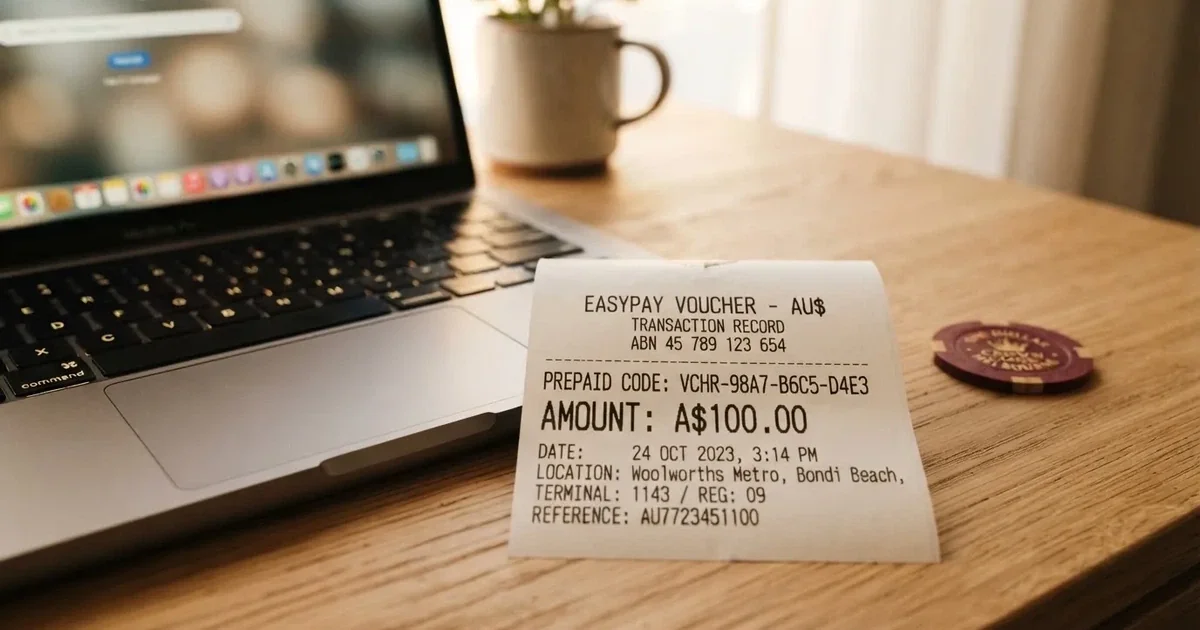
The deposit side is the part of the pitch most readers see. MiFinity can be topped up by debit or credit card, by cryptocurrency (BTC, ETH, LTC, USDT, USDC, XRP, XLM and BCH), by local payment methods that vary by country, and by the MiFinity eVoucher — a printed prepaid voucher sold in fixed denominations by partner resellers in 18 currencies. The eVoucher is the channel that lets a reader move money into an MiFinity eWallet without a bank account being directly involved in the casino transaction.
Verification documents are required before MiFinity lets a user move to higher spending limits. Receiving money into a personal MiFinity eWallet is free. Transfers to friends and family cost 1% of the amount, capped at 10 EUR. SEPA bank transfers into the wallet are free; card deposits (VISA/MasterCard, EEA) carry a 1.8% fee; cryptocurrency deposits and withdrawals both carry a 1.8% fee; foreign-exchange markup runs up to 2.99% for standard currencies and up to 3.99% for exotic currencies. After 12 months without a login, an inactivity fee of 1 EUR per month starts to apply to a personal account.
None of that changes the legal position. A 1.8% crypto fee on a deposit to an offshore casino is still a deposit to a casino the ACMA has warned. The fee structure is an operational detail, not a defence.
Withdrawals and where they actually go
A MiFinity withdrawal request still needs the casino’s own manual checks completed before the settlement lands back. The marketing often quotes a clearance window measured in hours; the reality is a window measured in “after the operator’s compliance team is satisfied” — a phrase that has no published time. A reader who treats a withdrawal timeline as a contract is reading past the line that says “subject to verification”.
When the money does clear, it lands in the reader’s MiFinity eWallet. From there it has to leave the wallet to become useful — to a bank account, to a card or out as cryptocurrency. Each leg carries its own fee, its own foreign-exchange markup and its own hold period. The “fast withdrawal” framing counts only the leg from the casino to the eWallet.
Card-based payment channels that the IGA affects
The card channels that intersect with the IGA are worth naming because they show where the law actually bites.
Westpac’s gambling block works at card level: it refuses authorisation of transactions registered under the merchant category code ‘Betting/Casino Gambling’ on eligible personal credit and debit cards. ANZ’s gambling block, activated in the ANZ app, blocks gambling transactions made through a digital wallet such as Apple Pay on an eligible card, not just the physical card. Once turned on, ANZ’s block requires a 48-hour waiting period to remove, and the bank warns that not all gambling transactions will be blocked and that some non-gambling transactions might be blocked in error.
Apple does not charge consumers a fee for using Apple Pay in stores, online or in apps; any surcharge comes from the merchant’s own card-processing fees. Transaction limits and PIN requirements for Apple Pay are set by the card issuer or merchant, not by Apple. By the end of 2025, Apple Pay, Google Pay and Samsung Pay together accounted for around 45% of all card payments in Australia by number. The volume is why the IGA’s credit-product ban matters in practice: a wallet linked to a credit account and used at an illegal site runs into both the card-issuer block and the wagering-services ban.
The Reserve Bank of Australia’s July 2025 review proposes removing surcharges only on eftpos, Mastercard and Visa transactions, explicitly leaving American Express outside the proposed surcharge ban. American Express — founded in 1850 as a freight-forwarding company, issuing its first charge card on 1 October 1958 — operates as a three-party scheme, issuing and processing transactions itself rather than through the four-party Visa/Mastercard model.
Bank transfer and PayID
Osko, run through Australia’s New Payments Platform, settles a bank transfer between participating Australian banks in under a minute, 24/7 including weekends, whether the transfer is addressed to a BSB and account number or to a PayID. Paying to a PayID shows the name of the account holder before the transfer is sent. Australian Payments Plus warns that being asked to transfer money to a PayID on an illegal gambling site almost certainly means a scam site — a hard sentence, and an accurate one. PayID-based instant transfers are available at over 100 Australian financial institutions. More than 25 million PayID identifiers were registered on the New Payments Platform as of April 2025.
The New Payments Platform became accessible to the public on 13 February 2018 and is owned by New Payments Platform Australia Ltd — a non-profit whose 13 shareholders include the Reserve Bank of Australia and the country’s major banks. In 2021 the ACCC authorised the merger of NPP Australia with BPAY and eftpos into a single company, Australian Payments Plus. Participants in the platform must keep monthly outages to no more than two minutes.
The PayID layer is what makes a domestic instant payment legible to the reader in a way MiFinity is not. The PayID shows the destination account name before the transfer is sent. A MiFinity deposit hides it. Hiding the destination is not a feature for a reader comparing options; it is a marker that the operator wants the money moved before it can be looked at.
The offshore MiFinity-accepting landscape reviewed
The 11 brands below are the ones the ACMA has acted against for offering prohibited interactive gambling services to Australians. None of them may lawfully take an Australian resident. The page describes each on its own terms, including its MiFinity status where research could confirm one and leaving the field blank where it could not — a “no-data” marker is not a denial, it is the absence of a verifiable record.
1. RocketPlay — re-warned under a new corporate wrapper
The ACMA issued a formal warning to Pulsup Ltd over Rocketplay.com.au in March 2026, and an earlier warning to Dama N.V. over the same brand in May 2022. Two warnings to two corporate vehicles, one product. The MiFinity status of the site could not be confirmed from the consulted sources; the operator group is the same one that runs Level Up, Woo Casino and Spirit Casino, and the question to ask is not whether the new wrapper has changed the product but whether the product has changed at all. Verdict: the same pattern that earned Dama N.V. its 2022 warning now sits under Pulsup Ltd; a reader comparing options is comparing a brand the regulator has had to warn twice.
2. Level Up Casino — Dama N.V., May 2022
Dama N.V. took the May 2022 formal warning covering six casino brands: Bambet, Dazard, Level Up, Rocketplay, Wild Tornado and Cobra Casinos. Level Up was on that list. Research’s consulted set picked up Level Up in a Westpac gambling-block page reference rather than a payment-method listing, which is the kind of finding that says less about the site than about where the operator’s brand surfaces in Australian finance-sector coverage. Verdict: the warning is the most material fact on the page; a reader who came looking for a MiFinity-friendly option is reading past the regulatory record.
3. Woo Casino — Dama N.V., March 2025
The ACMA warned Dama N.V. over Woo Casino in March 2025. Three months later, in May 2025, the same agency warned the same operator group again over Spirit Casino. Two warnings in 90 days to one operator group is a pace worth noting. Woo Casino’s MiFinity status is not publicly verified. Verdict: the warning pace at Dama N.V. is the more useful signal than any payment-method claim the site itself makes.
4. Spirit Casino — Dama N.V., May 2025
The May 2025 Spirit Casino warning came two months after the Woo Casino warning, both to Dama N.V. The sequence is what makes the brand legible to a regulator; it is also what makes the brand legible to a reader who reads the regulator’s record. Spirit Casino’s MiFinity status is not publicly verified. Verdict: a brand whose operator group has been warned twice in 90 days is a consistent operational pattern.
5. National Casino — Consolutetish S.R.L., July 2025
The July 2025 warning named Consolutetish S.R.L. as the operator of National Casino and Bizzo Casino. National Casino surfaces in AUSTRAC register entries and in Wikipedia background material in the consulted set — neither is a payment-method confirmation. The MiFinity status of the site could not be confirmed from those listings. Verdict: the AUSTRAC appearance is a financial-sector reference, not a regulator’s safety signal, and the ACMA warning is what remains on the record.
6. Bizzo Casino — Consolutetish S.R.L., July 2025; earlier TechSolutions, 2022
Bizzo Casino was the subject of a 2022 formal warning to TechSolutions (CY) Group Limited and TechSolutions Group N.V., and then a July 2025 warning to Consolutetish S.R.L. Two warnings, two operator groups, one brand — the same wrap-and-rewarn pattern the ACMA has documented at Dama N.V. MiFinity support could not be confirmed from the consulted sources. Verdict: a brand that has needed two warnings across two corporate vehicles is a brand the reader is being asked to fund on the regulator’s say-so against it.
7. Ignition Casino — Bamboo Media, July 2025
The ACMA warned Bamboo Media over Ignition Casino in July 2025. MiFinity support could not be confirmed from the consulted sources. The site targets Australian-facing acquisition through affiliate marketing, which is why the page sits alongside the ACMA’s parallel programme against affiliate marketing websites. Verdict: a brand whose operator has been formally warned in 2026 for offering prohibited services is the kind of brand the regulator’s own pages are written about.
8. Instant Casino — EOD Code SRL, February 2025
The ACMA warned EOD Code SRL over Instant Casino in February 2025. The consulted set picked the brand up in EcoPayz and PayID listings — payment-method references that name the operator group rather than the MiFinity status. Verdict: a PayID listing for an illegal gambling site is the exact pattern Australian Payments Plus warns about; the EcoPayz listing is a payment-processor reference, not a regulator’s clearance.
9. Jackbit — Ryker B.V., April 2026
The ACMA warned Ryker B.V. over Jackbit and CasinOK in April 2026. Jackbit’s MiFinity status is not publicly verified. Verdict: the most recent warning in the reviewed set; a brand launched under Ryker B.V. carries the same enforcement profile as CasinOK.
10. Casino Intense — Sterplay Holding Ltd, April 2025
The ACMA warned Sterplay Holding Ltd over Casino Intense in April 2025. The consulted set found Casino Intense in AUSTRAC register entries, in ITNews background material and in NAB references — three finance-sector touch-points that say where the brand surfaces in Australian banking and business coverage, not where the regulator has cleared it. Verdict: a brand the Australian finance sector has had to record is not a brand the regulator has cleared.
11. Sky Crown — Hollycorn N.V., September 2022
The ACMA issued a formal warning to Hollycorn N.V. over its Sky Crown and Blue Leo casino services, published in September 2022. Sky Crown is the older warning in the reviewed set, and Hollycorn N.V. is one of the operator groups that has continued to surface in Australian-facing acquisition since. Sky Crown’s MiFinity status is not publicly verified. Verdict: the oldest warning in the set, showing the established pattern — operator groups continue to launch brands under fresh wrappers.
How fast the ACMA blocks: the rate, not the number
The headline figure — 1,751 sites blocked since November 2019, 230 services having left the market since 2017 — is what the regulator quotes. The figure that matters to a reader considering an offshore site today is the rate at which new sites are being added. The June 2026 round added 12 names to the blocking list. Over the six years between November 2019 and June 2026, the cumulative count reached 1,751 — a long-run rate of roughly 22 blocked sites per month across the whole period, though the rate is heavily front-loaded by the early enforcement rounds.
The conditions that produce the rate matter. The ACMA acts on complaints, on its own monitoring, and on referrals from Australian banks and payment processors whose own anti-fraud systems flag the merchant category codes. A site added to the list is not a site the regulator chose at random; it is a site that has crossed a threshold the regulator has published. The threshold is not the same as a refund for a player whose balance is on a blocked site. A block is a forward-looking action, not a remediation for the player who played before the block landed.
Frequently asked questions
Is it legal for an online casino to accept MiFinity from a player in Australia?
No. Under the Interactive Gambling Act 2001, as amended in 2017, it is an offence to provide online casino games or online pokies to a person in Australia, and no state or territory licences those products. MiFinity is a payment method, not a licence — the question of whether the operator can lawfully take Australian players is settled before the payment screen appears. Enforcement is the ACMA’s, and the agency has issued formal warnings to the operators behind every brand reviewed above.
What is the smallest deposit a MiFinity casino site usually asks for?
MiFinity itself supports very small top-ups — the eVoucher is sold in fixed denominations by partner resellers, and the eWallet can be funded with as little as a single voucher’s value. The casino’s own minimum deposit is the figure that actually governs, and offshore casinos typically set minimums in the A$10 to A$30 range for a first deposit. The minimum is the cheapest the casino lets you in, not a guarantee that the deposit clears any further hurdle; the casino still applies its own verification before a withdrawal.
Does a MiFinity withdrawal clear any faster than a card withdrawal at these sites?
A MiFinity withdrawal typically clears to the eWallet faster than a card withdrawal clears to the card, because the casino-to-eWallet leg is internal to MiFinity rather than routed through Visa or Mastercard’s settlement windows. The leg FROM the eWallet to a bank account or card carries its own delay. A “fast withdrawal” headline counts only the first leg, and the casino’s own manual checks still sit ahead of both.
Can MiFinity be used at every offshore pokies-style site, or only some of them?
MiFinity is a mainstream eWallet across the offshore market and most large multi-brand casino groups list it. Coverage is not universal — some sites list only crypto, some only cards — and the MiFinity status of the specific brand a reader is looking at has to be confirmed against that brand’s own banking page. The consulted sources confirmed MiFinity-adjacent references for a subset of the reviewed brands and not for others; the absence of a listing in the consulted set is not a confirmation either way.
Does depositing with MiFinity add an extra fee at these casino sites?
MiFinity’s own fees apply to the wallet side, not to the casino side. Card deposits to the wallet carry a 1.8% fee (EEA cards), crypto deposits and withdrawals both carry a 1.8% fee, SEPA bank transfers are free, foreign-exchange markup runs up to 2.99% for standard currencies and up to 3.99% for exotic currencies, and the wallet itself charges an inactivity fee of 1 EUR per month after 12 months without a login. Whether the casino adds its own fee on top is a separate question that depends on the operator — many offshore casinos do not charge a deposit fee but most offset the cost in currency conversion or in bonus terms. The full fee the player pays is the wallet fee plus the conversion markup plus whatever the operator charges on its own side.
What should a player do if a MiFinity deposit does not appear in a casino account?
The first move is the casino’s own support, with the MiFinity transaction reference in hand. MiFinity’s own support can confirm whether the transfer cleared on the wallet side. If the casino disputes that the deposit arrived, the MiFinity transaction log is the document that resolves the dispute. If the casino is unresponsive, the recourse is the regulator in the jurisdiction that issued the casino’s licence — which, for the brands reviewed on this page, is a regulator outside Australia that does not take complaints from non-residents. The structural point is the one that matters: the deposit that does not arrive is the cost of the offshore option, not an exception to it.