
High RTP pokies in Australia: the figure, the law and the sites that pretend to offer it
Return-to-player is the number every punter chasing a “best” pokie fixates on, and every offshore casino chasing the same punter is happy to print it on a banner. The two are not the same conversation. One is a regulatory disclosure requirement built into the design of a poker machine licensed to operate in a pub, club or casino in Australia. The other is marketing copy attached to a service the Interactive Gambling Act 2001 prohibits from being offered to people here in the first place. Sorting those two apart is what this page is for.
Data current as of 29 October 2026, cross-checked against the ACMA’s published register of blocking requests and formal warnings.
Table of Contents
- How Australian regulators treat the RTP figure
- What the Interactive Gambling Act actually prohibits
- What responsible gambling support actually looks like
- The volume of pokies play that sits behind the RTP figure
- What an RTP shortlist actually compares
- The ACMA’s published record against offshore brands
- The mechanics of an RTP claim worth interrogating
- Why the offshore lobby advertises RTP figures the licensed venue does not
- Where this leaves the punter choosing between a licensed machine and an offshore site
- Frequently asked questions about high-RTP pokies in Australia
How Australian regulators treat the RTP figure
Poker machines have been legal in Australian clubs since New South Wales registered its first machines in 1956, and every state and territory now runs its own design approval process for them. The Australian Communications and Media Authority does not approve the games themselves — state and territory gaming regulators do — but the ACMA is the body that polices what can be reached from an Australian internet connection, which matters more than it sounds once online pokies are on the table.

The legal minimum return-to-player for a poker machine varies by jurisdiction. Western Australia sets the floor at 90%, South Australia at 87.5%, and the Australian Capital Territory and Tasmania at 87%. New South Wales, the Northern Territory and Queensland all require at least 85%, and Victoria matches that figure except at Crown Melbourne, where the minimum is 87%. These are minimums, not averages — a venue can install machines that sit well above the floor, and a number of them do.
Crown Perth’s machine stock grew from roughly 200 when the casino opened in 1985 to about 2,500 today, all approved by the state’s Gaming and Wagering Commission. Western Australia banned poker machines in pubs and clubs when the casino opened, which is why almost every high-RTP pokie accessible to a Western Australian sits behind the one venue allowed to host them. Tasmania ran a single-operator system under the Federal Group from 1968 until legislation passed in November 2021 ended that monopoly and moved oversight to the Tasmanian Liquor and Gaming Commission. Tasmania also planned nation-leading mandatory pre-commitment cards for its machines, with implementation pushed back to late 2025.
What return-to-player actually measures
RTP is the share of money a machine is programmed to return to players across a very large number of spins — typically millions — over the life of the game. It is not a guarantee on any individual session, not a forecast for an evening at the pub, and not a promise that a high-RTP machine “owes” a payout after a run of losses. A 96% machine returns, on average, A$96 for every A$100 taken in; the remaining A$4 is the house edge. The figure is symmetrical: a 92% machine keeps A$8 in the dollar.

The most useful way to read RTP is as a long-run cost per spin, in cents. A A$1 spin on a 96% machine costs about 4 cents on average. A A$1 spin on an 87% machine — the Crown Melbourne floor — costs 13 cents on average. Three times the cost per spin, before any consideration of bet sizing, hit frequency or how the bonus features are weighted.
The figure also says nothing about the shape of the wins. Two machines can both return 95% and feel completely different to play: one might pay A$50 frequently in small hits, the other might pay A$500 rarely. Return-to-player is a single number that flattens that distribution. Volatility is the term for the spread around it, and the two are independent variables.
Where the figure is disclosed
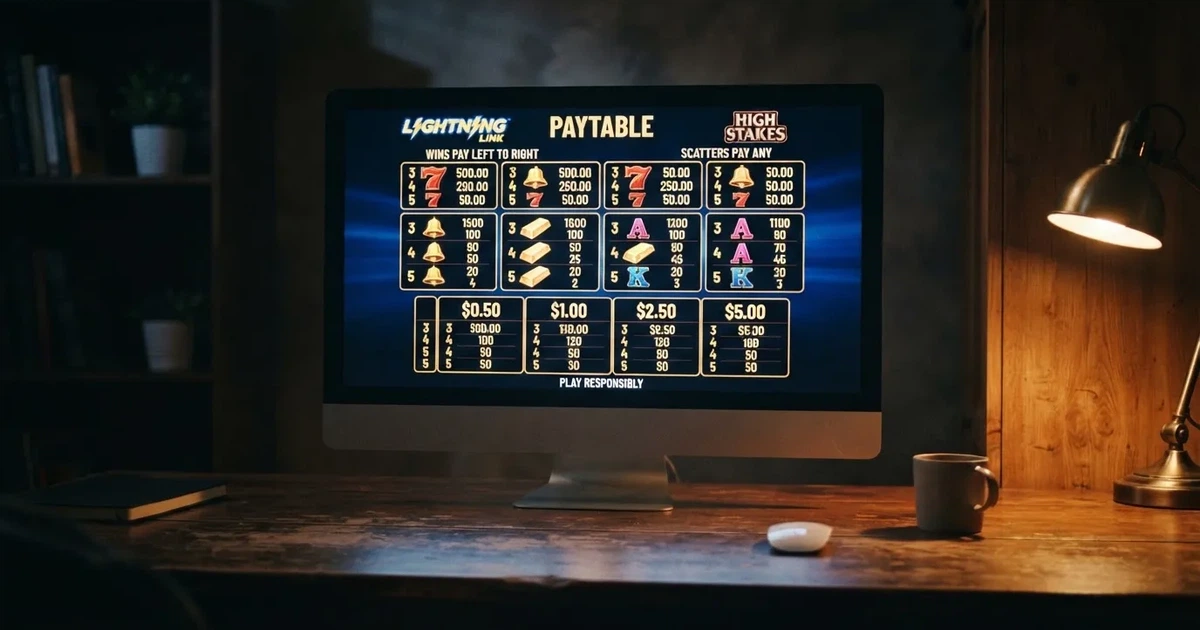
Every state and territory gaming regulator requires the return-to-player to be disclosed on the machine itself, on the game’s help screen or in a paytable accessible to the player. The disclosure is a condition of the game’s approval, not an optional courtesy. A licensed Australian pokie will tell you its RTP if you ask it to.
An offshore site advertising a 97% pokie has no such requirement. The figure sits on a marketing page because the operator chose to print it, not because a regulator required it, and there is no Australian body to complain to if the game behind the banner actually runs lower. Independent testing laboratories audit these figures for some operators, but the player on the other end has no way to verify the certificate from the lobby.
What the Interactive Gambling Act actually prohibits
The Interactive Gambling Act 2001, tightened by the Interactive Gambling Amendment Act 2017, makes it an offence to provide online casino games — including online pokies — to a person physically in Australia. No state or territory licenses them. The minimum age for any licensed gambling product is 18.
What is licensed is wagering on races and sport placed before the event, lotteries and keno. In practice, wagering is licensed by the Northern Territory, where the Northern Territory Racing and Wagering Commission oversees 52 online bookmakers — Sportsbet, Bet365 and Ladbrokes among them — from a commission that meets once a month in Darwin and has no full-time staff. The arrangement exists for tax reasons, not because the Northern Territory is the natural regulator of national wagering; the result is that the same Territory body approves every major Australian-licensed sportsbook.
Enforcement under the IGA targets the provider, not the player. The ACMA investigates complaints, issues formal warnings and can direct Australian internet service providers to block illegal sites. As of a round reported on 26 June 2026, the ACMA had asked ISPs to block 1,751 illegal gambling and affiliate websites since the first blocking request in November 2019, and more than 230 unlicensed gambling services had left the Australian market since enforcement was strengthened in 2017. The same round added 12 more domains to the block list: 7Signs, ChromaBet, Donbet, Duospin, Freshbet, Slots Gem, Jacks Club, Lucky Start, Pointsbetz, Spinrise, Vinyl Casino and Wildsino.
A blocked site is not a closed site. A punter who funds an account before a blocking order can find themselves with a balance they cannot withdraw, because there is no Australian complaints body to approach and no Australian consumer law to fall back on. The blocking regime assumes the provider honours outstanding balances in good faith; in practice, that is not something the IGA can enforce.
What an offshore operator cannot offer the player
Three protections a punter at a Crown table takes for granted simply do not exist offshore. There is no Australian dispute resolution body the player can lodge a complaint with. There is no requirement for the operator to keep customer funds in segregated accounts. And there is no Australian consumer protection law that applies once the money has left the country. The site’s licence — typically Curaçao or Anjouan — sits in a jurisdiction the ACMA has no relationship with.
The Interactive Gambling Amendment (Gambling Reform) Bill 2026 passed Parliament on 19 August 2026. Its advertising and inducement measures commence on 1 January 2027, which means the law is on the books but not yet in force on a page read this year. From 2027 the rules around how licensed wagering services advertise — bonus offers, sign-up inducements, the language used to describe odds — tighten in ways that will not change what an offshore casino can do, because the offshore casino was already operating outside the regime.
Payments and what they reveal
The payment methods a site asks for are the single clearest signal of where it sits in the regulatory frame. From 11 June 2024, credit cards, credit-related products and digital currency are banned as payment for licensed online wagering in Australia, with penalties up to A$247,500 for operators that take them. The legal deposit routes for a licensed wagering service are debit card, bank transfer, PayID/Osko and BPAY. A site asking for a credit card or a crypto deposit is, by definition, not an Australian-licensed wagering service.
This matters more for pokies than for sports. An offshore casino offering online pokies to Australians will almost always route payments through crypto, a foreign debit card processor or a fintech intermediary — because the Australian banks will not process a transaction they recognise as going to an unlicensed interactive gambling service. The payment rail is a fingerprint.
What responsible gambling support actually looks like
BetStop, the National Self-Exclusion Register, has been live since August 2023. It binds Australian-licensed online and phone wagering services, which means an offshore casino is not connected to it — self-excluding through BetStop stops the licensed bookmakers from accepting the punter’s bets but does nothing about the offshore casino still taking them. That asymmetry is a feature of how the IGA is structured, not a bug: there is no licensed Australian online pokie to exclude from.
The National Gambling Helpline is 1800 858 858, free and staffed around the clock. Chat support is available through Gambling Help Online. State and territory self-exclusion registers — separate schemes in New South Wales, Victoria, Queensland and the others — apply to the licensed land-based venues and to licensed clubs and hotels. A punter who has excluded themselves from Crown Melbourne’s gaming floor cannot be served at the cashier, but the same person can sit at home and open an offshore casino account within minutes.
For anyone reading this page because the cost of pokies is becoming a problem, the helpline is the first call. BetStop enrolment is the first formal step. The land-based self-exclusion register for the punter’s state is the third. None of these touch offshore sites, and a problem gambler who is only playing offshore has a narrower set of Australian tools to lean on than one who is playing in pubs and clubs.
The volume of pokies play that sits behind the RTP figure
In 2020–21 Australians bet almost A$150 billion through gaming machines and lost A$12.18 billion on them. Australia hosts about 3% of the world’s pub and club poker machines with roughly 0.3% of the global population — the highest density of poker machines per capita in the world, by a margin wide enough that no other country is close. The figure is the headline that makes any conversation about RTP a conversation about scale: a difference of three percentage points in return-to-player across the national machine stock represents hundreds of millions of dollars a year in additional player losses, before considering any individual machine.
The state breakdown is uneven. New South Wales had 87,298 gaming machines outside casinos across 2,195 venues in June 2023, with player losses of A$8.18 billion in 2022–23 — that single state accounts for more machine losses than every other state combined. Queensland had 21,122 machines in 351 venues in October 2023. Victoria had 26,380 outside Crown Casino across 488 venues in 2021–22, sitting under a hard statewide cap of 30,000. Western Australia, by deliberate policy, has its roughly 2,500 machines concentrated at Crown Perth.
How offshore sit between them
H2 Gambling Capital’s 2025 estimate puts annual Australian losses to illegal offshore gambling sites at about A$3.9 billion. The share of gambling going through legal Australian channels fell from 74% in 2021 to 64% by the time the report was compiled, meaning the offshore growth has come at the expense of the regulated market rather than displacing it. The figure does not break out pokies losses from sports wagering losses, and the offshore operators offering both do not keep separate ledgers that anyone outside the company can audit.
The A$3.9 billion estimate is what an offshore pokie site is competing for. A regulated Australian pub machine pays out at 85% to 90% minimum, returns its winnings in Australian dollars through Australian banking, and is overseen by a state regulator the punter can write to. The offshore site offers a higher printed RTP, takes payment in crypto or foreign debit rails, and answers to no one in Australia. The two are substitutes only in the sense that they both accept bets from the same person.
What an RTP shortlist actually compares
A list of “best RTP pokies Australia” can be assembled in three ways, and the choice between them matters because the answer it produces is different each time. The first way is to take the highest-RTP titles from a single licensed Australian venue and rank them by return-to-player figure. This produces an honest, jurisdictionally specific answer that the punter can act on by walking into that venue. The second way is to take the highest-RTP online slot games available through offshore casinos and rank them by the figures those casinos publish. This produces a marketing artefact that bears little relation to what an Australian player can actually access legally. The third way is to average across an offshore lobby and present the result as a benchmark. This produces a number with no meaning at all.
This page covers the first category, with the second category addressed as a regulatory problem rather than a comparison. The titles that sit at the top of any licensed Australian pokie list — Aristocrat’s Lightning Link, IGT’s Wheel of Fortune variants, certain Ainsworth titles — are not available online to Australians through any legal channel. The closest equivalent on an offshore lobby is a different game with the same name but a different math model, because the licensing arrangement that lets the game exist online is a different arrangement from the one that lets it run on a pub floor.
The criteria that actually separate one option from another
Five criteria carry the comparison once the jurisdictional question is settled. Return-to-player, the long-run cost per spin, is the first. Volatility is the second — how the wins are distributed around the average. Hit frequency, the share of spins that produce any return at all, is the third. The fourth is the maximum line credit or max bet the venue allows, which can compress the effective RTP if the math model rewards higher bets. The fifth is the venue itself — its location, its opening hours, its self-exclusion arrangements and whether it offers player card tracking that lets the punter see their own session data.
A shortlist that does not include the venue as a criterion is a shortlist built for the offshore lobby, not the pub. A high-RTP pokie at a venue three hours from the punter’s home that does not open until 5pm is a different proposition from a slightly lower-RTP pokie at the local club that opens at 10am. Distance and accessibility are part of the cost of playing, and they are rarely in the marketing.
The ACMA’s published record against offshore brands
The ACMA has issued formal warnings under the Interactive Gambling Act 2001 against every brand reviewed below. Each operator on this list has been the subject of a regulator-issued notice naming it for offering prohibited online casino services to Australians. The set is not a recommendation. It is the regulator’s own list of brands that have run afoul of the law, and a punter comparing what is on offer should read it as a record of who has been caught, not as a comparison of value.
| Brand | ACMA action and date | Operator named by the ACMA | Subject support |
|---|---|---|---|
| RocketPlay | Formal warning March 2026; earlier Dama N.V., May 2022 | Pulsup Ltd (Rocketplay); earlier Dama N.V. | — |
| Level Up Casino | Formal warning May 2022 | Dama N.V. | Listed by provider pages only |
| Woo Casino | Formal warning March 2025 | Dama N.V. | — |
| Spirit Casino | Formal warning May 2025 | Dama N.V. | — |
| National Casino | Formal warning July 2025 | Consolutetish S.R.L. | Listed by reference works only |
| Bizzo Casino | Formal warning July 2025; earlier TechSolutions, 2022 | Consolutetish S.R.L.; earlier TechSolutions Group | — |
| Ignition Casino | Formal warning July 2025 | Bamboo Media | — |
| Instant Casino | Formal warning February 2025 | EOD Code SRL | — |
| Jackbit | Formal warning April 2026 | Ryker B.V. | — |
| Casino Intense | Formal warning April 2025 | Sterplay Holding Ltd | Listed by reference works only |
| Sky Crown | Formal warning, ACMA record | Hollycorn N.V. | — |
The volume of action against a single corporate group is the story the table tells at a glance. Dama N.V. appears four times across this set — Level Up, Woo, Spirit, and an earlier RocketPlay warning — under three different brand names. The group has been on the ACMA’s published register across four separate formal-warning rounds between 2022 and 2026. A punter treating each brand as an independent operator is not looking at four operators; they are looking at one operator operating four brands.
RocketPlay
Pulsup Ltd received a formal warning in March 2026 for offering Rocketplay to Australian customers, on top of an earlier Dama N.V. warning in May 2022 that covered the brand under the previous operating entity. The site is among the offshore operators the ACMA has acted against more than once, which is a meaningful distinction given that the regulator’s enforcement is selective and the cost of issuing a formal warning is not trivial. A punter who arrived at the brand through an affiliate link in 2026 has arrived at the same destination the regulator told the previous operator to stop offering.
Level Up Casino
Dama N.V. was issued a formal warning covering Level Up Casino in May 2022 as part of a six-brand notice. Provider pages list some of Level Up’s content under their own portfolio — the “listings-only” qualifier the regulator’s record carries means the pokies on offer can be named from the provider’s catalogue without anyone having verified that the RTP figures printed next to them are what the games actually return. The brand sits inside the Dama N.V. group, alongside the three other brands on this list.
Woo Casino
The ACMA issued a further formal warning to Dama N.V. over Woo Casino in March 2025, more than two years after the original 2022 notice covering six Dama brands. A second warning for the same operator group, on the same set of prohibited services, is the regulator telling the corporate group the 2022 message did not land.
Spirit Casino
The ACMA’s May 2025 formal warning to Dama N.V. covered Spirit Casino alongside Woo Casino. The pair of 2025 warnings reflects the same pattern: the corporate group did not adjust its offering to Australian customers after the 2022 notice, and the regulator acted again two-and-a-half years later.
National Casino
Consolutetish S.R.L. received a formal warning in July 2025 covering National Casino and Bizzo Casino. Reference works list National Casino among operators offering a particular set of providers, but no verified RTP figures for the titles on the site have been published by an independent testing laboratory through the regulator’s own channels. The figure next to any title on the site is the operator’s own claim.
Bizzo Casino
Consolutetish S.R.L. was issued the July 2025 warning covering Bizzo Casino. TechSolutions (CY) Group Limited and TechSolutions Group N.V. had already received a formal warning over Bizzo Casino in 2022. The brand has changed operating entities and the regulator has chased it across both. A punter landing on the site in 2026 is landing on the third entity to operate it under that name, with two prior formal warnings on the regulator’s record.
Ignition Casino
Bamboo Media received a formal warning in July 2025 over Ignition Casino. Ignition has historically been marketed to Australian and New Zealand audiences through affiliate channels; the ACMA notice in 2025 was the formal record of what those channels had been doing.
Instant Casino
EOD Code SRL received a formal warning in February 2025 over Instant Casino. The brand markets heavily on “fast payout” language that is unverifiable from outside the operator’s own terms page — there is no Australian regulator to escalate a complaint to if a withdrawal is refused, and the Curaçao licence the brand displays sits outside the ACMA’s reach.
Jackbit
Ryker B.V. received a formal warning in April 2026 covering Jackbit and CasinOK. The April 2026 date places the warning inside the most recent enforcement window the regulator has published, and the brand is on the published list alongside a sister site that was caught in the same round.
Casino Intense
Sterplay Holding Ltd received a formal warning in April 2025 over Casino Intense. Reference works and a regulator publication list the brand; the operator has not been the subject of further action through the same enforcement channel in the year since the warning.
Sky Crown
Hollycorn N.V. was issued a formal warning covering Sky Crown and Blue Leo, published in September 2022. The brand’s RTPs and game catalogue are the operator’s own statements; the ACMA’s notice is on the public record and a punter landing on Sky Crown has landed on a site the regulator has told the operator to stop offering to Australians.
The blocking rate as a regulator-level signal
The ACMA’s blocking requests have moved from a single-digit cadence in 2019–2020 to a sustained monthly tempo by 2026. Between the first blocking request in November 2019 and the round reported on 26 June 2026, the regulator directed ISPs to block 1,751 illegal gambling and affiliate websites, averaging out to roughly 260 blocks a year over the six-and-a-half-year window — though the pace is not even across the period, with the early years carrying lighter volume and the most recent two years carrying substantially more. The 12 sites added in the 26 June 2026 round alone represent a single blocking tranche, not the annual total.
A blocking request is the regulator’s enforcement tool of last resort. Before a blocking direction goes out, the ACMA issues formal warnings, gives the operator an opportunity to comply, and only escalates to blocking when the operator does not adjust its offering. The fact that a brand has reached the blocking stage means it has already been warned, has already been given the chance to comply, and has not. The blocking round reported in June 2026 closed out the formal-warning pipeline that began with the warnings issued in 2025 to the Dama, Consolutetish and Sterplay groups. Every brand on this page sits somewhere on that pipeline.
The mechanics of an RTP claim worth interrogating
A 97% RTP printed on an offshore banner is not a regulator-required disclosure. It is a marketing claim that may or may not be backed by a certificate from a testing laboratory, and the punter has no way to verify it from the lobby. The laboratories that audit slot math — GLI, eCOGRA, BMM Testlabs — publish certificates for individual titles when those titles are submitted to them, and the certificate sits on the operator’s site if the operator chooses to display it. A site that does not display a current certificate for the title you are about to play has not, from where you sit, had its RTP independently verified in a way you can check.
The licensed Australian pokie is the inverse. The state gaming regulator’s approval process includes the RTP figure as a condition of approval; the figure sits on the help screen; the venue cannot legally change the setting without notifying the regulator. A venue operator who adjusts the RTP of a machine without approval is committing a regulatory breach that carries penalties, not a marketing choice with no consequence.
This is the asymmetry a “best RTP pokies” comparison hides when it treats the licensed venue and the offshore lobby as comparable sources. They are not comparable. One is a regulated disclosure backed by an approval the regulator can revoke; the other is a number on a web page that no one outside the operator has any obligation to verify.
Volatility and what it does to the RTP number
Two games can both return 96% and feel like entirely different propositions. A low-volatility game pays out often in small amounts — many A$1 to A$5 wins on A$1 spins, with the rare larger hit. A high-volatility game pays out rarely in large amounts — long stretches of nothing, punctuated by occasional A$50, A$100 or larger returns. The average is the same; the experience is not.
A punter with a small bankroll tends to do better on a lower-volatility game even if the RTP is marginally lower, because the bankroll survives longer and the punter sees more of the game. A punter chasing a feature jackpot tends to prefer high volatility for the upside, accepting the longer dry stretches as the cost of the larger payoff. The RTP number alone does not tell either punter which game suits them; volatility is the second axis the comparison needs.
Hit frequency as the third axis
Hit frequency is the share of spins that produce any return at all — typically between 15% and 40% for a modern slot. A 30% hit frequency means three in ten spins return something, two in seven return nothing. Hit frequency sits between RTP and volatility: a game with high RTP and high hit frequency is the cheapest per spin in expectation, because the bankroll stays roughly flat; a game with high RTP and low hit frequency is the same expected cost per spin but with a far bumpier ride.
How bet sizing interacts with RTP
Some licensed and offshore games carry a “max bet” RTP boost: the game returns a higher percentage when the punter bets the maximum number of lines or the maximum credit per line. A 92% RTP at one credit per line can climb to 96% at five credits per line. The shape of this curve is part of the math model and is disclosed in the paytable on a licensed Australian pokie. On an offshore game, the disclosure depends on the operator.
The implication for the punter is straightforward: at a licensed Australian pokie, the paytable tells you what you are buying at each bet level. At an offshore site, the same paytable may or may not be present, and the operator’s word on what the maximum-bet return is cannot be verified.
Why the offshore lobby advertises RTP figures the licensed venue does not
An offshore casino’s RTP banner is doing a job that is not being done at the licensed venue. At the licensed venue, the regulator’s approval process means the punter can find out the RTP from the machine, and the venue has no commercial reason to print it on a poster at the entrance. At the offshore casino, the regulator’s prohibition means the punter cannot play the game at all under Australian law, and the operator’s commercial incentive to advertise what the punter is missing is correspondingly large.
The banner exists because the offer is illegal. That is not a rhetorical flourish — it is the causal mechanism. A licensed Australian venue does not need to advertise its RTP because the punter can play the game and read it from the machine. An offshore operator needs to advertise because the punter cannot play, and the banner is the closest substitute the operator can provide while still being prohibited from offering the actual game.
Where this leaves the punter choosing between a licensed machine and an offshore site
Three considerations are worth weighing explicitly. The first is legal exposure for the provider rather than the player: an Australian punter playing an offshore pokie is not committing an offence, but the operator offering the game is, and the block list the ACMA maintains is the consequence on the operator’s side. The second is the absence of recourse: a dispute with an offshore operator has no Australian complaints body to escalate to, no segregated client funds requirement, and no consumer law to fall back on. The third is the RTP figure itself: a 97% figure on an offshore banner is the operator’s claim, not a regulator’s disclosure, and the figure is sitting on a site the ACMA has either warned or blocked.
The licensed Australian machine sits at 85% to 90% RTP, returns winnings in Australian dollars through Australian banking, and is overseen by a state regulator the punter can write to. The offshore machine sits at a higher printed RTP, takes payment in rails the Australian banks will not process for licensed wagering, and is overseen by a regulator in another country. The two are not substitutes for one another, and a comparison that treats them as such produces an answer that is technically true and practically misleading.
What the licensed venue can offer that the offshore site cannot
Player card tracking is the most concrete difference. Crown’s loyalty programme and the equivalent schemes at the major state-licensed clubs let a punter see their own session data — how much they bet, how long they played, what they lost. That data is the single most useful input into a personal decision about whether the cost of pokies is becoming a problem, and it is data the offshore site does not provide. The punter playing at home on an offshore site does not have a player card, does not have a session review, and does not have the venue’s intervention triggers — the staff member who notices a punter has been at the machine for six hours and asks if they want a break. None of those supports exist offshore, and the offshore operator has no incentive to build them because they would reduce the operator’s revenue.
What a high-RTP punter at a licensed venue actually does
The practical answer is to play the games at the higher end of the venue’s approved RTP range, at a bet size that does not activate the max-bet-only bonus features the punter cannot afford, and to use the venue’s player card to track every session. The combination of a higher-RTP title with disciplined bet sizing and session tracking produces the lowest cost per spin available to an Australian punter playing legally. It is not a route to winning — the house edge is the house edge — but it is the lowest-cost route to playing, and the only route that sits inside Australian consumer protection law.
Frequently asked questions about high-RTP pokies in Australia
What counts as a “high” RTP figure on an Australian pokies machine?
A licensed Australian machine returns between 85% and 90% minimum by law, depending on the state. Within that range, a machine at 90% in Western Australia or at 87.5% in South Australia is at the floor of its jurisdiction, not a “high” figure — the relative high point on the licensed market is a title whose RTP sits well above the floor, often 94% to 96% or higher, depending on the venue’s approval. Anything claiming 97% or higher and accessible only through an offshore site is not a comparable proposition because the figure is not regulator-disclosed.
Is RTP the same thing as the chance of winning on any single spin?
No. Return-to-player is the share of money returned across a very large number of spins — millions, not dozens. On any single spin, the chance of any return at all is governed by the hit frequency, which is a separate figure typically between 15% and 40%. A 96% RTP machine with a 30% hit frequency still has a 70% chance of returning nothing on any given spin, regardless of what has happened on the spins before.
Where is a pokies machine’s RTP figure legally required to be disclosed in Australia?
Every state and territory gaming regulator requires the RTP to be disclosed on the machine’s help screen or paytable, as a condition of the game’s approval. The figure is not on a marketing poster or on a website — it is on the machine itself, accessible to the player before they bet. An offshore site has no equivalent requirement; any figure it displays is the operator’s voluntary disclosure, not a regulator’s mandate.
Can a venue change a machine’s RTP setting after it is installed?
Not without notifying the state gaming regulator. Adjusting the RTP of a licensed machine without approval is a regulatory breach, not a routine maintenance task. The approval process that put the machine on the floor in the first place specifies the RTP setting, and changing the setting without re-approval invalidates the approval. Offshore operators have no equivalent constraint, which is one reason their figures cannot be verified.
Does a high RTP figure mean smaller or larger individual wins?
Neither, directly. RTP and volatility are independent variables. Two games with identical 95% RTP can have entirely different win distributions — one paying out frequently in small amounts, the other rarely in large amounts. A punter chasing feature jackpots is choosing volatility; a punter managing a bankroll is choosing the same axis. The RTP number flattens both into a single average, and reading it without considering volatility is the most common interpretive error in the marketing.
How does the number of pokies machines vary between Australian states?
New South Wales carries the bulk of the national machine stock, with 87,298 machines outside casinos across 2,195 venues as of June 2023. Victoria has 26,380 outside Crown Casino across 488 venues, sitting under a statewide cap of 30,000. Queensland has 21,122 across 351 venues. Western Australia, by deliberate policy, has its roughly 2,500 machines concentrated at Crown Perth after the state banned poker machines in pubs and clubs in 1985. Tasmania ended the Federal Group’s monopoly in 2021 and now regulates its machines through the Tasmanian Liquor and Gaming Commission.