
Top Welcome Sign Up Bonuses at Australian Online Casinos
The phrase “best casino sign-up bonus Australia” promises a ranking. There is no honest one to give. Online casino games and online pokies cannot be licensed anywhere in Australia under the Interactive Gambling Act 2001; every brand the ACMA has formally warned since 2017 has been warned precisely for offering those services to Australians. A bonus number, free-spins tally or “no deposit required” line in front of that fact does not become a deal — it becomes the entry point to an offshore site the regulator can block mid-session. This page is written from that position. It sets out the law, the ACMA’s enforcement record, what the offshore market actually looks like in dollars, and what a person in Australia can lawfully do instead.

Currency: figures current as of 29 October 2026, verified against the ACMA’s formal-warning register and its published blocking lists.
Table of Contents
- Comparing the Best Casino Sign Up Bonuses in Australia
- How the ACMA acts: blocking, warnings, the running total
- What “no-deposit” means on a prohibited site
- Responsible play in a market that is largely unregulated offshore
- Crypto and digital wallets: the deposit route the law does not allow for licensed wagering
- Apple Pay, Google Pay and the credit-card ban
- The shelf of brands the ACMA has named
- A closer look at the brands the ACMA has warned
- The arithmetic behind the blocking rate
- What a person in Australia can lawfully do instead
- A note on tax and on winnings
- What a reader comparing offers can take from the page
- Frequently asked questions
Comparing the Best Casino Sign Up Bonuses in Australia
The Interactive Gambling Act 2001 (IGA), tightened in 2017 and amended again in 2023, makes it an offence to provide a prohibited interactive gambling service to anyone physically in Australia. The prohibited class covers online casino games, online pokies and in-play betting on sport. What is licensable is wagering on racing and pre-event sport, lotteries and keno. The minimum age for any of it is 18. Online casino is not licensed federally and not licensed by any state or territory — including the Northern Territory, which sits behind 52 of Australia’s online bookmakers (Sportsbet, Bet365, Ladbrokes among them) but only because wagering, not casino, falls inside its remit.
The distinction matters for the page’s subject. A “sign-up bonus” is a promotional inducement tied to creating an account, often to a first deposit and sometimes to no deposit at all. Inducements of that kind are not in themselves unlawful; what is unlawful is the operator attaching them to an unlicensed casino product aimed at Australians. The IGA targets the provider, not the player. No Australian has been prosecuted for placing a bet. The provider faces civil penalties and, where it persists, blocking at the network level by Australian internet service providers acting on ACMA direction.

A 2026 reform sits on top of that frame. The Interactive Gambling Amendment (Gambling Reform) Bill 2026 passed Parliament on 19 August 2026 and brings new advertising and inducement measures into force on 1 January 2027. The bill tightens what licensed wagering operators can put in front of Australians — the inducement side, the very thing this page is named for — but it does not legalise online casino, and it is not yet operative on a 2026 page. Treat it as law with a start date, not as law in force.
How the ACMA acts: blocking, warnings, the running total
The ACMA’s tools are formal warnings and blocking requests. A formal warning is a public step on the regulator’s own register, naming the operator company and the brand, and is the trigger for the eventual blocking request that goes to Australian ISPs. The blocking tool is the heavier instrument: under section 313 of the Telecommunications Act 1997, the ACMA can ask ISPs to make a domain unreachable from Australia, and the ISPs comply.
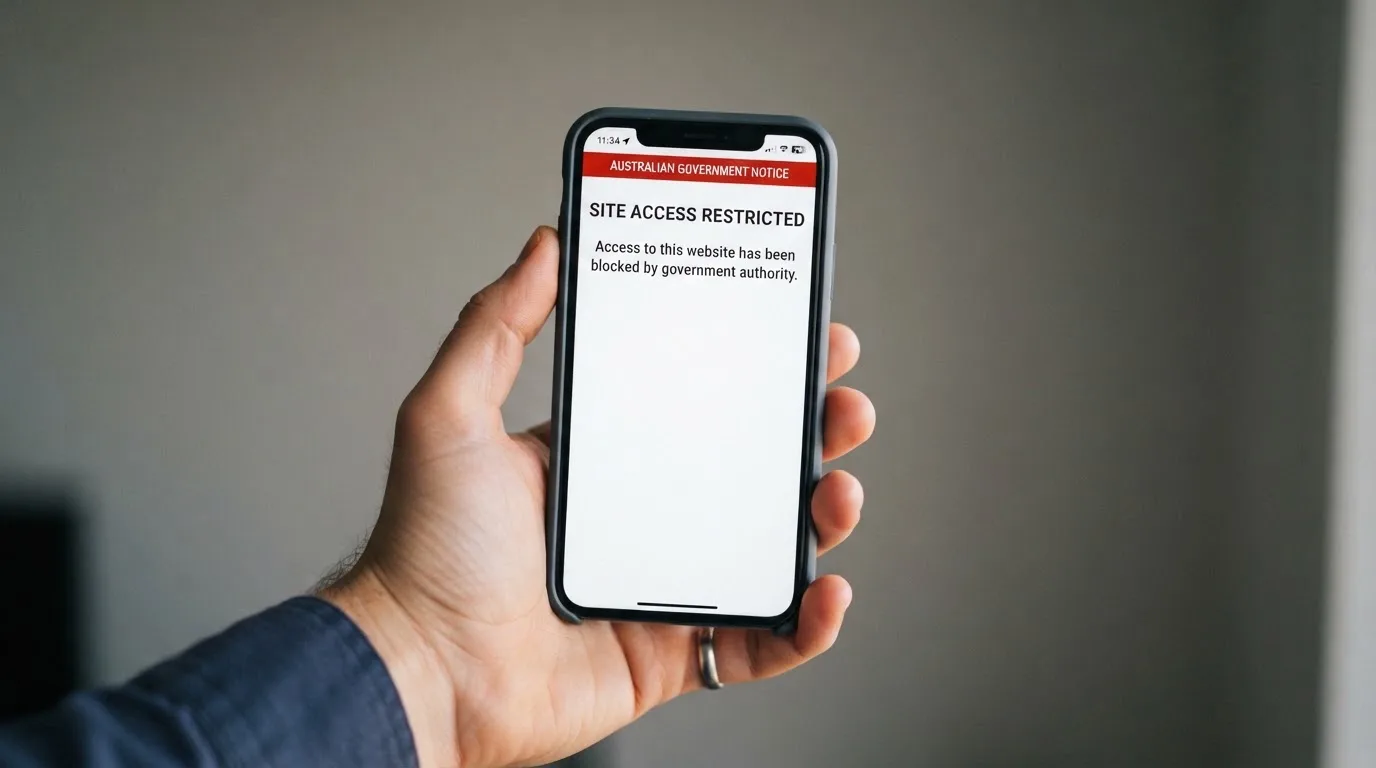
The running total is large and recently accelerating. As reported in June 2026, the ACMA had asked Australian ISPs to block 1,751 illegal gambling and affiliate marketing websites since the first blocking request in November 2019, and more than 230 unlicensed gambling services had left the Australian market since enforcement was strengthened in 2017. A single June 2026 round alone added twelve more domains: 7Signs, ChromaBet, Donbet, Duospin, Freshbet, Slots Gem, Jacks Club, Lucky Start, Pointsbetz, Spinrise, Vinyl Casino and Wildsino. The rate is the wrong way around to call this a passing enforcement push.
The pattern in the warnings tells the same story. The ACMA tends to act against the operator company behind several brands at once, because the same corporate wrapper fronts multiple sites. Dama N.V. alone took a May 2022 warning covering six casino brands — Bambet, Dazard, Level Up, Rocketplay, Wild Tornado and Cobra Casinos — and then a March 2025 warning over Woo Casino and a May 2025 warning over Spirit Casino. Consolutetish S.R.L. took a July 2025 warning over both National Casino and Bizzo Casino. Bamboo Media drew a July 2025 warning over Ignition Casino. EOD Code SRL drew a February 2025 warning over Instant Casino. Ryker B.V. drew an April 2026 warning over Jackbit and CasinOK. Sterplay Holding Ltd drew an April 2025 warning over Casino Intense. Hollycorn N.V. drew an earlier warning over Sky Crown and Blue Leo. Pulsup Ltd took a March 2026 warning over Rocketplay.
Two things follow from that pattern. First, a brand name on a casino site is not a guide to the company behind it, and the company is what the regulator actually moves against. Second, the operators who keep re-entering under new wrappers do so because the Australian market is profitable enough to justify the cost of being warned and then blocked: H2 Gambling Capital’s 2025 report puts Australians’ losses to illegal gambling sites at roughly A$3.9 billion a year, and estimates the share of gambling going through legal channels fell from 74% in 2021 to 64%.
What “no-deposit” means on a prohibited site
The “no-deposit” or “no deposit required” sign-up bonus is the offer that hooks the most players with the least skin in the game. In a regulated market it means exactly what it says: the operator credits a small cash or free-spins balance on registration, before the player has staked anything. In an offshore context aimed at Australians, the same wording sits on top of an unlicensed service. The wagering requirement — the turnover multiple the bonus must be played through before any winnings become withdrawable — tends to be high, the eligible games narrow, the maximum stake per spin capped low, and the maximum cashout cap sharply limited. None of those terms is unlawful in itself; each is a normal feature of the product worldwide. What makes the package unlawful is the offer being addressed to Australians at all.
The mechanics do not change just because the operator is offshore. A bonus of A$10 wagered at 40× requires A$400 of turnover before withdrawal. A house edge of 3% to 5% on the eligible slots means A$12 to A$20 of expected loss before the bonus is “cleared”. The marketing line is “free A$10”; the arithmetic is a small bonus against a much larger required play. That is the shape of the offer, on every site that runs one — and the page does not need a single working bonus code to show it.
Responsible play in a market that is largely unregulated offshore
Player protection in Australia runs through two routes, and the offshore sign-up bonus sits inside neither.
The first is BetStop, the National Self-Exclusion Register. Live since August 2023, BetStop lets a person exclude themselves from every Australian-licensed online and phone wagering service at once, for a chosen period from three months up to lifetime. A registered exclusion is enforced across every operator connected to the register — they cannot open an account, take a deposit or accept a bet from the excluded person. The catch is the word “licensed”: BetStop binds Australian-licensed services. An offshore casino is not connected to it. Self-excluding through BetStop does not stop the offshore sign-up offer from arriving.
The second is the bank-level gambling block. Australia’s major banks now offer card-level or app-level gambling transaction blocks. Westpac’s gambling block refuses authorisation of transactions registered under the merchant category code “Betting/Casino Gambling” on eligible personal credit and debit cards. ANZ’s gambling block, activated in the ANZ app, blocks gambling transactions made through a digital wallet such as Apple Pay on an eligible card as well as on the card itself; turning the block off requires a 48-hour waiting period, and the bank warns that not all gambling transactions will be blocked and some non-gambling transactions might be blocked in error. Commonwealth Bank lets customers apply a gambling lock to eligible cards via the CommBank app, which automatically blocks most gambling transactions, though it carries the same caveat that not every gambling-related purchase will be stopped. These blocks work at the bank. They do not need the casino to know who the customer is, and they are the most reliable layer a person in Australia can put between themselves and an inducement they have decided to refuse.
The National Gambling Helpline 1800 858 858 is free, 24/7, and online chat is available through Gambling Help Online. The helpline is the route to counselling and to a referral that does take account of the offshore gap.
Crypto and digital wallets: the deposit route the law does not allow for licensed wagering
Crypto and anonymity cluster the page’s subject on the deposit side. Two separate questions sit inside it.
The first is whether a sign-up bonus can be claimed by depositing in cryptocurrency. Crypto casino and bitcoin casino sign-up bonuses exist in the global product, but the deposits that fund them — Bitcoin, Ethereum, USDT and the rest — run on rails the Interactive Gambling Act 2001 amendments of 2023 do not permit. Since 11 June 2024, Australian-licensed online wagering services cannot accept payment by credit card, by credit-related products, or by digital currency; penalties for licensed operators that breach the rule run up to A$247,500. The deposit rails the law does permit, for licensed wagering, are debit card, bank transfer, PayID/Osko and BPAY. A licensed site that asks an Australian for a credit card or for crypto is not following the Australian rules. An offshore site that asks an Australian for either is not licensed at all.
The second question is what the offshore sign-up bonus actually settles into, when the player wants to cash out. The same prohibition does not bind the offshore operator’s payout side, and the practical question becomes whether the money can be moved back to an Australian bank account at all, and how. Bank transfers on Australia’s New Payments Platform, with Osko by PayID, land in under a minute, 24/7 including weekends, at more than 100 Australian financial institutions; the platform itself became accessible to the public on 13 February 2018 and is owned by New Payments Platform Australia Ltd, whose 13 shareholders include the Reserve Bank of Australia and the country’s major banks. More than 25 million PayIDs were registered on the platform as of April 2025. Paying to a PayID shows the name of the account holder before the transfer is sent, and Australian Payments Plus warns that being asked to transfer money to a PayID on an illegal gambling site almost certainly means a scam site.
BPAY is a separate bill-payment service in online banking — the payer enters the Biller Code and Customer Reference Number on the bill. BPAY has operated since 1997, is available in the online banking of over 140 banks and financial institutions, and is offered by over 95,000 businesses. Since September 2021 it has sat under the same holding company as eftpos and the New Payments Platform — Australian Payments Plus. Like PayID, it is a legitimate Australian payment rail. It is not, however, a route around the offshore prohibition. AUSTRAC’s threshold-transaction reporting rule applies only to physical cash; ordinary electronic bank transfers are not subject to that per-transaction reporting requirement, regardless of amount, and that has nothing to say about whether the destination is lawful.
Apple Pay, Google Pay and the credit-card ban
A separately raised question, in the 2026 Australian context, is whether using Apple Pay on a debit card lets a person sidestep the credit-card ban on licensed wagering. The short answer is no.
Apple does not charge consumer fees for Apple Pay in stores, online or in apps; any surcharge on a transaction comes from the merchant’s own card-processing fees, not from Apple. Transaction limits and PIN requirements for Apple Pay purchases are set by the card issuer or the merchant, not by Apple itself. Those mechanics sit behind the relevant question for an Australian player, which is what the linked card is.
A debit card is permitted as a deposit route for licensed wagering; a credit card is not. If Apple Pay is funding the transaction from a credit card, the transaction is a credit-card transaction for the purposes of the IGA ban. ANZ’s gambling block, in any case, blocks gambling transactions made through a digital wallet such as Apple Pay on an eligible card, not just the physical card — meaning that the bank-level block covers the wallet route as well as the card route. Westpac’s and Commonwealth Bank’s blocks cover the same ground through the merchant code. The wallet is a payment device; the underlying funding source decides whether the transaction is lawful at a licensed wagering operator.
A separate datapoint on wallet share: by the end of 2025, Apple Pay, Google Pay and Samsung Pay transactions collectively accounted for around 45% of all card payments in Australia by number. The wallet is ordinary at the checkout; it does not become a route around the credit-card ban because the volume is high.
American Express sits outside that picture in a different way. The Reserve Bank of Australia’s July 2025 review proposes removing surcharges only on eftpos, Mastercard and Visa transactions, explicitly leaving American Express outside the scope of the proposed surcharge ban. Amex is also a three-party scheme — the issuer and the processor are the same company, unlike Visa and Mastercard’s four-party model — which is why it sits outside the surcharge conversation. None of that changes the credit-card ban for licensed wagering. Where an Amex product is a charge card rather than a credit card, it still sits outside the deposit methods the IGA permits for licensed Australian wagering operators.
The shelf of brands the ACMA has named
The brand list below is not a recommendation. It is a roster of operators the ACMA itself has acted against, with the date of the formal warning and the operator company the regulator named. Each entry is the page’s record of an enforcement step; each one is also a brand whose sign-up offer is being marketed to Australians despite that step. The reader can match these names against the offer that arrives by email, by social media advertisement, or by a search result.
The table below uses the article-language no-data marker — the em dash — where research carries no corresponding datum. Most cells in the “subject support” column are exactly that: the ACMA has acted, the offer exists, and the search the research performed did not produce an authoritative third-party record beyond the ACMA’s own naming.
| Brand | ACMA action and date | Operator named by the ACMA | Subject support |
|---|---|---|---|
| RocketPlay | Formal warning, March 2026 (Pulsup Ltd); earlier Dama N.V., May 2022 | Pulsup Ltd / Dama N.V. | Listings only — Gambling Insider |
| Level Up Casino | Formal warning, May 2022 | Dama N.V. | — |
| Woo Casino | Formal warning, March 2025 | Dama N.V. | — |
| Spirit Casino | Formal warning, May 2025 | Dama N.V. | — |
| National Casino | Formal warning, July 2025 | Consolutetish S.R.L. | Listings only — acma.gov.au, austrac.gov.au, betstop.gov.au |
| Bizzo Casino | Formal warning, July 2025 (earlier TechSolutions, 2022) | Consolutetish S.R.L. / TechSolutions | Listings only — Gambling Insider |
| Ignition Casino | Formal warning, July 2025 | Bamboo Media | — |
| Instant Casino | Formal warning, February 2025 | EOD Code SRL | Listings only — Ecopayz, PayID |
| Jackbit | Formal warning, April 2026 | Ryker B.V. | — |
| Casino Intense | Formal warning, April 2025 | Sterplay Holding Ltd | Listings only — austrac.gov.au, betstop.gov.au, Gambling Insider |
| Sky Crown | Formal warning, September 2022 | Hollycorn N.V. | — |
The pattern the table sets out shows the reality of the offshore market. Eleven brands; four operator companies behind seven of them; warnings running from 2022 through to April 2026 without a single one of those names falling out of the marketing pipeline. The brand is the front; the operator company is what the ACMA has its hand on.
A closer look at the brands the ACMA has warned
Each of the brands above carries the same regulatory status: the ACMA has formally warned the operator company for offering prohibited interactive gambling services to Australians, and online casino games cannot be licensed anywhere in Australia, whatever offshore licence the site displays. What differs is the size of the marketing footprint, the operator behind the brand, and the warning history. The writeups below treat them as a roster — not a ranking — and they each close on a verdict specific to that brand, not a sentence repeated down the page.
RocketPlay
The RocketPlay brand has drawn two ACMA actions, separated by four years. The first was a May 2022 warning to Dama N.V., in the same bundle that covered Bambet, Dazard, Level Up, Wild Tornado and Cobra Casinos. The second was a March 2026 warning to Pulsup Ltd specifically over Rocketplay.com.au. The fact that two different operator companies have fronted the same brand tells the reader how the offshore market works: the brand persists, the wrapper changes when the wrapper is exposed. The signal a reader can take from that is not that RocketPlay is a worse offender than the next name on the list; it is that the brand is a stable marketing surface, and that stability is precisely what the ACMA is acting against.
Rocketplay.com.au — the Australian-targeted domain on the second warning — is also the strongest single piece of evidence on this page that the operator knows its customer is in Australia. Domains are not accidents. The verdict for a reader comparing offers: the brand has been warned twice across two operators in four years, the second warning explicitly naming an Australian-targeted domain, and the same brand continues to surface in affiliate marketing to Australian players. The price of the sign-up offer is whatever it advertises; the price of dealing with an operator the regulator has named twice is the absence of any Australian consumer protection when a withdrawal is refused.
Level Up Casino
Level Up Casino sat inside the May 2022 Dama N.V. bundle — the same six-brand warning that named Rocketplay and Bambet. The brand is not named again in a separate ACMA action; what is named, across subsequent warnings, is the operator. Dama N.V. took the March 2025 warning over Woo Casino and the May 2025 warning over Spirit Casino. The reader looking at Level Up Casino is therefore not looking at a brand with one warning to its name; the reader is looking at one of the brands inside a portfolio the regulator has returned to three times in four years.
The verdict for a reader comparing offers: the brand is one of six inside a single operator’s portfolio, and the operator has been named in three separate ACMA actions across four years. The standing of the sign-up bonus is the standing of every other bonus on this page: an inducement attached to a prohibited product, marketed to Australians, with no Australian complaints body behind it.
Woo Casino
Woo Casino took a March 2025 ACMA warning to Dama N.V. — the second warning to that operator in four years, after the May 2022 six-brand bundle. Woo Casino was not named inside the earlier bundle; the 2025 notice marks the ACMA’s debut enforcement against this brand. The pattern is the same as RocketPlay’s at the operator level: the wrapper persists, the brand is rotated in, the regulator returns to the operator. This brand has a single ACMA action against it, but the operator behind it is a repeat visitor to the regulator’s register.
Spirit Casino
Spirit Casino took the May 2025 warning to Dama N.V. — the third warning to that operator, and the second in 2025 alone. Spirit Casino is not named in either the 2022 bundle or the Woo Casino warning; this 2025 enforcement step targets the brand directly. The reader who has looked at Woo Casino has read this paragraph in advance: the same operator, a fresh brand, a fresh sign-up offer, the same gap to Australian consumer protection. This brand is another rotation within the same operator’s portfolio, rather than a new or independent service.
National Casino
National Casino took the July 2025 warning to Consolutetish S.R.L., in the same notice that named Bizzo Casino. Bizzo Casino had already been the subject of a 2022 formal warning to TechSolutions (CY) Group Limited and TechSolutions Group N.V. — the second operator to front the same brand, on a roughly three-year cycle. National Casino’s earlier history does not include a separate ACMA action; the July 2025 warning is the first direct naming. The operator behind it is an experienced one, but the brand itself is a fresh entry on the register; the bonus offer, however, remains the same prohibited product.
Bizzo Casino
Bizzo Casino carries two warnings, the way RocketPlay does, but to a different pair of operators. The first was a 2022 warning to TechSolutions (CY) Group Limited and TechSolutions Group N.V. The second was the July 2025 warning to Consolutetish S.R.L., in the same notice that named National Casino. Three years, two wrappers, the same brand continuing to take Australian sign-ups in between. The verdict for a reader: this is the second two-wrapper brand on this roster. The brand’s persistence through a regulator-named change of operator is the strongest signal in this list that the inducement is a marketing budget, not a regulated product.
Ignition Casino
Ignition Casino took a July 2025 warning to Bamboo Media — the first direct naming of the brand in the ACMA’s register. Bamboo Media is not named in any of the other warnings on this page, which makes Ignition Casino a different case from the brands above: a brand with a single warning, to an operator that has not reappeared in subsequent rounds. The reader comparing the roster can treat that as either a sign of an operator less entrenched in the Australian market or a sign of a brand that simply has not yet drawn a second notice. This single-warning, single-operator profile does not change the brand’s legal status; the inducement is still attached to a prohibited product.
Instant Casino
Instant Casino took a February 2025 warning to EOD Code SRL. The brand is not named in any other ACMA action on this page, and EOD Code SRL is not named elsewhere. This notice initiated the regulator’s enforcement work on this brand. The shape is the same as every other brand here — single operator, single warning, prohibited product. Where Instant Casino differs is in the surface presentation: it is marketed aggressively to Australian players, and the warning was issued early enough in 2025 to leave the brand in the active marketing pipeline for most of the rest of that year. The reader who has seen the offer in their inbox has seen the same offer the ACMA has formally warned the operator about.
Jackbit
Jackbit took the April 2026 warning to Ryker B.V., in the same notice that named CasinOK. Neither brand is named in any earlier ACMA action, and Ryker B.V. is not named elsewhere on this page. The warning is the most recent of the 2026 actions, sitting one month after the March 2026 warning to Pulsup Ltd over Rocketplay.com.au. The verdict for a reader: a brand new to the regulator’s register, in the most recent enforcement round. The inducement is no different in shape from any other inducement on this page; the recency of the warning is the only new information.
Casino Intense
Casino Intense took the April 2025 warning to Sterplay Holding Ltd — the first direct naming of the brand in the ACMA’s register, and the only ACMA action against Sterplay Holding Ltd in the data this page draws on. The regulator issued its formal warning against the brand in April 2025. It sits alone as a single warning against a single operator, yet the prohibited nature of the underlying product remains unchanged, leaving Australian players without any form of local consumer protection.
Sky Crown
Sky Crown took the earlier warning to Hollycorn N.V. — published in September 2022 as a PDF notice covering Sky Crown and Blue Leo. The brand is not named in any subsequent ACMA action in the data on this page, and Hollycorn N.V. is not named in any other 2023 to 2026 warning here. The verdict for a reader: the oldest warning on this list, sitting on a brand that has not been re-named by the regulator in the years since. The fact that the warning is older does not weaken its legal effect; the prohibition does not lapse.
The arithmetic behind the blocking rate
The ACMA’s blocking tool is converting into unreachable domains at a steady rate. The numbers — 1,751 blocked sites as of June 2026, dating back to the first request in November 2019 — show the scale of the enforcement effort.
A working rate is 1,751 sites over roughly 79 months from November 2019 to June 2026. That gives an average of about 22 blocked sites per month, or roughly 265 per year, on a straight-line basis across the full window. The actual rate has not been straight. The June 2026 round alone added 12; earlier rounds have run at higher and lower volumes; enforcement strengthened in 2017 and the blocking tool came into use from late 2019. The honest band, given the inputs the page has, is roughly 250 to 300 blocked domains per year, with the caveat that early years ran lower and recent rounds higher. The figure that matters is not a single number; it is that the ACMA’s blocking list is being added to in real time, and the brand a reader sees in an offer today is one blocking request away from being unreachable tomorrow.
What a person in Australia can lawfully do instead
The lawful Australian gambling product sits in three places.
The first is licensed wagering — racing and pre-event sport — through bookmakers licensed by the Northern Territory Racing and Wagering Commission or by a state regulator, and therefore connected to BetStop, to the bank-level gambling blocks where the card is used, and to Australian consumer protection law. The 2026 reform bill adds inducement restrictions from 1 January 2027 to this product; today, the inducement rules around licensed wagering are the IGA’s existing framework.
The second is licensed land-based venues — pubs and clubs with pokies, and the casinos in each state and territory. The inducement structure is not the online sign-up bonus; it is the venue membership, the loyalty card and the on-site promotion.
The third is lotteries and keno, licensed in each state and territory, with age 18 as the entry threshold.
None of these is a “best casino sign-up bonus”. All of them are what the Interactive Gambling Act 2001 leaves standing.
A note on tax and on winnings
Gambling winnings of a recreational player in Australia are not assessable income. Section 6-5 of the Income Tax Assessment Act 1997 treats them as windfalls, not as income, and the Australian Taxation Office does not require them to be declared. Losses are likewise not deductible against other income. The carve-out is gambling as a business — a professional punter running a systematic betting operation as their trade — and that is the edge of the rule, not its centre. The model here is the ATO’s: a casual player does not declare winnings and does not claim losses, and a person whose gambling has become a business should check with the ATO or a tax adviser directly. Neither rule changes anything about whether a particular casino sign-up bonus is lawful; the tax treatment and the IGA’s prohibition are separate frames.
What a reader comparing offers can take from the page
The page’s subject is a sign-up bonus the law does not allow. The honest comparison is therefore not a ranking of bonuses; it is a comparison of the gap between what the marketing says and what the ACMA has done. Eleven brands, four operator companies, a blocking total in the four-digit range, and an enforcement pipeline that adds names every quarter. The “best” sign-up bonus in Australia in 2026 is the one that is not on an ACMA list — which means it is not on this page.
Frequently asked questions
What is the difference between a sign-up bonus and a no-deposit bonus?
A sign-up bonus is the umbrella term for any promotional credit attached to opening an account — it can require a deposit, or not. A no-deposit bonus is a sign-up bonus that funds the account before any deposit is made. In both cases the bonus carries wagering requirements, game restrictions and a maximum cashout cap, and the difference between them is the deposit step, not the underlying terms.
What does turnover, or wagering requirement, mean for a sign-up bonus?
Turnover is the total amount a player has to wager before bonus winnings become withdrawable. A A$10 bonus with a 40× wagering requirement means A$400 of bets placed on eligible games before withdrawal. The number is mechanical, not promotional — every offshore and licensed operator that publishes a bonus publishes the multiple alongside it.
Is it legal for an online casino to offer a sign-up bonus to players in Australia?
No. The Interactive Gambling Act 2001 prohibits offering online casino games and online pokies to anyone in Australia, and no state or territory licenses them. The prohibition targets the operator, not the player. A sign-up bonus attached to an offshore casino and addressed to Australians is the kind of inducement the ACMA has been issuing formal warnings over since 2017.
Can a sign-up bonus be claimed using a cryptocurrency deposit?
Crypto deposits are not a permitted funding method for Australian-licensed wagering since 11 June 2024, and online casino is not licensed in Australia at all. A bonus that takes Bitcoin or USDT is sitting on an offshore site outside the Australian framework, regardless of what the licence displayed at the bottom of the page says.
Why do sign-up bonus terms usually cap the maximum bet allowed?
A maximum-bet cap is a turnover-control mechanism: it stops a player from clearing a large wagering requirement in a single spin and walking away with the bonus converted to withdrawable cash. The cap is normal across the global industry, licensed or not, and is the kind of term a player reads before claiming rather than after.
What happens to an unused sign-up bonus if the wagering period expires?
The bonus and any winnings attributed to it are forfeited when the wagering window closes. The exact expiry window — 7 days, 30 days, 90 days — varies by operator and is stated in the bonus terms. Expiry windows are short for a reason, and treating a bonus as something to be played later is the most common way to lose it.