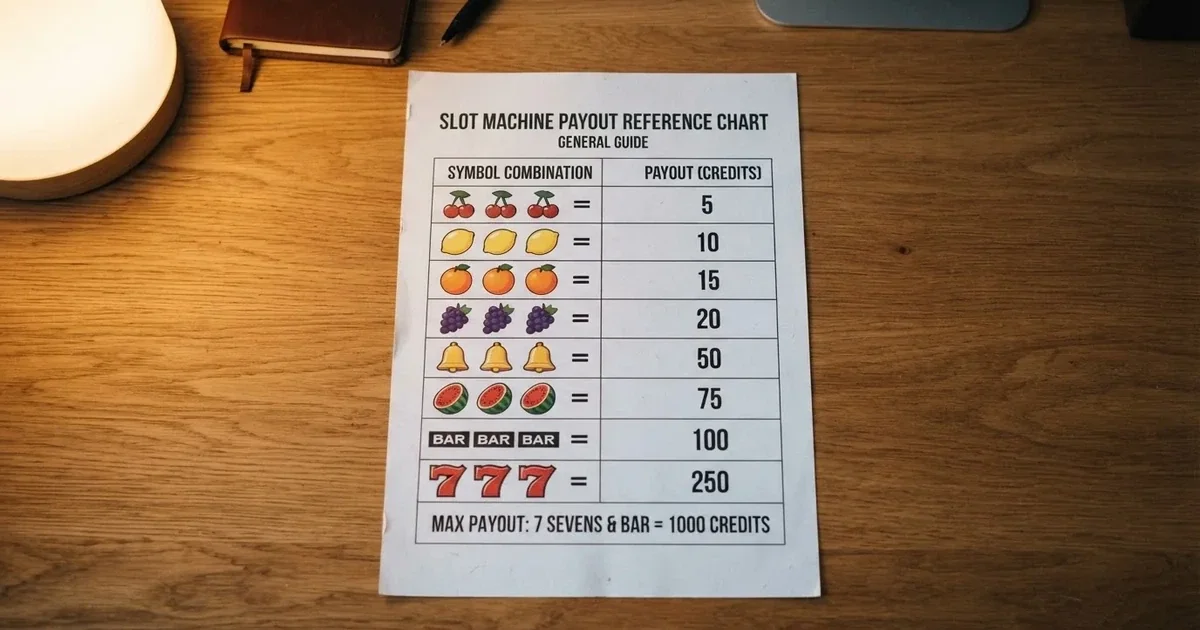
Best 5-reel slots in Australia in 2026: the format, the prohibition, and the price of the offshore route
 Available in US
Data current as of 23 September 2026, checked against the ACMA’s published formal warnings register and the Interactive Gambling Act 2001 (Cth).

A 5-reel slot is, on paper, one of the simpler casino formats: five spinning columns, a paytable, a line or two of matching symbols. In Australia the format exists. The legal way to play it, for real money, online, does not. The Interactive Gambling Act 2001 (IGA), tightened again by the Interactive Gambling Amendment Act 2017, makes it an offence to supply online casino games and online pokies to anyone in Australia — and no state or territory issues a licence for them. Every 5-reel slot a punter reaches over the internet arrives through an offshore operator outside Australian jurisdiction.
The page that follows is not a ranking of where to play. It is a read of what the landscape actually looks like in 2026: what the IGA does and doesn’t prohibit, what the Australian Communications and Media Authority (ACMA) has done about the offshore market since the first blocking request in November 2019, what the eleven brands on the ACMA’s own formal-warning list have in common, what a 5-reel slot’s paytable actually shows, and why the cost of “playing anyway” runs in two layers that the marketing never separates. The arithmetic at the centre of the page — the one the marketing never prints — works out how many of those offshore blocks the ACMA has issued, at the rate it has been issuing them, over the six-and-a-bit years since enforcement was given real teeth.
The page closes the way the topic itself closes: with the things a reader can act on (a self-exclusion register that does and doesn’t apply to them, a helpline that does, the ACMA register anyone can search), and the things they cannot (a way to make an offshore withdrawal legally enforceable inside Australia).
Table of Contents
- The legal frame: what the IGA actually prohibits
- Player protection: what helps an Australian punter, and what doesn’t
- Bonuses and free spins on offshore 5-reel slots: the offer, the terms behind it
- Five-reel slots as a format: what the paytable actually shows
- The eleven brands on the ACMA’s register: who they are, what the warning covers
- Where Australian 5-reel play does happen
- The wider context: what sits beside the 5-reel question
- Where this leaves a punter in Australia in 2026
- Frequently asked questions about 5-reel slots in Australia in 2026
The legal frame: what the IGA actually prohibits
The Interactive Gambling Act 2001 is short on definitions and long on consequence. Section 8 makes it an offence for a person to provide a “prohibited interactive gambling service” to a customer physically present in Australia; section 9 sets the parallel offence for the customer of an Australian-licensed wagering service using credit. The 2017 amendments broadened “prohibited” to cover online casino games, online pokies and in-play betting — three categories that, taken together, cover the full menu of a real-money online casino.

What remains licensable, in practice, is wagering on racing and sporting events placed before the event, lotteries and keno. The Northern Territory Racing and Wagering Commission (NTRWC) is the regulator that, for tax reasons, holds the bulk of those licences — Sportsbet, Bet365 and Ladbrokes among them, 52 of the country’s online bookmakers in total. The Commission has no full-time staff and sits once a month in Darwin. None of those licences covers an online casino floor. The distinction matters because the brand a punter sees online rarely maps cleanly onto the licence it advertises.
The offences target the supplier, not the player. No Australian has been prosecuted for placing a bet with an offshore site. The cost of that is not zero, though — it is paid by the punter who finds, when they want their money back, that the operator is outside every Australian consumer-protection regime the regulator could otherwise enforce.
What is and isn’t blockable
The ACMA’s enforcement powers fall into three buckets: investigating complaints, issuing formal warnings, and directing Australian internet service providers (ISPs) to block identified offshore sites at the DNS level. The third is the only one that visibly changes the player’s screen. As of the round reported on 26 June 2026, 1,751 illegal gambling and affiliate-marketing websites had been added to the block list since the first blocking request in November 2019 — a six-and-a-bit-year span. In the same round, ISPs were asked to block twelve more brands: 7Signs, ChromaBet, Donbet, Duospin, Freshbet, Slots Gem, Jacks Club, Lucky Start, Pointsbetz.com, Spinrise, Vinyl Casino and Wildsino. By the regulator’s own count, more than 230 unlicensed services have left the Australian market since 2017.
What the player does and doesn’t lose
A blocked site does not return a balance. It stops responding at the DNS layer, and the account sitting behind it — winnings, bonus credits, in-progress wagers — becomes inaccessible until the operator chooses to make it accessible again. The ACMA’s blocking power is not a seizure power. Money in an offshore account when a block lands is, for practical purposes, in escrow with the offshore operator.
The 2026 reform that hasn’t bitten yet
The Interactive Gambling Amendment (Gambling Reform) Bill 2026 passed Parliament on 19 August 2026. Its advertising and inducement measures commence on 1 January 2027. For a page read in 2026 the law is enacted but not yet in force — it constrains what licensed operators can advertise, not what offshore operators can offer, and it does not change the underlying prohibition on supply.
Player protection: what helps an Australian punter, and what doesn’t
The acronyms multiply, and the boundaries between them matter.
Gambling Help Online and the National Gambling Helpline (1800 858 858) are free, confidential, run 24/7, and take calls from anywhere in Australia. They do not require the caller to be a customer of any particular operator. They do not share information with a partner, an employer or a bank. They are the one entry point that is genuinely open to any Australian whose play has started to feel compulsive, regardless of whether the play is offshore or licensed.
BetStop, the National Self-Exclusion Register, went live in August 2023. It binds every Australian-licensed online and phone wagering service to honour a single registration: one exclusion, one form, every licensed bookmaker. Its limit is what it does not cover — offshore sites, online casino games, and online pokies whether played through a licensed wagering brand or not. A punter who registers with BetStop and then opens an account at an offshore casino is excluded only from the licensed Australian side; the offshore side does not see BetStop, has no obligation to honour it, and no technical way to check.
This is the seam in Australian player protection that the marketing around offshore brands rarely points at. The audit that follows is in two parts: the limit a punter can set (BetStop), and the limit a punter cannot (offshore sites, by design).
The numbers behind the warning list
The ACMA publishes a rolling register of formal warnings alongside its blocking list. Eleven 5-reel-slot-carrying brands appear on that register in the current cycle. They share three properties: they offer online casino games and online pokies, they target Australian customers, and they hold no licence under Australian law. They differ in which operator runs them, which month the warning was issued, and whether a second warning has since followed.
The wider losses to illegal sites are estimated, by H2 Gambling Capital’s 2025 report, at about A$3.9 billion a year, with the share of gambling going through legal channels falling from 74% in 2021 to 64% in 2025. The estimate is modelled, not measured, and the model carries the usual qualifications of any aggregate of an underground market — but the direction is consistent with what the ACMA has been publishing since enforcement was strengthened in 2017.
Bonuses and free spins on offshore 5-reel slots: the offer, the terms behind it
The free-spin offer is the entry point most offshore 5-reel sites lead with: register, deposit, get a number of spins on a named game at a fixed line value, with whatever the site collects from those spins paid as bonus money rather than withdrawable cash. The structure varies; the shape does not.
The shape has three pieces. A wagering multiple — how many times the bonus must be played through before any of it can be withdrawn; a maximum cashout, applied either to the bonus or to the free-spin winnings; and a game restriction, named at the bonus terms page rather than the marketing page. The terms are the product. The marketing is the cover.
For a player based in Australia, two additional terms are the only ones that actually determine what the offer is worth. The first is jurisdiction: the operator’s terms usually exclude players from Australia at the bonus stage, even where the operator continues to take deposits from Australian players at the cashier stage. The second is payment method: since 11 June 2024, credit cards, credit-related products and digital currency have been banned as payment for licensed online wagering in Australia, with penalties up to A$247,500 for operators who accept them. An offshore brand asking for a credit card or a crypto deposit is one operating outside the Australian rules; an offshore brand refusing an Australian player at the bonus step is one that read the legal frame from the safe side.
A wagering multiple of x40 on bonus money, against a 5-reel slot with a 96% return-to-player (RTP) figure, costs the player the bonus amount multiplied by 40, multiplied by (1 − 0.96), per claim — close to A$1.60 in expected loss per A$1 of bonus money at stake, ignoring any maximum-cashout cap. The arithmetic is the same at any wagering multiple; the only thing that changes with the operator’s generosity is how much the player is required to put through the maths. Where the bonus terms carry no RTP, no wagering multiple and no maximum-cashout figure, the offer cannot be costed from the page — and the player taking it cannot cost it themselves without first registering, depositing and reading the terms on the operator’s own pages.
What a “free spin” payout usually is
A free spin is paid at a fixed line value — A$0.10, A$0.20 or similar — and on a fixed configuration of lines, often fewer than the slot’s max line count. The site’s terms typically cap the cash equivalent of the spin package — A$100 in bonus money from 50 spins at A$0.10 each is a common ceiling — and the rest of any spin-package win is forfeit. Where the cap is set against the bonus rather than the winnings, the winnings themselves are unused and the cap behaves like a maximum stake on the bonus cycle.
The structure rewards high-variance slots: a single large win within the spin package can dominate the offer and the rest of the cap stops mattering. The structure punishes low-variance slots: a flat run of small wins accumulates slowly against a high wagering multiple and a low cap. The terms are not neutral between games; they pick the game they expect the player to pick, and the marketing leans into the choice.
Five-reel slots as a format: what the paytable actually shows
A 5-reel slot is a slot with five reels. That is the entire technical distinction. The three-reel machines Charles Fey developed in late-19th-century San Francisco used about ten symbols per reel and offered around 1,000 possible combinations; a modern 5-reel video machine can carry fifty or more symbols per reel, putting the odds of a top combination as high as 300 million to one. Where the older machine paid ten nickels for three bells in a row, the modern one quotes five- or six-figure prizes on a wager in cents, and reads from a video screen rather than a mechanical drum.
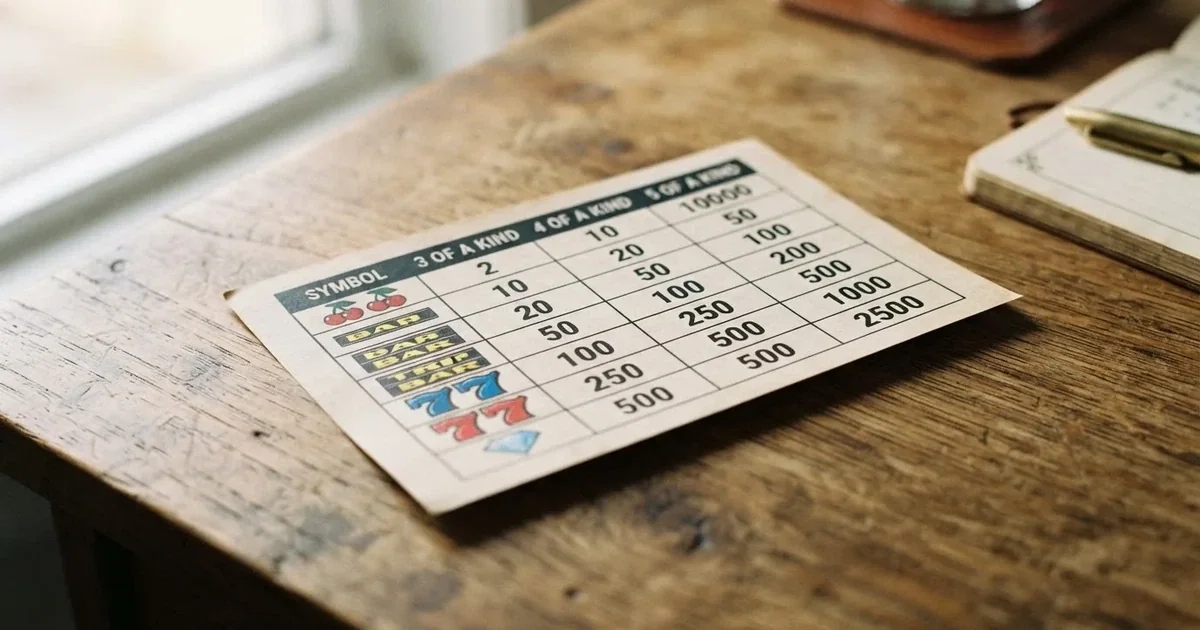
The paytable is the page that translates one set of numbers into the other. It states the symbol values, the win lines that count, and the multipliers attached to combinations of three, four or five matching symbols. It is the only part of the game the player can read before the wager is placed. The reels stop where the random number generator behind them decides; the paytable is the page the player reads in advance, and it is the page the marketing copies for marketing purposes.
Bally’s 1963 Money Honey was the first machine with a bottomless hopper and an automatic payout of up to 500 coins without an attendant. The first video slot machine was developed in 1976 by Fortune Coin Co. in Kearny Mesa, California. The move from mechanical reel to video reel took thirteen years; the move from video reel to modern five-reel online slot took the rest of the century. Both moves widened the gap between what the machine looks like and what it is doing on the player’s behalf.
Symbol values, win lines and RTP
Three things appear on a 5-reel slot paytable that don’t appear on a marketing page. The first is the symbol hierarchy — usually one or two top symbols at a high multiplier, a middle tier of theme symbols at lower multipliers, and a low tier of generic symbols at the smallest unit. The second is the line count — modern 5-reel machines use a fixed grid of paylines (the standard 5×3 has 243 ways, the 5×4 has 1,024), with the wager sized across all lines by default. The third is the bonus trigger — typically three or more “scatter” symbols paying out irrespective of line position and triggering a free-spin round.
RTP, where it is printed, is the percentage of total wagered amount that the slot returns to players over its full lifespan. An RTP of 96%, the rough band most modern online 5-reel slots sit in, returns about A$96 of every A$100 wagered, in aggregate, over millions of spins. The volatility class — usually printed or stated in the slot’s data sheet — tells the player how that A$96 is distributed. High volatility concentrates the return in rare, large wins; low volatility returns it in frequent, small wins.
State regulation in the United States sets minimum payout percentages: Nevada at 75%, Mississippi at 80%, New Jersey at 83%. Australia does not regulate online slot RTPs, because Australia does not licence online slots — the offshore operator is in a different jurisdiction entirely, and the only RTPs the player sees are the ones the operator chooses to publish.
The reel count is real, and so is the math
The reel count is a meaningful number for the player who reads the paytable. A 5-reel machine with a 5×3 grid and 243 ways has more combinations per spin than a 3-reel machine with one payline — which is why the top combination’s odds are higher, the RTP is the same, and the volatility is set higher (small wins are spread across a wider prize grid to keep the math balanced). A 5-reel slot with a 5×4 grid (1,024 ways) does the same thing at higher volatility again. A 5-reel slot with a 5×6 grid has higher variance still. The reel count is the lever; the math is the result.
The eleven brands on the ACMA’s register: who they are, what the warning covers
The brand list that follows is drawn directly from the ACMA’s formal-warning register. The order below is the order in research: it is not a recommendation, not a ranking, and not a list of where to play. Every brand on the list has been the subject of at least one formal ACMA warning for offering prohibited interactive gambling services to Australians. Every brand on the list is therefore outside Australian law, whatever licence it displays elsewhere.
The register is split across two columns in the comparison table at the foot of this section. The first column names the brand the ACMA warned about. The second names the legal entity the ACMA named when it issued the warning, and the date. A repeat warning against the same legal entity is listed under the same operator name.
| Brand | ACMA action and date | Operator named by the ACMA | Subject support |
|---|---|---|---|
| RocketPlay | Formal warning, March 2026 (also May 2022 under earlier operator) | Pulsup Ltd (March 2026); Dama N.V. (May 2022) | — |
| Level Up Casino | Formal warning, May 2022 | Dama N.V. | Game provider listings reference it (Bgaming.com) |
| Woo Casino | Formal warning, March 2025 | Dama N.V. | — |
| Spirit Casino | Formal warning, May 2025 | Dama N.V. | — |
| National Casino | Formal warning, July 2025 | Consolutetish S.R.L. | Game listings reference it (en.wikipedia.org) |
| Bizzo Casino | Formal warning, July 2025 (also 2022 under earlier operator) | Consolutetish S.R.L. (July 2025); TechSolutions (CY) Group Limited and TechSolutions Group N.V. (2022) | — |
| Ignition Casino | Formal warning, July 2025 | Bamboo Media | — |
| Instant Casino | Formal warning, February 2025 | EOD Code SRL | — |
| Jackbit | Formal warning, April 2026 (over Jackbit and CasinOK) | Ryker B.V. | — |
| Casino Intense | Formal warning, April 2025 | Sterplay Holding Ltd | News reference (Abc.net.au, acma.gov.au, Crownmelbourne.com.au) |
| Sky Crown | Formal warning, September 2022 | Hollycorn N.V. (Sky Crown and Blue Leo) | — |
The “operator named by the ACMA” column carries the legal entity the regulator addressed the warning to — the holder of the brand rather than its front name. It is the entity the regulator pursued; it is the entity that, in the regulator’s reading, was providing prohibited interactive gambling services to Australian customers. Where two operators have been warned for one brand (Bizzo, RocketPlay), both names are listed under the brand in the order of the warnings.
The blocking arithmetic: rate over the enforcement period
The regulator’s blocking statistics are a snapshot of its enforcement work. By the round reported on 26 June 2026, 1,751 illegal gambling and affiliate-marketing websites had been added to the ACMA’s block list since the first blocking request, issued in November 2019. This covers a span of roughly six years and seven months — about 79 months in total.
Dividing 1,751 by 79 months gives a band of roughly 22 blocked sites per month over the full enforcement period. The band is not a forecast; it is a description of what the regulator has actually added to the block list, averaged over the period of its doing so. Late-2025 and 2026 rounds alone have moved the count in larger batches — the 26 June 2026 round alone added twelve names, the rounds in 2025 added comparable bursts in some months and none in others. Treating the figure as an average is, accordingly, the only honest reading; treating it as a forward projection overstates the regulator’s hand.
The arithmetic the marketing carries with it is the inverse. Eleven names on the warning register above, six years and seven months of blocking, 1,751 total blocks — and the offshore market continues to turn over brands faster than the regulator can name them. The block list clears one set of names and another set fills the gaps; the warning list publishes the regulator’s pick of the most visible set; the affiliate-marketing sites carry the rest. None of these are the same number, and reading any one of them for what the market really looks like overstates one piece of the picture.
RocketPlay
In March 2026, the ACMA issued a formal warning to Pulsup Ltd concerning the Rocketplay.com.au service. Previously, in May 2022, Dama N.V. received a warning for the same brand. RocketPlay is not licensed to provide online casino games in Australia, despite any credentials displayed on its site. This brand is absent from standard industry game provider lists reviewed for this page. The ACMA’s warning register is the primary official record for this brand, and it remains active on the regulator’s list.
RocketPlay’s reading is the operator’s own until the ACMA acts against it again, and the brand continues to accept Australian customers at registration. The brand is one of the eleven on this list that the regulator has acted on more than once; the more-than-once pattern is what makes a brand a regulator’s case study rather than a one-off intervention.
Level Up Casino
Dama N.V. received a formal ACMA warning regarding Level Up Casino in May 2022. While some third-party listings mention the brand among gaming titles, it is not present in official regulator catalogues. The ACMA warning serves as the main reference for this operator in Australia. Level Up Casino is part of a cluster of brands associated with this operator, drawing the regulator’s ongoing oversight.
Level Up Casino sits at the older end of the ACMA’s register, and an older warning is not a clearer one. The regulator has not re-warned Dama N.V. specifically for Level Up Casino in the same period, though it has re-warned Dama N.V. for other brands (Woo Casino in March 2025 and Spirit Casino in May 2025), which has the effect of keeping the operator on the regulator’s working list.
Woo Casino
In March 2025, the ACMA issued a formal warning to Dama N.V. concerning Woo Casino. This action is documented in the regulator’s recent warnings. The brand lacks official presence in standard regulator listings and is not verified through authorized catalogues for this review. The warning is part of the regulator’s broader enforcement against Dama N.V., keeping this operator under continued scrutiny.
Woo Casino’s case is one of three on this page against Dama N.V. — a clustering that is itself the case the regulator’s enforcement builds. A single operator running multiple brands is the shape that makes a single warning less of a punishment than it looks; the regulator’s job, in that shape, is to follow the operator across the brands.
Spirit Casino
Spirit Casino was the subject of a formal ACMA warning in May 2025 against Dama N.V. The data carried for the brand is the regulator’s warning and nothing further. Spirit Casino is the third brand on this page against Dama N.V., and the most recent of the three.
The cost of the warning, on a brand-by-brand view, is small for the operator. The cost across the operator is the trend the regulator is reading: three formal warnings against one legal entity in three years is a record that the ACMA is willing to use, and that an operator’s choice of brand does not reset.
National Casino
Consolutetish S.R.L. was the subject of a formal ACMA warning in July 2025 regarding National Casino. Third-party sites may reference the brand, but it has no standing in official regulatory catalogues. The warning from the ACMA remains the central fact regarding the brand’s legal status in Australia. This operator is also associated with other brands that have drawn similar regulatory action.
National Casino’s case illustrates how the regulator names operators at the corporate level rather than the brand level. Consolutetish S.R.L., the operator of record in the July 2025 warning, is also the operator named in the same month’s warning for Bizzo Casino — a single legal entity, two brand entries on the ACMA’s register.
Bizzo Casino
Bizzo Casino has faced double regulatory action: a formal ACMA warning issued to Consolutetish S.R.L. in July 2025, and a prior warning to TechSolutions (CY) Group Limited and TechSolutions Group N.V. in 2022. These warnings are published on the regulator’s official register. The brand does not appear in authorized industry directories. The two-fold warning history for this brand underscores the ongoing regulatory attention directed at its changing operator structure.
Two operators warned for one brand, with four years between the warnings, is the pattern that makes the ACMA’s enforcement read like chasing. The cost of a block to an offshore operator is the cost of opening the next brand; the cost to the regulator is the cost of finding it again.
Ignition Casino
In July 2025, the ACMA issued a formal warning to Bamboo Media regarding Ignition Casino. The brand is absent from authorized game provider lists or regulator catalogues. This warning is part of the ACMA’s recent enforcement rounds and is included in the regulator’s public record of formal cautions. It remains an active entry on the warning list.
Ignition’s case is one of three on this page warned in the same July 2025 round — alongside National Casino and Bizzo Casino — a burst of activity the regulator has not matched in every month of enforcement. The pace varies; the direction does not.
Instant Casino
EOD Code SRL received a formal ACMA warning in February 2025 concerning Instant Casino. There are no authorized catalogues or industry directories that list this brand for 5-reel slot services. The warning itself constitutes the official regulatory position on this site, and it continues to be listed on the ACMA’s public warning record.
Instant Casino’s case is the standalone February 2025 warning — neither bookended by earlier warnings to the same operator, nor followed by later ones in the research window. The shape is a one-shot regulator intervention rather than a sustained case, and the warning still sits on the register.
Jackbit
The ACMA issued a formal warning in April 2026 to Ryker B.V. concerning both Jackbit and CasinOK. This regulatory notice covers both services. The brand is not validated in any standard gaming catalogues or lists for 5-reel slots. The formal warning from the ACMA serves as the verified account of this operator’s prohibited activity in the Australian market.
Jackbit’s case illustrates one warning, two brand names. The regulator names both names in one document, and either one can be the doorway the punter reaches. The cost of a single warning is measured across both doors.
Casino Intense
Casino Intense was the subject of a formal ACMA warning in April 2025 against Sterplay Holding Ltd. News references to the brand appear in third-party press and regulator coverage the research examined; the brand does not appear in any of the regulator catalogues as a 5-reel-slot listing.
Casino Intense is the brand on this page that the regulator has acted against the newest. The press record is thinner than for the longer-running brands, the regulator’s action is recent, and the brand sits at the front of the warning list rather than the back.
Sky Crown
Sky Crown was the subject of a formal ACMA warning issued in September 2022 against Hollycorn N.V., covering Sky Crown and Blue Leo in a single document. The data carried for the brand is the regulator’s warning and nothing further; the brand does not appear in any of the game-provider or regulator catalogues research examined for a 5-reel-slot listing.
Sky Crown is the oldest warning on this page that has not been re-issued against a different operator, and the only warning on this page for which the regulator has not yet (in the research window) re-acted against the same legal entity for a different brand. The pattern is consistent with where the other Hollycorn N.V. brands sit in the regulator’s archive. Where the operator has kept one brand running under the same corporate umbrella, the regulator’s case against that brand is the case against the umbrella.
Where Australian 5-reel play does happen
The licensed 5-reel slot play in Australia happens on casino floors and in clubs and pubs, on physical machines under state and territory regulation. The format is the same — five reels, a video or mechanical display, a paytable — and the regulatory frame is the opposite of the offshore frame: state-level licensing, on-floor supervision, audit and inspection, machine-count limits and per-state harm-minimisation settings.
The numbers are large. Pokies-style slot machines outside casinos numbered 87,298 in New South Wales as of June 2023; 26,380 in Victoria for 2021–22; 21,122 in Queensland in October 2023; 11,672 in South Australia in September 2023; and 3,587 in the ACT in November 2023. New South Wales legalised slot machines in 1956, and by 2010 Australia operated an estimated 97,103 gaming machines outside casinos — a per-capita rate about five times that of the United States. Australia’s pokie density on the licensed side is the country-level fact that the offshore-casino debate usually ignores.
The licensed and offshore markets are not substitutes; they cover different formats. The licensed venue operates in-person machines on a state-regulated floor. The offshore site operates an online casino accessible by browser. A player on the licensed venue sees the paytable on screen; a player on the offshore site sees only what the marketing exposes before a deposit. The licensed venue’s edge is published in audit reports filed with the regulator; the offshore site’s edge is whatever the operator discloses in the game data, if anything.
The wider context: what sits beside the 5-reel question
The 5-reel question never sits alone. A page about the format is also a page about baccarat (house edge 1.06% on Banker, 1.24% on Player, 14.36% on Tie), blackjack (house edge 0.28% under liberal Las Vegas Strip rules, 0.43% under Atlantic City rules) and craps (Pass/Don’t Pass 1.41%/1.36%; Any Craps 11.11%). The other games a casino carries set the band the 5-reel slot is judged against — and on that band, a 5-reel slot at 96% RTP is an above-average slot, not a below-average one.
Crown Melbourne, in Victoria, offers three baccarat variants — Traditional Baccarat, Crown Baccarat and 2 to 1 Baccarat — as approved table games regulated by the Victorian Gambling and Casino Control Commission (VGCCC), which replaced the VCGLR as Victoria’s casino regulator on 1 July 2022. Under section 66 of the NSW Casino Control Act 1992, a casino operator must not permit a game to be played unless the game and its rules are approved by the regulator, and the operator must make a copy of the approved rules available to patrons on request. The Victoria equivalent requires the VGCCC to approve any rules for table games, including blackjack, and any change to those rules, before they are introduced at the Melbourne casino; the public log of approved changes includes renaming the “Perfect Pairs” side bet to “Crown Pairs” on 23 December 2024 and introducing a “Free Bet” option with a new “Pot of Gold” side bet on 25 March 2024.
The licensed on-floor frame is detailed, public and approved in writing by a regulator with a staff and a sitting schedule. The offshore frame is none of those.
The games that aren’t 5-reel slots
Baccarat, blackjack and craps appear on the page because they sit beside the 5-reel slot at any casino — licensed or offshore — and because their house edges are part of the comparison a player makes when they choose. The 5-reel slot at 96% RTP is, against the table-game edges above, an average-to-good game. The slots with the highest published RTPs are above 97%; the slots with the lowest sit near the floor that US states set on minimum payout percentages (Nevada 75%, Mississippi 80%, New Jersey 83%). The range is wider than the range on the table games, and the choice of where in the range a punter plays is the operator’s, not the regulator’s.
Where this leaves a punter in Australia in 2026
The choice is the regulator’s choice, not the punter’s. The licensed route — pubs, clubs, casino floors — is regulated by state and territory law, with state-set machine-count limits, audited payout percentages, harm-minimisation settings and operator obligations that the offshore route does not bear. The offshore route is whatever the offshore operator chooses to publish, and the consumer-protection regime that backs it is the operator’s home jurisdiction’s, not Australia’s.
A player who registers with BetStop and then opens an account at an offshore casino has registered only against the licensed Australian wagering side. The offshore side is a separate account, with separate exclusion handling that the operator may or may not honour — and that BetStop cannot enforce. A player who wants the full force of Australian self-exclusion needs to use only Australian-licensed venues and online wagering services.
A player who needs help — at any hour, on any budget, in any state — calls 1800 858 858 or uses Gambling Help Online. The line is free, confidential and has no threshold for “enough of a problem to justify a call.” It is the one entry point that does not depend on which market the play is happening in.
Frequently asked questions about 5-reel slots in Australia in 2026
Is a 5-reel slot online the same as a 5-reel machine on a casino floor?
The format is the same — five reels, a paytable, matching symbols on a win line. The frame around it is not. The licensed floor regulates the machine in writing; the offshore site regulates itself through its terms page. The licensed venue files payout percentages with the state regulator; the offshore site publishes them where it chooses, on the games it chooses.
Can 5-reel slot machines be found in licensed Australian pubs and clubs?
Yes. The licensed market is the physical-venue market — clubs, pubs and casino floors under state and territory regulation. The machine count is large (87,298 in NSW as of June 2023, 26,380 in Victoria in 2021–22, 21,122 in Queensland in October 2023) and is regulated machine-by-machine. The online version of the same game is the offshore market, and that is not licensed in Australia.
Do 5-reel slots pay out differently from newer five-reel formats?
A 5-reel slot with five reels and a 5×3 grid has 243 ways and higher volatility than a 3-reel machine; a 5×4 has 1,024 ways and higher again; a 5×6 has higher variance still. The format changes the distribution of wins, not the average return. RTP stays the lever across formats; volatility is what the reel count changes.
Does reel count change how a paytable and volatility are usually described?
A 5-reel slot’s paytable usually publishes the symbol hierarchy, the win lines and the bonus trigger in the same way a 3-reel slot does. The volatility class is usually stated in the slot’s data sheet, separately from the paytable. Where neither RTP nor volatility is published, the offer cannot be costed from the page — and the player taking it cannot cost it themselves without first registering, depositing and reading the operator’s own data.
Are 5-reel slots for real money available legally from an Australian-based site?
No. The Interactive Gambling Act 2001 prohibits the supply of online casino games and online pokies to anyone in Australia, and no state or territory issues a licence for them. What is licensable is wagering on racing and sport placed before the event, lotteries and keno. A site offering online 5-reel slots to Australian customers is an offshore operator outside Australian law, whatever licence it advertises at the foot of its page.
Written by the editors at Low Deposit Casino Info.