Best 7-Reel Slots Australia 2026: The Format, the Law and What a Spin Really Costs
 Available in US
A 7-reel slot is the smaller corner of the format most Australians only glimpse on a pub screen, and that corner has moved almost entirely offshore in 2026. The page below is built around what the format is, what it costs the punter who tries to chase it online, and which offshore brands the Australian Communications and Media Authority has actually had words with over it. There is no recommendation here — only the comparison the law already forces on the reader.
Data current as of 23 September 2026 · cross-checked against the ACMA’s published formal-warning register.
Table of Contents
- Prohibition under the Interactive Gambling Act 2001 — and what the ACMA actually does about it
- Responsible gaming: the help that exists, and the help the offshore site does not connect to
- Bonuses and free spins on 7-reel slots: what the marketing phrase is hiding
- Reading a paytable: what a 7-reel screen actually says
- The landscape of ACMA formal warnings: 11 brands an Australian punter can name
- The fundamentals: reel counts, symbols and combinations
- Frequently asked questions about 7-reel slots in Australia
Prohibition under the Interactive Gambling Act 2001 — and what the ACMA actually does about it
Online casino games and online pokies of any reel count are illegal to provide to a person in Australia. That includes 7-reel slots. The Interactive Gambling Act 2001 — the IGA — makes the supply of “prohibited interactive gambling services” an offence, and the Interactive Gambling Amendment Act 2017 strengthened the regime by giving the regulator the enforcement tools that have shaped the past several years. No state or territory issues a licence for online casino games or online pokies. None. The product a reader typing “7-reel slots Australia” is searching for does not exist under Australian licence, has never existed under Australian licence in the online form, and the IGA is the reason.
What is licensable is narrower than the average punter assumes. Australian-licensed online gambling is, in practice, wagering on racing and sport placed before the event, lotteries and keno. The 52 Australian online bookmakers — including Sportsbet, Bet365 and Ladbrokes — are licensed in the Northern Territory for tax reasons, through the Northern Territory Racing and Wagering Commission, a body the ABC described in April 2026 as having no full-time staff and meeting once a month in Darwin. That is the regulator the law has actually built. None of those 52 bookmakers offers a 7-reel online slot, and none could lawfully offer one.
The IGA targets the provider, not the punter. Australian individuals are not prosecuted for opening an account at an offshore site, depositing, or playing. The Act puts the criminal and civil exposure on the operator — the corporate entity that makes the game available to a person physically in Australia. The corollary, which the marketing pages never volunteer, is that the same offshore operator is unreachable by any Australian consumer-protection body the moment a withdrawal stalls. There is no local dispute resolution, no local ombudsman, and no easy way to compel payment of a balance that an Australian-licensed bookmaker would be required to release.
Minimum age for any Australian-licensed wagering product is 18. The offshore 7-reel sites do not verify age in the Australian sense; they verify it the way an offshore site verifies anything — by collecting what the registration form asks for and moving on.
The ACMA’s tools: warnings, blocks, and what 1,751 websites actually represents
The Australian Communications and Media Authority is the regulator with teeth. It investigates complaints, issues formal warnings under the IGA, and — the part that bites — directs Australian internet service providers to block illegal services at the network level. The block list is the part of the regime the marketing pages never mention.
By June 2026, the ACMA had asked Australian ISPs to block 1,751 illegal gambling and affiliate marketing websites, with the first such request issued in November 2019. Run the figures: 79 months from that first blocking request to the June 2026 total. That works out to an average of 22 websites a month added to the block list, or close to 260 a year. The reader who imagines a quiet, occasional warning-and-block programme is wrong. The regulator has been grinding through offshore brands faster than the offshore brands have been able to rebrand and reappear.
The June 2026 round alone asked ISPs to block 12 more sites: 7Signs, ChromaBet, Donbet, Duospin, Freshbet, Slots Gem, Jacks Club, Lucky Start, Pointsbetz, Spinrise, Vinyl Casino and Wildsino. The mix tells its own story — name generators producing casino brands the way vending machines produce chocolate bars, each one a fresh corporate shell and a fresh risk to an Australian punter who arrives via a search result.
H2 Gambling Capital’s 2025 report put the cost on the other side of the screen. Australians lose about A$3.9 billion a year to illegal gambling sites, the firm estimates, and the share of gambling going through legal channels fell from 74% in 2021 to 64% by 2025. The reader is funding that A$3.9 billion. Every marketing-led headline about “free spins” or “welcome packages” runs through that number, and the comparison the law draws is simple: the legal channel has a regulator, a complaint body and a withdrawal your bank can trace; the illegal channel has a balance that disappears when the next blocking round lands.
Payments tell you which side of the line the site is on
The Australian rules changed on payments from 11 June 2024. Credit cards, credit-related products and digital currency are banned as payment for any licensed online wagering service, with penalties up to A$247,500 for the operator that takes them. The legal deposit routes for an Australian-licensed wagering account are debit card, bank transfer, PayID/Osko and BPAY. A punter who lands on a 7-reel slot site and is invited to fund the account with a credit card or a Bitcoin wallet is looking at a site that is operating outside the Australian rules from the first deposit onwards. That is not a marketing detail; it is the regulator’s own signpost.
2026 reform: the Interactive Gambling Amendment (Gambling Reform) Bill 2026
The Interactive Gambling Amendment (Gambling Reform) Bill 2026 passed Parliament on 19 August 2026. Its advertising and inducement measures commence on 1 January 2027. Law with a start date is law the regulator cannot yet enforce, and a page in 2026 has to mark that distinction: the rule exists; the bite starts next year. A punter reading about the new regime in 2026 is reading about a regime that has been announced and gazetted but has not yet been policed.
Tax: the small print most readers will not look for
Gambling winnings of a recreational Australian player are not assessable income, under section 6-5 of the Income Tax Assessment Act 1997, and losses are not deductible. The only exception is a person who carries on a business of gambling, which a recreational punter does not. The general rule — winnings are tax-free, losses are sunk — holds. That rule applies on both sides of the legal line. The IGA problem is not tax; the IGA problem is that the offshore operator has no obligation to pay out at all.
Responsible gaming: the help that exists, and the help the offshore site does not connect to
If thinking about 7-reel online slot play ever starts to feel compulsive or stressful, free confidential help is available around the clock. The National Gambling Helpline — 1800 858 858 — is free, 24/7, and reachable for the cost of a local call from anywhere in Australia. Chat counselling runs through Gambling Help Online at gamblinghelponline.org.au. These are not gambling-industry services; they are public-health services funded to help people who are having trouble with gambling, and the conversation is confidential whether the person on the other end of the line is a sports bettor, a poker player, a pokie punter or someone deep in an offshore 7-reel slot site at 3 a.m.
BetStop, the National Self-Exclusion Register, has been live since August 2023 and is the formal mechanism an Australian can use to bar themselves from every Australian-licensed online and phone wagering service through a single registration. The mechanism is strong on the licensed side. It is not connected to offshore casinos. A punter who has registered with BetStop has removed themselves from the 52 NT-licensed bookmakers, the lotteries and the keno operators — and is still welcome at every offshore 7-reel slot site in the ACMA’s block list. That is the structural gap the law has not yet closed, and the offshore marketing pages do not mention it.
The same gap applies to the help-line referrals. Gambling Help Online will help an Australian punter regardless of which site the punter has been playing on, licensed or not. The counsellor does not require an Australian-licensed account. The offshore site’s complaints process, by contrast, will respond only as long as the offshore operator chooses to.
A practical note that does not appear on most responsible-gaming pages: an offshore 7-reel slot site can be blocked by the ACMA while the punter still has a balance sitting in the account. The IGA does not require the operator to return the balance. BetStop cannot retrieve it; the helpline cannot retrieve it. The two are simply not connected to the offshore operator at all. That is the line a punter crosses when they leave the legal channel, and it is a real cost in 2026 that the marketing never itemises.
Bonuses and free spins on 7-reel slots: what the marketing phrase is hiding
A “7-reel bonus slot” is a marketing phrase, not a regulatory category. The format works the way every modern video slot works: a base game on the seven reels, scatter symbols that trigger a free-spins round, and usually one or more bonus features built around picking objects, expanding wilds, or a hold-and-spin mechanic where certain symbols lock in place for several spins. The seven reels change the math; the marketing layer is identical to the five-reel product.
“Free spins” means the slot gives the player a number of spins at the operator’s expense, rather than the player’s. The wager sits on the house for those spins; the winnings go into the player’s bonus balance, not the real-money balance. The size of the bonus is then tied to the player’s behaviour through a wagering requirement — a multiplier that determines how much of the bonus balance must be played through before any of it converts to withdrawable cash. A typical offshore package will quote a percentage match on the deposit (say 100%) up to a cap (say A$500), with a wagering requirement (say 40x the bonus) and a maximum cashout from the bonus (say 5x the bonus). Read together, those three numbers convert the marketing headline into the real question: how much of the deposit is the punter going to see again, and on what terms.
The terms are where the format earns its cost. A 40x wagering requirement on a A$100 bonus means the punter has to place A$4,000 in qualifying bets before the bonus balance can be withdrawn. On a 7-reel video slot at, say, A$1 a spin, that is 4,000 spins. With a five-second average spin, that is 20,000 seconds, or about five and a half hours of continuous play. The number is not a prediction of how long any individual punter will play; it is a description of the wagering volume the bonus terms demand before the bonus balance is real money. The punter who reads “100% up to A$500” and stops reading has not yet met the bonus.
Max-cashout caps are the second layer. Even after the wagering requirement is satisfied, the bonus terms may cap the amount that can be withdrawn from the bonus balance — typically five or ten times the bonus value, sometimes less. A punter who runs a hot streak inside the bonus, beats the wagering requirement and then finds the withdrawal capped has met the terms and still walked away with a fraction of what the balance said. The marketing does not advertise the cap.
This entire shelf exists in 2026 as background reading only, because the bonus in question is being offered to an Australian punter by an offshore site operating outside the IGA. The terms of the bonus are whatever the operator posts; there is no Australian regulator to escalate to if the operator refuses to honour them; the credit card and crypto payment ban does not apply to the offshore site; and BetStop does not block the bonus from being claimed. The reader looking at a “free 7-reel bonus slots” offer is reading an unregulated contract dressed as a promotional headline.
The honest reading of “free” in this context: the spins are free; the path to keeping what the spins win is paid in wagering volume, in time, and in the max-cashout cap. The marketing is true. It is also the only thing about the offer that is true at face value.
Reading a paytable: what a 7-reel screen actually says
The 7-reel layout sits inside a longer story about how slot machines moved from three spinning drums to screens full of reels. Charles Fey’s late-19th-century mechanism in San Francisco ran three reels with five symbols — horseshoes, diamonds, spades, hearts and the Liberty Bell — and three bells in a row paid the top prize of ten nickels. Bally’s “Money Honey” in 1963 introduced the bottomless hopper and automatic payout of up to 500 coins without an attendant. The first video slot machine was developed in 1976 by Fortune Coin Co. in Kearny Mesa, California. From that point the reel count was a software choice, not a mechanical constraint, and modern video slots routinely run five reels with 50 or more symbols per reel, producing odds as high as 300 million to one against the top combination. A 7-reel slot sits in the middle of that arc — wider than the classic three-reel machine, narrower than the longest modern five-reel layouts, and unusual in Australian pub and club play.
Australian pub and club play, to be precise, is overwhelmingly five-by-three. Pokies-style slot machines outside casinos numbered 87,298 in New South Wales as of June 2023; 26,380 in Victoria across 2021–22; 21,122 in Queensland in October 2023; 11,672 in South Australia in September 2023; and 3,587 in the ACT in November 2023. That is the licensed Australian floor, and it does not include 7-reel machines. The 7-reel format an Australian reader meets is essentially an online-only format, and the online venues are offshore.
Paytables, symbol values and the combination math
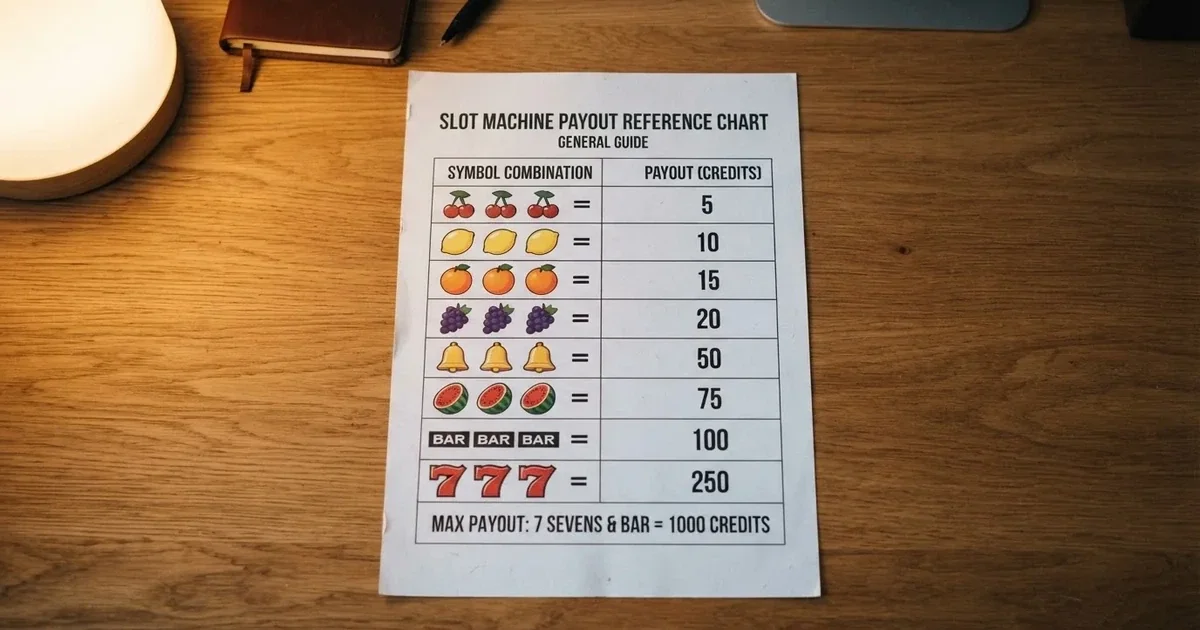
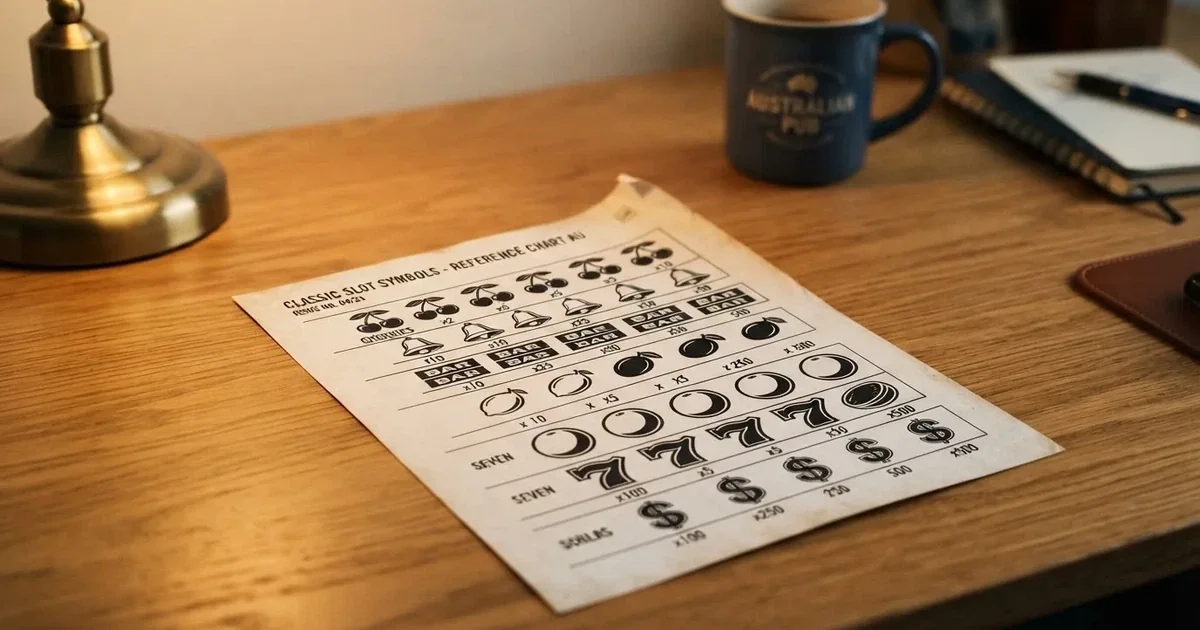
A paytable is the small-print panel that ranks which symbol combinations pay and how much. On a 7-reel layout, each reel carries a strip of symbols — anywhere from 20 to 60 stops, depending on the game — and a winning combination requires a matching symbol on a defined payline. The number of possible combinations from a single spin is the product of the symbols per reel across the seven reels. A 7-reel slot with 30 symbols per reel carries 30⁷, or about 2.187 × 10¹⁰, possible combinations on a single spin — far more than the roughly 1,000 combinations a classic three-reel machine offered. The slot achieves its return-to-player percentage by mapping payouts onto a vanishingly small fraction of those combinations and leaving the rest as losers.
The paytable states the RTP and the volatility honestly when it states them at all. A slot’s RTP is the share of wagered money the game returns to players as winnings over a long statistical run; volatility describes the shape of the payout distribution — low-volatility games pay small amounts often, high-volatility games pay large amounts rarely. Australia’s licensed venues operate under state-level technical standards; offshore 7-reel slots operate under whatever their home regulator requires, and the Australian punter has no local regulator to check the math against. For context on what an honest casino-game house edge looks like, blackjack with optimal strategy has a house edge of about 0.28% under liberal Las Vegas Strip rules, baccarat’s Banker bet runs 1.06%, and the craps Pass line runs 1.41% — those are the figures an honest casino game publishes, and the contrast with an unpublished offshore slot RTP is part of the comparison the reader has to make on their own.
The paytable also names the bonus mechanics — scatters, wilds, free-spin triggers — and the symbol combinations that activate them. Read carefully, the paytable is the contract. Read loosely, the paytable is decoration.
The landscape of ACMA formal warnings: 11 brands an Australian punter can name
Comparison of Offshore Features
| Feature | ACMA Action | Regulatory Status |
|---|---|---|
| Withdrawal Process | Formal Warning | Unregulated |
| Bonus Terms | Subject to Operator | Unverified |
| Dispute Resolution | None | Unavailable |
There is no legal comparison to draw. Every Australian-facing 7-reel slot site in 2026 operates offshore, and the regulator has been publishing names for years. What follows is not a ranking. It is not a recommendation. It is the ACMA’s own list of brands the regulator has issued formal warnings over, with the operator entity the ACMA named and the date the warning was published. The brands are listed because the ACMA itself put them on the page, not because any of them have been reviewed by this publication.
| Brand | ACMA action | Operator behind the brand | 7-reel availability |
|---|---|---|---|
| RocketPlay | Formal warning, March 2026 (earlier Dama N.V., May 2022) | Pulsup Ltd (Rocketplay) | — |
| Level Up Casino | Formal warning, May 2022 | Dama N.V. | Listed in third-party BGaming catalogues |
| Woo Casino | Formal warning, March 2025 | Dama N.V. | — |
| Spirit Casino | Formal warning, May 2025 | Dama N.V. | — |
| National Casino | Formal warning, July 2025 | Consolutetish S.R.L. | Referenced in gambling listings |
| Bizzo Casino | Formal warnings, 2022 and 2025 | TechSolutions (2022); Consolutetish S.R.L. (2025) | — |
| Ignition Casino | Formal warning, July 2025 | Bamboo Media | — |
| Instant Casino | Formal warning, February 2025 | EOD Code SRL | — |
| Jackbit | Formal warning, April 2026 | Ryker B.V. (with CasinOK) | — |
| Casino Intense | Formal warning, April 2025 | Sterplay Holding Ltd | Noted in passing in public listings |
| Sky Crown | Formal warning (Hollycorn N.V. action) | Hollycorn N.V. (with Blue Leo) | — |
The table reads cleanly for what it is. Eleven brands. Nine distinct operator entities. Two operator entities — Dama N.V. and Consolutetish S.R.L. — appear more than once. Two brands — RocketPlay and Bizzo Casino — have been warned under two different operator entities, which means the warning did not stop the brand from surfacing again under a fresh corporate shell. The column for 7-reel slot availability is mostly blank, because most of the ACMA’s enforcement action is over the supply of online casino games generally, not over 7-reel slots specifically; that does not mean 7-reel slots are absent from the offering, it means the ACMA does not name individual game formats in a warning notice. The few listings references in the column are third-party game-provider catalogues and gambling-directory mentions; none of them is the operator’s own claim.
The comparison the table is built to make is structural, not promotional. Offshore operators change wrappers; the ACMA names the new wrapper when it issues a warning; the brand lives on under a different corporate name until the next warning lands. The reader looking at a brand that does not appear in the table has not been cleared — they have simply not yet been warned, and the next blocking round may change that.
RocketPlay: warned twice, in 2022 and again in 2026
The ACMA issued a formal warning to Dama N.V. in May 2022 covering six casino brands — Bambet, Dazard, Level Up, RocketPlay, Wild Tornado and Cobra Casinos — and then issued a further formal warning over RocketPlay in March 2026, this time to Pulsup Ltd. The operator entity changed between the two warnings. The brand did not. The first warning treated RocketPlay as one of six Dama brands caught together; the second treated RocketPlay as a stand-alone case under a different company. RocketPlay treated the 2022 warning as a cost of doing business, and the 2026 warning tells the reader what that cost was.
Level Up Casino: part of Dama N.V.’s 2022 sweep
The May 2022 Dama N.V. warning covered Level Up alongside five sister brands. Level Up appears in third-party BGaming game-provider catalogues, which is the closest evidence available that the brand has been offering the kind of casino product a 7-reel slot would sit inside — though BGaming’s catalogue is not a Level Up-specific claim and the ACMA’s own action was over online casino games generally, not 7-reel slots specifically. Whether the warning changed how Level Up treated Australian customers is not a question the public file answers.
Woo Casino: Dama’s first 2025 follow-up
The ACMA issued a further formal warning to Dama N.V. over Woo Casino in March 2025, three years after the original 2022 sweep that included Woo’s sister brands. The operator was given three years to change tack and did not. Woo is the first 2025 escalation of an entity the regulator had already named in 2022, and the gap between the two warnings tells the reader how the regulator measures compliance.
Spirit Casino: Dama’s second warning two months later
Two months after the Woo warning, in May 2025, the ACMA issued a further formal warning to Dama N.V. over Spirit Casino. Same parent entity, two months apart — the regulator’s compliance assessment of Dama N.V. in 2025 was being written in two parts, not one. Whether Spirit was a new brand or a reactivation under a different marketing skin, the corporate structure that the ACMA named was the same.
National Casino: one of two Consolutetish brands warned in July 2025
The ACMA issued a formal warning in July 2025 to Consolutetish S.R.L. over National Casino and Bizzo Casino. Two brands, one warning, one operator entity. The regulator named the operator across both brands at once, which is a useful reminder that the unit of compliance is the corporate structure rather than the marketing front. National Casino appears in third-party gambling-directory listings, which is where the evidence of game availability sits in the absence of any operator-specific claim the public record captures.
Bizzo Casino: warned under two different parent entities
Bizzo Casino was first warned in 2022, when the ACMA issued a formal warning to TechSolutions (CY) Group Limited and TechSolutions Group N.V. The July 2025 warning went to Consolutetish S.R.L. Two warnings, two different operator entities, same brand on the punter’s screen. Bizzo is the clearest case on this list of a brand resurfacing under a fresh wrapper, and the question of whether the new operator is genuinely a new operator or the same people behind a new shell is not something the ACMA’s notice resolves.
Ignition Casino: the Bamboo Media brand in the July 2025 round
The ACMA issued a formal warning in July 2025 to Bamboo Media over Ignition Casino. Ignition is an Australian-facing brand name under an offshore media company; the corporate structure makes a local complaints pathway unavailable in the same way it is unavailable for every other brand on this list, but the Bamboo Media parent entity is one of the few cases where the corporate layer is described in those terms rather than as a generic Curaçao or Costa Rica shelf.
Instant Casino: the first ACMA action of 2025
In February 2025 the ACMA issued a formal warning to EOD Code SRL over Instant Casino. The action is the first 2025 entry in the ACMA’s formal-warning register and the start of a year that would close with the regulator’s running total at 1,751 blocked websites since November 2019. Instant Casino is the cleanest single-data-point case for what an ACMA warning looks like at the start of an enforcement cycle: one operator entity, one brand, one warning.
Jackbit: warned alongside CasinOK under Ryker B.V.
In April 2026 the ACMA issued a formal warning to Ryker B.V. over Jackbit and CasinOK. The warning was for the operator entity, not the brand alone — Ryker B.V. did not get the warning for one brand and not the other. Two brands caught together under one warning tells the reader that the ACMA’s enforcement lens is on the structure rather than the marketing front.
Casino Intense: a single Sterplay Holding warning
In April 2025 the ACMA issued a formal warning to Sterplay Holding Ltd over Casino Intense. A single entity, a single warning, the typical shape of an ACMA referral and the cleanest read of any brand on this list. Casino Intense is named in passing in some public listings, which is all the evidence available about what the brand actually offers.
Sky Crown: the Hollycorn N.V. action covering Blue Leo as well
The ACMA issued a formal warning to Hollycorn N.V. over its Sky Crown and Blue Leo casino services. The warning covered the operator, not the brand alone, which is the same structural pattern as the Jackbit and Consolutetish warnings — one operator, two brands, one notice. Hollycorn absorbed the warning across both brands at once, which is something the structure of the group made unavoidable.
The fundamentals: reel counts, symbols and combinations
Putting the pieces together: the 7-reel format is real, the law is clear, and the offshore reality is one Australian readers fund by mistake rather than by choice. By June 2026 the ACMA had blocked 1,751 illegal gambling and affiliate marketing websites since the first blocking request in November 2019 — close to 22 a month, close to 260 a year, on a rolling average that has held for more than six years. H2 Gambling Capital’s estimate of A$3.9 billion lost annually to illegal gambling sites in Australia is the bill the marketing pages do not include. The legal channel has a regulator, a complaint body and a withdrawal your bank can trace; the offshore channel has a balance that disappears when the next blocking round lands.

The format itself sits in the middle of a hundred-year arc. Three reels and a Liberty Bell at the end of the 19th century. Bottomless hoppers and automatic payouts in 1963. The first video slot in 1976. By the time 7-reel layouts were common in offshore online casinos, the Australian pub and club floor had standardised on five-by-three video pokies — 87,298 of them in NSW alone as of June 2023, with tens of thousands more across Victoria, Queensland, South Australia and the ACT. None of those licensed machines is a 7-reel machine. The format an Australian reader is searching for lives, in practice, on an offshore site the ACMA has warned over, blocked, or has yet to act on.
What the comparison above the operator table establishes is structural. The brands are not equivalent to an Australian-licensed operator and never will be. The bonuses are not regulated by any Australian authority and never will be. The withdrawals are not protected by Australian consumer law and never will be. The format is real; the protection is not. That is the line a reader crosses when they leave the licensed channel, and it is the one fact the marketing pages never lead with.
Frequently asked questions about 7-reel slots in Australia
How does a 7-reel slot differ from the standard five-reel video format?
Reel count drives the combination math. A 7-reel layout multiplies the symbols-per-reel product across seven reels, against roughly 1,000 combinations on a classic three-reel machine and 300 million to one against a top combination on a five-reel video slot with 50 symbols per reel. Seven sits between the two — wider than the old format, narrower than the modern five-by-three video slot that dominates Australian pub and club floors. The mechanical differences end there; the bonus mechanics, the paylines and the marketing around them are structurally the same.
Can a 7-reel slot machine be played in a licensed Australian venue?
Pokies outside casinos numbered 87,298 in NSW as of June 2023, with tens of thousands more across Victoria, Queensland, South Australia and the ACT. None of them are 7-reel — the licensed pub and club floor is overwhelmingly five-by-three video pokies. A 7-reel machine is, for practical purposes, an online-only format in Australia, and the online venues are offshore sites the ACMA has warned over or sought to block.
Do 7-reel slots return a different share of wagers than newer formats?
Paytables are not standardised by reel count. US state minimums offer a comparison: Nevada sets a 75% floor, Mississippi 80%, New Jersey 83%, applying to the approved machine whatever its reel layout. Australia’s licensed machines run under state technical standards; the offshore 7-reel format an Australian punter reaches online operates under no Australian floor at all. The reel count changes the odds of any single combination; the published RTP lives in the paytable’s math, not in the reel count alone.
Is an online 7-reel slot the same game as a 7-reel machine on a casino floor?
Mechanically the reels, symbols and paytable behave the same way — the screen displays reels, a random number generator resolves each spin, and the paytable ranks combinations. Practically, an Australian punter never meets the floor version: licensed venues run five-by-three pokies, not 7-reel machines. Online, the format exists almost entirely at offshore sites the ACMA has warned over or sought to block.
Is there any Australian-licensed site offering 7-reel slots for real money?
No. The Interactive Gambling Act 2001, as strengthened by the 2017 amendment, makes it an offence to provide online casino games or online pokies to a person in Australia; no state or territory issues a licence for them. Wagering on racing and sport before the event, plus lotteries and keno, are licensable. Any site offering 7-reel slots to an Australian is operating outside Australian law, and the offshore operator has no obligation to honour withdrawals under any Australian consumer-protection framework.
Prepared by the Low Deposit Casino Info editorial staff.