
What the search for high volatility slots runs into in Australia
A player who searches for high volatility slots and an Australian postcode gets back a thicket of offshore casino review sites, glossy payout tables and bonus ladders. The pages look like product guides. They are not. What they describe is a product that, for anyone in Australia, has been prohibited since 2001 and tightened twice since. The Interactive Gambling Act 2001, hardened by the Interactive Gambling Amendment Act 2017, makes it an offence to provide online casino games, online pokies or in-play betting to a person physically in Australia. No state or territory issues a licence for it. The pages do not say so, because that is not what sells a sign-up.
This guide is written from that position. It treats the high volatility slot as a real game with a real cost shape, sets out the law that governs whether an Australian can reach one online, and lists what is actually available to a reader sitting in Australia who wants the same kind of experience. The list of operators in the comparison later in this page is not a recommendation. Every brand named there is named because the Australian Communications and Media Authority itself issued a formal warning over it for offering prohibited services to Australians. That is the data, and that is what a working shortlist looks like under the current regime.
Currency and licence claims checked as of 29 October 2026 against the ACMA register and the Interactive Gambling Act 2001.
Table of Contents
- How the law puts online high volatility slots out of reach
- Player protection that exists only for licensed Australian wagering
- What a high volatility slot actually is, mechanically
- The ACMA formal warnings, by brand and date
- What the comparison finds, brand by brand
- What an Australian reader actually has
- Tax and the incidental facts a reader usually misses
- Frequently asked questions
How the law puts online high volatility slots out of reach
The Interactive Gambling Act 2001 (IGA) was drafted to catch interactive gambling services offered to Australians. Section 5 sets the test: a service is a prohibited interactive gambling service if it is supplied to a customer physically present in Australia and involves a game of chance, a game that mixes chance and skill, or wagering on a sporting or racing event after the event has begun. Online pokies and online casino table games fall squarely inside that test. The Interactive Gambling Amendment Act 2017 tightened the wording, extended the prohibition to in-play betting, and gave the regulator the teeth it uses today.

The practical consequence is not subtle. A company incorporated in Curaçao or Cyprus, running from servers in another country, can put a website on the open internet that advertises to Australians and accepts deposits in Australian dollars. What it cannot do is lawfully supply a prohibited service to anyone who is physically in Australia. The IGA targets the provider, not the individual player, but the consequence for the player is sharper than that framing sounds: an offshore site gives no Australian consumer protection, sits outside the complaints pathways that exist for Australian-licensed wagering, and can be blocked mid-session with a balance still on it.
What the ACMA has actually done, and how often
Enforcement sits with the Australian Communications and Media Authority. The ACMA investigates complaints, issues formal warnings, and can direct Australian internet service providers to block unlawful sites at the domain level. The June 2026 numbers are the cleanest summary of the regime in operation.
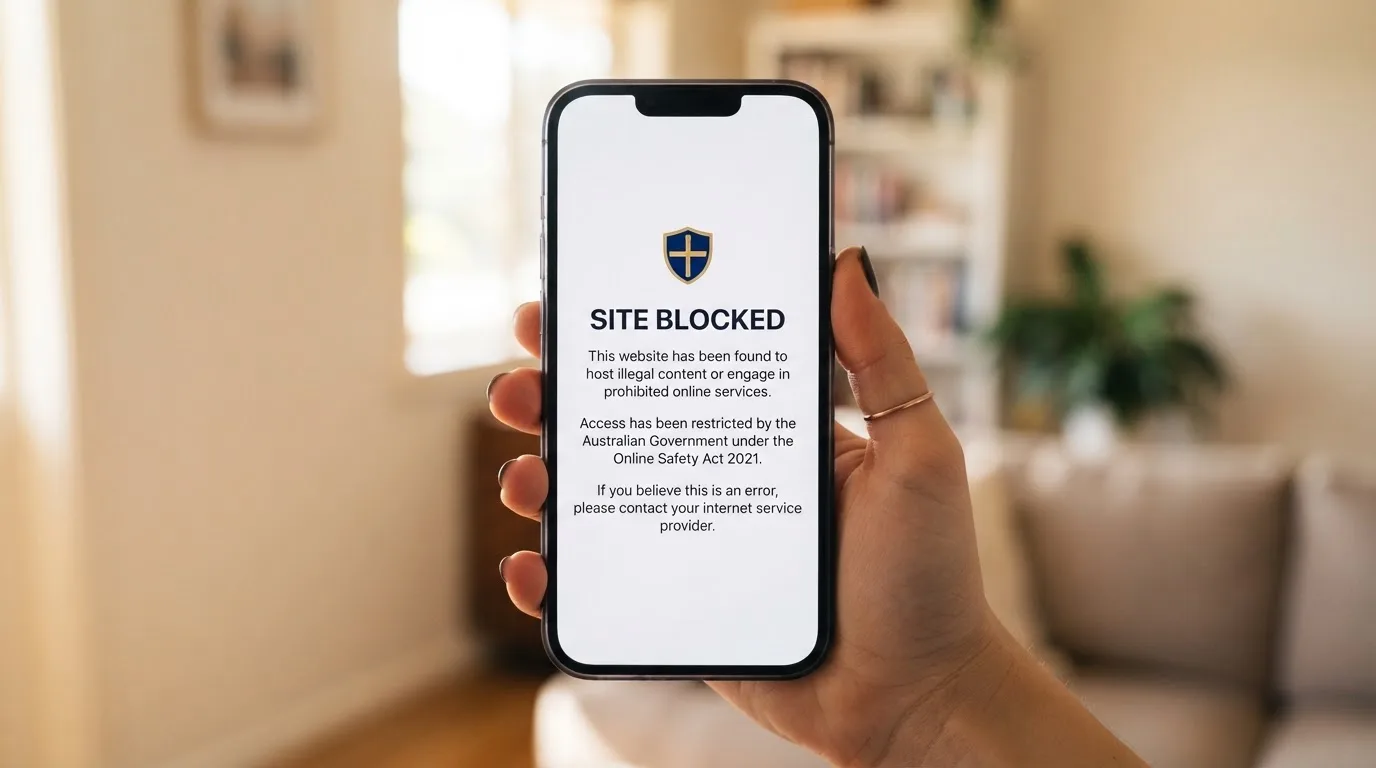
By the count published in June 2026, a cumulative 1,751 illegal gambling and affiliate marketing websites had been blocked since the ACMA’s first blocking request went out in November 2019, and more than 230 unlicensed services had withdrawn from the Australian market since enforcement was strengthened in 2017. The June 2026 round itself asked ISPs to block twelve more names: 7Signs, ChromaBet, Donbet, Duospin, Freshbet, Slots Gem, Jacks Club, Lucky Start, Pointsbetz, Spinrise, Vinyl Casino and Wildsino. That is what enforcement looks like in a single round — not a handful of stragglers, but a steady churn of sites that surface, are named, and are then routed out of Australian reach.
The blocking rate, calculated as the cumulative total of 1,751 blocked sites divided by the months from November 2019 to June 2026 — roughly 79 months — gives a working rate of about 22 sites blocked per month across that period, with the rate visibly higher in the years after 2017 once the amended Act took effect. The honest framing of that number is a band, not a point: the actual monthly figure swings from a handful to several dozen depending on which round the ACMA reports, and the headline count includes affiliate sites that never took a deposit themselves. What the rate confirms is that blocking is not symbolic — it is a routine tool, applied often enough that any single offshore brand is one round away from being unreachable.
Where wagering is licensed, and what that does not cover
A reader who sees a Northern Territory Racing and Wagering Commission logo on an Australian-facing site should not read it as covering the casino side of that site. The NTRWC regulates 52 of Australia’s online bookmakers — Sportsbet, Bet365 and Ladbrokes among them — because the Northern Territory is the corporate and tax home those operators chose. The commission runs on a part-time footing: it has no full-time staff and meets once a month in Darwin. That is a regulator for wagering on races and sport, which is what the IGA still permits. It is not a regulator for online casino games, which the IGA does not permit.
The same split holds for every other Australian jurisdiction. Lotteries and keno are licensed at state and territory level. Online casino games, online pokies, in-play betting — none of it is licensed, anywhere in Australia, at any level. A “Curacao licence” or “Anjouan licence” badge on a casino page is a foreign business licence; it is not an Australian licence, and the difference matters the first time the operator refuses to pay out.
Credit cards, crypto and the payment ban
Since 11 June 2024, credit cards, credit-related products and digital currency have been banned as a payment method for any licensed online wagering service offered to an Australian. The penalty for an operator that takes one anyway runs to A$247,500. The lawful deposit routes for a licensed Australian wagering account are debit card, bank transfer, PayID, Osko and BPAY.
A high volatility slot site that accepts a Visa credit card or a Bitcoin deposit from an Australian IP address is, on the payment side alone, operating outside the Australian rules. That is a separate violation from the games side and it has its own penalty. Two violations stacked on the same transaction is what most of the brands in the comparison later in this page have on their record, even before the games-side formal warning is counted.
Where the 2026 reform sits
The Interactive Gambling Amendment (Gambling Reform) Bill 2026 passed Parliament on 19 August 2026. Its advertising and inducement measures commence on 1 January 2027, which makes the new law a law with a start date, not yet in force on a page read in 2026. A reader looking at bonus terms or affiliate content between August 2026 and the end of the year is reading under the existing regime. The change is real, but it has not yet taken effect, and the comparison further down this page reflects what is in force now, not what will be in force in three months.
Player protection that exists only for licensed Australian wagering
The Australian framework is built around licensed wagering, and the player protection tools that exist were built for it. They do not reach an offshore casino.
BetStop and what it does, and what it does not
BetStop, the National Self-Exclusion Register, went live in August 2023. Australians who enrol are excluded, by name, from every Australian-licensed online and phone wagering service — wagering on races, wagering on sport, and licensed keno. The exclusion periods run from a minimum of three months up to a permanent block. A registered user who tries to open a new account, deposit, or place a bet with a licensed operator is refused at the point of sign-up. That is a real tool, working as designed, for the licensed wagering market.
What it does not do is bind offshore casinos. An Australian who has registered with BetStop and then opens an account at an offshore brand on the list further down this page is not stopped, because the offshore site is not connected to the register. The block works inside the Australian-licensed perimeter; outside that perimeter it does not exist. That is the gap to understand before relying on it.
Help that is free, 24/7 and Australian
The National Gambling Helpline is 1800 858 858, free, available around the clock, with online chat at Gambling Help Online. The service is funded to deal with Australian conditions and Australian operators. The same caveat applies: a session with the helpline is useful whether the underlying gambling was through a licensed operator or an offshore site, but the remediation tools the helpline can connect a caller to are the Australian ones, and the offshore side of the problem does not respond to them.
What a high volatility slot actually is, mechanically
A high volatility slot is a slot machine built around longer losing runs and larger payouts when the wins land. The other end of the spectrum — low volatility — pays smaller wins more often. The game design choice between them is the same axis the player feels as the difference between a steady drip and a drought followed by a downpour.
The history of the mechanism
The automatic payout slot was invented in San Francisco in the late 19th century by Charles Fey, with three reels and five symbols — horseshoes, diamonds, spades, hearts, and the Liberty Bell. Three bells in a row paid the top prize of ten nickels. The Liberty Bell did not invent the slot, but it set the design that every later machine followed: a fixed reel count, a fixed symbol set, and a top combination that pays a fixed multiple.
Bally’s Money Honey, released in 1963, was the first slot with a bottomless hopper and automatic payout of up to 500 coins without an attendant. That was the change that made the slot a stand-alone product — a machine that did not need a person beside it. The first video slot followed thirteen years later, from Fortune Coin Co. in Kearny Mesa, California in 1976. From that point the slot was software: more reels, more symbols, more combinations, and a much wider spread of outcomes per spin.
What modern volatility means in numbers
A modern video slot can run five or more reels with 50 or more symbols per reel, producing odds as high as 300 million to one against the top combination. A classic three-reel mechanical machine, with about ten symbols per reel, offers roughly 1,000 possible combinations. The increase from a thousand combinations to hundreds of millions is the structural reason modern slots sit further along the volatility axis: the top prizes are reachable, but only because the bottom of the payout table is mostly empty.
The house edge on a slot is the slot’s RTP, expressed the other way up: a 96% RTP is a 4% house edge. That is the long-run average the design is set to. Volatility is the shape around that average. A high volatility slot pays out at the long-run rate over millions of spins, but along the way it pays nothing for a long stretch and then a large amount on a single spin. A low volatility slot pays out at the same long-run rate, but the stretches of nothing are shorter and the wins are smaller. The expected loss is the same in the limit. The felt experience of playing them is not the same at all.
Where the same idea sits on a casino floor
The Australian pokies landscape is the highest-density slot market in the English-speaking world. Outside casinos, by the most recent published counts, New South Wales had 87,298 pokies-style machines in June 2023, Victoria had 26,380 across 2021–22, Queensland had 21,122 in October 2023, South Australia had 11,672 in September 2023, and the ACT had 3,587 in November 2023. New South Wales legalised the machines in 1956; by 2010 the country operated an estimated 97,103 gaming machines outside casinos, a per-capita rate about five times the United States.
Those machines are licensed, regulated, and physically present. They are not online, they are not anonymous, and they are not under the regime of an offshore operator. They are the lawful expression of the slot in Australia, and the closest an Australian player can come to a high volatility experience without leaving the licensed perimeter.
The volatility question sits next to other casino games
A reader thinking about high volatility is also thinking about other games whose variance shape is different. Baccarat’s house edge sits at 1.06% on the Banker bet, 1.24% on the Player bet, and 14.36% on the Tie. Blackjack, played with optimal strategy under liberal Las Vegas Strip rules — dealer stands on soft 17, double on any two cards, double after split, resplit aces, late surrender — has a house edge of about 0.28%, rising to about 0.43% under Atlantic City rules. Craps’ Pass/Come bet has a house edge of 1.41%, with Don’t Pass/Don’t Come at 1.36% and Any Craps at 11.11%.
Those numbers tell a reader where each game sits on the skill-and-edge scale, and they tell a separate reader where volatility fits in. A low-edge table game is not the same product as a high volatility slot; the design intent, the session shape, and the bankroll required to ride out the swings are different. The two are not interchangeable.
The ACMA formal warnings, by brand and date
The table that follows is the working shortlist this page can stand behind. Every brand on it has been the subject of a formal warning from the ACMA for offering prohibited interactive gambling services to Australians. The table does not rank them by bonus, payout speed, or game count — none of those metrics apply to a brand that the ACMA has warned off the Australian market, and the affiliates that publish them are not independent of the brands themselves.
| Brand | ACMA action and date | Operator named by the ACMA | Subject support |
|---|---|---|---|
| RocketPlay | Formal warning, March 2026 (Pulsup Ltd); earlier warning to Dama N.V., May 2022 | Pulsup Ltd | — |
| Level Up Casino | Formal warning, May 2022 | Dama N.V. | Listed as a BGaming partner by BGaming |
| Woo Casino | Formal warning, March 2025 | Dama N.V. | — |
| Spirit Casino | Formal warning, May 2025 | Dama N.V. | — |
| National Casino | Formal warning, July 2025 | Consolutetish S.R.L. | Listed on Wikipedia’s coverage of online gambling brands |
| Bizzo Casino | Formal warning, July 2025; earlier warning to TechSolutions, 2022 | Consolutetish S.R.L. | — |
| Ignition Casino | Formal warning, July 2025 | Bamboo Media | — |
| Instant Casino | Formal warning, February 2025 | EOD Code SRL | — |
| Jackbit | Formal warning, April 2026 | Ryker B.V. | — |
| Casino Intense | Formal warning, April 2025 | Sterplay Holding Ltd | Listed by ABC News, the ACMA register and Crown Melbourne’s coverage |
| Sky Crown | Formal warning, September 2022 | Hollycorn N.V. | — |
The “Subject support” column follows the ACMA’s own record and the public listings of those operators on the named directories. Where the research record carries no independent listing, the column is empty rather than filled in from the operator’s own marketing.
What the table is not
The table is not a buyer’s guide. It is not ordered by quality, payout speed, RTP, or game catalogue. It is ordered by the order in which the ACMA acted, working roughly from the most recent warning backwards, and each row reflects what the regulator published about that brand in the formal warning register. A reader who needs a casino to play at is not the audience for the table; a reader who wants to know what the ACMA has done is.
The other thing the table is not is exhaustive. The June 2026 blocking round alone named twelve sites the ACMA asked ISPs to block in that single round. Several of those names — 7Signs, Donbet, Duospin, Slots Gem, Vinyl Casino — appear on affiliate pages in this market but did not attract a formal warning in the period covered here. The ACMA’s preferred tool in those cases is the block request, which does not require a prior warning, and which does not produce a row in this table. A brand that does not appear here is not, by that fact alone, lawful.
What the comparison finds, brand by brand
The notes below are short by design. They repeat what the ACMA has already published, then add the one judgement a reader can act on. The reader here is an Australian who has reached this page because the search results pointed them at an offshore site and they want to know what the regulator has said about it.
RocketPlay
The ACMA issued a formal warning to Pulsup Ltd over RocketPlay in March 2026, on top of the May 2022 warning to Dama N.V. that covered the same brand under its earlier corporate owner. Two warnings across four years, against two successive corporate vehicles, is not the same situation as a brand that was warned once and quietly moved on; it is the same site being told twice that the Australian market is closed to it. The brand’s pitch to Australian players — bonuses, VIP tiers, tournament entries — is, by the ACMA’s own framing, the prohibited service. Worth it for nobody in Australia. The name is on the regulator’s list; the site is on the ISPs’ block list at the next round.
Level Up Casino
A May 2022 formal warning to Dama N.V. is the ACMA’s action on record for this brand. The brand is one of six that Dama N.V. was warned about in the same round — Bambet, Dazard, Level Up, Rocketplay, Wild Tornado and Cobra Casinos — which reads as a portfolio-wide warning rather than a brand-specific one. Dama N.V. is a Curaçao operator running many brands under one corporate roof, and the regulator’s response to that structure has been to name the operator, knowing several brands follow. Not a place for an Australian reader; the warning has been on the record for four years and the brand has not been re-licensed into the Australian perimeter.
Woo Casino
Dama N.V. received a further formal warning in March 2025 covering Woo Casino, then another in May 2025 covering Spirit Casino. The two warnings, two months apart, suggest the ACMA tracked both brands back to the same operator after the May 2022 round, and that the operator had not brought either into compliance. The shape of the case — operator-wide, repeat, with new brand names — is the most common pattern in the ACMA’s recent enforcement and the one a reader is most likely to meet in search results. Not lawful for Australians, and the March 2025 warning makes the position current.
Spirit Casino
The Spirit Casino warning, May 2025, sits beside the Woo Casino warning as the second Dama N.V. action in the same quarter. From a reader’s point of view the two brands behave like one operation under different skins, and the regulator’s behaviour — issuing the warnings against the operator rather than each brand separately — confirms that reading. The same reasoning as Woo applies: not an Australian option, the warning is recent, and any rebrand or successor will simply attract further ACMA action.
National Casino
The July 2025 warning to Consolutetish S.R.L. covered both National Casino and Bizzo Casino. Consolutetish is a smaller operator than Dama N.V., and the two-brand warning is the entirety of its record on the ACMA’s page. That is not a defence — the warning is on the record, the IGA covers the conduct, and an Australian reader who reaches either brand is on the wrong side of the prohibition. Not a place to play from Australia.
Bizzo Casino
The July 2025 warning is the second on this brand: Bizzo Casino had already been the subject of a 2022 formal warning to TechSolutions (CY) Group Limited and TechSolutions Group N.V. Two warnings, three years apart, against two different corporate vehicles, is the same pattern the RocketPlay row shows. A rebrand across entities does not change the conduct the regulator named. The brand remains firmly off-limits to Australian players, regardless of its corporate history.
Ignition Casino
Bamboo Media received the July 2025 warning covering Ignition Casino. The brand’s name in Australia is mostly a poker-room name from the early 2010s; the ACMA’s action is more recent and reflects the brand’s attempt to extend into casino verticals for the Australian market. The warning is on the record and the conduct is covered by the IGA. Not an Australian-licensed option, and the corporate operator behind it is not on the register of any Australian wagering regulator.
Instant Casino
The February 2025 warning to EOD Code SRL over Instant Casino is the earliest of the more recent round of ACMA actions in this set, and it is the one that gives the blocking-rate band its lower end. A single warning to a single operator over a single brand is the simplest case the ACMA handles. The brand operates without an Australian licence, and its formal warning status makes it unreachable under the current regulatory framework.
Jackbit
Ryker B.V. received the April 2026 warning covering both Jackbit and CasinOK. CasinOK is not in the comparison table on this page — the ACMA named it, but the published research does not carry an independent listing for it — so it appears here as the co-named brand in the same operator action. The operator is offshore and the brand falls squarely within the prohibition.
Casino Intense
Sterplay Holding Ltd received the April 2025 warning over Casino Intense. The brand appears in independent coverage from ABC News, the ACMA register itself, and Crown Melbourne’s published coverage of the Australian market, which is a different publication footprint from the typical offshore casino affiliate pages. That gives the warning an unusual amount of independent verification. Not an Australian option, with the unusual point being that the regulator’s action has been reported on by outlets that do not normally cover offshore casino brands at all.
Sky Crown
The Hollycorn N.V. warning, September 2022, is the oldest on this list and covers both Sky Crown and Blue Leo. The age of the warning is the most useful piece of information here: a 2022 warning is still in force in 2026 unless the ACMA has specifically withdrawn it, and the regulator does not withdraw warnings. A reader who reaches Sky Crown now is reaching a brand that has been on the regulator’s list for four years. Not an Australian option, with the additional note that an older warning has had longer to be tested by Australian consumer-protection channels, and has not produced a single outcome favourable to a player.
What an Australian reader actually has
The list above is what the ACMA’s enforcement record has produced. The list a reader can use is shorter, and it sits inside the Australian perimeter.
Licensed wagering on races and sport
Wagering on horse races, harness races, greyhound races, and sporting events placed before the event is the form of online gambling Australia actually licenses. Operators licensed through the Northern Territory Racing and Wagering Commission — Sportsbet, Bet365, Ladbrokes and the rest — accept Australian customers under Australian rules. The customer protections exist: complaints bodies, dispute resolution, the BetStop register, the credit card and crypto ban. The product is wagering, not casino gaming. A reader who wants casino gaming has not found it here.
Licensed pokies venues and land-based casinos
Pokies are legal in licensed clubs, hotels and casinos in every Australian state and territory, with NSW carrying the largest single-machine count outside casinos at 87,298 as of June 2023. Crown Melbourne, Crown Perth, The Star Sydney, The Star Gold Coast and SkyCity Adelaide operate the licensed casino floors; table games including baccarat, blackjack and the various approved variants run on those floors under the rules of the relevant state regulator. Victoria’s VGCCC, for example, approves every table-game rule change at Crown Melbourne before it is introduced — the public log records specific changes, including the renaming of the “Perfect Pairs” side bet to “Crown Pairs” on 23 December 2024 and the introduction of a “Free Bet” option with a new “Pot of Gold” side bet on 25 March 2024. NSW’s Casino Control Act 1992 puts the same gating around table games at the Sydney casino. The experience a reader would be reaching for on a high volatility offshore slot is available, at the closest licensed equivalent, on a casino floor in their capital city.
BetStop and the helpline
BetStop is the right tool for the right reader: an Australian who has decided that licensed wagering is also a problem and wants every Australian-licensed operator to refuse them at sign-up. The National Gambling Helpline is 1800 858 858, free, 24/7, with chat at Gambling Help Online. The two together are what player protection looks like in Australia; they do not reach offshore casinos, and that is the gap a reader needs to understand before either tool is useful to them.
Tax and the incidental facts a reader usually misses
Three small points that affect the rest of the picture, and that the offshore comparison pages rarely carry.
Winnings of a recreational player are not assessable income under section 6-5 of the Income Tax Assessment Act 1997. Losses are not deductible. The exception is a person who carries on a business of gambling, which is a higher bar than “wins regularly” — the ATO’s tests are built around professional punter cases, not lucky streaks. A reader who has had a big win on a slot — which on a high volatility machine is the design intent — should not plan on paying tax on it as income, and should not plan on claiming the year’s losses against it either.
The minimum age for any form of licensed gambling in Australia is 18. An offshore site has no Australian age-gating, which means a reader under 18 is not stopped at the door by the offshore operator’s own controls. That is a separate reason the offshore route is not the route for a minor, beyond the underlying prohibition.
The 2026 reform package — the Interactive Gambling Amendment (Gambling Reform) Bill 2026, passed 19 August 2026 — changes the advertising and inducement rules from 1 January 2027. Until that date, the law in force is the Interactive Gambling Act 2001 as amended by the 2017 Act. The reform does not legalise online casino gaming; it tightens the advertising that surrounds the wagering market that is already legal.
Frequently asked questions
What does high volatility mean for a slot machine?
A high volatility slot is built to produce longer losing stretches and larger payouts when the wins land, with the same long-run house edge as any other slot. The mechanic is design, not luck: the paytable concentrates payout weight at the top end. Players feel the difference as a session shape — quiet, then a single large hit — rather than as a steady drip of small wins.
How big are the swings between wins on a high volatility slot compared with a steadier one?
A high volatility slot can run hundreds of spins without paying a meaningful amount, then deliver a payout of several hundred times the stake on a single combination. A low volatility slot pays smaller wins more often, with shorter losing runs and a tighter band between the quietest and the noisiest sessions. The long-run RTP is set by the designer and is the same in the limit; the felt experience along the way is not.
Is it legal to play high volatility slots at an online casino from Australia?
No. The Interactive Gambling Act 2001 prohibits the supply of online casino games, including online pokies, to a person physically in Australia. The provider commits the offence; the player is not prosecuted, but the site has no Australian consumer protection and can be blocked mid-session with a balance on it. Credit cards and crypto have been banned as payment for any Australian-licensed online wagering since 11 June 2024.
Are high volatility pokies-style machines common in Australian pubs and clubs?
Yes. New South Wales alone had 87,298 pokies-style machines outside casinos in June 2023, with Victoria at 26,380 across 2021–22, Queensland at 21,122 in October 2023, South Australia at 11,672 in September 2023 and the ACT at 3,587 in November 2023. Australia operated an estimated 97,103 gaming machines outside casinos by 2010, a per-capita rate about five times that of the United States.
Why might a high volatility slot suit a player with a bigger bankroll?
A larger bankroll absorbs the longer losing runs that the high volatility design produces, and lets the player stay in the session until the design’s large payouts land. The same game with a small bankroll runs out of money during one of the quiet stretches, before the payout that justifies the design has a chance to arrive. The bankroll size is the variable that turns the same game from a punishing experience into the experience it was designed to deliver.