
The real price of a progressive jackpot slot for Australian players in 2026
Current as of 29 October 2026 · verified against the ACMA’s published formal-warning register and blocking notices.
A progressive jackpot slot is the only game in the casino where the headline number can hit eight figures on a single spin. It is also the only product the Australian Communications and Media Authority has spent the last seven years telling offshore operators to stop selling. The size of the prize and the size of the legal problem are not unrelated — the same offshore site that advertises a €19.4 million payout to a Belgian player in 2021 is the same offshore site the ACMA warned again last month. This page is about that gap: how the prize pool actually grows, why almost every site offering it from inside Australia is doing so illegally, and what an Australian player is paying for, in money and in recourse, when they sign up.
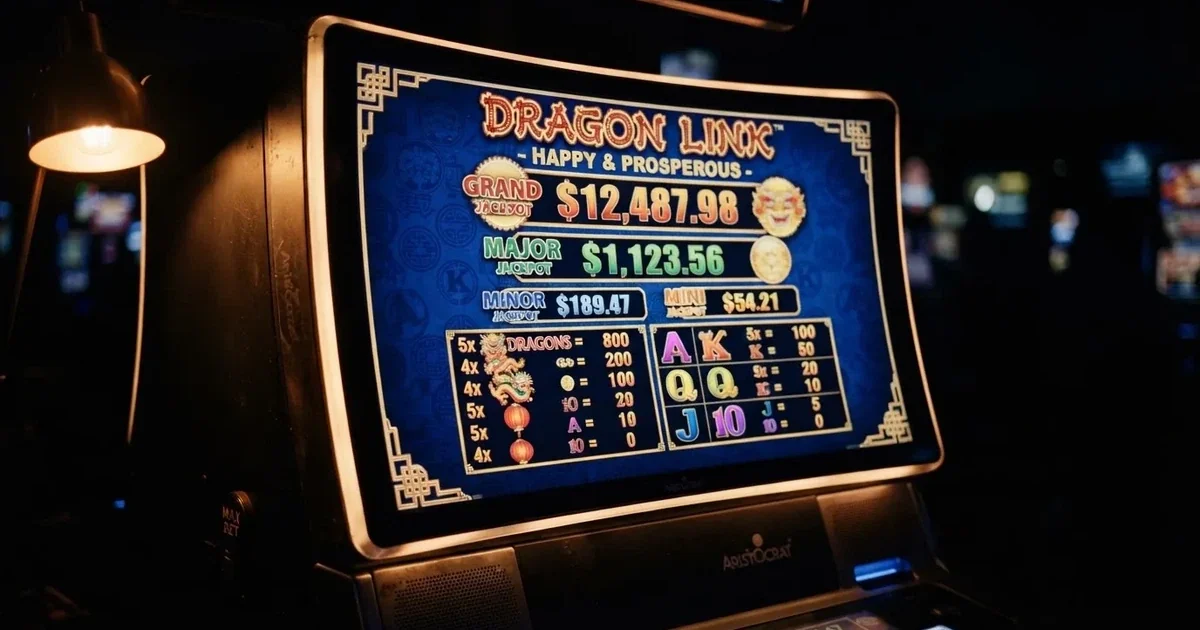
Table of Contents
- Why progressive jackpot slots sit on the wrong side of Australian law
- Player safety when the jackpot is the marketing
- How a progressive jackpot slot actually pays
- How a shortlist of progressive jackpot slots is actually built
- ACMA-warned operators offering progressive jackpot slots to Australians
- What an Australian player is actually paying for
- Progressives in the wider Australian context
- FAQ
Why progressive jackpot slots sit on the wrong side of Australian law
The Interactive Gambling Act 2001, tightened by the Interactive Gambling Amendment Act 2017, makes it a criminal offence to provide online casino games, online pokies or in-play betting to a person physically in Australia. The law targets the provider, not the punter — the player is not prosecuted for logging in — but it leaves the offshore operator with no licence to display, no Australian regulator to answer to, and no obligation to pay out a disputed jackpot through any Australian body.
Online casino products are not licensable anywhere in Australia. Wagering on racing and sport placed before the event is licensable, lotteries and keno are licensable, and the practical licensing home is the Northern Territory, where the Racing and Wagering Commission regulates 52 of the country’s online bookmakers — Sportsbet, Bet365, Ladbrokes among them — from a meeting room in Darwin that convenes once a month. Progressive jackpot slots are not on that list. No state or territory issues a licence for an online pokie that links to a rising prize pool, and any site showing a Curaçao or Anjouan seal while targeting Australians is selling something the local regulator cannot endorse.

The Interactive Gambling Amendment (Gambling Reform) Bill 2026 passed Parliament on 19 August 2026. Its advertising and inducement measures do not commence until 1 January 2027, so on a page read in 2026 the reform is law with a start date rather than law in force. The underlying prohibition on the product itself, however, has been on the books since 2017.
What the ACMA has actually done
The Australian Communications and Media Authority investigates complaints, issues formal warnings, and can direct Australian internet service providers to block offending websites at the domain level. By the ACMA’s own count reported in June 2026, 1,751 illegal gambling and affiliate marketing websites had been blocked since the first blocking request in November 2019, and more than 230 unlicensed services had left the Australian market since enforcement intensified in 2017. The blocking rate is what makes the page’s calculation worth running:
Between November 2019 and June 2026, the ACMA moved from a single blocking request to a cumulative 1,751 blocked sites. That works out to roughly 219 blocked domains a year, on average — almost one Australian-facing offshore site a business day, every business day, for six and a half years. The latest round alone, reported on 26 June 2026, asked ISPs to block 12 more: 7Signs, ChromaBet, Donbet, Duospin, Freshbet, Slots Gem, Jacks Club, Lucky Start, Pointsbetz, Spinrise, Vinyl Casino and Wildsino.
| Blocking Metric | Value / Range |
|---|---|
| Total sites blocked (since Nov 2019) | 1,751 |
| Average annual blocking rate | ~219 domains |
| Enforcement start date | Nov 2019 |
None of those 1,751 sites has ever been prosecuted for offering progressive jackpot slots to Australians; they were blocked as prohibited interactive gambling services, the legal category that swallows every offshore online pokie in the country.
The same report cited H2 Gambling Capital’s 2025 estimate that Australians lose about A$3.9 billion a year to illegal gambling sites, and that the share of gambling going through legal channels fell from 74% in 2021 to 64%. The legal channel is not losing ground because Australians are gambling less. It is losing ground because offshore sites keep appearing, and the ACMA’s blocking list keeps getting longer.
Why this section is not an inducement
It is worth being blunt about what the ACMA’s actions mean at the cashier window. An offshore casino accepting Australian deposits is not connected to BetStop, the National Self-Exclusion Register that has been live since August 2023, because BetStop binds Australian-licensed services and an offshore operator is not one. A player who wins a progressive jackpot at an offshore site has no Australian complaints body to appeal to if the operator refuses to pay, no enforceable right to a withdrawal, and no guarantee the site will still resolve to a working domain a week later. The block can come with a balance still on the account, and the operator is not required to refund it.
Player safety when the jackpot is the marketing
What the safeguards actually cover
The Australian player-protection framework was built around licensed wagering, not offshore casino products. Three pieces do real work, and the gap between them is exactly where a progressive jackpot slot falls through.
The first is BetStop. A person who signs up to the National Self-Exclusion Register is excluded from every Australian-licensed online and phone wagering service for a chosen period, and the exclusion is enforceable against the operator. The mechanism works because the operator is licensed and the regulator can act. An offshore progressive jackpot site is not in that network, and BetStop has no technical means of extending to it. Self-exclusion from BetStop therefore does not stop an offshore site from accepting the same player’s deposits.
The second is the National Gambling Helpline on 1800 858 858 — free, 24/7, with a chat service through Gambling Help Online. The helpline is the practical front door for anyone whose gambling has stopped being recreational, whether or not they play at a licensed venue, a pub pokie, an offshore site, or all three. The third is the Australian ban on credit cards, credit-related products and digital currency as payment for licensed online wagering, in force since 11 June 2024, with penalties of up to A$247,500 for operators that take them. A site that asks an Australian for a credit card or a Bitcoin deposit is operating outside the Australian rules. The ban applies to licensed operators; an offshore site is not in the regime and therefore not bound by it, but it is also a signal that what the player is being asked to do is not something the local framework endorses.
The protection that does not travel
The pattern across the three safeguards is the same: each works only where the operator is part of the Australian system. Offshore sites offering progressive jackpot slots are not part of it, and the marketing tends to skip over the part where this would matter. A reader comparing offers should treat any mention of “responsible gambling tools” on an offshore progressive-jackpot site as the operator’s own self-policing, because there is no Australian regulator behind it. The two practical things the player still controls are the deposit method — a credit card or crypto request is the warning light — and the place the dispute would go if the operator refused to pay a jackpot: nowhere Australian, in practice.
How a progressive jackpot slot actually pays
The paytable mechanism
A progressive jackpot slot works by skimming a fraction of every losing wager into a pooled prize that is not paid out until someone hits the qualifying combination or triggers the bonus round. The pool climbs with every spin that does not win it, then resets to a predetermined minimum when it is won, and the cycle starts again. Casinos fund the growth from a portion of their own profit margin, which is why the headline number can be larger than the underlying game’s theoretical return would otherwise support.
Two structural shapes matter to a player reading the paytable. The first is the standalone progressive, where the prize pool accumulates only on machines within one venue or one operator’s own network. The second is the wide-area progressive, where machines across many venues contribute to a single shared pool — the model behind the largest jackpots. The wider the pool, the faster the meter rises, and the longer the odds become for any individual spin. The pool size on the screen is not the player’s expected payout. It is the sum of every losing spin behind it.
A “must-hit-by” progressive is a separate variant. The random number generator sets the exact payout within a preset range, say A$1,000 to A$3,000, immediately after the previous jackpot is won, and the meter is forced to land inside that window before some upper limit is reached. The trade is a smaller ceiling for a much better trigger probability — the jackpot is engineered to fall within a defined window, even if it never reaches the eye-watering numbers a wide-area progressive can show.
What the base return looks like
Wide-area progressive slots tend to carry a lower base return-to-player than fixed-jackpot games of the same theme, because some of every dollar is being routed to the pool rather than to the regular paytable. A typical 96% fixed-jackpot game might be a 92% progressive, with the missing four points going to the meter. The structural point is that the player is paying for the chance at the headline number with every losing spin, and the headline number is the operator’s marketing as much as it is the player’s prize.
Some progressive games can grow large enough to push the theoretical return above 100%, creating a positive-expectation bet in the abstract. This is documented for certain video poker and Caribbean Stud variants, where the maths is publishable. For a slot machine, the reel layouts are not published, and the player cannot replicate the operator’s calculation. The point that does translate is the conceptual one: a big enough meter, on a small enough base game, can theoretically become a positive-expectation proposition. Whether any specific progressive at any specific meter reading is at that point is not something a reader can determine from the paytable.
Where the record sits
The largest verified online slot jackpot on the public record is €19,430,723.60, won on 27 April 2021 by a Belgian player at Napoleon Sports & Casino on Microgaming’s Absolootly Mad: Mega Moolah. Games Global, the business formerly known as Microgaming, now distributes the Mega Moolah series and has announced later Mega Moolah wins of £11.5 million and £13.5 million, which sit on the same progressive network. The physical side predates the online record: progressive jackpots were first introduced in large casinos in 1986, and the first Megabucks machine, made by International Game Technology, paid out its inaugural jackpot of US$4,988,842.17 on 1 February 1987. The headline numbers are real, the verification is on a public ledger, and the catalogue that produced them is identifiable. What is not on the public ledger is which offshore sites offering the same games to Australians are paying out at all.
What actually triggers the round
The trigger on a typical progressive jackpot slot is a bonus round, not a single symbol combination on the base reels. The base game runs as a normal slot, with the regular paytable in force; entry to the jackpot round usually requires either a scatter combination, a random trigger on any paid spin, or a “wheel” spin awarded inside a feature. Inside the jackpot round the player usually sees a fixed set of jackpot tiers — Mini, Minor, Major, Mega — and lands on one. The Mega tier is the wide-area progressive. The lower tiers are typically fixed or short-cycle progressives that reset to a known value, so the player can read the size of each tier from the paytable before betting.
This matters because the marketing tends to compress all four tiers into “the progressive jackpot.” A player who lands on a Minor that resets to A$500 has not won the headline number, and the headline number has not changed. The Meter the screen shows is the Mega, and the bonus round is what reaches it.
How a shortlist of progressive jackpot slots is actually built
The criteria that separate one from another
Any ranking that sorts progressive jackpot slots has to commit to four questions, because the headline number alone is not a basis for choosing. The first is the size of the seed — the minimum the meter resets to after a win — which sets the floor under the headline number. The second is the contribution rate, the share of every losing wager that goes into the meter, which determines how fast it climbs. The third is the network shape: a standalone pool rises slowly but pays more often, a wide-area pool rises fast and pays rarely. The fourth is the base game’s return to player, because the lower the base return, the more the player is paying in lost wagers to keep the meter growing.
A fifth criterion, often unspoken, is whether the operator offering the game is even permitted to offer it to the player in front of them. For an Australian player, that question does not just rank the slot — it eliminates most of the comparison, because the vast majority of slots offering wide-area progressives are on offshore sites that cannot lawfully accept Australian real-money play.
The cost to the player that the ranking never shows
A reader comparing two progressive jackpot slots sees the headline number, the theme and the provider. They do not see the wagering turnover the player has to put through the base game to keep the meter growing, the lower base RTP that pays for the meter, or the withdrawal terms that determine whether a real win is ever realised. A 92% base return on a slot the player would have played anyway at 96% is a four-point haircut on every spin that funds the chance at the headline. A withdrawal term that limits cashouts to a small multiple of the deposit caps the upside in a way the headline number does not telegraph.
This is what the table further down tries to lay side by side: the ACMA action against the operator offering each slot, the operator name on the warning, and what the listings themselves say about the operator’s progressive catalogue. Where the listings say nothing, the row says nothing.
What the comparison cannot settle
A table can line up the warning dates and the listing claims. It cannot tell the reader which slot will hit first, because no one knows which spin pays out the meter. It cannot tell the reader whether the operator behind the slot will still be reachable when the win comes through. The framework around the comparison — the offshore nature of the operator, the absence of Australian recourse — is the part that matters for a reader in Australia, and that part is the same on every row. The differences between rows are smaller than the thing they have in common.
ACMA-warned operators offering progressive jackpot slots to Australians
The eleven brands below are the operators the ACMA itself has warned, by name, for offering prohibited interactive gambling services to people in Australia. They are not a ranking of where to play. Several of them list progressive jackpot games in their public catalogues. The reason they sit on this page rather than on a recommendation list is that the ACMA’s own register put them there first.
| Brand | ACMA action and date | Operator named by the ACMA | Subject support |
|---|---|---|---|
| RocketPlay | Formal warning, March 2026 (earlier warning to the same operator group, May 2022) | Pulsup Ltd (RocketPlay); earlier Dama N.V. | — |
| Level Up Casino | Formal warning, May 2022 | Dama N.V. | listings say the operator’s catalogue includes BGaming-sourced progressive content |
| Woo Casino | Formal warning, March 2025 | Dama N.V. | — |
| Spirit Casino | Formal warning, May 2025 | Dama N.V. | — |
| National Casino | Formal warning, July 2025 | Consolutetish S.R.L. | listings describe progressive slot titles in the operator’s catalogue |
| Bizzo Casino | Formal warning, July 2025 (earlier warning, 2022) | Consolutetish S.R.L.; earlier TechSolutions (CY) Group Limited and TechSolutions Group N.V. | — |
| Ignition Casino | Formal warning, July 2025 | Bamboo Media | — |
| Instant Casino | Formal warning, February 2025 | EOD Code SRL | — |
| Jackbit | Formal warning, April 2026 | Ryker B.V. | — |
| Casino Intense | Formal warning, April 2025 | Sterplay Holding Ltd | listings describe progressive content within the operator’s catalogue |
| Sky Crown | Formal warning, September 2022 | Hollycorn N.V. | — |
The em-dash cells are not gaps because the data is hidden. They are gaps because the ACMA’s formal-warning register names the operator and the date, and the public listings either say nothing specific about progressive jackpot support or say only what a marketing listing chooses to advertise. The two warnings to Dama N.V. brands across two and a half years — May 2022 for Level Up, March 2025 for Woo Casino, May 2025 for Spirit Casino — show that the same parent company can be told, warned again, and continue to operate Australian-facing brands under new names.
The progressive jackpot catalogue itself is what the operator lists, not what the regulator audits. Where a listing describes Mega Moolah-style or BGaming progressive content on a warned operator’s site, that is a description of the listing’s claim, not a confirmation that the games are paid out to Australian players at the rates the listing implies. Several of these operators carry progressive games whose prize pools are denominated in currencies the operator has no Australian licence to convert at. The pool itself is real. The cashout to an Australian player is the part that is not.
RocketPlay
RocketPlay is the brand the ACMA warned Pulsup Ltd over in March 2026, with the brand’s website address named on the warning notice. The same warning action naming Dama N.V. over Rocketplay goes back to May 2022, so the brand has moved between operators and kept running. The site lists progressive jackpot slots among its content; whether any of those jackpots are paid out to Australian accounts is not a question the listing answers, because the listing is not subject to Australian consumer law. The cost picture for an Australian player here is the same as for every other row in this section: any deposit made to settle a progressive jackpot wager sits in an account at an offshore operator that the ACMA can ask an Australian ISP to block with the balance still on it.
Level Up Casino
Level Up Casino is the Dama N.V. brand the ACMA warned in May 2022, alongside Bambet, Dazard, Rocketplay, Wild Tornado and Cobra Casinos. The site’s catalogue lists BGaming progressive content, and BGaming’s progressive games are widely aggregated across offshore casinos. The relevant trade-off for the reader is that the BGaming label does not change the regulatory status of the site offering it. A progressive jackpot game on a site the ACMA has named is still a wager on a prohibited interactive gambling service.
Woo Casino
Woo Casino is the Dama N.V. brand that drew a fresh ACMA formal warning in March 2025, two and a half years after the May 2022 round that caught the same parent. The point of the second warning is not that the regulator had to repeat itself. The point is that the parent operator was able to keep one brand running while the warning was being prepared for another. Woo’s catalogue lists progressive jackpot content; the operator does not name the seed values, the contribution rates or the wide-area networks involved. The player reading the screen sees the meter. The player reading the catalogue sees the marketing.
Spirit Casino
Spirit Casino is the second Dama N.V. brand to draw a fresh warning in 2025, this one in May. The pattern across the three Dama N.V. brands in this section — Level Up, Woo Casino, Spirit Casino — is the same: a parent operator warned once, warned again under different brand names, and continuing to list progressive content to Australian-facing URLs. The progressive jackpot catalogue at Spirit Casino does not differ in any meaningful way from Woo’s. The warning does.
National Casino
National Casino is the Consolutetish S.R.L. brand the ACMA warned in July 2025, alongside Bizzo Casino. The site’s listings describe progressive slot titles within its catalogue, though the operator does not publish per-game seed values or contribution rates. For an Australian player, the difference between this row and the Dama N.V. rows is which parent entity the ACMA named. The difference between this row and any licensed Australian venue is the entire question the rest of this page exists to answer.
Bizzo Casino
Bizzo Casino is the second Consolutetish S.R.L. brand warned in the same July 2025 round. The earlier ACMA warning on the same brand went to TechSolutions (CY) Group Limited and TechSolutions Group N.V. in 2022, so the brand has cycled through three parent entities while keeping a consistent Australian-facing presence. The progressive jackpot content described in the operator’s own listings does not differ across the parent changes; the legal posture does, in the sense that each fresh warning is a fresh regulatory marker against a name the operator has put in front of Australian players again.
Ignition Casino
Ignition Casino is the Bamboo Media brand the ACMA warned in July 2025. The site’s listings position the operator around poker and casino content broadly; progressive jackpot slots are part of the catalogue without the operator publishing a per-game technical sheet. The marketing surfaces the headline numbers. The paytable does not.
Instant Casino
Instant Casino is the EOD Code SRL brand the ACMA warned in February 2025. The site’s progressive catalogue is described in the operator’s own marketing pages and not in any ACMA filing. The headline meters on the games the operator lists are real numbers from the underlying provider networks; whether the operator honours a withdrawal against an Australian account is the unstated part.
Jackbit
Jackbit is the Ryker B.V. brand the ACMA warned in April 2026, in the same action that named CasinOK. The site is structured around digital-currency wagering, which puts it on the wrong side of the Australian credit-and-crypto ban even before the IGA point. The progressive catalogue listed by the operator is the same Mega Moolah-style content other offshore sites list, with the added cost layer of a deposit method Australia has explicitly disallowed for licensed wagering.
Casino Intense
Casino Intense is the Sterplay Holding Ltd brand the ACMA warned in April 2025. Public listings describe progressive content within the operator’s catalogue, sourced from the same aggregators that supply most offshore casinos. The relevant reading for an Australian player is that “Casino Intense” sits behind a fresh ACMA warning and the progressive jackpot listing on the operator’s own site is not an Australian endorsement.
Sky Crown
Sky Crown is the Hollycorn N.V. brand the ACMA warned in September 2022, alongside Blue Leo. Sky Crown’s catalogue lists progressive slots in the same shape as the rest of this section. The warning is two years older than the others, but it is the same prohibition.
What an Australian player is actually paying for
The arithmetic of an offshore progressive jackpot
A progressive jackpot’s headline is the wide-area pool, not the base game. A player who deposits A$200 into an offshore site offering Mega Moolah is paying for two things at once. The first is a base game running at a lower return than the equivalent fixed-jackpot slot, because every spin contributes a fraction of a cent to the meter. The second is exposure to a withdrawal process that is not under Australian consumer law. The combination is what makes the offer look expensive once the marketing words are stripped out.
The reverse trade-off is real: the player pays in base-game return for the chance at a number the base game cannot reach. The trade-off is also voluntary, in the sense that the player can stop spinning, walk away from the meter, and never contribute another cent. Where the trade stops being voluntary is when the offshore operator accepts a deposit after the player has asked to self-exclude, refuses to process a withdrawal of a won jackpot, or stops responding altogether. None of those outcomes has a remedy in Australia.
What a licensed Australian pokie machine does instead
Progressive jackpot machines exist in licensed Australian venues — pubs and clubs run linked progressives, and the major casinos in Melbourne and elsewhere run wide-area networks under state regulation. These are physical machines, regulated under state gaming machine regimes, with published return-to-player percentages and a regulator who can act on a complaint. The Northern Territory Racing and Wagering Commission does not licence these; state regulators do, and the underlying authorisation is the relevant state or territory gaming act. The trade-off between the licensed Australian pokie machine and the offshore progressive slot is the trade between a regulated product with a published return and a marketed product with no Australian regulator behind it.
The cost the marketing does not print
Three costs sit beneath every offshore progressive jackpot offer. The first is the lower base RTP, paid in lost wagers to keep the meter moving. The second is the absence of recourse if a withdrawal is refused, because the ACMA’s mandate is to block the service, not to adjudicate disputes. The third is the credit-card and crypto ban that an Australian player cannot lawfully use at a licensed Australian wagering site — and the fact that an offshore site asking for one of those payment methods is asking for something the Australian framework has explicitly disallowed.
The cumulative cost is what the reader pays to access a jackpot that, in the licensed world, can only be reached by physically being at a regulated machine. A jackpot of €19.4 million paid to a Belgian player in 2021 is real, and so is the ACMA’s blocking list of 1,751 sites. The two facts do not cancel each other. They are the same market, viewed from two different ends.
Progressives in the wider Australian context
Where the legal money goes
The legal Australian online gambling market is, in practice, wagering on racing and sport placed before the event, lotteries and keno. The Northern Territory Racing and Wagering Commission regulates 52 of the country’s online bookmakers, including the major retail brands, from a meeting schedule that runs once a month in Darwin. The commission has no full-time staff, which is itself a structural fact about how thin the regulatory layer is for the products that are licensed. Progressive jackpot slots are not part of this market. The H2 Gambling Capital estimate that the legal share of gambling fell from 74% to 64% between 2021 and 2025 is the practical measure of how much of the rest has gone offshore.
What the 2026 reform actually changes
The Interactive Gambling Amendment (Gambling Reform) Bill 2026 passed Parliament on 19 August 2026. Its advertising and inducement measures commence on 1 January 2027. On a page read in 2026, the reform is law with a start date. The provisions tighten the rules around marketing inducements — bonus offers, “free bet” advertising, sign-up incentives — aimed at Australians, even where the underlying product is already prohibited. The effect on progressive jackpot slots specifically is to extend the existing prohibition into the marketing layer rather than to legalise the product.
What an Australian player should read before depositing
An Australian player looking at a progressive jackpot slot, whether online or in a venue, can read three things that decide whether the offer is worth what the marketing says it is. The first is the seed value and the contribution rate, where the operator publishes them — and most offshore operators do not. The second is the base RTP, which determines the per-spin cost of keeping the meter alive. The third is the dispute path, which in Australia is BetStop and the relevant state regulator for licensed products, and not an Australian body at all for offshore products. Where the third item is empty, the first two items do not change, but the cost of getting them wrong rises sharply.
FAQ
How does a progressive jackpot slot’s prize pool actually grow between wins?
A fraction of every losing wager is skimmed into a pooled prize, the meter climbs with each spin that does not win the jackpot, and when the qualifying trigger lands the meter pays out and starts again from a predetermined seed. Wide-area networks feed the pool from many venues at once, which is why the meter rises faster than a standalone machine’s would.
What is the difference between a standalone jackpot and a network-wide progressive jackpot?
A standalone jackpot accumulates on machines in a single venue or operator’s network and tends to pay smaller prizes more often. A wide-area progressive links machines across many venues to a single shared pool, climbs much faster and pays the headline numbers; the trade-off is a much lower chance per spin of triggering the top tier.
Do licensed Australian pokies venues offer progressive jackpot machines?
Yes, in pubs, clubs and casinos operating under state gaming machine regimes. These are physical machines with published return-to-player percentages and a state regulator behind them. They are not online casino products, and the ACMA’s offshore-blocking actions target a separate market entirely.
Why do progressive jackpot slots typically have a lower base return-to-player than fixed-jackpot games?
Because some of every dollar wagered is being routed to the progressive pool rather than the regular paytable. The headline meter is funded by the gap between a fixed-jackpot game’s RTP and a progressive game’s RTP, which is why the base game returns less per spin than its non-progressive cousin would.
How is a record progressive jackpot payout verified?
The Mega Moolah €19,430,723.60 win in April 2021, the largest verified online slot payout on the public record, was reported by the operator and the platform provider and covered by the European gaming press; Games Global, the current Mega Moolah distributor, publishes subsequent wins on the same network. Verification comes from the operator and the platform, not from a third-party audit body in the way a financial statement would be.
What triggers the jackpot round on a typical progressive jackpot slot?
A bonus round rather than a base-game symbol combination. The base reels run as a normal slot, and entry to the jackpot round comes from a scatter combination, a random trigger on any paid spin, or a wheel inside a feature round. Inside the jackpot round the player lands on one of the preset tiers — Mini, Minor, Major, Mega — and the Mega tier is the wide-area progressive shown on the meter.