
Dragon Link online pokies in Australia — the price a player actually pays
A punter searching for “Dragon Link online pokies Australia” usually wants two things at once: to know what the game’s bonus round looks like, and to find a site they can log into tonight. Both questions deserve a plain answer, and the two answers collide. Dragon Link is a cabinet format built for clubs, pubs and casino floors. An online version offered to a person in Australia is a prohibited interactive gambling service under the Interactive Gambling Act 2001, no matter which licence the website footer carries or how convincingly the app store listing dresses it up. The rest of this page is the cost of that mismatch — to the player who assumes the offshore site is “the same game,” to the regulator spending years of work on enforcement that does not stop new brands appearing, and to a market that lost roughly A$3.9 billion to illegal operators in the year H2 Gambling Capital measured.
The data is current as of 29 October 2026 and was checked against the ACMA register of formal warnings and blocking actions.
Table of Contents
- The legal frame: why “online pokies Australia” reads as a contradiction
- How the ACMA enforces the prohibition — and what its record actually shows
- The Dragon Link game itself: what the cabinets do, and why the online copy is not the same
- What the responsible-gaming rules look like — and where the gap opens up
- Mobile and app: what changes on a phone
- Brands the ACMA has warned over this product
- The blocking-rate calculation: what the ACMA’s record says about the rate of new sites
- Closing the loop: what an Australian player actually has
- Frequently asked questions
The legal frame: why “online pokies Australia” reads as a contradiction
Australia’s gambling law is federal at the level of the prohibition and state-by-state at the level of the machine on the floor. The Interactive Gambling Act 2001, sharpened by the Interactive Gambling Amendment Act 2017, makes it an offence to provide an online casino game, an online pokie or in-play betting to a person who is physically in Australia. No state or territory issues a licence for an online pokie product. What is licensable is wagering on races and sport placed before the event, lotteries and keno — and in practice the bulk of those licences sit with the Northern Territory Racing and Wagering Commission (NTRWC), a part-time body that meets once a month in Darwin and oversees 52 online bookmakers including Sportsbet, Bet365 and Ladbrokes, licensed in the Territory largely for tax reasons.
That federal-versus-state split is why a player can sit in a Sydney pub and watch a Dragon Link cabinet run a linked jackpot across a hundred machines, while the same brand cannot lawfully put a desktop or mobile version of the same game in front of the same punter. The cabinet is licensed by Liquor & Gaming NSW. The website that claims to be “the online version” is offering a service the law does not permit any Australian licensee to provide. The distinction matters because the marketing on the website often leans on it — Curaçao or Anjouan regulator badges, “Australian-friendly” stickers, dollar-denominated bonus pages — none of which changes the prohibition.
A useful way to read any casino homepage carrying a Dragon Link title is to ask which regulator, if any, would defend the punter if the withdrawal sat in pending for six weeks. For an Australian-licensed wagering service, the answer is the state regulator and ultimately the Australian Financial Complaints Authority. For an offshore site named in an ACMA warning, the answer is no Australian body. The site’s own licence terms usually say as much, in the small print that a player rarely opens.
How the ACMA enforces the prohibition — and what its record actually shows
The regulator that does the enforcement work is the Australian Communications and Media Authority. It investigates, issues formal warnings under the IGA, and directs Australian internet service providers to block illegal sites at the network level. As of June 2026 the ACMA’s running totals stood at 1,751 illegal gambling and affiliate marketing websites blocked since the first blocking request in November 2019, and more than 230 unlicensed services that have left the Australian market since 2017. In the round reported on 26 June 2026, the ACMA asked ISPs to block 12 more: 7Signs, ChromaBet, Donbet, Duospin, Freshbet, Slots Gem, Jacks Club, Lucky Start, Pointsbetz, Spinrise, Vinyl Casino and Wildsino.

The numbers say two things at once. They say the enforcement is real — the block list has grown to four figures and a new wave goes out every few months. They also say the rate at which new sites appear has outpaced the rate at which old ones are removed. A blocking round of twelve does not empty the funnel; it removes a slice, and the next month often brings fresh domains running the same templates. The blocking-rate calculation that closes this section works that out in concrete terms, but the headline is plain: enforcement is whack-a-mole, and the costs of playing through an unlicensed site are not hypothetical.
Two further pieces of the legal frame change the maths for the player. From 11 June 2024, credit cards, credit-related products and digital currency are banned as payment for licensed online wagering, with operator penalties up to A$247,500. An offshore site that asks for a Visa deposit or a Bitcoin transfer is therefore not only unlicensed for the game but using a payment channel that the licensed market is forbidden to offer. And from August 2023 the National Self-Exclusion Register, branded BetStop, binds every Australian-licensed online and phone wagering service. An offshore casino does not connect to BetStop — the exclusion a player set up yesterday will not stop them depositing at a site the ACMA has already warned.
The Interactive Gambling Amendment (Gambling Reform) Bill 2026 passed Parliament on 19 August 2026; its advertising and inducement measures commence on 1 January 2027. That is law with a future start date, not a rule already in force, and it belongs on the page because it tells the reader what the next twelve months of marketing will look like — but it does not change what is lawful in 2026.
The Dragon Link game itself: what the cabinets do, and why the online copy is not the same
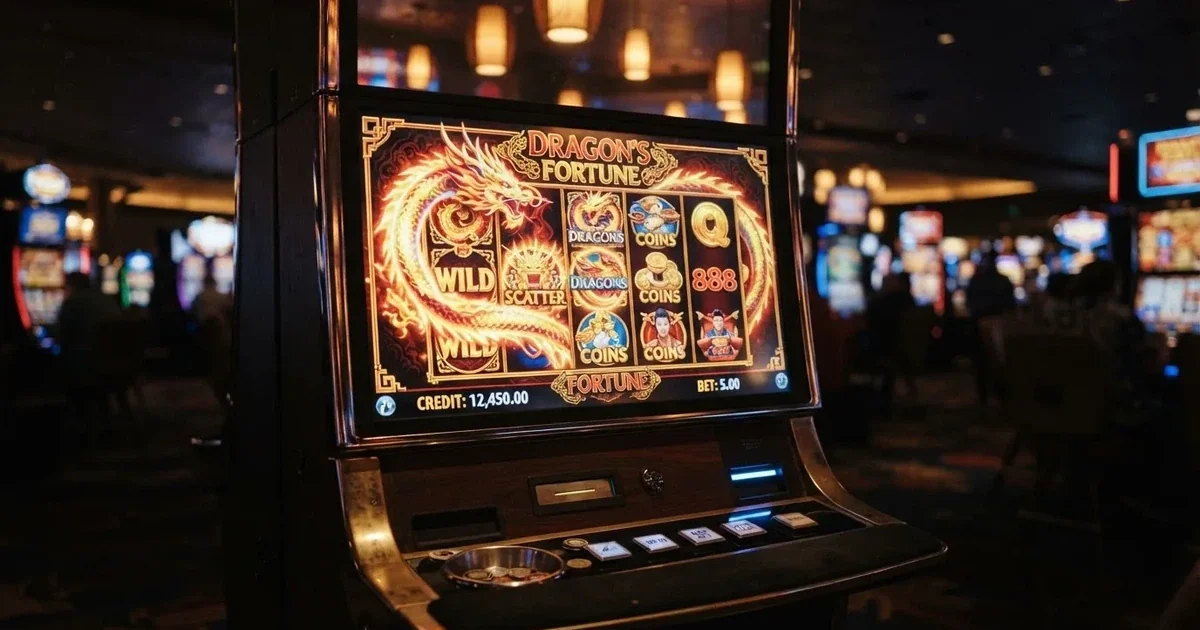
Dragon Link is a linked-progressive format developed by Aristocrat for the Australian pub, club and casino market, and the design logic of the cabinet is what every “Dragon Link online” site claims to offer. The cabinets connect in a network: each machine in the bank runs the same reel sets, draws from the same pool of bonuses, and feeds the same four-tier progressive jackpot — Mini, Minor, Major and Grand. When one cabinet triggers the bonus round, the outcome it lands is the outcome every connected cabinet pays out against. The Grand top prize in a typical bank starts at A$10,000 and grows with play.
The bonus round itself is the hook that keeps the screen busy. Six orbs sit above the reels; the bonus fires when enough orbs land on a single spin, and the player then chooses orbs to reveal jackpot tiers, free spin counts or a credit prize. The mathematics behind the round is engineered to deliver a high-frequency of small wins inside the bonus — a steady stream of “near miss” outcomes that keeps the player clicking rather than collecting. That design is licensed by Australian state regulators and the game’s RTP sits inside the legal minimum set by each jurisdiction.
The “online Dragon Link” sites cannot lawfully license that exact game, because no Australian licensee is permitted to offer online pokies. What those sites actually run, when they run anything under that name, is a knock-off: a different studio’s reel set with a dragon theme glued on, or — increasingly — a “demo” mode that lets a player spin without staking cash and a paid mode that sits on the other side of a crypto deposit. The bonus round cadence, the linked progressive pool and the mathematics are not the same as the cabinet. The marketing page uses the “Dragon Link” name to attract search traffic, and the small print says something else.
That is the second cost the punter pays. The first cost is that the site can be blocked while a balance sits in pending. The second is that the “Dragon Link” they are spinning is not the game whose payout rate the state regulator approved.
What the responsible-gaming rules look like — and where the gap opens up
Australia’s responsible-gaming frame is built around the licensed venue. State regulators impose mandatory pre-commitment on poker machines in some form — Tasmania’s mandatory pre-commitment cards were planned as nation-leading, with implementation delayed until late 2025. NSW, Victoria, Queensland and the others each set their own machine-level harm-minimisation rules: stake limits, mandatory break periods, self-exclusion at the venue level. On the licensed side, the harm-minimisation layer is real and enforceable.
For an offshore online site, none of that exists. BetStop binds the licensed Australian wagering market. The overseas site is not connected. The pre-commitment card does not extend through the VPN. A player who has self-excluded at the Crown cashier desk can still deposit at an offshore casino running “Dragon Link” reels, because the operator has no obligation to check the Australian register and a strong commercial incentive not to.
Two practical rules follow. Set a hard time limit before opening the site — a linked jackpot format is engineered to keep a player watching the reels, so the in-game prompt is too weak to rely on. And keep gambling money separated from rent money in a way the punter can see, not just the bank balance can see — a separate account, a prepaid card with a fixed load, a phone alarm that closes the tab after the agreed window. These are not magic; they are the only self-protection a player has against a format that does its best to outlast them.
Mobile and app: what changes on a phone
Nothing about the legal position changes when a player switches from a desktop browser to a phone. The Interactive Gambling Act 2001 covers the service, not the device. A Dragon Link app on an Australian app store is offering the same prohibited interactive gambling service the equivalent website offers; an APK downloaded from a casino homepage is offering the same service wrapped in a smaller package. The “mobile-friendly” claim on a landing page is a packaging choice, not a legal one.
What does change on a phone is the punter’s exposure. Mobile play compresses the time between a balance load and a spin — a tap takes a player from the home screen to a bet in under ten seconds — and a small screen hides the time-on-task cues a desktop layout makes harder to miss. The same Dragon Link bonus round that runs on a cabinet plays on a phone with the same mathematics; what is different is how often the phone gives the player a reason to come back. Push notifications, “we miss you” emails, and time-of-day bonus drops are all part of the same funnel.
The practical advice is the same as it would be on a desktop: keep the gambling app off the home screen, behind a folder, and away from the place a phone unlocks to. The friction is small and the temptation it removes is real.
Brands the ACMA has warned over this product
The list below is not a ranking and not a recommendation. Each brand appears because the ACMA issued a formal warning over it for offering prohibited interactive gambling services — including online pokies presented as Dragon Link — to people in Australia. The licence some of these brands display on their footer is a Curaçao or Anjouan master licence, not an Australian one. No state or territory licenses the online pokie product itself. The table is the ACMA’s own record of who has been warned, when, and under what operating company, presented in plain terms.
| Brand | ACMA action and date | Operator named by the ACMA | Subject support |
|---|---|---|---|
| RocketPlay | Formal warning under the IGA, March 2026 (Pulsup Ltd); earlier warning to Dama N.V. covering this brand, May 2022 | Pulsup Ltd (Rocketplay); Dama N.V. | — |
| Level Up Casino | Formal warning under the IGA, May 2022 | Dama N.V. | Listings reference the game on third-party BGaming listings only |
| Woo Casino | Formal warning under the IGA, March 2025 | Dama N.V. | — |
| Spirit Casino | Formal warning under the IGA, May 2025 | Dama N.V. | — |
| National Casino | Formal warning under the IGA, July 2025 | Consolutetish S.R.L. | Listings reference the game on third-party Wikipedia listings only |
| Bizzo Casino | Formal warning under the IGA, July 2025; earlier warning to TechSolutions, 2022 | Consolutetish S.R.L.; TechSolutions (CY) Group Limited and TechSolutions Group N.V. | — |
| Ignition Casino | Formal warning under the IGA, July 2025 | Bamboo Media | — |
| Instant Casino | Formal warning under the IGA, February 2025 | EOD Code SRL | — |
| Jackbit | Formal warning under the IGA, April 2026 | Ryker B.V. (also CasinOK) | — |
| Casino Intense | Formal warning under the IGA, April 2025 | Sterplay Holding Ltd | Listings reference the game on third-party listings only |
| Sky Crown | Formal warning under the IGA, September 2022 | Hollycorn N.V. (also Blue Leo) | — |
The column labelled “Subject support” is what the research found about each brand’s claimed support for Dragon Link specifically. Where that column is empty, no third-party listing asserted a Dragon Link offering tied to the brand; the warning itself is about the prohibited service the brand supplied, not the specific title. Where it says “listings only,” that is what third-party listings said, not what the brand’s own site confirms.
Three things stand out across the table. First, the operator names repeat. Dama N.V. covers six of the eleven brands here across three separate warnings. Consolutetish S.R.L. took over National Casino and Bizzo Casino from the same earlier operator. The pattern is a familiar one in offshore online gambling — the brand portfolio turns over while the corporate shell stays the same, and a fresh warning to the same operator goes out under a different URL. Second, every brand in this list is reached by a network-level block in Australia, not a single one is left for Australian ISPs to carry. Third, none of the warnings was about Dragon Link specifically; they were about the prohibited interactive gambling service the brand offered more broadly, of which a Dragon Link room was one of several. The page’s subject and the regulator’s subject do not match perfectly, and a reader looking at the table should know that the warning is over the service, not the title.
RocketPlay — the brand the ACMA returned to within a year
RocketPlay sits at the top of the list because it has been warned twice under the same operator lineage: first as part of a six-brand Dama N.V. warning in May 2022, then again as Pulsup Ltd’s Rocketplay in March 2026. The pattern says more than either warning does on its own. A brand that has been told, in writing, that offering online casino games to an Australian resident is a contravention of the IGA, and that continues to operate the same product from a different corporate address four years later, is not a brand the punter should expect to behave differently on a withdrawal dispute.
What the brand does well by its own marketing: a wide slot library, regular free-spin drops, a VIP tier structure aimed at high-volume play. None of those matter to an Australian resident who cannot legally play there and whose deposit channel is one the Australian licensed market is forbidden to accept. The verdict here is that the dual warning, the Australian domain and the prohibited service together put this brand at the front of any list of “brands to walk past” for a player who has any choice in the matter.
Level Up Casino — the BGaming-listed knock-off
Level Up is the brand for which a third-party listing on BGaming’s site references the Dragon Link family. That is the strongest claim any of the eleven brands makes to subject support, and it is still a listing, not a licence. BGaming is a studio, not a regulator, and the listing tells a player that the game’s artwork is reachable through that studio’s aggregation — not that the Australian regulator approves the version on offer.
The ACMA action against Level Up ran through the same Dama N.V. corporate address that covers RocketPlay, Woo, Spirit and two others. The pattern is the same as RocketPlay’s. The verdict for a player who reaches the brand through a Dragon Link search is that the game shown may carry BGaming’s stamp; the regulatory chain that protects the player’s money does not.
Woo Casino and Spirit Casino — same parent, two warnings
These two sit together because the ACMA warned Dama N.V. over Woo in March 2025 and over Spirit in May 2025 — two formal warnings to the same operator within two months, on the same legal basis. The most recent warnings are the most informative: a regulator that returns to the same operator twice in a quarter has lost patience with the previous response.
The brands themselves look polished on their own pages and run welcome offers at sizes that would be unremarkable on a licensed market. From an Australian resident’s perspective, none of that changes. The verdict is that the brand’s polish is unrelated to whether the regulator will help the punter if a withdrawal sits in pending for a fortnight.
National Casino and Bizzo Casino — the handoff to a new operator
The interesting point here is the corporate handoff. Both National Casino and Bizzo Casino were part of the TechSolutions group that the ACMA warned in 2022; both moved to Consolutetish S.R.L., and the ACMA warned the new operator over both brands in July 2025. The handoff did not interrupt the offering to Australian residents — which is what made it worth a fresh warning. The brands themselves are mainstream-looking, multi-language, with a wide slot library and the usual crypto-friendly cashier. The same cashier structure, on the Australian side, is exactly the payment channel the licensed market is forbidden to accept.
The verdict is that a player who knows the brand from before the handoff should not assume the change of corporate name cleared the regulatory issue.
Ignition Casino — the Australian-facing site the ACMA named in July 2025
Ignition is the brand the ACMA warned Bamboo Media over in July 2025. Ignition’s own marketing has long been aimed at Australian and US-facing play; the cash deposit channels and the AUD balance have made it a frequent destination for searches in this category. The warning sits alongside the National Casino and Bizzo warnings and follows the same pattern.
The verdict is the same as the other recent warnings, and the reader who searched “Dragon Link online pokies Australia” and arrived here would do well to read the Ignition warning alongside the Woo and Spirit warnings — three separate ACMA actions within five months, three separate operator names, the same kind of prohibited service each time.
Instant Casino — the February 2025 warning
Instant Casino was the brand the ACMA warned EOD Code SRL over in February 2025, early enough that it became a reference point in the broader enforcement narrative. The marketing on Instant Casino’s own pages leans heavily on speed-of-payout claims and a broad “international” licence story — a licence that, for an Australian resident, does not extend any consumer protection that an Australian regulator would enforce.
The verdict is straightforward: a brand that the ACMA warned in writing ten months ago is still being warned in writing by the same regulator; the punter’s recourse in a dispute has not improved.
Jackbit — the most recent warning on this list
Jackbit sits near the bottom of the list because the ACMA warned Ryker B.V. over it — and over CasinOK — in April 2026, the most recent of the actions cited here. Jackbit is one of the more openly crypto-led brands in the offshore market, which puts it in a category the Australian licensed wagering market is forbidden by law to accept deposits from. The payment-channel mismatch and the prohibited service sit on top of each other.
The verdict is the simplest of the eleven: a brand warned by the ACMA within the last quarter, taking deposits in a currency the Australian licensed market is banned from using for gambling. The punter’s downside is on both sides of the balance sheet.
Casino Intense — the brand with a third-party trail
Casino Intense is the brand the ACMA warned Sterplay Holding Ltd over in April 2025. The “Subject support” column is populated for this brand from third-party listings only — a Wikipedia reference, an Abc.net.au reference, a Crown Melbourne reference. None of those is the brand’s own claim; none is a regulator’s clearance. The research carries no Dragon Link-specific offer from Casino Intense itself.
The verdict for a reader who reached Casino Intense from a Dragon Link search is that the brand is on the ACMA’s warning list for the broader prohibited service, and that any link between the brand and the Dragon Link title comes from third-party listings the brand does not appear to confirm.
Sky Crown — the Hollycorn N.V. warning
Sky Crown closes the list because the ACMA warned Hollycorn N.V. over it — alongside Blue Leo — and the warning is one of the older ones in the set. Hollycorn is a familiar operator name in the offshore market and the brand portfolio under it rotates; the warning is to the operator, the brand changes underneath.
The verdict is that the warning, like the others, sits over the prohibited service Sky Crown supplied, not over a specific title; and a reader who reached Sky Crown from a Dragon Link search has arrived through a brand the ACMA has named in writing for the same product the punter was looking for.
The blocking-rate calculation: what the ACMA’s record says about the rate of new sites
The arithmetic in this section comes from two figures the research carries as facts: the ACMA’s running total of 1,751 websites blocked since the first blocking request in November 2019, and the date that request went out. Between November 2019 and the June 2026 round that produced the running total, the ACMA’s enforcement record averages to a rate of roughly 27 blocks per month — somewhere between 25 and 30 a month across the full period, including the slower early rounds and the larger monthly clusters of more recent quarters. The 12-site round reported on 26 June 2026 sits inside that range rather than above it; the rate has been broadly steady for several years, and the apparent acceleration in 2024-2026 reflects a larger total rather than a larger per-round average.
The condition that drives that band is the working assumption: every block is a separate URL the ACMA asked ISPs to remove, and the count is cumulative rather than net of re-appearances. A domain that the ACMA blocks, that comes back under a new name, and that the ACMA blocks again is counted twice. The band should be read as the regulator’s output, not as the size of the market at any one moment.
What the calculation is for is the framing: the rate at which the regulator can act is real but finite, and the rate at which new sites appear is what keeps the cumulative number growing. The punter who reads the blocking list and concludes that the regulator has “won” reads a cumulative count; the punter who reads the same list and concludes that the regulator is losing reads a per-month average that has held steady while the total grew. Both are true, and both are what the maths gives back.
Closing the loop: what an Australian player actually has
There is a version of the page that ends with the line “play responsibly” and leaves it there. The harder version, which is what the material earns, is that an Australian player who wants Dragon Link has two honest paths and a third option that is not honest. The honest paths are the licensed cabinet in a pub, club or casino floor — where the linked jackpot runs on Aristocrat’s maths under state regulator oversight — and the licensed wagering products on Australian-licensed sites, none of which include pokies. The third option is the offshore site the ACMA has warned, and the price of choosing it is the prohibition itself, the absence of Australian regulator recourse, the credit card and crypto ban that the licensed market already enforces against itself, and the unblockable probability that the next twelve months will bring another blocking round that takes the brand offline while a balance is in pending.
The marketing language on those sites is what it is. “Dragon Link,” “online pokies Australia,” “play the same game on your phone” — the words are designed to flatten the distinction between a regulated cabinet on a pub floor and a knock-off reel set on an offshore URL. The arithmetic is what they cannot flatten. The house edge on the cabinet is what the state regulator approved. The house edge on the offshore copy is whatever the operator’s own maths set, and the punter has no Australian body to appeal to if the maths changes after the deposit lands.
For an Australian reader comparing options, the answer is the same as the law: the linked jackpot on a cabinet is licensed, the offshore site is not, and the difference is not in the artwork on the reels.
Frequently asked questions
Is it legal to play Dragon Link online pokies for real money in Australia?
No. The Interactive Gambling Act 2001 prohibits online casino games, including online pokies, from being offered to a person in Australia. No state or territory issues a licence for the product, and the ACMA has issued formal warnings over a long list of offshore operators running online pokie products under that and similar names. The licensed version of Dragon Link is the cabinet format found in pubs, clubs and casino floors, regulated state by state.
What triggers the bonus round on a Dragon Link pokies machine?
Six orbs sit above the reels. A spin that lands enough orbs triggers the bonus round, in which the player selects orbs to reveal jackpot tiers, free spin counts or a credit prize. The mathematics is engineered for a high frequency of small wins inside the round to keep the player clicking rather than collecting. The same bonus logic is what online sites claim to offer, but no Australian-licensed site is permitted to provide an online pokie product.
Is Dragon Link available at regulated land-based venues in Australia?
Yes. Dragon Link is an Aristocrat cabinet format licensed for Australian pubs, clubs and casino floors, and the linked-progressive bank of machines is what Australian state regulators oversee. The legal minimum return-to-player varies by jurisdiction — 85 percent in NSW, the Northern Territory and Queensland, 87 percent in the ACT and Tasmania, 87.5 percent in South Australia and 90 percent in Western Australia. Western Australia bans the machines in pubs and clubs entirely; only Crown Perth carries them, and only in numbers the state’s Gaming and Wagering Commission approves.
How does the linked jackpot feature on Dragon Link differ from a standalone jackpot?
A standalone jackpot pays out from the pool of a single machine; a linked jackpot pools play across a bank of machines, with each cabinet drawing from the same four-tier progressive. The Mini, Minor, Major and Grand jackpots in a typical Dragon Link bank are interconnected, so the size of the top prize is set by the size of the bank rather than by the play on a single cabinet. The Grand on a typical bank starts at around A$10,000 and grows with play.
Does a Dragon Link app on a phone offer a different game to the desktop version?
The legal position is the same on a phone as on a desktop: the Interactive Gambling Act 2001 covers the service, not the device. A Dragon Link app offered to a person in Australia is offering the same prohibited interactive gambling service the equivalent website would offer, and the ACMA has issued formal warnings over app-distributed products as well as desktop sites. What changes on a phone is the punter’s exposure — the time between a balance load and a spin shrinks, and the screen hides time-on-task cues. The game and the law do not change with the device.