
Plinko casino Australia 2026: the offer, the prohibition, the cost the page actually costs
A Plinko ball drops through a pegboard and lands in a slot worth a multiplier of the stake. The screen says “99% RTP” and “×1,000 top multiplier”, and the offshore site offering it from Curaçao or Cyprus takes the wager through a deposit in Bitcoin, Tether or a Visa card. None of that changes the central fact: the Interactive Gambling Act 2001 makes it an offence to provide online casino games to a person in Australia, and the ACMA’s June 2026 blocking round alone asked ISPs to take down twelve more of these sites. The rest of this page walks the player through what the game itself is, what the prohibitions and penalties on the provider look like, what an offshore payout actually promises, and what the ACMA’s running record of formal warnings says about the brand list any reader is likely to be looking at.

Current as of 29 October 2026 against the ACMA’s published blocking-round notices and its formal-warning register.
Table of Contents
- What the Plinko casino game is, and what the offshore pitch glosses over
- The legal prohibition Australians actually face when an offshore site offers Plinko
- Responsible gambling when the operator is outside the regime
- What crypto on an offshore Plinko site actually changes
- Payment methods, payout speed, and what an offshore Plinko site actually promises
- The Plinko game itself, side by side: what each setting changes
- The eleven brands the ACMA has acted against, and what each carries
- How often the ACMA’s blocking requests actually result in a blocked site
- What the legal and the practical frame look like side by side
- What an Australian reader should take from the comparison
- Frequently asked questions
What the Plinko casino game is, and what the offshore pitch glosses over
Plinko itself is older than the internet. It premiered on the American television show The Price Is Right on 3 January 1983, where contestants drop chips down a pegboard into nine bottom slots. The outermost slots pay $100, the next $500, the next $1,000, the centre $10,000, and the show’s maximum possible win on a single chip was $50,000 (raised from $25,000 before 1998 when the centre slot was worth $5,000). The TV version is a game show, not a betting product, and the player does not pay to drop a chip.

What an offshore casino calls “Plinko” copies the visual and the multiplier structure. BGaming’s Plinko, the version most of the offshore sites link to, advertises a 99% return-to-player figure and a ×1,000 top multiplier. A ball drops through a pyramid of pegs and lands in one of the slots at the bottom; each slot is tagged with a multiplier that scales the wager. The player sets two parameters before each drop: a risk level (low, normal or high) and the number of lines the pegboard uses (from 8 to 16). More lines means more slots, more slots means lower top multipliers and a flatter distribution. Higher risk pushes the top multiplier up and the bottom multipliers down. The player can fire one ball at a time or run an auto-bet that drops a programmed sequence.
The 99% RTP is the headline figure the offshore pitch leans on. The figure is supplied by the game’s publisher, not measured against any Australian gameplay, and it is the long-run return averaged across many balls and many players. A single session of a few hundred balls can sit well above or well below that number. The ×1,000 top multiplier is the ceiling of a probability tail — most balls land in slots paying less than the stake, and the slots that pay ×1,000 are rare by construction.
The pegboard’s geometry is the only thing the player controls. The risk setting changes the multiplier spread, the line setting changes the number of slots, and neither changes the order in which the ball ricochets off pegs. The ball-path through a peg pyramid is the same kind of pure-chance sequence a roulette wheel or a pokie reel produces: every drop is independent of the last, no skill input changes the destination, and the house edge sits in the multipliers themselves rather than in any decision the player makes along the way.
How a ball drop turns into a payout
The ball enters at the top of the pegboard and falls one peg-row at a time. Each contact with a peg sends the ball left or right with roughly equal probability, and the path through successive rows is what determines which slot the ball reaches at the bottom. With 16 lines, the pegboard has 17 slots along the bottom edge, and the multipliers assigned to those slots follow a curve that is symmetric around the centre — the outermost slots carry the smallest multipliers, the slots nearer the centre carry the largest, and the centre slot carries the top multiplier.
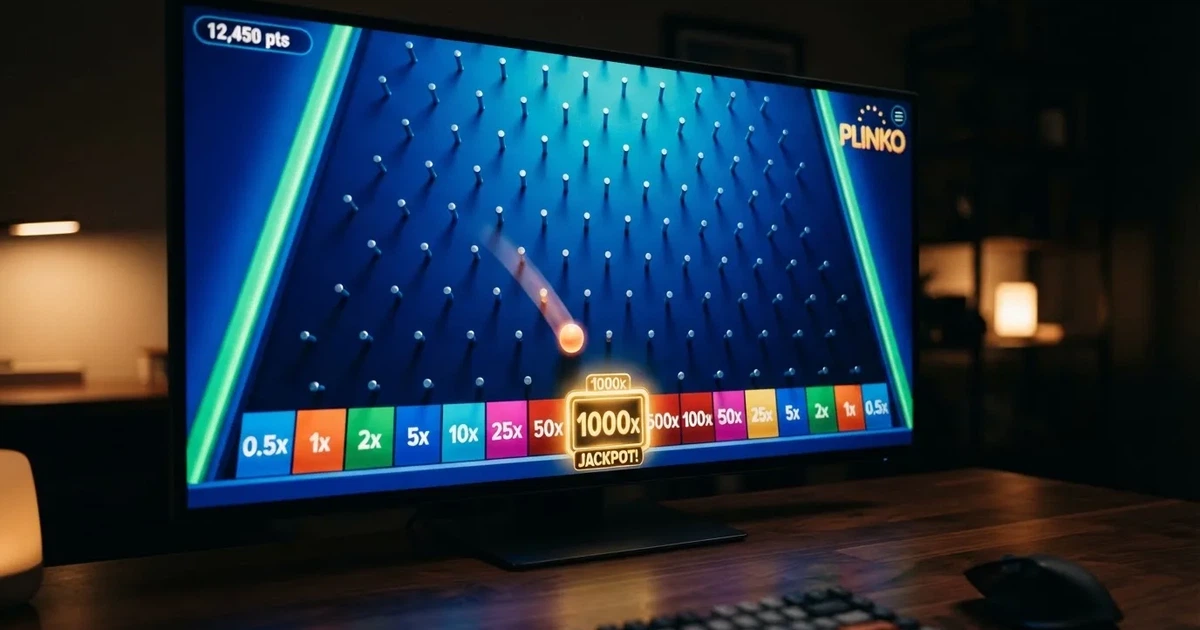
Three things follow from that geometry, and all three matter for a reader sizing up the offer:
- The probability of any single slot is set by the number of paths through the pegboard that end at that slot, not by the multiplier that slot displays. The slots with the largest multipliers have the fewest paths. A ×1,000 slot on a 16-line board is reached by a small fraction of one percent of balls.
- The payout on any single drop is stake × multiplier. A A$1 ball that lands in a ×1,000 slot pays A$1,000; the same ball that lands in a ×0.2 slot costs A$0.80 of stake. Across enough drops, the small-multiplier slots dominate by volume and the large-multiplier slots dominate by total payout, and the ratio between those two is what produces the 99% RTP in the long run.
- The risk level moves the multiplier spread. “Low” risk flattens the curve so almost every slot pays roughly the stake. “High” risk steepens it so the top slot pays the headline multiplier and the bottom slots pay well below the stake. The 99% figure is the average across the three settings at the publisher’s chosen line count, not a guarantee for any one drop or any one setting.
This is what the offshore page does not surface. The screen shows “99% RTP” and “×1,000 max win” as if they were two facts about the same game. They are two ends of the same probability distribution: a low probability of the top end and a high probability of much smaller returns, with the average somewhere in the middle.
The Plinko paytable against the games the offshore lobby usually sits beside
Plinko’s RTP, as advertised, sits well above most pokies and table games the same offshore lobby offers. The baccarat house edge is 1.06% on the Banker bet, 1.24% on the Player bet and 14.36% on the Tie. Blackjack with optimal strategy under liberal Las Vegas Strip rules is about 0.28% (dealer stands on soft 17, double on any two cards, double after split, resplit aces, late surrender) and about 0.43% under Atlantic City rules. Craps’ Pass/Come bet carries a 1.41% house edge, Don’t Pass/Don’t Come 1.36%, Any Craps 11.11%. Each of those numbers is a published house edge and is the closest the player gets to an honest summary of what a dollar at the table costs in the long run.
Plinko’s 99% RTP, taken at face value, would put it at a roughly 1% house edge — close to a single-zero roulette wheel, well below most pokies, well above optimal blackjack. That comparison is the one the marketing page is built around. It does not tell the reader what any session is likely to produce, and it does not say anything about whether the operator behind it is licensed to take Australian bets at all. The next shelf addresses that second point.
The legal prohibition Australians actually face when an offshore site offers Plinko
No state or territory in Australia licenses an online casino game. The Interactive Gambling Act 2001 (IGA), strengthened by the Interactive Gambling Amendment Act 2017, makes it an offence to provide online casino games, online pokies or in-play betting to a person physically in Australia. Plinko-style multiplier games are caught by the same prohibition as roulette, blackjack and pokies. Penalties under the IGA reach up to A$220,000 per day for individuals and up to A$1.1 million per day for corporations that provide prohibited services to Australians.
What is licensable is narrower than the marketing copy suggests. Wagering on races and sport placed before the event, lotteries and keno are licensable, and in practice those wagering services are licensed by the Northern Territory. The Northern Territory Racing and Wagering Commission (NTRWC) regulates 52 of Australia’s online bookmakers — including Sportsbet, Bet365 and Ladbrokes — which are licensed in the Territory for tax reasons. The commission has no full-time staff and meets once a month in Darwin. That bookmaker licence does not extend to online casino games. A sportsbook licensed in Darwin cannot lawfully offer roulette, blackjack or Plinko to an Australian customer. The IGA’s prohibition applies to the provider, not the player — the individual who logs in is not prosecuted — but an offshore site gives the player no Australian consumer protection, no complaints body and no recourse if a withdrawal is refused.
How the ACMA enforces the prohibition
The Australian Communications and Media Authority (ACMA) is the body that investigates, issues formal warnings and directs internet service providers to block illegal services. According to the ACMA as reported in June 2026, a total of 1,751 illegal gambling and affiliate marketing websites had been blocked since the first blocking request in November 2019, and more than 230 unlicensed gambling services had left the Australian market since enforcement was strengthened in 2017. The figure includes both casino-style services and affiliate marketing pages that referred Australian traffic to them.
The June 2026 round alone asked Australian ISPs to block twelve more illegal gambling websites: 7Signs, ChromaBet, Donbet, Duospin, Freshbet, Slots Gem, Jacks Club, Lucky Start, Pointsbetz.com, Spinrise, Vinyl Casino and Wildsino. A round is not an enforcement action against a single operator — it is a list of domains sent to ISPs under section 313 of the Telecommunications Act 1997, and the ISPs implement the block at their end. A domain that is blocked in one round can resurface under a new name in the next; the ACMA’s running count of 1,751 is the cumulative number of distinct blocking requests since November 2019, not the number of currently-blocked domains at any given moment.
H2 Gambling Capital’s 2026 report estimates that Australians lose about A$3.9 billion a year to illegal gambling sites, and that the share of gambling going through legal channels fell from 74% in 2021 to 64%. The drop is partly the licensed wagering market reaching a more mature size and partly the illegal market growing faster than the regulator’s blocking cadence can keep up with.
What a formal warning from the ACMA looks like
A formal warning is the regulator’s first step against a service it believes is providing prohibited interactive gambling to Australians. It is published on the ACMA’s website with the operator name, the brand name, the date and a brief summary of the conduct that triggered it. A second warning, or evidence the operator has continued the conduct, is what usually leads to a blocking request.
The warnings most relevant to this page’s subject matter are recent enough to be on the ACMA’s own register:
- March 2026: formal warning to Pulsup Ltd over Rocketplay.com.au.
- May 2022: formal warning to Dama N.V. covering six casino brands — Bambet, Dazard, Level Up, Rocketplay, Wild Tornado and Cobra Casinos.
- March 2025 and May 2025: further formal warnings to Dama N.V. over Woo Casino and Spirit Casino.
- July 2025: formal warnings to Bamboo Media over Ignition Casino and to Consolutetish S.R.L. over National Casino and Bizzo Casino. Bizzo Casino had already been the subject of a 2022 formal warning to TechSolutions (CY) Group Limited and TechSolutions Group N.V.
- February 2025: formal warning to EOD Code SRL over Instant Casino.
- April 2026: formal warning to Ryker B.V. over Jackbit and CasinOK.
- April 2025: formal warning to Sterplay Holding Ltd over Casino Intense.
- September 2022: formal warning to Hollycorn N.V. over its Sky Crown and Blue Leo casino services.
A formal warning does not carry a fine. It puts the operator on notice that the ACMA considers the service prohibited. Most operators that receive one either stop accepting Australian customers, block Australian IP ranges themselves, or simply keep operating until the next round of blocking requests catches their domains. None of those outcomes is a guarantee that a brand the reader sees advertised today will still be reachable next month.
The reform that has passed but is not yet in force
The Interactive Gambling Amendment (Gambling Reform) Bill 2026 passed Parliament on 19 August 2026. Its advertising and inducement measures commence 1 January 2026+1 — law with a start date, not a regime that binds on this page. The reform tightens what licensed wagering services can offer as an inducement to bet; it does not change the underlying prohibition on online casino games, which is the IGA’s existing position. A reader who sees the reform reported as “new Australian gambling laws” should know that the prohibition that catches offshore Plinko has been in force since 2001 and is unaffected by the new package.
Responsible gambling when the operator is outside the regime
The Australian responsible-gambling framework is built around the licensed wagering market. The National Self-Exclusion Register, BetStop, has been live since August 2023 and binds Australian-licensed online and phone wagering services. An offshore casino is not connected to it. A player who self-excludes through BetStop is excluded from every Australian-licensed sportsbook and wagering service but can still register, deposit and play at an offshore site that has no link to the register. The same gap applies to deposit limits, loss limits, time-out features and activity statements: the licensed market’s consumer protections are domestic in scope and have no leverage over a Curaçao- or Cyprus-incorporated operator.
The national support services the reader can reach from inside Australia are domestic too. The National Gambling Helpline is 1800 858 858, free, 24/7, with chat at Gambling Help Online. Both services are Australian-government-funded and are not tied to any operator. A player who has been playing at an offshore site and wants to stop can self-exclude from the licensed services through BetStop and can use the helpline for counselling and referral regardless of which sites they have been using.
A practical point that often gets lost: the player is not the regulator’s target. The IGA prohibits the provider, and the ACMA’s blocking requests and formal warnings are directed at operators, not at the customers who have already placed bets with them. The customer’s account balance, if any, sits with an offshore company that the ACMA cannot compel to refund it. A site that is blocked in one round can hold the balance while the customer waits for a payout channel that may never come.
What crypto on an offshore Plinko site actually changes
Crypto deposit and crypto payout are marketed as an anonymity feature. They are not anonymity in the Australian legal sense. A Bitcoin or Tether transaction is recorded on a public ledger, and an exchange that converts crypto to Australian dollars on the player’s behalf sits inside the Australian anti-money-laundering regime. The crypto route does not put the player outside Australian law; it puts the transaction outside the licensed payment system that the Australian wagering rules otherwise constrain.
From 11 June 2024, credit cards, credit-related products and digital currency are banned as payment for licensed online wagering, with penalties up to $247,500 for operators that take them. The ban binds Australian-licensed services. An offshore casino asking an Australian for a credit card or a crypto deposit is operating outside the Australian rules by definition, because it is not a licensed service to begin with. Legal deposit routes for licensed wagering are debit card, bank transfer, PayID/Osko and BPAY. A Plinko deposit at an offshore site is not in that list, and the absence is itself the signal: the operator is not licensed, and the payment method reflects that.
A second, smaller point. Crypto payout speed is real but uneven. The blockchain leg is fast — a transaction can confirm in minutes — but the operator’s manual approval step is what determines when funds actually move. Sites that advertise “instant crypto withdrawals” usually mean “instant once we approve the request”, and approval is where withdrawals stall on offshore sites that have a track record of refusing payouts.
Payment methods, payout speed, and what an offshore Plinko site actually promises
The payment-method shelf the offshore pages describe is a checklist of deposit routes rather than a payout record. Visa and Mastercard are common; some sites add bank transfer on the deposit side; crypto (Bitcoin, Ethereum, Tether, Litecoin) is the route most offshore Plinko pages push because it dodges the Australian credit-card ban and because the conversion to Australian dollars happens off the operator’s balance sheet. PayID, Osko and BPAY do not appear on offshore Plinko deposit pages — those are the rails the licensed wagering market uses, and offshore operators are not connected to them.
“Payout speed” on these pages is usually a stated window: “instant”, “within 24 hours”, “1-3 business days”. The window is the operator’s promise, not a measured record. A reader who wants to know what the payout actually looks like in practice is looking for an external source the operator does not control, and that source is harder to find for offshore sites than it is for the licensed Australian sportsbooks. The signal that should carry the most weight is the ACMA’s own record: a site the ACMA has issued a formal warning to is, by definition, an offshore site the regulator has decided is providing prohibited services to Australians. The site’s payout speed is one of several things the regulator’s action does not vouch for.
A reader who wants to compare offshore Plinko offers side by side is comparing claims, not records. The comparison is still useful: it shows how the offer differs in RTP claim, multiplier ceiling, risk-level spread and line count. It does not turn any of those into a guarantee.
The Plinko game itself, side by side: what each setting changes
This is where the comparison actually lives. The three Plinko settings the player controls — risk level, line count, auto-bet or manual — change the multiplier spread, the volatility and the time the session takes, and each of them has a cost that the marketing page does not state.
- Risk level. Low risk flattens the curve so almost every ball returns close to the stake. High risk steepens the curve so the top multiplier reaches the publisher’s ceiling and the bottom slots pay a fraction of the stake. The published 99% RTP holds across all three settings at the publisher’s chosen line count; the spread between top and bottom multipliers widens as risk rises.
- Line count. 8 lines give 9 bottom slots and the largest gap between the smallest and largest multiplier; 16 lines give 17 bottom slots and a flatter distribution. The headline ×1,000 top multiplier is set at the line count the publisher has chosen; on a flatter 16-line board the top multiplier is usually lower.
- Auto-bet vs manual. Auto-bet runs the programmed sequence without the player touching the page. It removes the friction of clicking for each drop and it removes the moments where the player would otherwise pause. The friction-removal is itself a feature on a game with no skill input: the only thing the player is doing during a manual drop is choosing to drop the next ball, and auto-bet makes that choice on the player’s behalf, continuously, until the auto-bet stops or the balance runs out.
A session is what auto-bet makes it. With auto-bet on, a A$1 stake at 5-second intervals is 720 balls an hour, or roughly A$720 of stake turnover. At a 1% house edge that is an expected loss of about A$7.20 an hour. At a faster auto-bet cadence the turnover rises and the expected loss rises with it. None of that is a guarantee — a session can return above or below the long-run average — and the 99% RTP is the long-run figure that drives the A$7.20, not a prediction for the next hour.
Why the comparison is about volatility, not house edge
The house edge on Plinko is, by the publisher’s own claim, around 1% across most settings. That puts it in the same band as single-zero roulette and well below the average pokie. What separates Plinko from a pokie is not the house edge; it is the volatility, and the volatility is what a stake-limited session actually feels.
A pokie reel produces small wins and small losses at a steady cadence and rare larger payouts. Plinko on a high-risk 16-line board produces mostly losses and rare larger payouts; on a low-risk 8-line board it produces mostly small wins and small losses. The line count and risk level are what move the game between those two profiles, and the publisher’s published RTP is the average of all of them. A reader who wants a low-volatility experience can set low risk and high line count; a reader who wants a high-volatility experience can set high risk and low line count. The RTP is roughly the same in both. The session experience is very different.
The eleven brands the ACMA has acted against, and what each carries
The ACMA’s formal-warning register is the only public, regulator-published list of operators the regulator itself has decided are providing prohibited services to Australians. Each of the brands below sits on that register. They are not ranked; they are not recommended; the only thing they share is the regulator’s decision that the service they offer is prohibited under the IGA. The reader who sees any of them advertised today is looking at a brand the ACMA has already named.
The table carries what the ACMA’s register carries: the brand name, the date the warning was issued, the operator name on the warning, and whether the page’s own subject — Plinko support — is something the operator’s own page confirms. Where research does not confirm that the brand runs Plinko, the cell stays empty, because a brand’s name appearing on an offshore comparison page is not the same as the brand running the game.
| Brand | ACMA action | Operator named on the warning | Plinko support |
|---|---|---|---|
| RocketPlay | March 2026 | Pulsup Ltd | — |
| Level Up Casino | May 2022 | Dama N.V. | listed on third-party game directories |
| Woo Casino | March 2025 | Dama N.V. | — |
| Spirit Casino | May 2025 | Dama N.V. | — |
| National Casino | July 2025 | Consolutetish S.R.L. | listed on third-party game directories |
| Bizzo Casino | July 2025; earlier 2022 | Consolutetish S.R.L.; earlier TechSolutions | — |
| Ignition Casino | July 2025 | Bamboo Media | — |
| Instant Casino | February 2025 | EOD Code SRL | — |
| Jackbit | April 2026 | Ryker B.V. | — |
| Casino Intense | April 2025 | Sterplay Holding Ltd | listed on third-party game directories |
| Sky Crown | September 2022 | Hollycorn N.V. | — |
The cells that read “listed on third-party game directories” are what research carries. They mean the brand appears on listings that aggregate offshore casino games; they do not mean the brand’s own page confirms it, and the reader should treat that distinction as the one that matters. The cells that read “—” are operators the ACMA has warned but whose Plinko support the available sources do not confirm. Their absence is information, and the operator review below keeps that distinction in view.
RocketPlay
The ACMA’s most recent warning to Pulsup Ltd, dated March 2026, names Rocketplay.com.au directly. Pulsup Ltd is also the recipient of the warning; earlier Dama N.V. warnings covered the same brand in May 2022. The brand has been on the register twice across roughly four years, which is the ACMA’s working definition of a service that has not changed course. The ACMA action is the headline fact; the offshore licence Rocketplay displays on its own page is not an Australian licence, and the IGA does not recognise it as one. For a reader looking at Rocketplay because the offshore pitch places it as a Plinko option, the page is the wrong audience: an Australian-facing brand the regulator has named twice is not a service the regulator has decided is safe to use.
Level Up Casino
Level Up sits on the May 2022 Dama N.V. warning alongside Bambet, Dazard, Rocketplay, Wild Tornado and Cobra Casinos. It is the oldest Dama N.V. warning still relevant to the Plinko subject matter. Plinko support is reported on third-party game directories but not on the brand’s own page, and the gap matters: a directory listing is what an aggregator carries, not what the operator confirms. For a reader weighing whether to chase the directory listing through to a deposit, the ACMA’s warning is the regulator’s published view that the service is prohibited, and the warning has been on the register for over three years.
Woo Casino
Woo Casino sits on the March 2025 Dama N.V. warning, separate from the May 2022 batch. The fresh date is the operative fact: Woo Casino is on the register within the last twelve months, and a blocking round for the brand’s domains is the regulator’s next step if the conduct continues. The page’s own subject — Plinko support — is not something the available sources confirm, and the absence is a signal a reader should not paper over. The operator’s own marketing copy fails to address the regulator’s findings.
Spirit Casino
Spirit Casino sits on the May 2025 Dama N.V. warning, alongside Woo Casino and the older May 2022 batch. Spirit Casino is on the register within the last twelve months and sits on the same operator group as several other brands on the list. The pattern — the same operator name on multiple recent warnings — is the ACMA’s working evidence that the conduct is not isolated. Plinko support is not confirmed on the brand’s own page. For a reader looking at Spirit Casino as a Plinko option, the brand’s own pitch is not the place to read about it.
National Casino
National Casino sits on the July 2025 Consolutetish S.R.L. warning alongside Bizzo Casino. The operator name is recent and is the second time Consolutetish S.R.L. has appeared on the register in this subject area. Plinko support is reported on third-party directories. The gap between a directory listing and an operator-confirmed offering is the same gap as elsewhere on this list, and the warning is the regulator’s published view that the service is prohibited.
Bizzo Casino
Bizzo Casino is the brand on this list with the longest warning history. The July 2025 Consolutetish S.R.L. warning is the most recent, but Bizzo Casino was already the subject of a 2022 formal warning to TechSolutions (CY) Group Limited and TechSolutions Group N.V. Two operators, two dates, one brand: the ACMA has named Bizzo Casino across two distinct operator groups. Plinko support is not confirmed. The repeated appearance is itself the signal: the regulator has had cause to name the brand twice, and the brand’s own pitch does not address the gap.
Ignition Casino
Ignition Casino sits on the July 2025 Bamboo Media warning. Bamboo Media is a single operator-group name that has not appeared on the rest of this list, and the warning is the first formal entry for the brand. Plinko support is not confirmed. For a reader who has heard of Ignition Casino from a poker-side context — it is one of the better-known offshore brands in that adjacent market — the ACMA’s action is the regulator’s view that the casino product the same brand offers is prohibited in Australia. The adjacent-market familiarity is not a defence against that.
Instant Casino
Instant Casino sits on the February 2025 EOD Code SRL warning. EOD Code SRL has not appeared elsewhere on this list, and the warning is the first formal entry for the brand on the ACMA’s register. Plinko support is not confirmed. A reader who saw the brand advertised in early 2025 was looking at a brand the regulator had already named within months of the brand’s appearance in the Australian market.
Jackbit
Jackbit sits on the April 2026 Ryker B.V. warning alongside CasinOK. Ryker B.V. is a single operator group with two brands named in the same warning — a pattern that suggests the ACMA’s investigators treated the two as the same operation. Plinko support is not confirmed. The fresh date is the operative fact: the brand is on the register within the last quarter.
Casino Intense
Casino Intense sits on the April 2025 Sterplay Holding Ltd warning. Sterplay Holding Ltd is a single operator group that has not appeared on the rest of this list, and the warning is the first formal entry on the register for the brand. Plinko support is reported on third-party directories. The gap between a directory listing and an operator-confirmed offering is the same gap as elsewhere on the list.
Sky Crown
Sky Crown sits on the September 2022 Hollycorn N.V. warning alongside Blue Leo. Hollycorn N.V. has not appeared on the rest of this list, and the September 2022 warning is the oldest entry on the register for any brand that the ACMA has named on a Plinko-relevant page. Plinko support is not confirmed. The brand has been on the register for over three years without a fresh warning, which is the regulator’s working evidence that the brand has either moderated its conduct or moved its offering out of the Australian market’s reach.
How often the ACMA’s blocking requests actually result in a blocked site
The arithmetic the ACMA’s blocking record supports is a rate, not a total. Between November 2019 and June 2026, the ACMA asked Australian ISPs to block 1,751 illegal gambling and affiliate marketing websites. That is the cumulative figure across roughly six and a half years, or about 270 blocking requests a year on average, or about 5.2 a week. The June 2026 round alone added 12 domains. The rate is not constant: blocking rounds cluster when investigations close, and a quiet month is not a sign that the regulator has stopped, only that no round has been published.
The figure carries a condition the marketing pages do not state. The 1,751 is the number of blocking requests, not the number of distinct operators and not the number of currently-blocked domains. A single operator can run several domains, and a blocked domain can resurface under a new name in the next round. The cumulative count is the regulator’s working measure of how often it has asked; it is not a count of how many sites a reader is being blocked from at any given moment. A reader who treats “1,751 blocked” as “1,751 operators shut down” is reading past the data.
What the rate shows is the pace at which new offshore services appear in the Australian market’s reach. New domains appear faster than the regulator’s blocking cadence can take them down, which is part of why the legal-channels share of gambling fell from 74% in 2021 to 64%. The arithmetic is the ACMA’s own, and the conclusion it supports is qualitative: a reader who wants to compare offshore Plinko offers against each other is comparing claims about services the regulator is actively working against, and the comparison does not turn any of those services into a safe option.
What the legal and the practical frame look like side by side
A reader weighing an offshore Plinko offer is balancing three things at once. The IGA prohibits the provider. The ACMA enforces by formal warning, blocking request and, eventually, by the offshore operator leaving the Australian market. The licensed Australian market offers wagering on races and sport but does not offer Plinko or any other online casino game. The licensed market’s payment rails — debit card, bank transfer, PayID/Osko and BPAY — are not available on offshore Plinko pages; the offshore pages accept Visa, Mastercard and crypto, all of which are outside the Australian licensed rails. The credit-card and crypto ban that took effect on 11 June 2024 binds licensed operators; an offshore site asking for either is operating outside the regime by definition, and the absence of those payment methods is the cleanest signal that a site is licensed.
The player protection shelf is where the gap is widest. BetStop binds Australian-licensed services and does not bind offshore Plinko sites. Deposit limits, loss limits and activity statements are domestic consumer protections and do not apply to a Curaçao- or Cyprus-incorporated operator. The National Gambling Helpline at 1800 858 858 and Gambling Help Online chat are Australian-government-funded and available to any reader, regardless of which sites they have used. Self-excluding from BetStop stops the licensed side of the reader’s gambling; it does not stop the offshore side, and a reader who wants both should treat the helpline as the route to a more complete plan than the offshore operator is offering.
The tax frame is the smallest piece and the easiest to state. Gambling winnings of a recreational player are not assessable income under section 6-5 of the ITAA 1997, and losses are not deductible, unless the person carries on a business of gambling. The model is the standard ATO position; a reader whose situation is unusual should check with the ATO rather than rely on the offshore site’s terms page. Tax is not the reason to avoid an offshore Plinko site; the prohibition is.
What an Australian reader should take from the comparison
The headline figure on the offshore pitch — 99% RTP, ×1,000 top multiplier — is what the page’s own publisher reports. The arithmetic behind it is what makes the figure true. A high probability of small losses, a low probability of large wins, an average across many balls sitting at 99%. The same publisher’s setting controls change the experience: low risk flattens the curve, high risk steepens it, more lines means a flatter distribution, fewer lines means a more volatile one. None of that is a guarantee for any single session, and the figure is an average, not a forecast.
The prohibition that catches every offshore site offering Plinko to Australians has been in force since 2001 and was strengthened in 2017. The ACMA’s blocking request count — 1,751 between November 2019 and June 2026 — is the regulator’s working pace against the offshore market, and the rate is what makes the legal-channels share of Australian gambling fall rather than rise. The reform that passed Parliament in August 2026 tightens inducement rules on licensed wagering from 1 January 2026+1 and does not change the prohibition on online casino games.
The eleven brands on the ACMA’s formal-warning register that this page names are the regulator’s view of services that have offered prohibited products to Australians. Plinko support is reported on third-party directories for three of them and is not confirmed on the brand’s own page for any of them. The brand’s offshore licence is not an Australian licence; the IGA does not recognise it, and the ACMA’s warning is the regulator’s published view that the service is prohibited. A reader who wants to play Plinko for real money from Australia is looking at an offer the regulator has decided is not lawful, and the offer’s RTP figure is not a counter-argument to that.
Frequently asked questions
What is the Plinko casino game, and how does the ball-drop mechanic actually determine a payout?
Plinko is a ball-drop game: a ball falls through a pyramid of pegs and lands in one of the slots at the bottom, each tagged with a multiplier that scales the wager. The probability of any slot is set by the number of paths through the pegboard that end there, not by the multiplier it displays. Top multipliers have few paths, bottom multipliers have many, and the average across all of them is the publisher’s stated 99% RTP.
Does a crypto version of Plinko pay out any differently to a standard real-money version?
Crypto changes the payment rail, not the game’s mathematics. The same pegboard, the same multipliers and the same publisher-stated RTP apply regardless of whether the deposit is in Bitcoin, Tether or Australian dollars converted at the cashier. Crypto payout speed is limited by the operator’s manual approval step, not by the blockchain leg, and “instant crypto withdrawals” usually means “instant once we approve the request.”
Is playing Plinko for real money at an offshore casino something Australians are legally allowed to do?
The IGA prohibits the provider, not the player, so an individual Australian is not prosecuted for playing. But the offshore operator is providing a prohibited service, the ACMA can block the service with a balance still on it, and the player has no Australian consumer protection, no complaints body and no recourse if a withdrawal is refused. The credit-card and crypto ban that took effect on 11 June 2024 binds licensed operators, not offshore ones.
What return-to-player rate do offshore sites typically advertise for their Plinko game?
The publisher’s most-advertised figure is 99% RTP, set by BGaming and carried across the offshore sites that license the game. That figure is the publisher’s own measurement, averaged across many balls and many players, not a guarantee for any single session. It is also not an Australian-government measurement; the ACMA does not test offshore game RTP.
Why do Plinko casino apps get advertised separately from ordinary Plinko casino websites?
A mobile app is the offshore operator’s route around browser-level blocks. When the ACMA asks ISPs to block a domain, a browser user on a typical Australian ISP sees a blocked page; a mobile app that connects to a different domain, or that uses a non-standard connection, can still reach the offshore service. The app pitch is therefore part of the offer to a reader whose browser has been blocked, and it is part of the reason the regulator’s blocking count is not the same as the count of services Australians can actually reach.
How does a Plinko game’s payout table differ from a pokies reel in terms of the odds involved?
A pokie reel produces a long sequence of small outcomes governed by a random number generator, and the volatility is set by the symbol-and-payline structure the developer chose. Plinko produces a single outcome per ball governed by the pegboard geometry, and the volatility is set by the player: risk level and line count move the multiplier spread. Both are pure-chance games with no skill input, and both pay an average set by the publisher’s RTP.