
BGaming Casinos in Australia: What 2026 Offshore Play Actually Costs
The studio called BGaming is real. It is run by Stable Games Ltd out of Valletta, holds a Malta Gaming Authority Critical Gaming Supply Licence, and has 250-plus certified titles on its books. None of that changes the central fact of this page: there is no such thing as a licensed Australian BGaming casino, and the eleven brands the ACMA has formally warned about in the last four years are the only places its slots turn up for an Australian player. Reading “best BGaming online casinos Australia” as a shopping list is reading it wrong. Reading it as a map of what offshore play costs — in lost protection, frozen withdrawals and a regulator that does not know your name — is reading it right.
Data current as of 29 October 2026 · Verified against the ACMA’s formal-warning register.
Table of Contents
- The prohibition behind every BGaming casino search in Australia
- Responsible gambling: where the help is real, and the offshore gap
- Payments: what the law lets through and what it does not
- Bonuses and free spins: the cost behind the headline number
- Mobile: how offshore BGaming play actually shows up on a phone
- BGaming and the studios sharing the same offshore lobby
- Eleven BGaming-carrying brands the ACMA has warned Australians away from
- The fundamentals of the landscape this search sits inside
- Frequently asked questions
The prohibition behind every BGaming casino search in Australia
Online casino games and online pokies are prohibited in Australia. The Interactive Gambling Act 2001, strengthened by the Interactive Gambling Amendment Act 2017, makes it a criminal offence for a provider to offer them to a person physically in Australia. No state or territory issues a licence for them. The wagering market that is licensed — pre-event betting on races and sport, lotteries, keno — does not include casino, slots or in-play betting. A website displaying a Curaçao or Malta seal is licensed somewhere; it is not licensed in Australia, because Australian licensing of online casino does not exist as a category.
The Northern Territory Racing and Wagering Commission (NTRWC) is the regulator that holds most of the country’s online wagering licences. It supervises fifty-two bookmakers, including Sportsbet, Bet365 and Ladbrokes, all licensed in the Territory for tax reasons. It has no full-time staff and meets once a month in Darwin. The reason that detail matters: this is the body responsible for the only online gambling Australia actually permits, and even there the staffing is part-time. Online casino is not under-supervised. It is not supervised at all, because the activity is illegal at the federal level and there is no state or territory category to supervise it under.
The minimum age for any form of Australian gambling is eighteen. For an Australian resident the IGA’s prohibition bites on the provider, not the player — the player is not prosecuted for using an offshore site. The practical effect is similar to prosecution in the cases that matter: no Australian consumer protection, no Australian complaints body, no recourse if a withdrawal is refused, and no guarantee that the site will still be reachable — or still paying out — the next morning.
What the Interactive Gambling Act actually prohibits
The 2001 Act is the original prohibition. It was narrowed in scope over its first decade and then widened again by the 2017 amendment, which is the version that covers the offshore marketing era this page is about. Three product categories are caught. Online casino games — the slots, the table games, the live-dealer studios that an Australian player would recognise as a casino product — are prohibited. Online pokies, the Australian term for slot machines, are prohibited in their online form regardless of who supplies the software. In-play betting, meaning wagering on a sporting event after it has started, is prohibited as well. Lotteries and keno, and wagering on races and sporting events placed before the event begins, are the only online products the Act permits.
The Act has extraterritorial reach. A provider does not need to be Australian-owned, Australian-hosted or Australian-staffed to fall foul of it. Supplying a prohibited interactive gambling service to a customer physically in Australia is the offence, and the location of the supply is what the law looks at. A Curaçao company serving an Australian IP is in scope. A Maltese company serving an Australian IP is in scope. The licence the operator displays is a licence to operate somewhere else, and it is not a defence under the IGA.
The NTRWC’s fifty-two-licence footprint is a misleading detail at first glance. A reader might assume fifty-two licences means a competitive local market. It means, in practice, that Sportsbet, Bet365, Ladbrokes and a long tail of smaller Australian-facing brands have all chosen the Northern Territory as their licensing jurisdiction for tax reasons. The Territory has historically offered the most favourable rate. The licensed product they offer is wagering, not casino. None of the fifty-two can re-deploy that licence to add a BGaming slot to its lobby.
What the ACMA actually enforces, and at what pace
The Australian Communications and Media Authority is the body that does what little enforcement is possible against offshore providers. Its three tools are formal investigation, formal warning under the Interactive Gambling Act, and — its heaviest move — directing Australian internet service providers to block illegal sites at the network level. A blocked site still loads for someone using a foreign VPN, but for an Australian residential connection it stops resolving, which is the practical end of an Australian player reaching it.
The blocking programme has been running since November 2019. By the ACMA’s most recent published figure, 1,751 illegal gambling and affiliate marketing websites have been blocked in total, and more than 230 unlicensed gambling services have left the Australian market since enforcement was strengthened in 2017. The June 2026 round alone added twelve more: 7Signs, ChromaBet, Donbet, Duospin, Freshbet, Slots Gem, Jacks Club, Lucky Start, Pointsbetz, Spinrise, Vinyl Casino and Wildsino.
Stated as a band with its condition, the blocking rate works out to an average of just over twenty-two sites per month across the roughly seventy-nine months between the first blocking request in November 2019 and the June 2026 update. That average is misleading on its own, because the rate is not steady. Some months pass without a single new block; one round, like the June 2026 announcement, adds a dozen at once. Treat the figure as a ceiling rather than a metronome. The ACMA publishes its blocks in rounds, and the round is the unit that actually moves the dial.
The ACMA also publishes formal warnings, which are the regulator’s way of saying, in writing, that a named company is providing prohibited services to Australians. A warning is not a block; the site keeps running until an ISP-level order lands. But the warning is a public document, and the ACMA names the operator behind the brand, not just the brand itself. The eleven brands named later in this page all come from that register, and the dates attached to them are the dates the warnings were published, not the dates the activity started. Several of the operators had been running for years before the warning was issued.
What offshore access actually costs the Australian player
The IGA targets the provider, not the player. That is the line the offshore industry uses to recruit. It is technically true, and it is also a half-truth. The cost falls on the player the moment something goes wrong.
No Australian complaints body has jurisdiction over an offshore casino. There is no ombudsman, no alternative dispute resolution service and no regulator an Australian player can email and expect a reply from. A withdrawal that is refused, a bonus that is confiscated on a technicality, an account that is closed after a win — each of these is a real outcome, and each of these leaves the player with two options: chase the operator through its own support channels, or initiate a chargeback through a card issuer. Neither is fast. Neither is certain. The operator’s own support channel answers to the operator, not to the player.
There is also the blocking risk. A balance sitting on an offshore site the morning an ACMA blocking order lands is not recoverable in any practical sense. The site still exists, somewhere, but an Australian connection cannot reach it. The blocked-IP page the player sees when they next try to log in is the regulator’s statement that the activity is illegal; it is also, for any money the player had on the book, the end of that particular transaction.
H2 Gambling Capital’s 2025 estimate puts Australian losses to illegal gambling sites at roughly A$3.9 billion a year. The same report tracks the share of gambling going through legal channels falling from 74 per cent in 2021 to 64 per cent in 2025. Two-thirds of the market remains in the legal column, which is the regulator’s defence. The other third is the segment this page is about, and the offshore operators are not losing money on it. The third that has migrated offshore represents, in dollar terms, more than A$3 billion a year in Australian household spending that produces no Australian tax revenue and no Australian consumer protection.
What the 2026 reform bill changes, and what it does not
The Interactive Gambling Amendment (Gambling Reform) Bill 2026 passed both houses of Parliament on 19 August 2026. Its advertising and inducement measures commence on 1 January 2027. That makes it law with a start date, not law already in force — for a reader looking at this page in 2026, the new inducement rules are a few months away, not operating today.
What the bill aims at is the marketing side: bonus offers, affiliate inducements, the kind of “best BGaming casino” promotion that drives searches like the one this page is answering. It does not legalise online casino, does not create an Australian licensing category, and does not put a single BGaming slot inside a regulator’s reach. The prohibition stands. What changes is the way offshore operators will be allowed to advertise into Australia when 2027 begins.
For the player, the practical effect of the reform in its first year is on what they see, not on what they can play. Affiliate pages that once pushed a deposit-match headline may have to add disclosures; bonus offers may have to carry clearer odds-of-completion statements; inducements aimed at people on a self-exclusion register become a specific offence rather than a soft-target grey zone. The bill does not change the cost analysis on this page. It changes the marketing that lands a player at the analysis in the first place.
Responsible gambling: where the help is real, and the offshore gap
The serious side of this subject is what happens when play stops being a choice. Two pieces of Australian infrastructure exist, and both come with a caveat the reader needs to understand before relying on them.
BetStop, the National Self-Exclusion Register
BetStop has been live since August 2023. Registering with BetStop is free, and it binds every Australian-licensed online and phone wagering service to refuse the registered person’s play for the exclusion period they choose — a minimum of three months, with longer options up to a permanent exclusion. Sportsbet, Bet365, Ladbrokes and the other licensed bookmakers have to honour it. A land-based casino runs its own exclusion scheme in each state and territory.
An offshore casino is not connected to BetStop. Registering on BetStop does not stop an offshore site from accepting a deposit or letting a session open. The reason is structural: BetStop is an Australian register, and the offshore operator has no Australian licence to suspend. Some offshore sites run their own self-exclusion tools; many do not. The protection that BetStop offers is real for the licensed market. It is not a solution for the offshore market this page is about.
The offshore industry’s response to self-exclusion is, at best, inconsistent. The reputable studios and aggregators that supply BGaming will sometimes honour an Australian exclusion request directly emailed to the operator’s support team. Many will not. A self-excluded player who knows they should stop and finds an offshore site still happily accepting their deposits is being failed by a system that does not exist for the segment they are using.
The 24/7 helpline and chat line
The National Gambling Helpline is 1800 858 858, free, twenty-four hours a day, every day of the year. The same service is reachable by online chat through Gambling Help Online. Both are confidential, both are Australian, and neither is tied to a particular operator. For any reader who feels play is becoming more than they intended — whether the venue is a licensed bookmaker, an offshore casino, a pokies lounge or anything in between — that is the line to call.
The helpline is not a substitute for BetStop, and BetStop is not a substitute for the helpline. They sit at different ends of the problem. BetStop is a mechanical block that prevents play at licensed venues. The helpline is a counselling and referral service that addresses the thinking that drives the play. The offshore gap above applies to the mechanical block, not to the counselling. Anyone whose gambling has become compulsive can talk to Gambling Help Online at three in the morning regardless of where they have been playing.
Payments: what the law lets through and what it does not
Since 11 June 2024, Australian-licensed wagering operators have been prohibited from accepting credit cards, credit-related products and digital currency as payment. The penalties for a licensed operator taking one run up to A$247,500. The reason this matters on a page about offshore BGaming casinos: a licensed Australian wagering site physically cannot take a Visa credit-card deposit or a Bitcoin transfer. If a site is asking for either, it is operating outside the Australian rules, regardless of what licence it displays in the footer.
The 11 June 2024 credit card and crypto ban
The credit-card ban covers credit cards and credit-related products, which includes buy-now-pay-later products and any line of credit that lets a player fund gambling with money they do not have in their account at the moment of the deposit. The crypto ban covers digital currency, which for regulatory purposes means any cryptocurrency or token used as payment. The two bans sit together because both are credit-like — credit in the formal sense, and crypto in the sense that the operator has no visibility into the player’s broader position and no easy chargeback route once the transaction has cleared.
The legal deposit routes for an Australian-licensed wagering account are debit cards, bank transfer, PayID and Osko, and BPAY. None of those routes requires the player’s bank to be the enforcer; the rule sits with the operator. A licensed operator that took a credit-card deposit on 12 June 2024 would have been in breach and would have been fined; the bank would not have been fined for processing the transaction. The bank’s role was simply to follow the operator’s merchant category code.
The penalties are sized to deter. A$247,500 is the maximum fine per offence, and an offence can accumulate per transaction in a civil penalty case. For an offshore operator the penalty is academic — the ACMA has no way to collect an A$247,500 fine from a Curaçao company that has no Australian assets. The ban matters because it is the test that distinguishes an Australian-licensed operator from an offshore one. A site that asks an Australian player for a credit card is not licensed in Australia, by definition, and is operating illegally.
What a deposit page reveals about the operator
The payment-method signal is also the most reliable test for what kind of recourse the player has. A debit-card deposit through a licensed operator sits inside the Australian regulatory perimeter; a chargeback or a complaint runs through Australian channels. A credit-card deposit through an offshore operator sits outside that perimeter; the only Australian-side tool is the card issuer’s chargeback process, and the offshore operator may treat a chargeback as a breach of its own terms and confiscate the balance in response.
Crypto deposits make this worse. A Bitcoin or USDT transaction that has cleared the network cannot be reversed by anyone. There is no card issuer to charge back through. There is no bank to escalate to. The transaction is final the moment it appears in the operator’s wallet, and the only thing standing between the player and a refused withdrawal is the operator’s own support process. The crypto deposit method is, in practice, an irrevocable transfer to an entity the player cannot legally compel.
The deposit page is also where many offshore operators do their most aggressive bonus marketing. A “200% match on your first crypto deposit” headline is, structurally, the offer of a bonus in exchange for an irreversible payment method. The bonus sits on top of the crypto risk, and the player has to clear the wagering requirement before any withdrawal, all without the chargeback safety net. The arithmetic of the bonus is the same as it would be through any other payment method. The arithmetic of the loss is not.
Bonuses and free spins: the cost behind the headline number
An offshore BGaming casino advertises a “welcome” number — often a deposit match, sometimes a package that adds free spins. The number is the marketing; the cost is in the small print, and the small print is where the player pays.
Wagering requirements, time limits and withdrawal caps
| Term | Effect on Player |
|---|---|
| Wagering Requirement | Multiple of bonus/deposit to be turned over before withdrawal |
| Time Limit | Window (days) to complete the wagering requirement |
| Max Cashout Cap | Limit on winnings withdrawable from bonus play |
| Game Weighting | Percentage of bet volume counted toward wagering goal |
Three terms do almost all the work. The wagering requirement is a multiplier on the bonus (and often on the deposit too) the player has to turn over before any withdrawal is allowed. A 35x wagering requirement on a A$100 bonus means A$3,500 in qualifying bets. A 35x wagering requirement on bonus plus deposit on a A$100 deposit means A$7,000 in qualifying bets. The difference between the two is the difference between an expensive bonus and a punishing one, and the offer page does not always make the distinction clear.
Time limits — typically seven to thirty days — force that volume into a window. A player who cannot put the volume through inside the window forfeits both the bonus and any winnings tied to it. Maximum cashout caps put a ceiling on what can actually be withdrawn from bonus-derived winnings, regardless of how much the player wins in the meantime. Game weighting closes off the easy routes: slots usually count 100 per cent, table games and live dealer often count 10 to 20 per cent or zero.
There is also the max-bet rule. Most bonus terms forbid individual bets above a small threshold — typically A$5 to A$10 — while the bonus is active. A player who exceeds it, even once, forfeits the bonus and any winnings. The rule exists because a single large spin on a high-volatility slot can swing the bonus balance from positive to nothing in one round. The player who is hit by it is rarely told in advance. The audit trail is the operator’s.
Reading an offer against its real cost
The arithmetic is worth doing once. A A$100 bonus with 35x wagering on the bonus alone requires A$3,500 of qualifying bets. At a 96 per cent return-to-player slot, the expected loss across that volume is roughly A$140. The “free” A$100 bonus costs the player A$140 in expected value before any cap, time limit or game-weighting adjustment is applied. That figure is a statistical estimate averaged across many spins, not a guaranteed loss for any one player; it is also the floor of what the bonus costs the people who take it up.
The same arithmetic holds for free-spin packages. A bundle of one hundred free spins at A$0.20 per spin is A$20 in nominal value. After the wagering requirement on the winnings — 35x to 50x is common on free-spin wins — the player needs to turn over several hundred dollars before the cash is theirs. If the slot’s RTP is 96 per cent and the wagering is 40x, the expected loss on the playthrough is again roughly four per cent of the volume. The free spins did not pay the player; they bought the player’s time on the reels.
The expected-loss figure is the right number to weigh against any offer’s headline, and the headline is rarely the right number to weigh against the offer. The page deliberately does not print working bonus codes. Codes expire, codes are geo-restricted, codes come with terms that change without notice. What the page does say is the shape of the offer and what it costs. That information is the same across every operator; the code is the variable the operator should keep free.
Mobile: how offshore BGaming play actually shows up on a phone
Every studio in this catalogue ships in HTML5, which means the game itself runs in the phone’s browser. No install is needed to play. Offshore casinos understand that — the mobile product is the browser product, with a layout that fits a five-inch screen.
What offshore sites call a “mobile app” is usually one of three things. A progressive web app adds an icon to the home screen and behaves like an installed app without going through a store. A wrapped webview packages the same browser product inside a thin native shell and is distributed as an APK that has to be sideloaded rather than installed through Google Play. A thin native shell with a login screen and a webview behind it is the third variant, and is functionally identical to the wrapped webview. The Apple App Store and Google Play do not host real-money casino apps targeting Australians, because of the platforms’ own policies on IGA-restricted products. A “download our app” link that resolves to an APK is doing what Google Play refuses to do.
Two practical notes follow from the mobile setup. Geo-detection runs in the browser. A player using a VPN to mask an Australian IP address is in breach of the operator’s terms the moment the operator notices, and the operator’s response is usually to void winnings and close the account. The mobile experience is convenient; the mobile terms are not under Australian jurisdiction. The operator’s terms can be changed by the operator at any time, with notice or without.
There is a third issue that mobile reveals more clearly than desktop. The offshore casino is, structurally, a website the Australian player is reaching from inside Australia. The bet the player places is placed in Australian dollars, on a game that runs in the player’s browser, against an operator in Curaçao or Malta. The mobile interface hides the geography. The legal reality is unchanged.
BGaming and the studios sharing the same offshore lobby
BGaming itself is a real B2B supplier with a Maltese licence and a real catalogue. Three other studios turn up in the same offshore lobbies, and one is an Australian manufacturer whose online arm sits on the legal side of the line. Each is worth knowing for what it adds to a picture of the market the reader is searching.
BGaming: the studio, the catalogue, the supply licence
BGaming’s team has worked on games since 2012; the BGaming brand itself debuted in 2018 and now carries 250-plus certified titles, spanning video slots, video poker, lottery, card, scratch, crash and casual games. The operating company is Stable Games Ltd of Valletta, Malta. The studio holds a Malta Gaming Authority Critical Gaming Supply Licence, MGA/B2B/785/2020, a Type 1 B2B gaming services licence issued on 18 March 2021 — that is the licence under which BGaming supplies its games to operators, not a licence to take bets from end customers.
Three mechanics are BGaming signatures. TRUEWAYS, the headline one, offers up to 262,144 ways to win on certain titles; the ways are counted by combinations of matching symbols on adjacent reels rather than by fixed paylines. MultiDice X and Merge UP round out a small set of proprietary mechanics that distinguish BGaming’s catalogue from a payline-driven competitor. The studio reports that its games are used by more than 3,000 operators, naming Blaze, Pin-Up and Gamdom among them.
The MGA licence is real, and it is the reason BGaming appears in the aggregator directories that offshore casinos use to fill their lobbies. It is also why a player should not read a studio licence as a personal safety net. The licence is between BGaming and the MGA; the player is not a party to it, and the MGA’s complaints process is not open to an Australian end-user playing through a Curaçao-licensed operator that happens to have an MGA-certified studio on its roster.
Other studios in the same offshore lobby
1spin4win is a slot provider founded in 2021 by a group of industry professionals with fifteen years of iGaming experience, headquartered at Scharlooweg 39 in Willemstad, Curaçao, and licensed in Curaçao. The studio’s portfolio spans more than 190 online slots, all built in HTML5 for low-bandwidth connections — a deliberate choice for the markets the studio targets, and a reason the games run on a five-year-old phone without lagging. It reports more than 1,000 partnerships with online casinos and aggregators, and says its total bet sum grew 46 per cent in the first half of 2025 against the first half of 2024. The growth number is an aggregate, not a per-brand figure, and it tells the reader that the supply side of the offshore market is in expansion, not contraction.
Betsoft was founded in 2006 and lists more than 200 RNG games across slots, table games, video poker and specialty titles. Betsoft describes itself as operating under licensing authorities including Italy’s ADM (Customs and Monopolies Agency), with RNG certification from Quinel and Gaming Labs International, and states it partners with more than 500 operators across regulated markets in Europe, Scandinavia, Latin America and Africa. Two specific titles give a sense of the spread. Good Girl Bad Girl 2, with a published 96.22 per cent RTP, “Very High” volatility and a 15.59 per cent hit rate on a 5-reel, 20-payline layout. The Slotfather, live since 13 December 2012, with a 95.69 per cent RTP, “Medium” volatility and an 8.17 per cent hit rate on a 5-reel, 30-payline layout. The first title is high variance, the second is mid-variance, and the difference between them is exactly what a paytable can communicate to a reader who knows where to look.
Booming Games, formally Booming Games (Malta) Limited, is headquartered in Malta and holds a Malta Gaming Authority B2B licence numbered MGA/B2B/459/2018 plus a UK Gambling Commission account numbered 57254. The studio also lists licences from Sweden’s Spelinspektionen, Ontario’s AGCO, Romania, Denmark, Greece, Belgium, Germany and Brazil — a regulatory footprint wider than most peer studios, and the reason Booming Games content reaches both regulated European markets and offshore aggregation hubs. The wider footprint does not, however, translate into Australian licensing. None of those jurisdictions covers Australian players, and Booming Games titles reach Australia only through the same offshore route as every other studio on this page.
Aristocrat Leisure is the Australian name in this set, and it is on the legal side of the line. Founded in 1953 by Leonard Ainsworth, listed on the Australian Securities Exchange in 1996 under the ticker ALL, with its administrative and research headquarters in the Sydney suburb of North Ryde and offices in South Africa, Russia and the United States, Aristocrat is the largest gambling-machine manufacturer in Australia and the second-largest slot-machine manufacturer worldwide, behind International Game Technology. Reported 2025 revenue was A$6.30 billion, with normalised net profit after tax and amortisation of A$1.55 billion and 7,400 employees. The acquisition trail is itself part of the picture: Video Gaming Technologies in 2014 for around US$1.3 billion, Plarium in 2017 for US$500 million, Big Fish Games in 2017 for US$990 million, and NeoGames in April 2024 for roughly US$1 billion after a 2023 announcement. A US$3.7 billion bid for Playtech was rejected by Playtech shareholders in 2021.
Aristocrat’s online arms are Product Madness, which makes social casino games, and Aristocrat Interactive, the regulated real-money online arm. Aristocrat Interactive was formed in April 2024 by combining the Anaxi unit with the newly acquired NeoGames group, which includes Aspire Global, BtoBet and Pariplay. Product Madness does not touch Australian real-money players. Aristocrat Interactive operates in regulated international markets. Neither builds an Australian online casino route, because the route does not exist. A reader looking for Aristocrat’s online offering in Australia is, by definition, looking at a product the company does not sell in Australia.
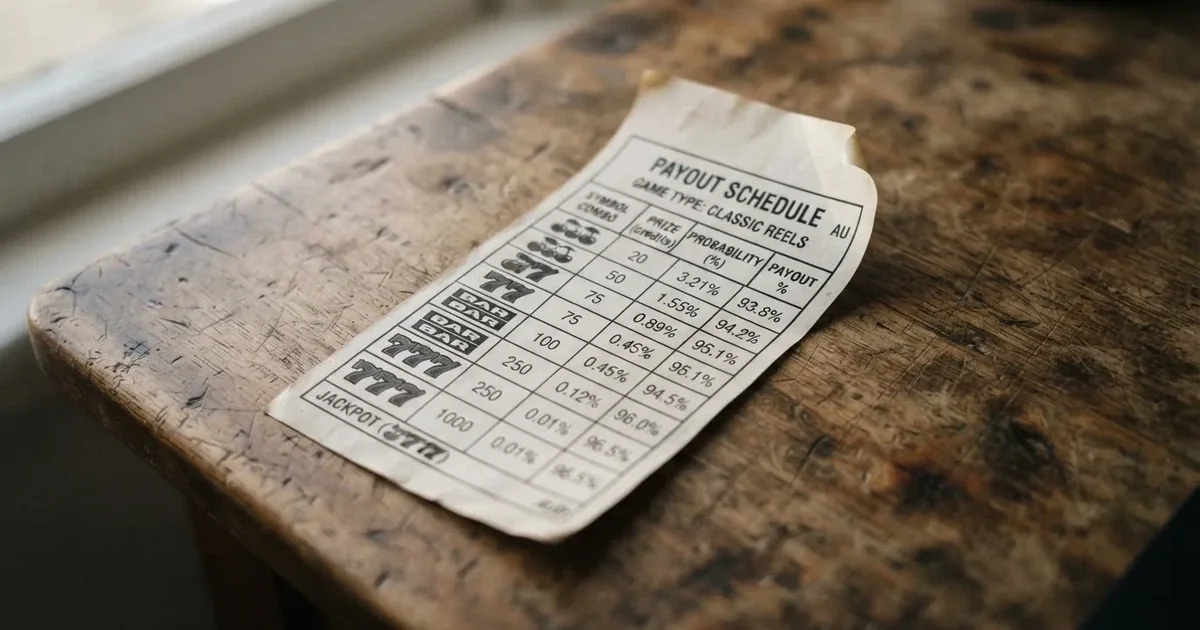
What a paytable typically shows, line by line
The paytable on a BGaming slot does what every other slot paytable does, with the mechanical twist that BGaming’s signature makes the difference. Three blocks of information sit on the page: the symbol-value table, the payline-or-ways diagram, and the rules for the bonus features.
The symbol-value table maps every symbol to its payout at every bet level. For a five-reel slot, that is a grid of roughly fifteen to twenty-five symbols against three to five match-lengths, with each cell holding a multiplier of the line bet. Wilds substitute for paying symbols; scatters usually pay anywhere on the reels and trigger the feature; bonus symbols trigger free spins or a pick-me round. A high-paying symbol pays more for a five-of-a-kind match than for a three-of-a-kind; a low-paying symbol — usually a stylized playing-card rank — pays small multiples even at the longest match.
The payline block tells the player how wins are counted. On a fixed-payline slot, the lines are drawn across the reels in set patterns: horizontals, diagonals, V-shapes, zigzags. Wins count only along the highlighted lines. On a TRUEWAYS slot, the count is different. With up to 262,144 ways, the slot counts every combination of matching symbols on adjacent reels, left to right, regardless of where on each reel they sit. The slot’s effective hit rate — how often any spin returns something — is usually higher on a TRUEWAYS slot than on a fixed-payline slot of similar RTP, but the average win per hit is usually smaller. That is the trade the paytable is silently negotiating, and the trade is the reason a high-volatility title can advertise a respectable RTP without paying out often.
The bonus block describes the feature. Free-spin counts, retrigger rules, expanding wilds, multiplier ladders, hold-and-spin mechanics, gamble features — each is itemised. The block also tells the player the volatility class, sometimes the hit rate, and almost always the RTP. Those last three numbers are what a reader should actually read, and the rest of the paytable is the context those numbers sit inside. The numbers do not change between operators. What changes between operators is whether the bonus they advertise is worth the volume the bonus requires the player to turn over.
Eleven BGaming-carrying brands the ACMA has warned Australians away from
The table below is not a ranking. It is not a recommendation. Every brand on it has received a formal warning from the ACMA for offering prohibited interactive gambling services to people in Australia, and every brand is, by definition, operating outside Australian law.
| Casino brand | ACMA action | Corporate entity named | BGaming in catalogue |
|---|---|---|---|
| RocketPlay | March 2026 (Pulsup Ltd); May 2022 (Dama N.V.) | Pulsup Ltd / Dama N.V. | — |
| Level Up Casino | May 2022 | Dama N.V. | Mentioned in aggregator listings |
| Woo Casino | March 2025 | Dama N.V. | — |
| Spirit Casino | May 2025 | Dama N.V. | — |
| National Casino | July 2025 | Consolutetish S.R.L. | Mentioned in aggregator listings |
| Bizzo Casino | July 2025 (Consolutetish S.R.L.); 2022 (TechSolutions) | Consolutetish S.R.L. / TechSolutions | — |
| Ignition Casino | July 2025 | Bamboo Media | — |
| Instant Casino | February 2025 | EOD Code SRL | — |
| Jackbit | April 2026 | Ryker B.V. | — |
| Casino Intense | April 2025 | Sterplay Holding Ltd | Mentioned in aggregator listings |
| Sky Crown | September 2022 | Hollycorn N.V. | — |
Two patterns fall out of the register. The first is the dominance of Dama N.V.: the same corporate entity has been warned over six brands in May 2022 — Bambet, Dazard, Level Up, Rocketplay, Wild Tornado and Cobra Casinos — and over two more in 2025, Woo Casino in March and Spirit Casino in May. Naming a fresh brand does not, in the regulator’s eyes, change the entity that is being warned, because the entity is what runs the operation. The brand rotation is the marketing; the corporate entity is the legal address.
The second pattern is the 2025-2026 acceleration. Of the eleven formal warnings on this list, six fell in 2025 or 2026 — Woo Casino, Spirit Casino, National Casino, Bizzo Casino, Ignition Casino and Instant Casino in 2025, with Rocketplay and Jackbit following in 2026. The ACMA is not slowing. The brand rotation is. The pattern is consistent with a regulatory environment in which the same operator shuts a warned brand and reopens under a different name, which is the playbook the ACMA’s named-entity warning was designed to defeat.
The “BGaming in catalogue” column is honest about what is and is not independently verifiable. Three of the eleven brands — Level Up Casino, National Casino and Casino Intense — appear in aggregator directories that name BGaming as a studio they carry, but the operator’s own roster pages were not the source of that claim. The remaining eight are marked with an em dash because no source the page could check confirmed BGaming as present on those brands. Treating any of these as a verified BGaming casino is overstating what the page knows.
None of the eleven is recommended. None is endorsed. The page describes them so the reader can recognise the names when an affiliate page, an advertisement or a referral link drops one into their feed — and so the reader understands what each name has meant to the ACMA’s register. The same advice applies to any name the reader meets that is not on this list. If a casino offering BGaming slots to an Australian player is not on the ACMA’s register today, it is either about to be, or it has not been noticed yet. The register is updated in rounds, not continuously.
The fundamentals of the landscape this search sits inside
Three things make up the landscape, and they do not overlap.

The first is BGaming itself: a real B2B supplier, Malta-licensed, with a catalogue of 250-plus titles that ship in HTML5 and run on the phone in the browser. The studio does not take bets. It does not run an end-customer casino. It licenses its games to operators, and it makes money on every spin those operators run, regardless of whether the player wins. Reading BGaming as the answer to the search is reading the wrong layer. The studio is the supply-side ingredient; it is not the venue.
The second is the legal Australian market, which is wagering on races and sport before the event, lotteries, keno, and licensed land-based gaming. The NTRWC’s fifty-two bookmakers do business in the country, supervised by the Territory regulator, paid for by taxes that flow to the Northern Territory. None of them offers a BGaming slot. None of them could, because the IGA does not let them. Aristocrat’s Australian business is on the land-based side, building the physical machines that sit in clubs and casinos around the country. The licensed market is what BetStop protects and the credit-card ban defines.
The third is the offshore market, which is everything else: online casino, online pokies, in-play betting, and the brands that have paid for the eleven formal warnings listed above. The offshore market is where the player who searched this page actually ends up, and it is the segment H2 Gambling Capital values at roughly A$3.9 billion a year in Australian losses. The legal market has BetStop, the helpline, the NTRWC and the credit-card ban. The offshore market has the ACMA’s blocking programme, formal warnings, and the player on their own.
The reader arrived at this page wanting a list. The page gives a register instead — and the register is the answer to what the search actually costs. The legal market does not stock BGaming. The offshore market stocks it but offers no Australian recourse. The cost of choosing between those two is the cost this page has been measuring.
Frequently asked questions
Is BGaming itself a casino, or just a supplier of games to other sites?
BGaming is a B2B supplier of games. It is operated by Stable Games Ltd of Valletta under a Malta Gaming Authority Critical Gaming Supply Licence (MGA/B2B/785/2020). The studio designs, certifies and licenses more than 250 titles to operators; it does not run an end-customer casino where a player can deposit and play.
Can I play BGaming slots for real money at any Australian-licensed casino?
No. Online casino games and online pokies cannot be licensed anywhere in Australia. The Interactive Gambling Act 2001 makes providing them to a person in Australia a criminal offence for the provider. The only Australian-licensed gambling products are wagering on races and sport before the event, lotteries and keno, and none of those carry BGaming slots.
Why do offshore casinos promoting themselves to Australians make such a point of BGaming?
Because studio brand recognition is the marketing lever the offshore operator has when it cannot claim an Australian licence. A studio name like BGaming, with its MGA-licensed catalogue and 250-plus titles, signals “we have real games”, and aggregator directories list BGaming on hundreds of sites, which makes it a useful badge. The marketing works on trust the regulator cannot back up.
Is it legal for a website to offer BGaming games to someone in Australia?
No. The Interactive Gambling Act 2001 makes it an offence for a provider to offer online casino games to a person physically in Australia. The law targets the provider rather than the player, but the player gets no Australian consumer protection, no Australian complaints body and no Australian recourse if a withdrawal is refused.
What typically sets a BGaming paytable apart from other studios’ games?
BGaming’s signature is the TRUEWAYS mechanic, which on certain titles offers up to 262,144 ways to win by counting combinations of matching symbols on adjacent reels rather than fixed paylines. The hit rate on a TRUEWAYS slot is usually higher than on a payline-driven slot of similar RTP, but the average win per hit tends to be smaller. The rest of the paytable — symbol values, wilds, scatters, feature triggers — works the same way as any other modern video slot.