
The real cost of chasing a Booongo casino in Australia in 2026
A player looking for a Booongo-powered online casino in Australia in 2026 is, before they place a bet, looking at something the law has already decided. Online casino games and online pokies cannot be licensed for Australian customers anywhere on the continent. The studio’s titles live on offshore sites running outside Australian jurisdiction, and the Australian Communications and Media Authority has spent the last several years warning those sites by name, blocking new ones each quarter, and watching more than 230 unlicensed services quietly leave the market since enforcement was strengthened in 2017.
The substance of this page is the cost of that arrangement. The bonus, the licence on the wall, the “fast payout” banner, the PayID logo that suggests a local connection none of these sites actually has — each of these is part of how offshore play is sold. Each of them also has a price the marketing does not name. The shape of that price is what this comparison sets out.
Data current as of 29 October 2026; licence claims checked against the Australian Communications and Media Authority register.
Table of Contents
- The legal floor under Australian online casino play
- Where player protection actually sits
- What the offshore shelf actually looks like
- Bonuses and free spins on a market the law has already judged
- Mobile play on offshore Booongo sites
- The studio itself, and what its titles actually are
- Eleven brands, eleven warnings, one shelf
- The choice this page is built around
- Frequently asked questions
The legal floor under Australian online casino play
The Interactive Gambling Act 2001, tightened by the Interactive Gambling Amendment Act 2017, makes it an offence to provide online casino games, online pokies or in-play betting to a person physically in Australia. No state or territory issues a licence for those products. What is licensable — wagering on races and sport placed before the event, lotteries, keno — is regulated in practice by the Northern Territory Racing and Wagering Commission, which oversees 52 of the country’s online bookmakers (Sportsbet, Bet365, Ladbrokes among them) from a single monthly meeting in Darwin and, by the ABC’s account in April 2026, runs without full-time staff.
Casino play is a different category. The Northern Territory licence a sportsbook holds does not extend to slot-style products. A site that takes Australian sign-ups and lets them spin Booongo reels is operating in a category the IGA does not allow at all, regardless of what authority it points to on its footer. Minimum age across every licensed product is 18. The individual player is not prosecuted under the Act; the law aims at the provider. That distinction does the player no practical good if a withdrawal stalls or a balance is locked by a site the regulator cannot reach.
What enforcement looks like in 2026
The ACMA’s tools are warnings, formal investigations, and requests to Australian internet service providers to block offending domains at the network layer. By June 2026 the authority had asked providers to block 1,751 illegal gambling and affiliate marketing websites since the first blocking request in November 2019. A round reported on 26 June 2026 added 12 more: 7Signs, ChromaBet, Donbet, Duospin, Freshbet, Slots Gem, Jacks Club, Lucky Start, Pointsbetz, Spinrise, Vinyl Casino and Wildsino. A site can sit outside the country, hold a Curaçao sub-licence, and still be uncontactable from an Australian kitchen.
A site that has been warned once is not necessarily gone. Dama N.V. was warned in May 2022 over six brands (Bambet, Dazard, Level Up, Rocketplay, Wild Tornado and Cobra Casinos) and again in March 2025 over Woo Casino and May 2025 over Spirit Casino. The second warning does not close the first one; it confirms the pattern. TechSolutions Group, Consolutetish S.R.L., Bamboo Media, EOD Code SRL, Ryker B.V., Sterplay Holding Ltd and Hollycorn N.V. all carry the same shape — a formal caution, a named operator entity, a product the regulator cannot reach from Australia.
What that means for a “licensed” Booongo site
An offshore site pointing to a Curaçao, Anjouan or Costa Rica sub-licence is licensed in that jurisdiction. It is not licensed in Australia. The licence it shows covers its own corporate structure, its own RNG certification, and its own KYC obligations under the regime that issued it. It does not give an Australian customer an Australian complaints body, an Australian recourse if a withdrawal is refused, or an Australian guarantee that the balance on the account will be paid. BetStop, the National Self-Exclusion Register that has bound Australian-licensed wagering since August 2023, does not cover any of these sites. Registering with BetStop and then playing on an offshore casino is two acts in different systems with no overlap.
The cost of that asymmetry is concrete. A blocked site can take a player’s balance with it when the domain goes dark. A dispute over a bonus term has no Australian forum. The “responsible gambling” page on an offshore site is a marketing asset, not a binding protection. None of this is hypothetical — it is the shape of the market the rest of this page describes.
Where player protection actually sits
For anyone whose Booongo-casino search has started to feel like a habit they would rather not have, the help that matters is Australian and free. The National Gambling Helpline, 1800 858 858, runs around the clock. Gambling Help Online offers live chat. The counsellors do not ask which site the caller was on; the issue is the same whether the platform is local or offshore.
BetStop — the National Self-Exclusion Register — is the binding tool for any Australian-licensed wagering service: sports betting, racing, the licensed lotteries. Signing up stops new accounts from opening and tells existing operators to close the customer’s play. It does not, by design, reach an offshore casino; the offshore site is not part of the system and the register does not know about it. For an Australian wanting a hard stop across the legal market, BetStop works. For an Australian wanting a hard stop across the market they actually use, the help line is the entry point.
The asymmetry has a price. The licensed wagering market in Australia has consumer protection as part of its licence; the offshore market has nothing of the kind. A punter who limits themselves to licensed products and a punter who drifts to offshore play sit in two completely different regulatory rooms. The first has recourse. The second has a balance on a site the ACMA may have already asked providers to block.
Payment rails as a tell
A second tell sits in the deposit screen. Since 11 June 2024, credit cards, credit-related products and digital currencies have been banned as payment for any licensed online wagering service in Australia, with penalties up to A$247,500 for the operator. The legal deposit routes for a licensed bookmaker are debit card, bank transfer, PayID/Osko and BPAY. A casino asking an Australian customer for a credit card or a Bitcoin wallet is asking outside that frame. The very presence of a crypto deposit button is, in 2026, a marker that the product is not the Australian one.
That has practical consequences. A crypto deposit sits outside the Australian banking system, outside AUSTRAC’s reporting net, and outside any chargeback the customer might otherwise rely on. PayID carries a real name; a USDT transfer carries a wallet address. The friction the law builds into the licensed side is exactly what the offshore side removes, and what it removes is what the licensed side is there to keep.
What the offshore shelf actually looks like
Eleven brands appear in this comparison. Each is named because the ACMA issued a formal warning about it — not because any of them is recommended. The point of listing them together is that the comparison itself becomes readable: who is operating these sites, what licence they claim, how recent the warning is, and what the studio’s own footprint says about the brand.
The wider market behind those eleven is the H2 Gambling Capital estimate for 2026: Australians lose about A$3.9 billion a year to illegal gambling sites, and the share of gambling going through legal channels fell from 74% in 2021 to 64%. The 1,751 blocked sites are the ACMA’s count of domains it has removed from Australian reach; the A$3.9 billion is the estimate of what the unblocked ones still take. Both numbers point to a market that exists and that the regulator cannot, by itself, shut down.
The brands themselves, with the operator entity and the date the ACMA published its warning:
| Brand | ACMA action and date | Operator named by the ACMA | Subject support |
|---|---|---|---|
| RocketPlay | Formal warning, March 2026 (also May 2022) | Pulsup Ltd / Dama N.V. | — |
| Level Up Casino | Formal warning, May 2022 | Dama N.V. | listings-only |
| Woo Casino | Formal warning, March 2025 | Dama N.V. | — |
| Spirit Casino | Formal warning, May 2025 | Dama N.V. | — |
| National Casino | Formal warning, July 2025 | Consolutetish S.R.L. | listings-only |
| Bizzo Casino | Formal warning, July 2025 (also 2022) | Consolutetish S.R.L. / TechSolutions | — |
| Ignition Casino | Formal warning, July 2025 | Bamboo Media | — |
| Instant Casino | Formal warning, February 2025 | EOD Code SRL | — |
| Jackbit | Formal warning, April 2026 | Ryker B.V. | — |
| Casino Intense | Formal warning, April 2025 | Sterplay Holding Ltd | listings-only |
| Sky Crown | Formal warning, September 2022 | Hollycorn N.V. | — |
Every brand in the table carries the same product-prohibition caveat: online casino games cannot be licensed anywhere in Australia, whatever footer the site displays. The “subject support” column shows whether the studio whose games the player is chasing — or, where the listings do not show it, the wider Booongo-adjacent provider market — names the brand at all. Most cells are empty by design; the absence of a studio mention is itself the relevant fact, and a marketing-style listing does not change what the ACMA has done.
A reader looking at the table should see two things at once. First, the warnings are recent and ongoing: the most recent in this set is April 2026, the oldest is September 2022, and the regulator has been adding new operator entities to its list every quarter. Second, the operator entities repeat. Dama N.V. appears four times across different brand names; Consolutetish S.R.L. appears twice. A player looking at a “new” Booongo casino in 2026 is often looking at a re-skin of an entity the ACMA has already named.
The blocking rate, in plain numbers
Between November 2019 and June 2026 the ACMA asked Australian internet service providers to block 1,751 illegal gambling and affiliate marketing websites. Spread over the 79 months from the first blocking request to the most recent reporting point, that is an average of roughly 22 sites blocked per month, or one site every 33 hours of office time. The pace has not slowed. The June 2026 round alone added 12.
The shape of that rate tells a reader what enforcement actually does. It does not shut the offshore market — the H2 estimate of A$3.9 billion in annual losses to illegal sites is from 2025, after six and a half years of blocking. What it does is raise the cost of operating one. A site that survives has to keep changing domains, paying for new front companies, and accepting that any Australian customer it has today may be cut off tomorrow. The cost of that churn is what the operator passes to the player through bonus terms, withdrawal friction and the absence of any real protection when something goes wrong.
This is the arithmetic of an offshore shelf: the regulator pushes the cost of compliance onto the operator, the operator pushes the cost of compliance onto the player, and the player ends up with a product the law was written to keep out of the country in the first place. None of the numbers above is invented; each is from the ACMA’s own reporting or from the industry estimate it cites.
Bonuses and free spins on a market the law has already judged
A Booongo casino “welcome bonus” reads on its face like a marketing event: a percentage match on the first deposit, a stack of free spins on a featured title, the suggestion that the player is being given something. What it is in practice is a wagering requirement dressed up as a gift. The expected cost of clearing it is mechanical, and the player pays the mechanical cost in the form of turnover the bonus forces through the games.
The arithmetic is plain. Suppose the bonus is A$200 at a 35x wagering factor on the bonus amount; the player must turn A$7,000 through the games before the bonus becomes withdrawable. At an average slot stake of A$1 per spin, that is 7,000 spins. At a 5-second interval between spins, that is 9.7 hours of continuous play. The slot’s published RTP — Booongo-era titles are commonly published in the mid-96% range — gives an expected loss across those 7,000 spins of roughly A$280. The “A$200 bonus” is therefore expected to cost about A$280 to clear, on average, before the player ever sees a cent of winnings. The marketing word for this arrangement is “free”. The arithmetic word is “subsidy to the house”.
The maximum-cashout cap on free-spin winnings sits on the same shelf. A “50 free spins” promotion that pays out at a 10x cap turns a lucky spin into a small fixed sum, and the rest of the win evaporates. The casino has not lost anything; the player has. The phrase “free spins” implies a gift of risk-free turns; the mechanics imply a gift of turns with a ceiling on what the turns can produce.
None of this is unique to Booongo casinos. It is the shape of the offshore welcome offer in 2026. What makes it sharper on a Booongo site is that the studio itself has spent the last several years licensing into regulated markets where this kind of structure is policed. In the UK, 3 Oaks Gaming — the regulated-market brand that grew out of Booongo’s 2021 restructuring — was granted a remote operating licence by the UK Gambling Commission on 9 February 2024, and the Commission has since certified more than 50 of its slot titles. In Malta, the MGA issued a recognition notice on 4 August 2025, letting 3 Oaks offer Sun of Egypt 4, Coin UP: Lightning and 3 Hot Chillies to MGA-licensed operators. The studio’s products are clean enough for the UK and Malta. The sites that market them to Australians are not the ones the UK and Malta regulate.
What “no deposit bonus” actually delivers
A “no deposit” offer takes this same shape and removes the deposit. The player signs up, the casino credits a small bonus (often A$10 to A$30), and the same wagering factor applies. The bonus cannot be withdrawn until it is cleared. The win from clearing it is usually capped. The effective offer is a free trial of the platform that pays out, on average, less than the player’s time costs — and that, by design, gives the casino a chance to take a real deposit from the player once the trial is over.
The cost of claiming one of these, when it is on a site the ACMA has already warned, sits in the same place as the cost of claiming any offshore bonus: in the absence of recourse when the bonus terms are interpreted against the player. A reader considering the offer should weigh what is being asked against what is being given. The asking side is mechanical; the giving side is conditional. The shape of the comparison is the shape of the offer.
Mobile play on offshore Booongo sites
A Booongo mobile casino in 2026 is, in practice, a browser tab. The studio’s catalogue — 3 Pots of Egypt, Sun of Egypt 4, 3 Hot Chillies, Hawaii Riches — is built in HTML5 for low-bandwidth connections, which is the same technology stack that powers the desktop version. There is no Booongo app; there are Booongo games inside apps built by the operators themselves, most of which sit in the App Store and Google Play under names unrelated to the studio.
What changes on a phone is the friction. The deposit screen is one tap closer; the credit-card ban that applies to licensed Australian wagering does not apply to the offshore site, so the deposit goes through. The “play on the train” pitch is real on this product in a way it is not on the licensed Australian market — because the licensed Australian market does not have casino games at all. The convenience is genuine. The protection that convenience bypasses is also genuine.
A punters’ associations publishes a guide every year on the warning signs of harmful play; one of them is “play on mobile” because the harder it is to interrupt, the more likely it is to continue. An offshore site with no friction, no Australian regulator and no cooling-off period is exactly the shape that warning describes. The cost of mobile convenience, on this shelf, is the cost of being one tap from a deposit at any hour of the day or night.
A note on apps and downloads
A “booongo casino download” or “booongo casino app” promoted in search results is almost always a wrapper around the operator’s own casino client. The studio’s name is the marketing draw; the application is the casino’s. Installing one of these on a phone gives the casino access to notifications, identity data and a payment method on file — none of which is necessary to play the games and all of which gives the operator more reach than a browser tab does. The cost of installing the app is not in the install itself. It is in the perimeters the install lowers around the player’s day.
The studio itself, and what its titles actually are
Booongo is, and has been since the 2021 restructuring that produced 3 Oaks Gaming, a slot studio — a business that designs, builds and licences slot machine games to operators. It does not run casinos. It does not take deposits. It does not hold player balances. The thing a player is buying when they search for a Booongo casino is access to the studio’s catalogue through a third party, and the third party is the entity the ACMA has been naming.
What the studio sells is a particular look. 3 Oaks titles — Sun of Egypt 4, 3 Pots of Egypt, Coin UP: Lightning, 3 Hot Chillies — share a structural shape: a hold-and-win bonus round, a four-pot jackpot ladder above the reels, an aesthetic that sits between the older Aristocrat-style “pokies” look and the modern high-volatility European slot. The volatility is generally on the high side. The RTP, where it is published, sits in the mid-96% band that is the studio’s house style. None of this is unique to Booongo; the same shape is offered by studios from Pragmatic Play to Betsoft to BGaming.
The licensed footprint is the part that matters for the comparison. The UK Gambling Commission’s certification of more than 50 3 Oaks titles means those games have been independently tested for RTP, for RNG behaviour, and for the absence of predatory mechanics that the UK regime forbids. The MGA’s recognition notice does the same in Malta. The studio’s games are regulated-market products. The operators selling them to Australians are not.
A reader who likes the look and feel of Booongo-era slots can find the same shape in studios that do hold Australian-facing products: Aristocrat Leisure’s online arm, for instance, sits under Aristocrat Interactive, formed in April 2024 from the merger of Anaxi and NeoGames. Aristocrat, the largest gambling-machine manufacturer in Australia and the second-largest slot manufacturer worldwide behind International Game Technology, has the catalogue and the licensed footprint. The offshore Booongo site is not on that path. The path goes through regulated markets and licensed operators; the offshore shelf is the path that the IGA was written to close.
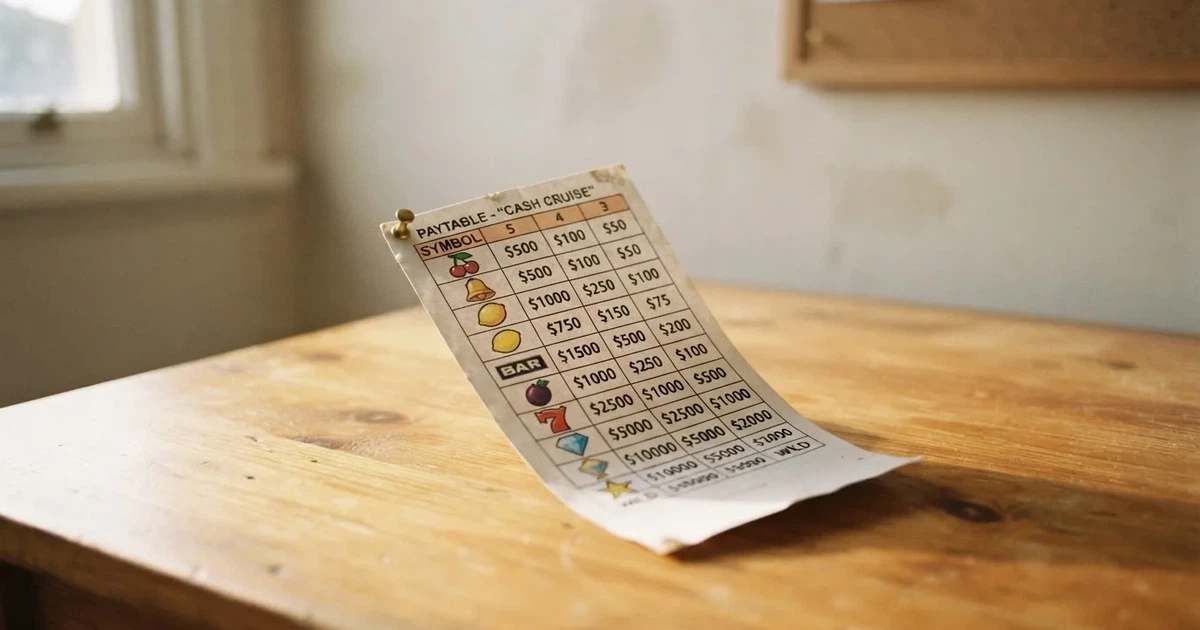
What a paytable actually shows
A reader looking at a Booongo paytable for the first time will see a grid of symbols with a credit value beside each, a list of the bonus symbols, and the rules of the hold-and-win round. The math behind the paytable is the RTP — the percentage of all wagered money the game is designed to return to players over a long run. A 96% RTP means a 4% house edge. Over 7,000 spins at A$1, the math says about A$280 will leave the player’s bank on average. The paytable does not show that figure. The paytable shows the symbols.
The cost of misunderstanding a paytable is the cost of misunderstanding the product. A player who reads the bonus symbols and imagines they are seeing a generous game is reading what the paytable says. A player who reads the same paytable and sees a 4% house edge is reading what the paytable means. The difference is the difference between marketing and analysis, and it is the difference this page is built around.
Eleven brands, eleven warnings, one shelf
The brands below are the eleven the ACMA has named. The point of running through them one by one is the same as the point of the table above: the comparison itself becomes readable when the operator entities and the warning dates sit beside the brand names.
RocketPlay
The ACMA’s most recent formal warning over RocketPlay was issued to Pulsup Ltd in March 2026, with an earlier warning to Dama N.V. in May 2022. The brand has lived under two different operating entities in the period the ACMA has been naming it; the licence on its footer in 2026 is whichever sub-licence its current operator holds. The product is the same shape as every other entry in this comparison: an offshore casino offering prohibited Australian play, with no Australian recourse if a withdrawal stalls.
The reason it is at the top of this list is the freshness of the action. March 2026 is three months before this page’s data point, and a site under a fresh warning is a site the ACMA has its eye on.
Level Up Casino
The ACMA warned Dama N.V. over Level Up Casino in May 2022. The studio whose name this comparison is built around is not listed by Level Up’s own site in a verifiable way; the only listing-style reference is on a third-party provider page (Wazdan). The absence of a clear studio affiliation is itself the information. A player chasing a specific studio’s look at Level Up is chasing a look the brand does not claim.
Woo Casino
Woo Casino sits under the same Dama N.V. umbrella as Level Up. The ACMA’s warning is from March 2025, ten months before this page’s data point. A player looking at Woo’s bonus terms in 2026 is looking at terms an offshore site has put together without Australian regulatory oversight. The cost of those terms sits in the same place as the cost of any offshore offer: in the gap between what the marketing says and what the regulator would say if it could reach the site.
Spirit Casino
Spirit Casino carries the May 2025 ACMA warning, also over Dama N.V. The pattern is familiar: an offshore casino offering prohibited Australian play, named by the regulator, continuing to operate under a sub-licence the regulator cannot reach. The product is the same shape as the others. The freshness of the warning is what sets the rhythm of the comparison.
National Casino
The ACMA named Consolutetish S.R.L. in July 2025 over National Casino. Unlike several of its neighbours in this comparison, National Casino does carry a verifiable listing of the studio family whose look this page is built around (a Betsoft page and a Pragmatic Play page both name National Casino among their partners). The studios themselves are clean; the operator selling them to Australians is the entity the regulator has warned. The cost of playing on a “studio-verified” site is that the verification is the studio’s, not the regulator’s.
Bizzo Casino
Bizzo Casino carries two ACMA actions: the July 2025 warning to Consolutetish S.R.L., and a 2022 warning to TechSolutions (CY) Group Limited and TechSolutions Group N.V. The pattern of two warnings to two different operator entities, several years apart, is the clearest signal in this comparison: a brand that has been warned, restructured under a new corporate umbrella, and been warned again. A player who expects the second warning to change the operating behaviour of the brand is reading the warnings as enforcement; the regulator reads them as record-keeping.
Ignition Casino
The ACMA named Bamboo Media in July 2025 over Ignition Casino. Ignition is a brand whose market is largely the United States; its appearance in the Australian warning list reflects the global nature of the offshore shelf. A player who ends up at Ignition from an Australian search is reaching a brand whose primary market is several thousand kilometres away and whose Australian-facing operation sits outside the Australian regulator.
Instant Casino
The ACMA warned EOD Code SRL in February 2025 over Instant Casino. The brand markets itself heavily on speed (“instant withdrawals” is in the name) and on the absence of identity checks. Both of those features are, in the Australian frame, markers of a product that the regulator cannot reach: the absence of identity checks is the absence of KYC, which is the absence of the customer-protection infrastructure the licensed market is built around.
Jackbit
Jackbit carries an April 2026 warning to Ryker B.V., the freshest in this comparison alongside RocketPlay. Jackbit is a crypto-first casino; the deposit screen is built around digital currencies. A crypto deposit in Australia, on a licensed wagering service, is illegal; on an offshore casino, it is the entry point. The brand is exactly the shape the ACMA’s June 2024 credit-card and crypto ban was written to keep out of the licensed market. The cost of the shape is in the absence of Australian recourse.
Casino Intense
Sterplay Holding Ltd received an April 2025 ACMA warning over Casino Intense. The brand does carry verifiable listings from several studios in the wider Booongo-adjacent provider family (1spin4win’s site, the Gambling Commission’s UK register, and the wider iGaming press). The listing-style references are real; the operating licence is not.
Sky Crown
Hollycorn N.V. carries the oldest warning in this comparison, September 2022, over Sky Crown. The brand has been on the regulator’s list the longest; its product in 2026 is the same shape as it was then. A reader who chooses Sky Crown on the basis of familiarity is choosing familiarity over the regulator’s record, and that is the comparison the rest of the shelf is built around.
The choice this page is built around
The page has not pointed to a place to play. It has pointed to what the offshore shelf is, what it costs, and what the regulator has said about it. The arithmetic of the bonus offer, the asymmetry of the licence, the freshness of the ACMA’s warnings, and the absence of Australian recourse are not competing points of view. They are the same point seen from different angles.
A player who reads this comparison and walks away from offshore Booongo play has made the choice the law was written to support. A player who reads it and stays on an offshore site is choosing familiarity, or a bonus, or a payout speed, or a studio look — against a regulator’s record and against the absence of Australian protection. The decision is the player’s. The substance of what they are deciding between is on the page.
Frequently asked questions
What is Booongo — a casino or a game studio?
Booongo is a slot studio, not a casino. It designs and builds online slot games and licences them to casino operators under its own name and, since the 2021 restructuring, under the 3 Oaks Gaming brand. It does not run a casino, take deposits, or hold player balances. The “Booongo casino” a player is searching for is a third-party casino operator offering Booongo-made games in its catalogue.
Are any Australian-licensed casinos running Booongo titles?
No. Online casino games and online pokies cannot be licensed anywhere in Australia under the Interactive Gambling Act 2001, and no state or territory issues a licence for them. Every casino offering Booongo titles to Australian customers is an offshore operator running outside Australian law, regardless of the licence it displays.
What does a Booongo slot paytable typically look like?
A Booongo paytable shows a grid of symbols with credit values, a list of bonus symbols and the rules of a hold-and-win bonus round, usually with a four-pot jackpot ladder above the reels. The published RTPs are commonly in the mid-96% range and the volatility tends toward the high side, which is the studio’s house style rather than a per-game rule.
Does Booongo run its own casino, or licence to other operators?
Booongo licences to other operators. The 2021 restructuring produced the regulated-market brand 3 Oaks Gaming, which now holds a UK Gambling Commission remote operating licence (granted 9 February 2024, licence number 063055-R-338209-005) and a Malta Gaming Authority recognition notice (4 August 2025) — and licences its certified titles to operators in regulated markets. Booongo does not operate any casino directly.
Why do offshore casinos market Booongo games to Australian players?
Booongo games have a recognisable look, a hold-and-win mechanic that has been widely adopted across the offshore shelf, and the credibility of a studio that has cleared regulatory review in the UK and Malta. Offshore operators use that credibility to draw Australian search traffic, even though the Australian market itself cannot license the product. The marketing is legal; the product being marketed is not.
Is it legal for a site to offer Booongo games for real money to Australians?
No. The Interactive Gambling Act 2001 makes it an offence to provide online casino games to a person in Australia. A site offering Booongo slots for real money to Australian customers is operating in a category the regulator has been warning and blocking since 2017. The individual player is not prosecuted; the offshore site has no Australian consumer protection, no Australian complaints body, and no guarantee that any balance on the account will be paid.