
GameBeat Slots in Australia: What an Offshore Casino Actually Costs the Player
A reader looking for “GameBeat online casinos in Australia” runs straight into a wall the marketing never names: GameBeat-built slots reach Australian players only through offshore sites, and offshore casino sites are precisely what the Australian Communications and Media Authority spends its working week blocking. That single fact reshapes every other question — about bonuses, about payout speed, about mobile play, about which “top” brand is worth trusting. This page works through what is actually law, what enforcement looks like in practice, and what a player trades away by playing on an unlicensed site anyway.

Data current as of 29 October 2026, checked against the Australian Communications and Media Authority’s register of formal warnings and blocking requests.
Table of Contents
- The Legal Frame in Australia: Why GameBeat Casinos Don’t Hold an Australian Licence
- ACMA Enforcement: What Has Actually Been Blocked and Why
- Player Protection Tools Available in Australia
- Payments and Payout Speed at Offshore GameBeat Casinos
- Bonuses and Free Spins: Reading the Marketing Past the Number
- Mobile and App Access: What Phone-Screen Play Looks Like
- GameBeat and Comparable Slot Studios: What the Content Looks Like
- The 2026 Australian Field: How These Operators Compare
- Tax and Practical Questions for Australian Players
- The Situation in Australia: What a Reader Actually Has
- Frequently Asked Questions
The Legal Frame in Australia: Why GameBeat Casinos Don’t Hold an Australian Licence
The Interactive Gambling Act 2001, tightened by the Interactive Gambling Amendment Act 2017, makes it an offence to provide online casino games, online pokies or in-play betting to a person physically in Australia. No state or territory issues a licence for online casino gambling — what is licensable is pre-event wagering on races and sport, lotteries and keno. The minimum age to gamble in Australia is 18.
That legal posture is the load-bearing wall of this entire subject. GameBeat, the slot studio set up in 2021, describes itself as a business-to-business supplier that distributes games only to licensed operators and commercial partners, not to players directly. It does not run a casino. The casinos carrying its catalogue hold licences from regimes such as Curaçao, and those licences do not authorise them to take Australian casino play. The site a reader reaches from Sydney or Perth is, from the Australian regulator’s view, an unlawful service.

A common misreading is that a Curaçao or Malta licence “covers” Australian play. It does not. Licensing authorities in those jurisdictions approve the operator’s general business; it is Australian law, not the operator’s licence, that decides whether taking bets from an Australian customer is permitted. The licence displayed in a footer answers the question of where the company is regulated; it does not answer the question of whether the player’s own country permits the activity. Enforceability sits the other direction, too: if a Curaçao-licensed operator refuses a withdrawal, an Australian player has no local complaints body to escalate to. The licence the player can see is real; the protection it implies is not.
The Northern Territory Racing and Wagering Commission sits as the de facto online regulator because of tax arrangements — it oversees 52 Australian-licensed online bookmakers including Sportsbet, Bet365 and Ladbrokes, runs without full-time staff and meets once a month in Darwin. It does not license casino games. The distinction between a bookmaker and a casino is not administrative nitpicking; it is the difference between a lawful product and a prohibited one.
ACMA Enforcement: What Has Actually Been Blocked and Why
Enforcement runs through the Australian Communications and Media Authority. The ACMA investigates complaints, issues formal warnings, and asks Australian internet service providers to block identified sites at the network level. The cumulative figures are telling: by a round reported in June 2026, the ACMA had asked for 1,751 illegal gambling and affiliate marketing websites to be blocked since the first blocking request was lodged in November 2019, and more than 230 unlicensed gambling services had exited the Australian market since enforcement intensified in 2017.
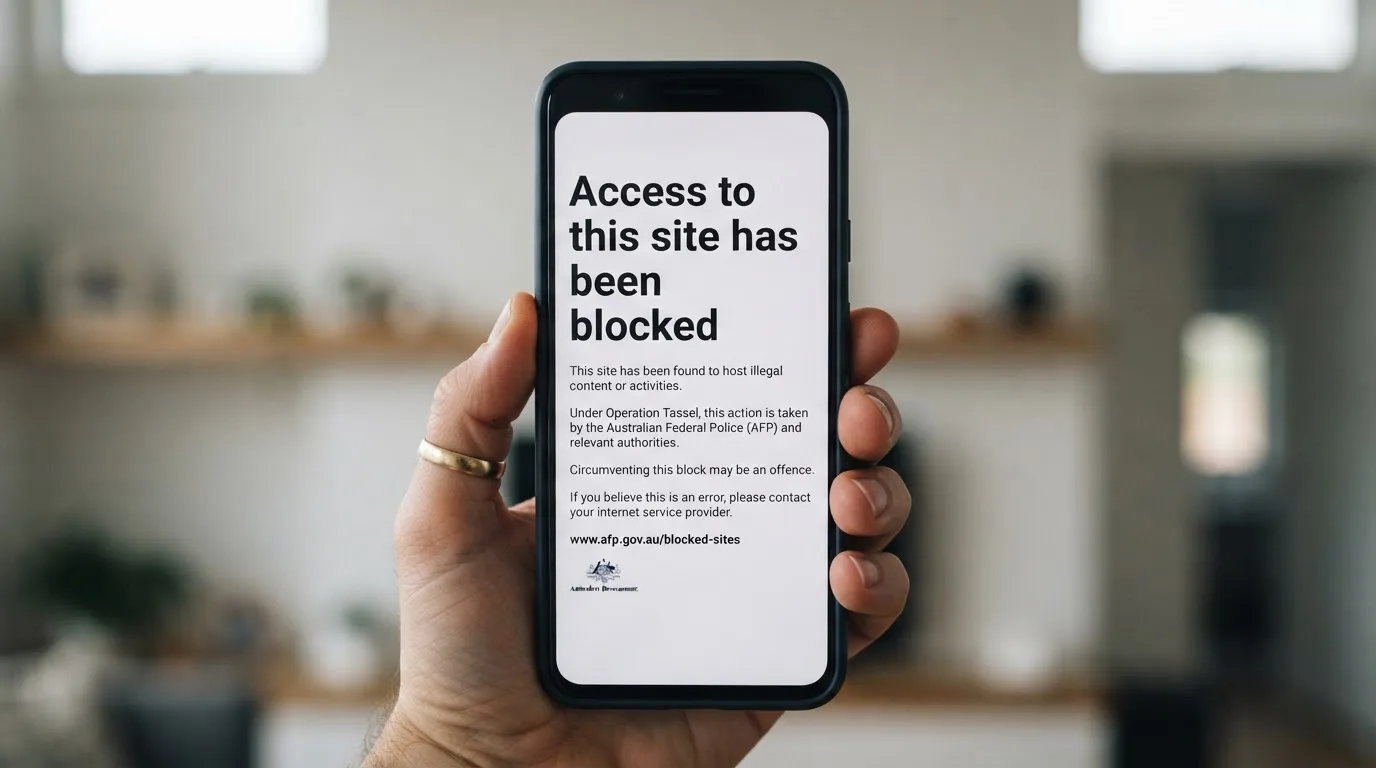
The mechanic is worth spelling out. A site listed for blocking does not disappear from the internet; it becomes unreachable through most Australian ISPs. For a player, that means a balance can sit on a site one day and the same site be a dead screen the next. There is no advance warning, no grace period, no automatic payout of the balance first. A blocked service keeps player funds in the same legal no-man’s-land as an offshore licence: outside any Australian framework the player can compel to act.
A Blocking-Rate in Context
Between the first blocking request in November 2019 and the snapshot reported in June 2026, the ACMA’s blocking tally moved from zero to 1,751 sites. That is roughly 263 sites directed for blocking per year on average, or about one illegal gambling or affiliate site added to the block list every 28 hours. Twelve of those were added in a single June 2026 round, including 7Signs, ChromaBet, Donbet, Duospin, Freshbet, Slots Gem, Jacks Club, Lucky Start, Pointsbetz, Spinrise, Vinyl Casino and Wildsino. A reader who treats any current list as stable is reading yesterday’s data.
The framing matters here. The rate is a policy output, not a market one — it reflects what the ACMA has chosen to act on, not the count of illegal sites still accepting Australian customers. A site not yet on the list is not necessarily legal; it may simply not yet have caught the regulator’s attention, or it may have changed domains faster than the next blocking request can be processed.
The Operators on the ACMA Register
The table below summarises the brands the ACMA has formally warned by name for offering prohibited interactive gambling services to Australians, with the operator named in each warning and the date as published. The page returns to individual brands in the ranking section below; this table is the landscape they sit inside.
| Brand | ACMA action and date | Operator named by the ACMA | GameBeat support |
|---|---|---|---|
| RocketPlay | Formal warning, March 2026 | Pulsup Ltd (Rocketplay) | — |
| Level Up Casino | Formal warning, May 2022 | Dama N.V. | Listed by Wazdan as carrying its content |
| Woo Casino | Formal warning, March 2025 | Dama N.V. | — |
| Spirit Casino | Formal warning, May 2025 | Dama N.V. | — |
| National Casino | Formal warning, July 2025 | Consolutetish S.R.L. | Listed on Betsoft, Wikipedia and Pragmatic Play partner pages |
| Bizzo Casino | Formal warning, July 2025; earlier 2022 | Consolutetish S.R.L. (2025); TechSolutions (CY) Group Limited and TechSolutions Group N.V. (2022) | — |
| Ignition Casino | Formal warning, July 2025 | Bamboo Media | — |
| Instant Casino | Formal warning, February 2025 | EOD Code SRL | — |
| Jackbit | Formal warning, April 2026 | Ryker B.V. | — |
| Casino Intense | Formal warning, April 2025 | Sterplay Holding Ltd | Listed by 1spin4win, Wikipedia and the UK Gambling Commission |
| Sky Crown | Formal warning, September 2022 | Hollycorn N.V. | — |
A handful of points the table cannot carry. Some operators carry multiple warnings — Dama N.V. has appeared at least three times across Woo Casino, Spirit Casino and the May 2022 batch that included Level Up. Consolutetish S.R.L. now faces the regulator over National Casino and Bizzo Casino, both of which had earlier been warned under TechSolutions. A repeated appearance is a stronger indicator than a single one. The GameBeat-support column is sparse on purpose: where research could not name a GameBeat reference from the listed providers’ pages, the cell is left empty rather than asserting an unverified link.
One structural point worth holding. The sites the ACMA names are a sample, not the market. Other operators may carry GameBeat titles, accept Australian customers, and simply not yet have been formally warned. The absence of a name on the ACMA register is not evidence of legality; the ACMA publishes actions, not cert of clean operation.
Player Protection Tools Available in Australia
The responsible-gambling infrastructure in Australia is built around licensed services and does not extend offshore. Australians do have meaningful safeguards — they simply do not cover play on a GameBeat-carrying casino.
BetStop, the National Self-Exclusion Register, has been live since August 2023. It binds every Australian-licensed online and phone wagering service to honour a registered exclusion. That is exactly its limit: an offshore casino is not licensed by an Australian regulator and not connected to BetStop. A player who registers a self-exclusion through BetStop blocks themselves from licensed Australian wagering services, not from GameBeat slots on an offshore site. The protection a reader wants does not reach the place they are most likely to need it.
Help is available regardless of the channel. The National Gambling Helpline is 1800 858 858 — free, 24 hours a day. Gambling Help Online provides web chat and email support. These services are open to people whose gambling has taken any form, including on offshore sites, and they are the right first call for anyone concerned about their own or someone else’s play.
Limits and Controls on Australian-Licensed Wagering
A comparison a reader is likely to want: what gambler protections apply to Australian-licensed wagering, and what they cost operators that try to ignore them. From 11 June 2024, credit cards, credit-related products and digital currency have been banned as payment methods for licensed online wagering in Australia, with penalties up to A$247,500 for operators that breach the rule. Legal deposit routes for licensed wagering are limited to debit card, bank transfer, PayID or Osko and BPAY. A site asking an Australian customer for a credit card or a crypto deposit is, by the payment method alone, operating outside the Australian framework. GameBeat-carrying sites routinely accept crypto and credit cards; the contrast with the Australian licence rules is structural, not incidental.
Pre-commitment tools, deposit ceilings and activity statements are required on licensed Australian wagering services. None of these obligations touch an offshore casino: there is no requirement on the operator and no mechanism for a regulator to enforce one against a company with no Australian presence.
Payments and Payout Speed at Offshore GameBeat Casinos
The marketing pitch on payout speed tends to lead with a number — “withdrawals in 24 hours” or “instant payouts” — that describes the casino’s internal processing target, not the time from the player’s click to money in an Australian bank account. For an Australian reader, three layers separate the marketing number from a usable result.
First, the casino’s own pending period. Withdrawals on offshore casinos typically sit in a pending queue that can run from a few hours to several business days, and the queue is the operator’s to extend when extra “verification” is requested. Second, the payment rail. Cards take longer; bank wires take longer; e-wallets and crypto are faster but ride entirely outside Australian consumer protection. Third, the receiving-bank side. An Australian bank may flag a transfer from a known offshore gambling merchant, pause it for review and ask the account holder to confirm the source before releasing funds. That review sits outside the casino’s promised timeline.
The marketing-line efficiency and the end-to-end timeline are not the same thing, and the gap between them is one of the ways an offshore casino extracts value from a player. A withdrawal that the casino releases within 24 hours can still take a working week to clear an Australian account if it bounces through any intermediate review. A player who needs the money for a bill cannot plan around the casino’s marketing claim.
The credit-card-and-crypto ban, dated 11 June 2024, applies to Australian-licensed wagering and gives an Australian reader a useful heuristic.
| Payment Method | Status in Licensed Wagering | Status in Offshore Casinos |
|---|---|---|
| Debit Card | Allowed | Accepted |
| Bank Transfer | Allowed | Accepted |
| PayID / Osko | Allowed | Often Unavailable |
| BPAY | Allowed | Unavailable |
| Credit Card | Banned | Accepted |
| Cryptocurrency | Banned | Accepted |
The next time a “GameBeat casino” deposit page offers a Visa deposit or a Bitcoin wallet address, that site is, by the deposit method alone, not the kind of operation the Australian rules recognise. The argument that “many players use crypto” is a description of how offshore sites actually work, not a defence of legality.
Bonuses and Free Spins: Reading the Marketing Past the Number
An offshore casino’s headline bonus is the easiest number on the page to misread, and the most expensive to discover you misread it. Three mechanisms do most of the work.
Wagering requirements. A “100% match up to A$500, 40x bonus” means the player must stake forty times the bonus amount before any winnings become withdrawable. A A$500 bonus requires A$20,000 in qualifying wagers to clear; at a typical slot of roughly 3-second rounds, that is over 16 hours of continuous play, before any contribution limits or game-weighting rules apply. The bonus is real money only after it is earned through play.
Game weighting. Not every wager counts equally toward the requirement. Slots typically contribute 100%; table games often 10% or 0%; live dealer games frequently exclude themselves entirely. A player who likes blackjack and clears the bonus by playing slots is doing exactly what the casino’s small print said they had to do.
Maximum cashout and expiry caps. A bonus that “lets you win up to A$1,000” sets a ceiling on what can ever be withdrawn from the bonus funds, regardless of the balance shown. An “expiry” of 7 days means the wagering target must be cleared within a week or the bonus balance is forfeit. A player who reads the headline number and ignores the conditions does so at the cost of any winnings the bonus appeared to deliver.
The chapter’s higher point: bonuses are price, not gift. The cost of capital an offshore casino extends to a player is paid back through the wagering requirement, the weighted game contributions and the time pressure. The dollar sign on the offer is the maximum input; the condition text determines the actual economics, and on offshore sites the condition text is the player’s responsibility to read because no Australian body enforces it for them.
A calculation on a representative offer, using the formulas typical of bonus disclosures:
- Bonus: A$500
- Wagering: 40x bonus = A$20,000 required turnover
- Average slot stake assumed: A$1 per spin
- Spins required: 20,000
- At a 3-second average interval: ≈ 16.7 hours of continuous play
That is the time cost on the input side. The expected-cost side depends on the slot’s return-to-player percentage. For a GameBeat-style slot at a typical 96% RTP, the expected loss across A$20,000 of wagers is roughly A$800 — which is more than the bonus itself. The bonus is, on average, paid for before it can be withdrawn.
Where Player Protection Intersects With Bonus Conditions
Australian licensed wagering services already operate under inducement restrictions being phased in further. The Interactive Gambling Amendment (Gambling Reform) Bill 2026 passed Parliament on 19 August 2026, and its advertising and inducement measures commence on 1 January 2026. The bonus terms described above exist in a regulatory gap that is closing from the licensed side. Offshore operators are not subject to those rules; the close is on Australian licence holders, which is why offshore casinos’ bonus pages read the way they do.
Mobile and App Access: What Phone-Screen Play Looks Like
The three forms mobile play takes at an offshore casino: a mobile browser version of the desktop site, a downloadable app distributed as an APK or through an alternative store, and a progressive web app cached to the home screen. Each has its own tradeoffs.
The browser version is the most consistent. It requires no install, leaves no separate update trail and inherits the mobile browser’s own security model. The download-an-APK route is common on offshore casinos because Google’s Play Store policy and Apple’s App Store policy both prohibit real-money gambling apps from jurisdictions that do not licence them. A reader who sees an APK direct download is being asked to bypass the standard app-store protections the platform vendor built — a quiet change to the player’s threat model that the deposit page does not foreground.
Performance differences between GameBeat slots and HTML5-built slots on a phone are mostly imperceptible on a modern device. The slots themselves are built in HTML5 and run in the mobile browser the same way they run on the desktop, with the layout reflowing to the smaller screen. GameBeat describes itself as a B2B slot studio and the games themselves are designed for low-bandwidth conditions, which makes the mobile experience largely indistinguishable from the desktop one on connection quality alone. Where mobile play changes the experience is in the operational details: smaller screens make it easier to misread the paytable, the spin button is closer to the screen edge, and sessions on a phone tend to run longer than the player intends because the device is always in reach. None of that is the casino’s doing, and all of it is what a responsible session has to defend against.
A point the mobile section rarely makes: an app installed through an APK has no automatic update channel. The user must notice the new version, find it and install it themselves. Each manual step is a chance to skip, and a stale version can carry fixes the user does not have.
GameBeat and Comparable Slot Studios: What the Content Looks Like
GameBeat is a slot-focused studio, founded in 2021, with a small stated team and a B2B distribution model. Its catalogue is built around 3D slot games with mechanics similar to other modern slots: free spins, bonus rounds, expanding symbols and a handful of proprietary features. There is no live-dealer offering under the GameBeat label and no original table game line — the studio is essentially “3D slots” plus variations on the slot form.
For comparison, three adjacent studios a reader is likely to meet on the same casino lobbies:
1spin4win was founded in 2021 by a group of iGaming professionals with 15 years of experience. Its games are built in HTML5 for low-bandwidth connections, the catalogue spans more than 190 online slots, and the company reports more than 1,000 partnerships with online casinos and aggregators, with total bet sum growth of 46% in the first half of 2025 against the first half of 2024. 1spin4win is headquartered in Willemstad, Curaçao, and holds a Curaçao gaming licence.
Betsoft has been operating since 2006 with a catalogue of more than 200 RNG games spanning slots, table games, video poker and specialty titles. It states it partners with more than 500 operators across regulated markets in Europe, Scandinavia, Latin America and Africa, and lists RNG certification from Quinel and Gaming Labs International alongside Italian ADM compliance. Two of its slots illustrate the volatility range a player should expect: Good Girl Bad Girl 2 publishes a 96.22% RTP with “Very High” volatility and a 15.59% hit rate, while The Slotfather, live since December 2012, sits at a 95.69% RTP with “Medium” volatility and an 8.17% hit rate.
BGaming traces its team’s game-development work to 2012 and the brand itself to 2018. The studio offers 250+ certified games including video slots, video poker, lottery, card, scratch, crash and casual formats, with proprietary mechanics such as TRUEWAYS (offering up to 262,144 ways to win), MultiDice X and Merge UP. BGaming operates under Stable Games Ltd of Valletta, Malta, holds a Malta Gaming Authority Critical Gaming Supply Licence (number MGA/B2B/785/2020, issued 18 March 2021) for Type 1 B2B gaming services, and lists more than 3,000 operator partners including Blaze, Pin-Up and Gamdom.
The wider provider mix on offshore GameBeat-supporting casinos is broader than GameBeat alone. Aristocrat Leisure, the largest gambling-machine manufacturer in Australia and the second-largest slot-machine manufacturer worldwide, was founded in 1953, listed on the ASX in 1996 under the ticker ALL, and reported 2025 revenue of A$6.30 billion and normalised net profit after tax and amortisation of A$1.55 billion across 7,400 employees. Its Australian-domiciled status does not extend to Australian online casino licensing. Aristocrat Interactive — formed in April 2024 by combining the Anaxi unit with the NeoGames acquisition (US$1 billion deal completed that April) — handles its regulated online real-money operations through Aspire Global, BtoBet and Pariplay. Aristocrat’s product mix in the online channel runs to lottery and casino games, social casino through Product Madness, and casino management systems; its online casino presence in Australia is a corporate fact, not a player-accessible channel. The provider list a reader sees in an offshore casino’s lobby has, in other words, companies that do not want the casino accepting Australian customers any more than the Australian regulator does.
Live Dealer Tables
Live-dealer tables at offshore GameBeat casinos are typically supplied by third-party studios (Pragmatic Play Live, Evolution, Asia Gaming and similar). GameBeat does not field its own live product. The studio behind the table determines the rules, the house edge and the regulatory framework. Where GameBeat titles sit in a casino lobby with live tables from those studios, the casino is mixing suppliers — and each one has its own licensing status, which the player is not in a position to verify per table.
The 2026 Australian Field: How These Operators Compare
Each brand below is on the ACMA’s register because the regulator has issued a formal warning over it for offering prohibited interactive gambling services to Australians. This is not a ranking and not a recommendation — the ACMA list is, by definition, a list of operators whose behaviour the regulator has already judged unlawful. The comparison that follows is between offshore sites that Australian players should not be using, and the reason it is being made at all is to give a reader who is researching the subject, rather than planning to deposit, the structural picture.
RocketPlay
Pulsup Ltd warned in March 2026 over Rocketplay; an earlier Dama N.V. warning over Rocketplay dates to May 2022. Two separate operators across four years, same product, same warning type. No GameBeat subject support could be confirmed in the consulted sources — the brand appears on no GameBeat-facing listing, and “GameBeat casino” searches yield no Rocketplay-specific match. For a reader looking at promotional material that promises a welcome bonus and Rocketplay-themed GameBeat content, the regulator’s view is the one that matters, and that view is consistent across the operator changes.
Level Up Casino
Dama N.V. was warned in May 2022 over a batch that included Level Up, alongside Bambet, Dazard, Rocketplay, Wild Tornado and Cobra Casinos. Wazdan’s published partner listings reference Level Up as carrying Wazdan content, which gives the brand at least one confirmed upstream provider relationship but no GameBeat-specific confirmation. The Dama N.V. warnings recurred in 2025 over Woo Casino and Spirit Casino — the same operator structure, separate brands, repeated regulatory contact.
Woo Casino
Formal warning issued to Dama N.V. over Woo Casino in March 2025, one of the two 2025 escalations for Dama N.V. beyond the 2022 batch. Woo Casino does not appear on consulted GameBeat-facing pages; the warning confirms it accepts Australian play on prohibited products, which is what GameBeat slots are.
Spirit Casino
Dama N.V., May 2025, the second of the 2025 escalations. Spirit Casino sits in the same operator family as Woo Casino and the 2022 Level Up batch, with the same warning logic applying — a recent formal warning over a brand offering prohibited products to Australians.
National Casino
Formal warning issued to Consolutetish S.R.L. over National Casino in July 2025. National Casino appears in the published partner pages of Betsoft, Wikipedia references and Pragmatic Play listings — three sources independently listing it as a tier-one operator of those providers, which speaks to the brand’s footprint on the offshore market and not to any Australian-legal status. GameBeat support is not specifically confirmed by the consulted GameBeat-facing pages.
Bizzo Casino
Two warnings, four years apart. The first, to TechSolutions (CY) Group Limited and TechSolutions Group N.V. over Bizzo Casino in 2022; the second, to Consolutetish S.R.L. over Bizzo Casino in July 2025 — a change of operator between warnings and a recurrence of the issue. Few brands in the table have had this pattern: an offshore operator selling prohibited products to Australians, a regulator acting, a new operator stepping in to run the same product, and the regulator acting again. That recurrence is a stronger signal than either warning alone.
Ignition Casino
Formal warning to Bamboo Media over Ignition Casino in July 2025. Ignition has a strong association with the US-facing crypto-poker and casino audience; that audience and an offshore Australian-facing audience are not the same, but the regulator’s view does not turn on which audience the brand serves where. Bamboo Media did not receive the Australian-targeted warning for incidental activity.
Instant Casino
Formal warning to EOD Code SRL over Instant Casino in February 2025, the earliest of the 2025 escalations. Like Ignition, Instant Casino is positioned around fast-deposit crypto flow; unlike Ignition, it carries no legacy reputation outside the offshore channel. The warning was published at the start of the year in which Dama N.V. would separately be escalated.
Jackbit
Formal warning to Ryker B.V. over Jackbit (and CasinOK) in April 2026. A current-year action against an operator carrying crypto and sportsbook verticals across an offshore footprint. The April timing places the warning in the same reporting window as Rocketplay’s, both for .
Casino Intense
Formal warning to Sterplay Holding Ltd over Casino Intense in April 2025. Casino Intense carries the most robust upstream confirmation of GameBeat-aligned content in the table — listed on 1spin4win’s pages, on Wikipedia references, and in a UK Gambling Commission reference — which makes the formal warning a useful case in itself: an operator sourcing from reputable B2B studios can still be on the receiving end of Australian regulatory action, because the question is where the player is, not which providers license the content.
Sky Crown
Formal warning to Hollycorn N.V. over its Sky Crown and Blue Leo casino services, published in September 2022. Two brands, one operator entity, one warning — and an older case than the rest of the 2025 escalations. The Sky Crown and Blue Leo warning is the longest-running of the warnings in the table without a corresponding 2025 or 2026 escalation; that does not reflect any change in status, only that nothing further has been published.
Reading the Operator Landscape as a Whole
Every brand above sits on the ACMA register because the regulator has already acted on it. Two patterns stand out across the table. The first is the duplication of operator entities across multiple brand names — Dama N.V. has appeared at least three times, Consolutetish S.R.L. twice across two warnings per brand, and other operators run multiple skins. A repeated regulator-and-operator pairing is the closest thing the data offers to a strong repeated signal. The second is the absence of any branded operator that markets itself as legal for Australian play: the warning is for offering prohibited products to Australian customers, every time. A reader researching a “GameBeat casino Australia” that does not appear in this list is researching an operator whose compliance record the ACMA has not yet been asked to publish; that is not the same as a clean record.
The structural issue is the same for each brand. A Curaçao-licensed GameBeat-carrying site accepts Australian customers on prohibited products, because the alternative — refusing Australian customers — would shrink its addressable market by a large fraction. The Australian regulator’s enforcement works by requesting blocking at the ISP level and by publishing formal warnings; both shapes of enforcement reduce accessibility without eliminating the underlying site, and neither provides a path of recourse for a player whose withdrawal is delayed or whose bonus is reversed. The “payout speed” headline on such a site is the casino’s marketing promise — not an enforceable commitment in any Australian jurisdiction.
Tax and Practical Questions for Australian Players
Gambling winnings of a recreational player in Australia are not assessable income under section 6-5 of the ITAA 1997, and losses are not deductible. That position holds whether the gambling occurs at a licensed Australian wagering service or an offshore casino. A player who gambles as a hobby, on either side of the lawful/unlawful divide, owes no tax on winnings and gets no deduction on losses. The position changes where the person carries on a business of gambling — model-only, and the right answer for any specific taxpayer is the ATO itself, not an article.
A practical matter the legality section does not cover: bank statements. An offshore casino paying into an Australian bank account is a foreign transfer from a gambling merchant. Australian banks apply transaction monitoring and may pause or request source-of-funds confirmation on those transfers, especially above certain thresholds. That monitoring is independent of any casino’s policy, runs on bank schedules the player does not see, and can hold funds for days. The “instant withdrawal” claim is measured against the casino’s clock, not the bank’s.
The Situation in Australia: What a Reader Actually Has
The honest answer for any reader looking for online casinos is that no such site — GameBeat-enabled or otherwise — is lawfully available to Australian customers outside the licensed wagering, lottery and keno channels. The service this inquiry names is precisely what the Interactive Gambling Act 2001 prohibits offering in Australia. The casino brands the ACMA has acted against in the last two years alone — RocketPlay, Level Up Casino, Woo Casino, Spirit Casino, National Casino, Bizzo Casino, Ignition Casino, Instant Casino, Jackbit, Casino Intense and Sky Crown — are the operators the regulator has already addressed, and they remain a sample, not the full set.
For a reader who wants to play a slot machine, the lawful path in Australia runs through licensed land-based casinos and licensed pokies venues — Crown Melbourne, The Star Sydney, the Treasury Brisbane complex, Crown Perth, and the licensed clubs and pubs running approved poker machines. The wagering, lottery and keno options covered by Australian licences are also a lawful outlet if the draw suits; pre-event race and sports betting is licensed in every state and territory, with the National Self-Exclusion Register (BetStop) providing a meaningful exclusion tool that covers those same services.
For a reader concerned about their own or someone else’s gambling, the National Gambling Helpline at 1800 858 858 is free, operates 24/7 and is the first call regardless of where the gambling has happened. Gambling Help Online provides chat and email support. BetStop enrolment covers Australian-licensed services; offshore sites are not connected to it, which is the one structural limit of the register a reader should be aware of before relying on it.
A reader who has a balance on an offshore site and is concerned about its recoverability should treat that balance the same way as any money already paid to an unregulated counterparty. The path of recourse is whatever the casino’s own dispute process is, plus any card-chargeback rights the deposit method supports. There is no Australian regulator the player can complain to about an offshore casino’s conduct, and there is no Australian body that can compel an offshore operator to release funds. The likelihood of a clean withdrawal depends on the operator, not on any framework the Australian rules provide around it.
The next section answers the most common questions a reader lands on this subject with.
Frequently Asked Questions
What kind of games does GameBeat make?
GameBeat is a slot-focused studio founded in 2021. Its catalogue is built around 3D slot games with mechanics common to modern slots — free spins, bonus rounds, expanding symbols and a handful of proprietary features. The studio does not field its own live-dealer tables or original table games; GameBeat games are typically found in the slot section of a partner casino alongside titles from other studios.
Is GameBeat used by any casino licensed to operate in Australia?
No state or territory in Australia licenses online casino gambling. The Interactive Gambling Act 2001, as strengthened by the 2017 amendment, makes it an offence to provide online casino games — GameBeat-built or otherwise — to a person in Australia. Any operator accepting Australian casino customers is operating outside the Australian framework, whatever its Curaçao or other offshore licence displays in the footer.
Can Australians legally play GameBeat slots at an online casino?
No. Online casino games, including slots built by GameBeat, are prohibited interactive gambling services under the Interactive Gambling Act 2001. The prohibition applies to offering, not to playing — an individual Australian player is not the target of enforcement — but the player accepts that any balance on the offshore site sits outside Australian consumer protection and may become inaccessible if the site is blocked or ceases operation.
Are GameBeat games available at land-based Australian casinos?
GameBeat is a digital slot studio and does not, on its published positioning, supply land-based gaming machines. Major Australian gaming machine manufacturers with a presence in Australian venues include Aristocrat Leisure — Australia’s largest gambling-machine manufacturer — alongside competitors such as International Game Technology. GameBeat’s content is online-only in the markets where it operates.
What should someone check before trusting a site that claims to offer GameBeat games?
The first check is whether the site accepts Australian customers: an “Australia” tab in the registration form, an AUD currency option, or an Australian payment rail at deposit stage all indicate that the site is targeting Australian play, which sits on the prohibited side of the Interactive Gambling Act 2001. The second check is the licence: a Curaçao or Malta licence authorises the operator in those jurisdictions but does not extend to Australian casino play. The third check is the payment method — credit cards and crypto being offered as a deposit method is a structural signal that the site is outside the Australian regulatory framework. Beyond those, the ACMA’s published register of formal warnings names many of the operators acting against Australian law; checking that list before depositing is the closest a reader gets to a published compliance check.
Does GameBeat software run on mobile browsers?
Yes. GameBeat slots, like the vast majority of modern slot content, are built in HTML5 and run in a mobile browser without a separate app. Some casinos wrap those titles in downloadable APKs to get around the Google Play and Apple App Store policies that prohibit real-money gambling apps from jurisdictions that do not licence them. The HTML5 browser version is the most stable mobile option and avoids the manual-update path that an APK install creates.