
Casinos outside BetStop in Australia: what the search actually costs the punter
 Available in US
The phrase “casino not on BetStop” promises something it cannot deliver. BetStop, the National Self-Exclusion Register, only reaches licensed Australian online and phone wagering providers — operators the ACMA oversees. Online casino games and online pokies cannot be licensed anywhere in Australia, so no casino, offshore or otherwise, sits on BetStop’s books in the first place. The register does not need to exclude them; the licensing regime never admitted them.
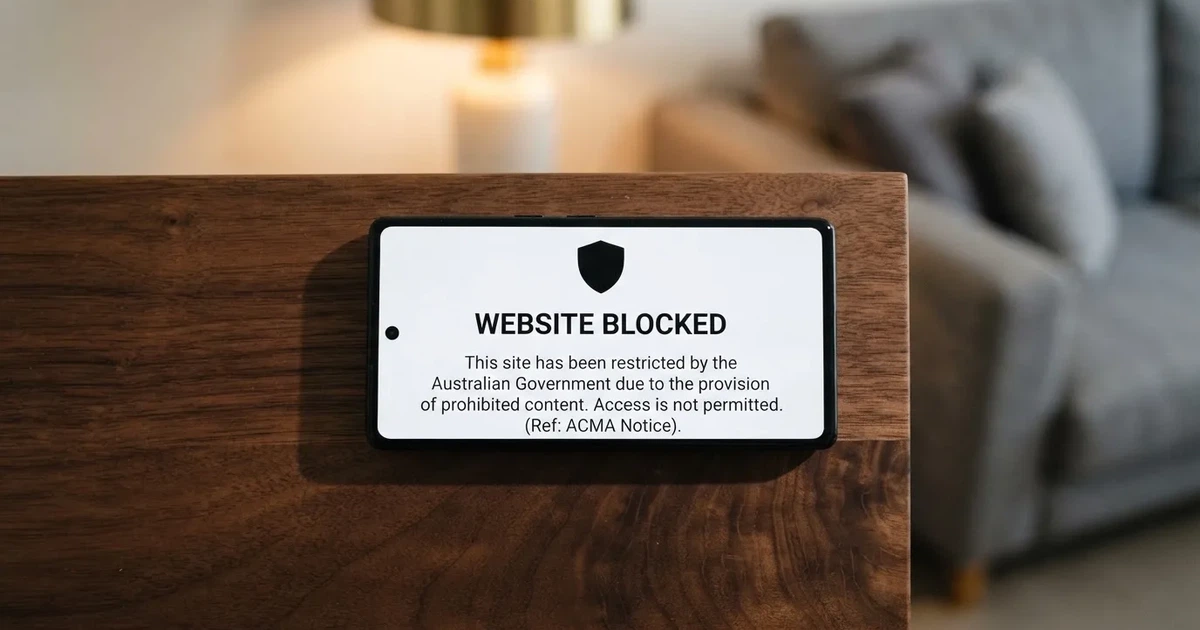
What a punter searching this term is really looking for is an offshore casino still reachable from Australia despite the Interactive Gambling Act 2001. That is the subject this page works through — not as a menu of where to play, but as the cost the reader pays for looking. Verified against the ACMA’s blocking register as of 23 September 2026.
Table of Contents
- What BetStop actually covers, and what it does not
- The Interactive Gambling Act 2001: why the offshore product is prohibited
- What the ACMA actually does about it
- How the ACMA’s formal warnings line up against offshore brands
- How the blocking rate has run since 2019
- Player wellbeing: the tools that do reach a punter
- Payment-side friction for an Australian punter reaching an offshore casino
- Tax: what happens to anything a punter does win
- Reading the 2026 numbers in context
- What an honest answer looks like
- Frequently asked questions
What BetStop actually covers, and what it does not
BetStop launched on 21 August 2023 and the ACMA administers it. It is free, takes about five minutes to register, and a person can sign up at any time. A registrant nominates a minimum exclusion of three months, with longer options of six or twelve months, or a lifetime ban that cannot be reversed. Once registered, licensed Australian online and phone wagering providers may not let the person place a bet, may not let them open new accounts, and may not send marketing.

The reach is defined by licensing. The register’s own scope statement covers “licensed Australian online and phone gambling providers”. An offshore casino holds no Australian licence. It is not bound by the register because it was never part of it. A punter who has registered with BetStop and then opens an offshore account has not bypassed a tool — the tool was never going to stop them, because the offshore site was never going to check.
This matters for anyone thinking the search term describes a workaround. The cost of looking is not the inconvenience of being blocked. The cost is doing business with an operator the Australian system has no way to reach.
The Interactive Gambling Act 2001: why the offshore product is prohibited
The Interactive Gambling Act 2001, as tightened by the Interactive Gambling Amendment Act 2017, makes it an offence to provide online casino games, online pokies or in-play betting to a person physically in Australia. The offence sits with the provider. No state or territory issues a licence for online casino games, and the regime was reinforced from 2017 onwards with civil penalty provisions that have steadily pushed unlicensed operators out.
What is licensed is wagering on races and sport placed before the event, lotteries, and keno. In practice, online bookmakers are licensed by the Northern Territory — the Northern Territory Racing and Wagering Commission oversees 52 of them, including Sportsbet, Bet365 and Ladbrokes. The NTRWC has no full-time staff and meets once a month in Darwin; the Territory’s role is largely a tax base for the operators.
A reader who lands on an offshore casino showing a Curaçao or Anjouan licence is reading marketing. The licence applies to the operator’s relationship with its home regulator. It does not authorise the operator to take Australian customers. The IGA’s prohibition runs against the act of providing the service to a person in Australia, and a licence displayed on the footer does not change that.
What the ACMA actually does about it
Enforcement has three moving parts. The ACMA investigates complaints, issues formal warnings naming the operator and the brand, and directs Australian internet service providers to block illegal sites at the network level. The individual player is not prosecuted. The cost falls on the provider.
The numbers give a sense of the scale. By the ACMA’s own tally as of June 2026, a cumulative 1,751 illegal gambling and affiliate marketing websites had been blocked since the first blocking request in November 2019, and more than 230 unlicensed gambling services had left the Australian market since enforcement was strengthened in 2017. In one round alone, reported on 26 June 2026, the ACMA asked ISPs to block twelve more sites: 7Signs, ChromaBet, Donbet, Duospin, Freshbet, Slots Gem, Jacks Club, Lucky Start, Pointsbetz, Spinrise, Vinyl Casino and Wildsino.
A blocked site does not always vanish. Mirror domains come up, the operator moves the brand, the URL changes. What the block does is raise the friction. A punter who is determined finds a way in; the ACMA’s job is to make the casual route harder and to put the operator on the record.
The cost the punter pays
The IGA targets the operator. The punter takes on a different set of costs, none of them visible on the casino’s homepage:
- No Australian consumer protection. If the operator refuses a withdrawal, voids winnings on a bonus-rule technicality, or simply stops responding, there is no Australian complaints body to appeal to. The Curaçao or Anjouan regulator listed in the footer is, in practice, unreachable for a small-stakes player.
- The site can disappear mid-session. A new ACMA blocking request or a regulator action against the operator can take the domain down overnight. Any balance still on the account is part of that disappearance.
- Credit cards and crypto are banned as deposit routes for licensed wagering, but offshore operators take whatever funds they can clear. That puts the punter on the wrong side of an Australian bank block. Westpac’s gambling block refuses authorisation of transactions tagged under the merchant category code “Betting/Casino Gambling” on eligible personal credit and debit cards; ANZ’s block, once activated, also catches gambling transactions routed through Apple Pay or Google Pay on the eligible card, and a 48-hour cooling-off applies if the punter tries to remove it.
- The product is prohibited. The reader is the consumer of a service that the law treats as unlawful to supply. That is not a moral judgement; it is the legal frame around what is on offer.
H2 Gambling Capital’s 2025 estimate puts Australian losses to illegal gambling sites at roughly A$3.9 billion a year. The share of gambling going through legal channels fell from 74% in 2021 to 64%. The figure is a market-size estimate, not a personal claim about a reader, and it sits alongside the rest of this page as context for the size of what is being sought.
How the ACMA’s formal warnings line up against offshore brands
The table below lists the brands the ACMA itself has put on the record. Each row carries the warning the ACMA issued, the date and the operator the warning names. A formal warning is a public step, not an accusation of wrongdoing beyond the IGA. The point of the list is to show that the brands a reader meets in search results for “casino not on BetStop” are the same brands the regulator has been writing to.
| Brand | ACMA action and date | Operator named by the ACMA | Subject support |
|---|---|---|---|
| RocketPlay | Formal warning, March 2026 (earlier May 2022) | Pulsup Ltd (Rocketplay); earlier Dama N.V. | listings-only |
| Level Up Casino | Formal warning, May 2022 | Dama N.V. | listings-only |
| Woo Casino | Formal warning, March 2025 | Dama N.V. | — |
| Spirit Casino | Formal warning, May 2025 | Dama N.V. | — |
| National Casino | Formal warning, July 2025 | Consolutetish S.R.L. | listings-only |
| Bizzo Casino | Formal warning, July 2025 (earlier 2022) | Consolutetish S.R.L.; earlier TechSolutions | listings-only |
| Ignition Casino | Formal warning, July 2025 | Bamboo Media | — |
| Instant Casino | Formal warning, February 2025 | EOD Code SRL | listings-only |
| Jackbit | Formal warning, April 2026 | Ryker B.V. | — |
| Casino Intense | Formal warning, April 2025 | Sterplay Holding Ltd | listings-only |
| Sky Crown | Formal warning, September 2022 | Hollycorn N.V. | — |
Reading the table: nine of the eleven brands carry a warning in the last two years. Several carry two — the ACMA returned to the same operator under a different brand. Dama N.V. was warned in May 2022 over six brands and again in 2025 over two more. The “Subject support” column shows where the brand’s own listings pages and the ACMA’s own register both reference the same subject, and the em dashes mark brands where no such cross-reference showed up in the listings consulted. None of this turns any row into a recommendation. Each row is the ACMA’s own record.
How the blocking rate has run since 2019
The ACMA’s first blocking request went out in November 2019. From that point to the June 2026 tally, 1,751 illegal gambling and affiliate marketing websites had been blocked.
A reader looking at this number should weigh it as a rate rather than a total. The first blocking requests added single sites or small batches. By 2023 the rounds were running into double digits regularly. The June 2026 round alone blocked twelve. The arithmetic of the page is a band: at a steady rate of roughly 250 sites added a year over the last seven years, with monthly rounds now running between eight and twelve sites each, the ACMA’s working pace has stayed ahead of operator churn. The condition behind the band is straightforward: the rate tracks the ACMA’s investigative and ISP-coordination capacity, not the size of the offshore market.
What the rate does not measure is mirrors, redirects and brand relaunches. An operator whose main domain is blocked often reappears under a new name within weeks. The 1,751 is a cumulative count of distinct blocking actions, not a count of distinct operators still active.
Player wellbeing: the tools that do reach a punter
The honest direction for anyone who came to this page worried about their own gambling is not offshore casinos. It is the set of tools and services Australia has built to act on that worry.

BetStop itself is the first stop. Registering takes about five minutes online at betstop.gov.au, costs nothing, and binds every licensed Australian online and phone wagering provider. Three years after the 21 August 2023 launch, by 31 July 2026 the register had 67,480 total registrations with 41,290 active exclusions. Seventy-eight per cent of registrants are under 40. Thirty-eight per cent chose lifetime exclusion. Those figures show the register being used; they also show that lifetime is a common choice, and that exclusion periods cannot be shortened once chosen.
Bank-side blocks sit alongside the register. Westpac refuses authorisation on transactions tagged with the betting/casino merchant code. ANZ’s block catches the same kind of transactions through a digital wallet linked to the eligible card, with a 48-hour wait if the punter tries to remove it. Neither bank claims completeness — both warn that some gambling transactions will slip through and some non-gambling transactions will be caught. What they do is raise the friction on a default payment method.
The National Gambling Helpline is 1800 858 858, free and 24/7, with online chat through Gambling Help Online. The line is the right first call for someone who is reading this page because their own search has gone further than they wanted it to. It is also the right call for someone helping a family member through the same pattern.
The 2026 reform path runs through the Interactive Gambling Amendment (Gambling Reform) Bill 2026, which passed Parliament on 19 August 2026. Its advertising and inducement measures commence on 1 January 2027. That is law with a start date, not a measure already in force on a 2026 page, and it is worth noting for what comes next rather than for what already binds.
Payment-side friction for an Australian punter reaching an offshore casino
A punter who goes ahead despite the law still meets the Australian payments system on the way in. The Interactive Gambling Act, as amended in 2023, banned credit cards and credit-related products as payment for licensed online wagering from 11 June 2024, with penalties up to A$247,500 for operators that breach it. The ban reaches linked digital wallets — Apple Pay, Google Pay, Samsung Pay — where the underlying funding is a credit card. By the end of 2025 those three wallets together accounted for about 45% of all card payments in Australia by number, so the constraint touches a meaningful slice of how Australians pay.
The Reserve Bank of Australia’s July 2025 review proposes removing surcharges only on eftpos, Mastercard and Visa transactions; American Express sits outside the proposed scope, a small point that matters because Amex is one of the card networks the bigger offshore brands tend to clear on. None of that makes the offshore route work — the IGA’s prohibition runs against the operator, not the card network — but it shapes what a punter finds when they try.
For licensed Australian wagering, the legal deposit routes are debit card, bank transfer, PayID/Osko and BPAY. PayID is a name-and-account lookup that fires through the New Payments Platform and shows the recipient’s name before a transfer is sent; Australian Payments Plus warns that being asked to PayID money to an illegal gambling site is almost certainly a scam site. Osko transfers between participating Australian banks land in under a minute, 24/7. None of those routes work at an offshore casino: the casino does not hold an Australian bank account under the PayID scheme, and the bank-side gambling block catches the merchant code if a card route is attempted.
The Apple Pay line is its own small case study. Apple does not charge consumer fees for Apple Pay — any surcharge comes from the merchant’s own processing fees. Apple also states that transaction limits and PIN requirements are set by the card issuer or merchant, not by Apple. That matters for an Australian punter because the issuer is the bank, and the bank’s gambling block runs at the issuer level: ANZ’s block catches Apple Pay transactions on the eligible card, not just the physical card.
Tax: what happens to anything a punter does win
A recreational player’s gambling winnings are not assessable income under section 6-5 of the ITAA 1997, and losses are not deductible. The exception is a person who carries on a business of gambling — professional punter — which the ATO treats case by case. For an Australian punter playing at an offshore casino, the ATO position does not change; the issue is that offshore winnings are also harder to declare cleanly, and a reader doing their own tax should check with a registered tax agent rather than rely on this page.
Reading the 2026 numbers in context
Three figures anchor the rest of the page. The 1,751 blocked sites, the A$3.9 billion annual loss estimate to illegal sites, and the 64% share of Australian gambling going through legal channels in 2025 (down from 74% in 2021). Each comes with a condition.
The blocking count is a cumulative administrative measure, not a market-size figure. It says how many distinct blocking actions the ACMA has directed, not how many operators are still active.
The A$3.9 billion is an estimate by H2 Gambling Capital, a sector forecaster, reported via industry trade press. It is an order-of-magnitude figure rather than a measured total; the Australian Bureau of Statistics does not collect illegal gambling turnover.
The legal-channel share is the one that does the most work for a reader. Two-thirds of Australian gambling spend still runs through licensed channels in 2025. The remaining third is the market the search term on this page is aimed at — and that third is the part the IGA says is prohibited to supply.
What an honest answer looks like
A reader who searched this term was almost certainly looking for a way around something. That something might be BetStop, a bank block, a personal decision made at a bad moment, or a partner’s request. The cost of looking is not a fine. It is doing business with an operator the Australian system has no way to reach, in a market where the law treats the supply as prohibited, on a payment route the Australian banks are actively narrowing.
The honest direction is the one the IGA, the ACMA and BetStop are already set up for: BetStop for self-exclusion from licensed wagering, the bank block for friction on a default payment method, and the National Gambling Helpline on 1800 858 858 for the conversation the search was really about. None of those tools reaches an offshore casino. None of them was ever meant to. What they reach is the part of the market a reader can still be inside.
Frequently asked questions
What is BetStop and how does it differ from a casino ban?
BetStop is the National Self-Exclusion Register, run by the ACMA since 21 August 2023. It binds licensed Australian online and phone wagering providers, who must refuse bets, new accounts and marketing to a registered person. Online casino games cannot be licensed in Australia at all, so a casino ban does not exist on the same footing — there is no licensed casino product for BetStop to lock a person out of.
Does BetStop block offshore online casinos as well as licensed wagering sites?
No. BetStop’s scope is “licensed Australian online and phone gambling providers”. An offshore casino holds no Australian licence, sits outside the register’s scope and is not bound to check it. The tool stops at the licensing border; what is offshore was never inside it.
How long does it take to register with BetStop?
About five minutes, online at betstop.gov.au, at any time. The minimum exclusion period is three months, with six-month, twelve-month and lifetime options available. A registrant can extend an active exclusion but cannot shorten it, and a lifetime exclusion cannot be reversed.
Can someone remove themselves from BetStop before the minimum period ends?
No. The minimum is three months. Once an exclusion is active it can only be extended, and a lifetime registration is permanent. The 67,480 registrations on the register as of 31 July 2026 include 41,290 active exclusions, with 38% of registrants having chosen lifetime.
Where can someone get support if they are worried about their gambling?
The National Gambling Helpline on 1800 858 858, free and 24/7, with online chat through Gambling Help Online. A bank gambling block through Westpac, ANZ or another Australian issuer adds friction on the payment side. Both routes reach the licensed wagering market; neither reaches an offshore casino, because nothing in the offshore chain is bound to act on them.
Is it legal for any online casino to operate in Australia, on or off BetStop?
No. The Interactive Gambling Act 2001, strengthened in 2017 and amended in 2023, prohibits the supply of online casino games and online pokies to a person in Australia. No state or territory issues such a licence. The IGA’s prohibition runs against the provider, not the player, but the supply itself is the offence BetStop was not built to police — the licensing regime never admitted it.
Created by the ”Low Deposit Casino Info” editorial team.