International casinos serving Australian players: the lawful picture behind the search
 Available in US
A reader typing “international casino” or “international casinos” usually wants a shortlist. There is a real answer to that wish, and the answer is the reason this page does not begin with one. Offering an online casino game to anyone in Australia is an offence under the Interactive Gambling Act 2001, and no Australian jurisdiction issues a licence for one. The brands an Australian reader meets in search results are the brands the Australian Communications and Media Authority has spent the last several years actively warning, blocking and pushing off the market. A page that ranks them is, by construction, ranking a product that cannot lawfully be sold here.

That is what this page is for. It walks the legal landscape first, then the responsible-gambling tools that apply, then the ACMA’s own record of action against the brands a reader is most likely to meet, then the lawful alternatives that actually exist. The cost frame stays fixed on the reader throughout — what a banned product costs the person paying for it, and what the lawful channel costs the person choosing it.
Data current as of 23 September 2026, checked against the ACMA’s register of formal warnings and blocking requests.
Table of Contents
- The Australian legal frame around international online casinos
- The safeguards an Australian reader actually has
- The arithmetic the marketing copy leaves out
- The brands an Australian reader actually meets in search results
- What an Australian reader can lawfully do
- What a reader new to this should know
- Frequently asked questions
The Australian legal frame around international online casinos
The Interactive Gambling Act 2001, as tightened by the Interactive Gambling Amendment Act 2017, makes it an offence to provide an Australian customer with an online casino game, an online pokie or in-play betting. The offence sits with the provider, not the player. A reader sitting in Sydney who logs into a Curacao-licensed site is not the one facing prosecution; the offshore operator is. That asymmetry looks protective on paper and is anything but in practice, because the same law leaves the player with no Australian complaints body, no Australian recourse if a withdrawal is refused, and no guarantee the site will still be reachable next week.

The licence a site displays at the bottom of its homepage is granted by another jurisdiction. Curacao, Anjouan, Kahnawake, the Isle of Man — these are real regulators, with real rules, applying to the operator on their patch. None of them has the reach, or the duty, to enforce those rules on behalf of an Australian consumer. An offshore licence is not a substitute for an Australian one; it is a marker that no Australian licence exists.
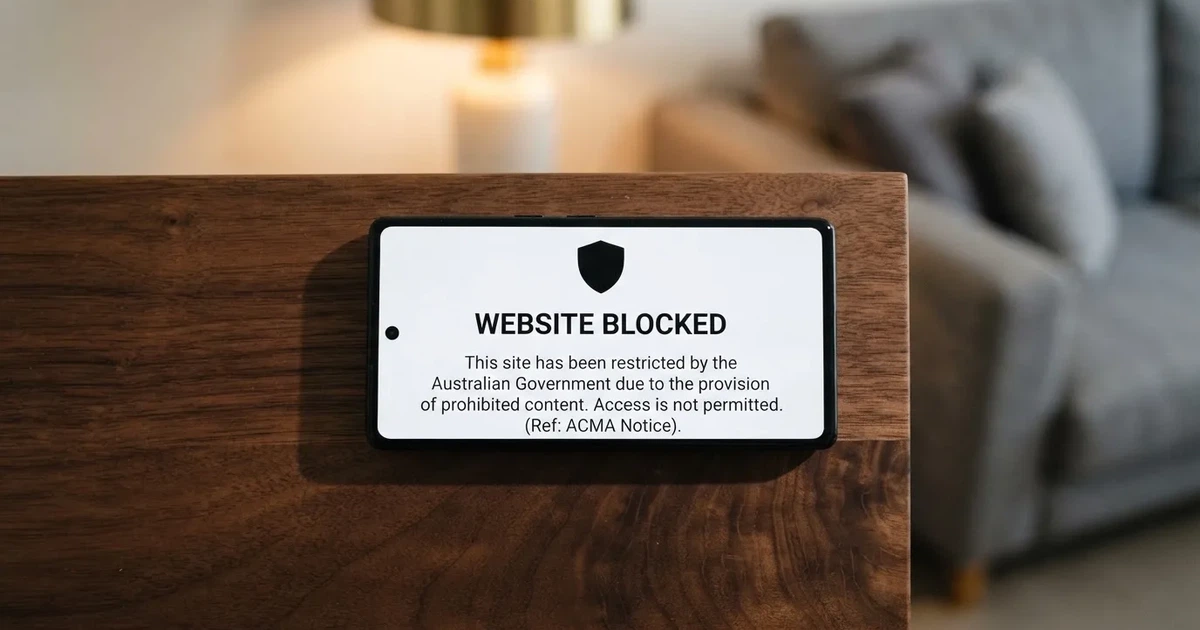
Enforcement runs through the ACMA. The regulator investigates complaints, issues formal warnings to operators, and asks Australian internet service providers to block sites that keep operating after a warning. By June 2026 the cumulative count stood at 1,751 illegal gambling and affiliate marketing websites blocked since the first blocking request in November 2019, and more than 230 unlicensed services had left the Australian market since 2017. The June 2026 round alone named twelve sites: 7Signs, ChromaBet, Donbet, Duospin, Freshbet, Slots Gem, Jacks Club, Lucky Start, Pointsbetz, Spinrise, Vinyl Casino and Wildsino. A site can be blocked with a balance still on it. There is no compensation scheme for that.
The Northern Territory Racing and Wagering Commission is the regulator Australians most often see named. It oversees fifty-two online bookmakers, including Sportsbet, Bet365 and Ladbrokes. Its remit is wagering — racing and sport, pre-event only — not casino games. The commission runs with no full-time staff and meets once a month in Darwin, a detail that does not undermine its authority over the bookmakers it does license and is worth knowing before treating the licensing landscape as anything like a casino-style supervisory regime.
What is actually licensed in Australia is narrower than the search results suggest. Wagering on races and sport placed before the event. Lotteries and keno. Land-based casinos in each state and territory. Licensed pokies venues. Anything else, on a screen at home, sits outside the licence frame and inside the prohibition.
What the 2026 reform package changes
The Interactive Gambling Amendment (Gambling Reform) Bill 2026 passed Parliament on 19 August 2026. Its advertising and inducement measures commence on 1 January 2027. On a page read in 2026 this is law with a start date, not law in force. The next twelve months are the run-up, not the regime itself. Treat the change as a known future, not a current rule.

The payment frame around an offshore site
Credit cards, credit-related products and digital currency have been banned as payment for Australian-licensed online wagering since 11 June 2024. Penalties for an operator breach run up to A$247,500. The lawful deposit routes are debit card, bank transfer, PayID/Osko and BPAY. A site asking an Australian customer for a credit card or a crypto deposit is, by that request alone, operating outside the Australian rules. That single fact does the work of a long paragraph: the payment page on an offshore casino is usually the cleanest evidence a reader has that the site is not subject to Australian consumer law.
PayID, Osko and BPAY are the rails the lawful Australian market runs on. PayID transfers between more than 100 Australian financial institutions resolve under a minute, 24/7, and the screen shows the name of the account holder before the transfer is sent. AP+ itself warns that a PayID attached to an illegal gambling site is almost certainly a scam — a reader who has been asked to send money that way already has the answer to whether the operator is who it claims to be. BPAY has been running since 1997 and sits in the online banking of more than 140 Australian institutions. Osko and PayID sit on the New Payments Platform, which became accessible to the public on 13 February 2018 and has more than 25 million PayIDs registered as of April 2025. The rails are not exotic; they are ordinary Australian banking.
The safeguards an Australian reader actually has
BetStop — the National Self-Exclusion Register — has been live since August 2023. It binds Australian-licensed online and phone wagering services. A reader who registers with BetStop and then logs into a Curacao-licensed offshore casino is logging into a service that is not connected to BetStop at all. The exclusion does not carry across. That is the single most important fact about the register, and it is also the single most important reason the register cannot do for an offshore customer what it does for a licensed one.
The same gap sits with the dispute-resolution bodies. An Australian-licensed bookmaker sits inside the Australian complaints ecosystem. An offshore casino sits inside whatever its own jurisdiction provides, which may be nothing. The National Gambling Helpline is 1800 858 858, free, 24/7, with web chat at Gambling Help Online. These lines are not enforcement and they do not move a withdrawal. They exist because the consumer protection the law provides in other sectors is precisely the protection this one, by design, does not.
AUSTRAC’s threshold-transaction-report rule applies only to physical cash transfers of A$10,000 or more. Ordinary electronic bank transfers are not subject to the per-transaction reporting requirement, regardless of the amount. A reader worried that a single transfer will trip a reporting line has misread the rule. A reader worried that several smaller transfers will never be assembled into a single picture has misread it differently; both should check the AUSTRAC page before relying on either guess.
What a card-level gambling block changes
Westpac’s gambling block works at card level: it refuses authorisation of transactions registered under the merchant category code for betting and casino gambling, on eligible personal credit and debit cards. Commonwealth Bank’s equivalent sits in the CommBank app, applied to eligible cards, and the bank states plainly that it cannot guarantee every gambling transaction will be stopped. ANZ’s gambling block, once turned on, also blocks gambling transactions made through a digital wallet such as Apple Pay on the eligible card — and removing the block again requires a 48-hour waiting period. ANZ’s own page carries the warning that not all gambling transactions will be blocked and that some non-gambling transactions may be blocked in error. Three of the four majors run the same pattern: the block is a barrier, not a seal.
The Apple Pay and Google Pay numbers are large enough to matter. By the end of 2025, mobile wallet transactions were about 45% of all card payments in Australia by number. The Reserve Bank’s July 2025 review proposes removing surcharges only on eftpos, Mastercard and Visa transactions — explicitly leaving American Express outside the scope of the proposed ban. None of that changes the law. It changes where the friction sits when a reader tries to deposit at an offshore site, and friction is, at scale, the only consumer-side mechanism that actually does anything in this market.
Apple Pay, the platform itself, charges the consumer nothing — any surcharge is the merchant’s, from its own card-processing fees. Apple also states that transaction limits and PIN requirements are set by the card issuer or merchant, not by Apple. The friction is upstream of the wallet. The card-level block is upstream of the wallet too. Both are switches the reader can flip, and both have the limits their own terms pages describe.
The arithmetic the marketing copy leaves out
H2 Gambling Capital’s 2025 report estimates that Australians lose about A$3.9 billion a year to illegal gambling sites. The same report notes the share of gambling going through legal channels fell from 74% in 2021 to 64%. Two numbers, two messages: the money leaving the regulated frame is large in absolute terms, and the regulated frame is shrinking as a share of the whole. A reader weighing the choice between a lawful wagering account and an offshore casino is weighing not a niche product against a mainstream one but a small fraction of the market against the rest of it.
A blocking rate is one way to read the ACMA’s record. The first blocking request was issued in November 2019. By June 2026 the running total was 1,751 blocked sites — roughly 262 per year across the seven-year window, or about twenty-two per month. The band this sits in is the right way to describe it, because the count includes affiliate marketing sites as well as operator domains, and the rate at which new sites replace blocked ones is the more interesting number. The lesson is the shape of the curve, not any single point on it: blocking is steady, replacements are steady, and the regulator’s pace has not slowed.
A reader who reads only the ACMA’s blocking announcements gets one picture. A reader who also reads the warnings gets a sharper one. The warnings name the operator behind the brand, and the same operator names repeat. Dama N.V. was warned in May 2022 over six brands — Bambet, Dazard, Level Up, Rocketplay, Wild Tornado and Cobra Casinos — and again in March 2025 over Woo Casino, and again in May 2025 over Spirit Casino. Consolutetish S.R.L. was warned in July 2025 over National Casino and Bizzo Casino. Bizzo Casino had already been the subject of a 2022 warning to TechSolutions. The pattern is a brand-and-shell cycle the regulator keeps catching. The reader who is being asked to trust a brand today has no good reason to believe the same operator will not reappear under a different name tomorrow.
The lawful channel does not eliminate the house edge — it does not, and this page does not pretend otherwise. What it does is give the customer a complaints body, an exclusion register that includes them, and a payment route that does not start with a credit-card-or-crypto prompt. The cost is a smaller product range, and a sportsbook or a tote rather than a casino. For a reader whose aim is a flutter on the Melbourne Cup, that is the whole product. For a reader whose aim is a slot session at 2 a.m., there is no Australian-licensed equivalent, and that absence is the reason this page has the shape it has.
The brands an Australian reader actually meets in search results
The list below is the ACMA’s record, not a recommendation. Each entry is a brand the regulator has formally warned for offering prohibited online casino services to Australians. The column headed “Subject support” reports what third-party listings say about the brand’s support for an Australian subject — payment methods, self-exclusion reach and similar — without confirming those claims as the operator’s own statement. Where the regulator’s record gives no clear answer, the entry stays out of that column.
| Brand | ACMA action and date | Operator named by the ACMA | Subject support |
|---|---|---|---|
| RocketPlay | March 2026 formal warning; earlier Dama N.V., May 2022 | Pulsup Ltd (Rocketplay); Dama N.V. | — |
| Level Up Casino | May 2022 formal warning | Dama N.V. | — |
| Woo Casino | March 2025 formal warning | Dama N.V. | — |
| Spirit Casino | May 2025 formal warning | Dama N.V. | — |
| National Casino | July 2025 formal warning | Consolutetish S.R.L. | AUSTRAC and BetStop coverage reported by third-party listings |
| Bizzo Casino | July 2025 formal warning; earlier TechSolutions, 2022 | Consolutetish S.R.L.; TechSolutions (CY) Group Limited and TechSolutions Group N.V. | — |
| Ignition Casino | July 2025 formal warning | Bamboo Media | — |
| Instant Casino | February 2025 formal warning | EOD Code SRL | ecoPayz and PayID reported by third-party listings |
| Jackbit | April 2026 formal warning | Ryker B.V. | — |
| Casino Intense | April 2025 formal warning | Sterplay Holding Ltd | AUSTRAC, BetStop and gambling-industry listings |
| Sky Crown | Formal warning | Hollycorn N.V. | — |
What the table does not show is the licence the brand displays on its homepage. None of those licences is an Australian one, because no Australian jurisdiction issues one. A Curacao or Anjouan sub-licence is the marker the reader is most likely to see, and it carries no Australian consumer protection. The reader who treats that licence as a quality mark is reading a different document than the one that exists.
What the table also does not show is a bonus number, a free-spin count or a deposit-match percentage. Those figures exist on the brands’ affiliate marketing pages, and the only sources for them are those same pages. A ranking by bonus size would be a ranking by marketing budget, and this page is not that. The marketing copy lives where it lives and is read where it is read; it is not transcribed here.
Reading the table as a pattern, not a ranking
The eleven brands are not eleven separate stories. They are one story told eleven times: an operator sets up a brand, the ACMA warns, the brand is renamed or the licence is moved, a new warning follows. Dama N.V. alone has been warned in three separate years, covering three different brand cohorts. TechSolutions was warned in 2022 over Bizzo Casino; Consolutetish S.R.L. was warned in 2025 over the same brand. The brand is the constant; the corporate shell is the variable.
A reader who arrives at one of these brands through a search result is arriving at the most recent layer of that pattern. The warning they will not have seen is the warning the regulator has already issued. The blocking request they will not have seen is the one already in the queue. The pattern is the warning, and the warning is not on the landing page.
What an Australian reader can lawfully do
A shortlist of lawful Australian options is shorter than the offshore list, and is shorter for the reason the law draws the line where it does. The product mix on the lawful side does not include online casino games or online pokies, and no review of offshore casinos fills that gap honestly.
Licensed wagering on sport and racing
Pre-event wagering with an Australian-licensed bookmaker is the closest analogue to what an offshore casino offers in spirit, though not in product. The big three — Sportsbet, Bet365 and Ladbrokes — are licensed by the Northern Territory Racing and Wagering Commission. The list of fifty-two NTRWC licensees is the universe the regulator itself oversees. A bet with any of them is a bet inside the Australian consumer-protection frame: complaints go through the bookmaker and, if necessary, through the regulator; deposits use the lawful payment rails; the credit-card and crypto prohibitions are observed. The product is narrower than a casino. The frame is wider.
Lotteries, keno and land-based play
State and territory lotteries and keno products run inside the Australian licence frame. Land-based casinos operate in each state and territory under their own regulator. Licensed pokies venues — clubs and pubs — operate inside state and territory gaming-machine rules, with their own self-exclusion schemes that sit alongside BetStop. None of these is an offshore casino. The substitution is partial, by design.
BetStop, the helpline and the bank-side blocks
BetStop is the exclusion register that does apply to licensed services. A reader who has registered with BetStop and then tries to open a new account with an Australian-licensed bookmaker is refused. The same exclusion does not reach an offshore casino. The 1800 858 858 helpline and Gambling Help Online are the two points of contact that apply across the divide — they do not enforce anything, but they exist for the situation enforcement cannot reach. The bank-side gambling blocks, on Westpac, ANZ and Commonwealth Bank cards, are the consumer-side switches an Australian reader can flip on their own. They are imperfect: each bank’s own page carries the warning that not all gambling transactions will be blocked and some non-gambling transactions may be blocked in error. They are also the only switches the reader controls.
What this page is not
This page is not a comparison of offshore casinos. It is not a ranking. It is not a recommendation. It does not hand a reader a brand to play at. The brands named above are named because the ACMA has warned them, and a ranking of them would be a ranking of a product the Australian consumer-protection frame does not cover. The most useful thing this page can do for a reader is to make that frame visible, name the rails that work inside it, and put the ACMA’s record beside the search results the reader met first.
What a reader new to this should know
The first decision is whether to play at all
A page that began with a ranking would skip this step. This page does not. The decision to play any form of gambling is a decision the reader makes, and the legal frame around it is part of the information that decision needs. Offshore casino play carries a different consumer-protection picture than a bet with an Australian-licensed bookmaker. The arithmetic the marketing copy leaves out — the A$3.9 billion a year leaving the regulated frame, the 1,751 sites blocked since 2019, the eleven-operator, eleven-brand warning pattern — is part of the cost.
The second decision is the rails
A reader who has decided to play within the Australian frame uses a debit card, a bank transfer, PayID/Osko or BPAY. The same reader does not use a credit card, does not use a credit-related product, does not use digital currency, and does not use a path that asks for any of those. A payment page that asks for one of those is, by that request, evidence that the operator is not subject to Australian rules.
The third decision is the safeguards
BetStop. The bank-side block. The 1800 858 858 helpline. Each one has the limits its own terms describe; none of them is a seal. They are the switches a reader can flip, and the switches have the effect their own pages say they have.
Frequently asked questions
What does international casino mean as distinct from an Australian-licensed one?
An international casino is an offshore operation licensed in another jurisdiction — Curacao, Anjouan, Kahnawake, the Isle of Man and similar. An Australian-licensed casino does not exist as a category: the Interactive Gambling Act 2001 prohibits offering online casino games to anyone in Australia, and no state or territory issues a licence for one. The term “international casino” describes the product the law does not let an Australian-licensed operator sell.
Can an international online casino legally accept players located in Australia?
No. The Interactive Gambling Act 2001 makes it an offence to provide online casino games, online pokies or in-play betting to a person in Australia. The offence sits with the provider. The individual player is not prosecuted, but the site itself is operating outside Australian law and can be blocked by Australian ISPs at the regulator’s request.
Does an overseas gambling licence carry any weight for an Australian player?
Only as a marker of who supervises the operator in the licensing jurisdiction. It does not carry Australian consumer protection. An Australian player with a complaint has no automatic recourse through the overseas regulator, and no Australian complaints body will take the complaint on. The licence is real; its reach stops at the border.
What protections, if any, apply to an Australian using an international casino site?
None of the Australian ones. BetStop does not reach an offshore casino. The Australian bank-side gambling blocks reach the card and the wallet, not the site. The dispute-resolution bodies an Australian-licensed bookmaker answers to do not apply. The reader is, for consumer-protection purposes, outside the Australian frame.
Are international land-based casino resorts different from the international online sites people search for?
Yes, and the difference matters for what the law does. International land-based casino resorts are physical venues, licensed in their home country, where a person physically present can play under that licence. International online casinos are websites, licensed in another jurisdiction, offering games over the internet to a person who is not physically present. Australian law addresses the online offering; the physical venue is a different question, addressed at the border.
Who can an Australian contact if an international casino site will not pay out?
The National Gambling Helpline on 1800 858 858, free, 24/7, with web chat at Gambling Help Online, can advise on the situation. The helpline is not enforcement and will not move a withdrawal. The site’s own regulator is the body with formal authority, but its enforcement is on its own patch, and a withdrawal dispute from an Australian customer is rarely at the top of its queue. There is no Australian complaints body that can compel an offshore operator to pay.
Written by the editors at Low Deposit Casino Info.