
What a “safe” online casino in Australia really costs the punter
The phrase “safe online casino Australia” does the work of an answer before the question has been asked. Every offshore casino that advertises to Australians wraps itself in the word safe, and the wrapping is the product: a Curacao or Anjouan licence badge, a padlock in the browser bar, an audited-RTP sticker on the lobby page. None of it changes the underlying fact. Online casino games and online pokies are prohibited interactive gambling services in Australia. The Interactive Gambling Act 2001, as tightened by the Interactive Gambling Amendment Act 2017, makes it an offence to provide them to a person physically in Australia. No state or territory issues a licence for them. The badge is real. The protection it implies is not.

This page is a working out of what safe actually buys an Australian player, what the regulator has done about offshore operators that market here anyway, and how to read the deposit and withdrawal rails that any site will push you onto. The angle is the cost — to the player, in money, in recourse, and in the things a marketing page quietly does not say.
Currency stamp: data current as of 29 October 2026 and cross-checked against the Australian Communications and Media Authority’s published formal-warning register and the Reserve Bank of Australia’s payments publications.
Table of Contents
- Why “safe” is a marketing word before it is anything else
- What the ACMA has actually done, and what the warnings add up to
- The arithmetic of enforcement, and the blocking rate
- How to read what an offshore casino is offering an Australian player
- What a payment rail actually tells you about the casino behind it
- What the banks do, and the limits of what they can do
- BetStop and the National Self-Exclusion Register
- The eleven operators on the ACMA’s recent register
- The cost in plain terms
- A short practical checklist
- Frequently asked questions
Why “safe” is a marketing word before it is anything else
A casino calling itself safe is making two claims at once. One is technical: TLS encryption, segregated player funds, a known random-number generator. The other is regulatory: somebody, somewhere, is watching this operator on the punter’s behalf. The technical claim is the easier of the two to test. Look for an independent audit certificate from a recognised testing house (e.gCOGRA, GLI, iTech Labs), read it on the auditor’s own domain rather than the casino’s, and check that the certificate names the games actually being played rather than a generic platform. The regulatory claim is the harder one, and it is the one the marketing leans on.

Three things an Australian needs to know before reading any further.
First, no Australian-licensed operator offers online casino games or online pokies. Wagering on sports and racing before the event, lotteries and keno are licensable and licensed — in practice through the Northern Territory Racing and Wagering Commission (NTRWC), which covers 52 online bookmakers including Sportsbet, Bet365 and Ladbrokes for tax reasons, and which the ABC reported in April 2026 has no full-time staff and meets once a month in Darwin. The NTRWC is a wagering regulator. It is not, and has never been, a casino regulator. When a search result says a casino is “licensed in Australia”, the licence in question is almost always a wagering licence held by a related entity, and it does not cover the casino product on the same website.
Second, every offshore casino that markets to Australians is, by definition, providing a prohibited service. The Interactive Gambling Act targets the provider, not the individual punter. That is a real distinction — no Australian has been prosecuted for placing a bet — but it cuts both ways. The offshore site gives the punter no Australian consumer protection, no complaints body to escalate to, and no recourse if a withdrawal is refused. The site can be added to the ACMA’s blocking list, with a balance still sitting on it.
Third, the marketing vocabulary is calibrated. Safe, licensed, regulated, audited, trusted all appear on the same landing page, often in the same paragraph, and they slide past each other. The licence they point to is in Curacao, or Anjouan, or the Isle of Man. Those regimes exist. They do not, in practice, arbitrate individual player disputes against their own licence-holders with anything like the rigour of, say, the UK Gambling Commission or the Malta Gaming Authority, and they do not cover Australian players at all. The page is what the operator chose to write. The protection it implies is what the operator chose to imply.
What the ACMA has actually done, and what the warnings add up to
The ACMA’s enforcement arc is the cleanest record of how the offshore market behaves in Australia. The agency’s first request to have illegal sites blocked by Australian internet service providers was made in November 2019. As of June 2026, the running total of blocked sites and affiliate pages sat at 1,751, with more than 230 unlicensed services having left the Australian market since enforcement was strengthened in 2017. The round reported on 26 June 2026 added twelve names to the block list: 7Signs, ChromaBet, Donbet, Duospin, Freshbet, Slots Gem, Jacks Club, Lucky Start, Pointsbetz, Spinrise, Vinyl Casino and Wildsino.
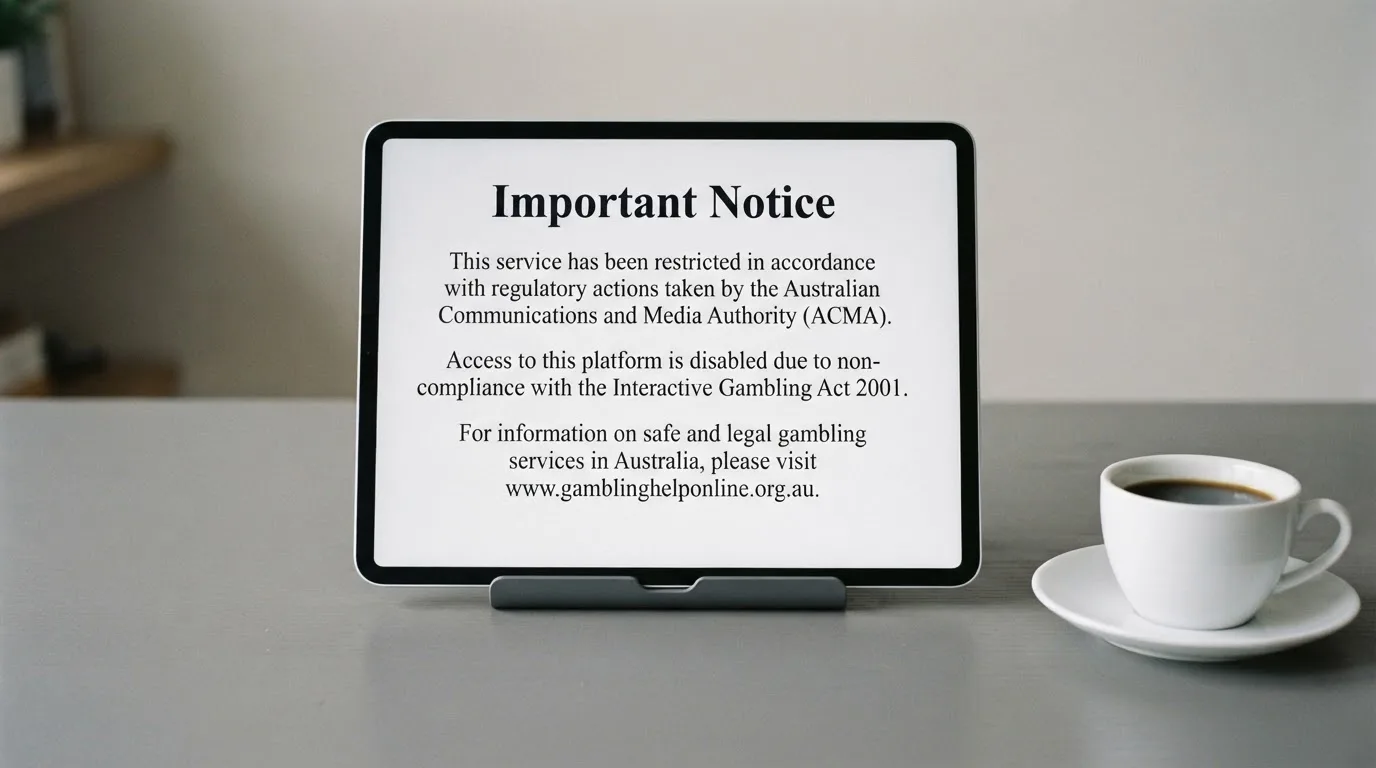
A block is not a fine, and an exit is not a conviction. It is the ACMA using the tools it has — referral to ISPs, formal warnings, civil penalty proceedings against the most persistent offenders — and the cumulative effect is what an Australian punter sees as the search-results page they actually have to scroll through. The H2 Gambling Capital 2025 estimate put annual losses to illegal gambling sites at roughly A$3.9 billion a year, and noted that the share of gambling going through legal Australian channels fell from 74% in 2021 to 64%. The block list is the regulator’s response. The trend line is the market’s.
The formal-warning register is the most useful document on the ACMA site for someone comparing operators, because it names both the casino brand and the corporate entity behind it. A handful of the more instructive entries:
- March 2026: a formal warning to Pulsup Ltd over Rocketplay. Rocketplay had earlier been warned in May 2022 as one of six Dama N.V. brands.
- July 2025: formal warnings to Bamboo Media over Ignition Casino, and to Consolutetish S.R.L. over National Casino and Bizzo Casino. Bizzo had already been warned once in 2022, when it sat under TechSolutions (CY) Group Limited and TechSolutions Group N.V.
- May 2025: a formal warning to Dama N.V. over Spirit Casino.
- March 2025: a formal warning to Dama N.V. over Woo Casino.
- February 2025: a formal warning to EOD Code SRL over Instant Casino.
- April 2025: a formal warning to Sterplay Holding Ltd over Casino Intense.
- April 2026: a formal warning to Ryker B.V. over Jackbit and CasinOK.
- September 2022: a formal warning to Hollycorn N.V. over Sky Crown and Blue Leo.
Two patterns are worth holding onto. First, the same operator-company can reappear under a new brand name when the warning lands — Dama N.V. has surfaced under at least six casino brands, and the warning follows the company, not just the URL. Second, the same brand can be re-warned under a new corporate vehicle when one shell is exhausted — Rocketplay moved from Dama N.V. to Pulsup Ltd, Bizzo from TechSolutions to Consolutetish. The marketing is fresh. The underlying pattern is not.
The arithmetic of enforcement, and the blocking rate
The blocking-rate question — how fast the ACMA is actually reducing the number of illegal sites accessible to Australians — is the one calculation that belongs on this page.
The running total stated in the June 2026 reporting round was 1,751 sites blocked since the first blocking request in November 2019. That is roughly 80 months between the first block and the June 2026 reporting date. The average across that span is about 22 blocked sites per month. The actual monthly figure is far from steady: the early years were slower, and the per-round count of twelve in June 2026 is closer to a typical month than an outlier. A reasonable band for the long-run pace is therefore somewhere between fifteen and twenty-five new blocks per month, with the long-run average at the lower end of that band once the slower early years are included.
What that arithmetic does not measure is the replacement rate — the speed at which a blocked operator reappears under a new domain, a new shell, or a new brand name. The ACMA’s own enforcement record suggests the replacement is non-trivial: a single operator-company can sit behind half a dozen brands over a few years, and each new brand carries a fresh round of marketing spend before the next warning lands. Read against that, the long-run pace of fifteen to twenty-five blocks a month is the rate at which the regulator keeps the head above water, not the rate at which the supply of prohibited services is contracting.
How to read what an offshore casino is offering an Australian player
A practical way to read an offshore casino’s offer is to separate the three things it bundles together, because they fail in different ways.
The first bundle is the bonus. Welcome packages of 100% to 200% of the first deposit, sometimes stretching across the first three or four deposits, are the norm. The marketing is the headline number. The cost is the wagering multiple — typically thirty to fifty times the bonus, sometimes the bonus-plus-deposit — and any game-weighting rules that quietly reduce the contribution of table games or live casino to clearing that turnover. A 100% match with a 40x bonus wagering requirement on pokies clears, in principle, in tens of thousands of spins at small stakes. The terms of those bonuses are written by the operator and adjudicated by the operator. There is no Australian body to take a complaint to.
The second bundle is the withdrawal. The advertised payout window is typically twenty-four to seventy-two hours once the account is verified. The lived experience is longer for a first withdrawal — the site asks for fresh KYC documents, sometimes a utility bill, sometimes a selfie with the card used to deposit, and the verification window resets each time a new deposit method is added. If a withdrawal is refused, the operator’s own terms usually reserve the right to confiscate the balance on the grounds of “irregular play” or “bonus abuse” — phrases with no fixed meaning and no external arbiter.
The third bundle is the game library. Pokies, live-dealer tables, and the same progressive jackpots the licensed European market sees are all available. What is not available is an RTP figure for the specific title you are playing, audited against a specific version of the game running on a specific date — most offshore sites state an RTP range and leave the actual return on any individual spin undisclosed. The published figure is what the provider set when the game was released. The figure you are playing to is whatever the operator has configured.
Read the three bundles together and the picture is consistent: the marketing speaks in the language of consumer protection; the underlying product is a self-regulated offshore service with no Australian recourse. The cost of any individual session is whatever the house edge is on the games played. The cost of any dispute is the dispute itself.
What a payment rail actually tells you about the casino behind it
The way a casino asks to be paid is a stronger signal than the licence badge on the about page. Two rails deserve separate attention because they behave differently in Australia.
PayID and Osko are the rails worth understanding first. PayID is the address layer built on Australia’s New Payments Platform (NPP), which went live to the public on 13 February 2018 and is owned by New Payments Platform Australia Ltd — a non-profit whose thirteen shareholders include the Reserve Bank of Australia and the major banks. By April 2025 more than 25 million PayID identifiers had been registered. Over 100 Australian financial institutions offer PayID-based instant transfers. The settlement rail is Osko, which delivers bank-to-bank transfers in under a minute, 24/7 including weekends, whether addressed to a BSB and account number or to a PayID. Participants in the NPP must keep monthly platform outages to no more than two minutes, and in 2021 the ACCC authorised the merger of NPP Australia, BPAY and eftpos into Australian Payments Plus (AP+).
Two facts make PayID the most legible rail for an Australian punter. First, paying to a PayID reveals the name of the account holder before the transfer is sent — so the punter can see whose account the money is going to. Second, AP+ itself warns that being asked to transfer to a PayID on an illegal gambling site almost certainly means a scam site. That is the operator’s own payments infrastructure saying, in so many words, that the site is not what the marketing says it is.
BPAY, by contrast, is a bill-payment service: the payer enters a Biller Code and a Customer Reference Number (CRN) from the bill. It has run in Australia since 1997 (launched 18 November 1997), sits inside the online banking of more than 140 banks and financial institutions, and is used by over 95,000 businesses. It is run by AP+, the same operator as PayID and Osko, and was brought under the AP+ holding in September 2021. BPAY is the rail an Australian-licensed wagering operator uses. An offshore casino asking for BPAY is asking the punter to treat it as a bill — and the punter’s bank will treat it as one too, with the biller’s name sitting in the transaction record rather than a casino’s trading name.
The other rails tell different stories. A credit card or a credit-linked digital wallet is not a legal deposit route at an Australian-licensed online wagering service at all, since the Interactive Gambling Act 2001 as amended in 2023 banned credit cards and credit-related products for that purpose. An offshore site that accepts credit cards or Apple Pay paid from a credit card is operating outside the Australian rules — and the punter paying by that route has no consumer protection that an Australian regulator would recognise. A debit card works, and is the rail most Australians will end up on by default, but it does not by itself validate the casino on the other end.
Two specific cards deserve a note. American Express was established in 1850 as a freight-forwarding company and became a card issuer with its first charge card on 1 October 1958; unlike Visa and Mastercard’s four-party network, Amex traditionally issues cards and processes transactions itself as a three-party scheme. The Reserve Bank of Australia’s July 2025 review of merchant card payment costs and surcharging proposed removing surcharges on eftpos, Mastercard and Visa transactions, and explicitly left American Express outside the scope of the proposed surcharge ban. For an Australian punter that means Amex surcharges at an offshore casino remain whatever the merchant chooses to set — and the merchant is, by definition, not bound by the RBA’s proposed framework.
Digital wallets are now the rail a large share of Australians would reach for by default. By the end of 2025, Apple Pay, Google Pay and Samsung Pay collectively accounted for around 45% of all card payments in Australia by number. The detail that matters here is what sits underneath the wallet. Apple does not charge consumers for using Apple Pay in stores, online or in apps; any surcharge is the merchant’s own card-processing fee, not Apple’s. Apple also states that transaction limits and PIN requirements are set by the card issuer or merchant, not by Apple. Whether a wallet transaction is a credit transaction or a debit transaction is decided by the card in the wallet — and that is what the Interactive Gambling Act’s credit ban turns on.
That is the more important point for an Australian punter. The Interactive Gambling Act 2001 as amended in 2023 makes it unlawful for an Australian-licensed online wagering service to accept payment by credit card or any other credit-related product. The same restriction catches a digital wallet like Apple Pay when it is funding a credit-card transaction. There is no equivalent rule at an offshore casino, but the rule’s existence is the cleanest piece of evidence for what the Australian regime treats as a higher-risk rail.
What the banks do, and the limits of what they can do
Three of the four major Australian banks have built transaction-level gambling blocks, and the fourth has equivalents through its card portfolio. The mechanic is similar in each case: a card-level refusal of authorisations on transactions registered under the merchant category code Betting/Casino Gambling.
Westpac’s gambling block works at card level: it refuses authorisation of transactions registered under that MCC on eligible personal credit and debit cards. ANZ’s block, activated inside the ANZ app, also blocks gambling transactions made through a digital wallet such as Apple Pay on an eligible card, not just the physical card — the wallet token sits on the card, the card sits on the block. Commonwealth Bank’s gambling lock, applied via the CommBank app, blocks most gambling transactions on eligible cards, with the same caveat the others carry: the bank cannot guarantee every gambling-related purchase will be stopped. Each of these is opt-in, and each carries the same warning — not all gambling transactions will be blocked, and some non-gambling transactions might be blocked in error, because the MCC is set by the merchant, not the bank.
The 48-hour cooling-off period on ANZ’s block is the part of the design that deserves more attention than it usually gets. Once the block is on, switching it off again requires a 48-hour waiting period. The block is not designed to be flicked on and off by the punter as a session-management tool; it is designed to be difficult to remove, and to make a removal a deliberate act rather than an in-the-moment reversal. That is the bank’s read on how gambling blocks actually fail in practice, and it is worth taking seriously before turning one off.
The two things a bank block cannot do are the two things that matter most. It cannot stop a PayID transfer, because PayID is a normal bank-to-bank transfer with no merchant category code attached. It cannot stop BPAY, because BPAY is a bill payment with the biller sitting in the transaction record rather than a merchant category. A punter who has turned on a card block and is still gambling through PayID or BPAY is gambling through the rails their bank cannot see into. The block helps. It is not a seal around the account.
BetStop and the National Self-Exclusion Register
BetStop — the National Self-Exclusion Register — has been live since August 2023 and is the Australian regime’s central player-protection instrument. The mechanics are simple in form: a punter registers, picks a self-exclusion period (minimum three months, with longer options up to a permanent exclusion), and Australian-licensed online and phone wagering services are bound to refuse the punter’s business for the duration of the exclusion. The register does not, on its own, stop a single deposit. What stops the deposit is the obligation every Australian-licensed wagering operator carries to check BetStop before accepting a new account or a new deposit from an existing one.
The boundary of the regime is the binding constraint. BetStop binds Australian-licensed online and phone wagering services. It does not bind an offshore casino. An offshore operator is not required to check the register, is not connected to it, and is not bound by its exclusions. A punter who has registered with BetStop can, in principle, walk straight to an offshore casino that has never heard of the register and open an account in the time it takes to fill in a sign-up form. The register is the most carefully designed Australian player-protection instrument. It is also, by construction, only as strong as the set of operators it actually binds.
The other parts of the Australian support system sit alongside BetStop. The National Gambling Helpline — 1800 858 858 — is free, runs 24/7, and has a chat service at Gambling Help Online. Both are funded for anyone in Australia, regardless of where they have been playing. The self-exclusion regime and the counselling regime are deliberately separated — one is a legal instrument with teeth, the other is a service without eligibility conditions — and the gap between them is the gap between what BetStop can stop and what counselling can pick up.
The eleven operators on the ACMA’s recent register
The brand list below is not a ranking and not a shortlist. It is a record of operators the ACMA itself has issued formal warnings to for offering prohibited interactive gambling services to Australians. The corporate vehicle and the date of the warning are as published by the ACMA. The card columns describe what an Australian-facing punter can see in third-party listings, not what the operator itself claims. Where the listings carry nothing verifiable, that gap is the column.
Brand-by-brand record
| Brand | ACMA action and date | Operator named by the ACMA | Subject support |
|---|---|---|---|
| RocketPlay | March 2026; May 2022 | Pulsup Ltd; Dama N.V. | Listings-only |
| Level Up Casino | May 2022 | Dama N.V. | Listings-only |
| Woo Casino | March 2025 | Dama N.V. | No-data |
| Spirit Casino | May 2025 | Dama N.V. | No-data |
| National Casino | July 2025 | Consolutetish S.R.L. | Listings-only |
| Bizzo Casino | July 2025; 2022 | Consolutetish S.R.L.; TechSolutions | Listings-only |
| Ignition Casino | July 2025 | Bamboo Media | No-data |
| Instant Casino | February 2025 | EOD Code SRL | Listings-only |
| Jackbit | April 2026 | Ryker B.V. | No-data |
| Casino Intense | April 2025 | Sterplay Holding Ltd | Listings-only |
| Sky Crown | September 2022 | Hollycorn N.V. | No-data |
A short note on each row, in the same order.
RocketPlay. Two ACMA warnings across four years, with a corporate handover in between. The brand’s third-party listings show it as an active casino operation; what those listings do not show is the corporate continuity from the 2022 warning to the 2026 one. The verdict on the brand is the ACMA’s own record, not the listings — and the record is that the operator behind the brand has been on the wrong end of two formal warnings for offering prohibited services to Australians.
Level Up Casino. A single 2022 warning to Dama N.V., and the brand has stayed in active marketing through to the present. Dama N.V. is the operator that recurs across this list: it surfaces under six brand names at the ACMA’s count. The cost for a punter is the cost of playing at any single one of those brands, multiplied by the knowledge that the operator behind it has run the same warning cycle under several different names.
Woo Casino. A March 2025 warning, again to Dama N.V. The marketing surface is the standard offshore casino offer: pokies, live dealer, a welcome package across the first deposits. The protection an Australian punter buys is the protection Dama N.V. is bound to provide under its own licence — a licence held in a jurisdiction that does not arbitrate Australian player disputes.
Spirit Casino. A May 2025 warning to Dama N.V., issued two months after the Woo Casino warning. The pattern is the same operator-company running two parallel brands, both of which the ACMA has now named. A punter comparing the two brands is comparing two front doors to the same building.
National Casino. A July 2025 warning to Consolutetish S.R.L. The brand appears on the ACMA, AUSTRAC and BetStop registries, which is a useful piece of arithmetic: a brand an Australian punter can find in three different regulator-adjacent registries is a brand that has been in the Australian market long enough to be recorded in three places. The reading is not flattering.
Bizzo Casino. Two warnings — the July 2025 entry to Consolutetish S.R.L., and a 2022 entry to TechSolutions (CY) Group Limited and TechSolutions Group N.V. Two corporate vehicles, two warnings, one brand. The brand’s third-party listings confirm the operation; the ACMA’s record confirms the warning cycle. A punter who picks up the brand in 2026 is reading the third chapter of the same story.
Ignition Casino. A July 2025 warning to Bamboo Media. The brand’s third-party presence is thin enough that the most legible thing about it is the ACMA record. The verdict is the same as for the others: an offshore operator that has been formally warned for offering prohibited services to Australians.
Instant Casino. A February 2025 warning to EOD Code SRL. The brand shows up in payment-rail directories, including references on the ecoPayz and PayID pages — a useful reminder that the appearance of a brand in a payment directory is not a regulator’s endorsement, only an indication that the payment processor and the brand have a commercial relationship.
Jackbit. An April 2026 warning to Ryker B.V., shared with CasinOK. The brand’s third-party footprint is not visible in the listings that the regulator-facing directories cover. The ACMA record is the most legible thing about it.
Casino Intense. An April 2025 warning to Sterplay Holding Ltd. The brand is listed on AUSTRAC, BetStop and industry directories — three places, like National Casino, and for the same reason. A punter who wants to know how visible a brand is to Australian enforcement can read the registry footprint as a rough proxy.
Sky Crown. A September 2022 warning to Hollycorn N.V., shared with Blue Leo. The brand’s third-party presence is thin. Hollycorn N.V. sits across several brands, the same way Dama N.V. does — and the same warning-cycle logic applies.
What the table as a whole says: eleven offshore brands, ten distinct operator-companies, a warning cycle that has run continuously since 2022, and a corporate pattern of brand-to-brand migration under the same operator-company. The cost for an Australian punter is the cost of the underlying product, which is the cost of any offshore casino game, plus the cost of being on the wrong end of a withdrawal dispute with an operator the ACMA has already told once that the product is prohibited.
The cost in plain terms
A punter trying to judge what an offshore casino is offering them is looking at three prices that the marketing page never puts on the same line.
The first is the house edge. On a pokie with a published 96% RTP, the long-run cost of a session is 4% of turnover. A$100 of spins at A$1 each costs the punter about A$4 on average, before any bonus wagering requirement sits on top. The published RTP is the figure the provider set when the game was released; the configured RTP is whatever the operator has loaded. For most offshore titles, only the range is disclosed. The arithmetic still works — it just works against a less specific number.
The second is the bonus cost. A 100% match bonus with a 40x wagering multiple on the bonus alone, played through on a 96% pokie, requires the punter to turn over 40 × the bonus before withdrawal. On a A$200 bonus that is A$8,000 of turnover, at an expected cost of 4% of turnover, or about A$320, before the bonus balance is withdrawable. The bonus headline is “free A$200”. The arithmetic headline is “you will lose about A$320 clearing it, on average, before you see any of it”. A punter who skips the bonus saves that expected cost. A punter who takes it pays it. There is no third option.
The third is the dispute cost. This one is harder to put a number on because it is contingent on a withdrawal actually being refused. The cost when it is refused is the full disputed amount, plus the time spent arguing with the operator, plus the realisation that the operator’s own terms are the only terms that apply. There is no Australian complaints body that will hear a case against an offshore casino. The dispute cost is the tail risk that the marketing never prices in.
Add the three prices together and the picture is consistent: the technical safety claim is real, the regulatory safety claim is not, and the difference between the two is what an Australian punter is paying for, in expected loss on every session and in tail risk on every withdrawal. The cheapest way to reduce all three is to play with an Australian-licensed wagering provider on a product the IGA actually permits — and to recognise that the cheapest answer is also the one the marketing never offers.
A short practical checklist
Three checks before depositing anywhere.
Read the licence. If the licence is not from a regime with a public register that names Australian-facing restrictions, the licence is doing marketing work, not regulatory work. The Curacao and Anjouan regimes have registers. They do not arbitrate Australian disputes.
Read the payment rail. PayID is a bank-to-bank transfer with the account-holder’s name visible. The punter can see whose account the money is going to, and AP+ warns that a PayID request on an illegal gambling site is a scam signal. A credit card or a credit-funded wallet is not a legal rail for an Australian-licensed wagering service — and an offshore site accepting it is operating outside the Australian rules.
Check the ACMA register. The ACMA publishes formal warnings, with the operator-company named and the date. A brand that appears on the register has been formally warned for offering a prohibited service to Australians. A punter reading the register before depositing is reading the document the marketing page was written to make them skip.
Frequently asked questions
How do I tell that an offshore casino calling itself “safe” is not actually licensed anywhere reputable?
Look at the licence the page points to and find the regulator’s own register. If the regulator has no public list of licensees, or the list exists but does not name any player-complaints procedure, the licence is a marketing artefact rather than a regulatory one. The Australian regime is the cleanest test: no Australian licence exists for online casino games, so any Australian-facing casino is, by definition, unlicensed for the product it is selling.
Is a PayID deposit any safer than a card deposit at an offshore casino?
The rail is different, but neither route makes the casino safer. PayID shows the account-holder’s name before the transfer is sent, which is a useful anti-scam check — AP+ warns that a PayID request on an illegal gambling site is itself a scam signal. Card deposits run through merchant-category-coded rails that banks can block. Neither turns an offshore casino into a regulated one. The protection stops at the rail; the casino on the other end is the same.
Is it legal for me to play at an offshore casino from Australia?
The Interactive Gambling Act 2001 targets the provider, not the individual punter, and no Australian has been prosecuted for placing a bet. The offshore site remains a prohibited interactive gambling service. An Australian punter at an offshore casino has no Australian consumer protection, no complaints body and no recourse if a withdrawal is refused, and the site can be blocked by ISPs with a balance still on it.
What should I do if I have been playing at an offshore casino and want to stop?
BetStop — the National Self-Exclusion Register — binds Australian-licensed online and phone wagering services and not offshore casinos, so registration alone will not stop play at the offshore site. The practical steps are to switch the bank-side gambling block on at each of your card issuers (Westpac, ANZ and CommBank all offer them; the ANZ block carries a 48-hour waiting period before it can be removed), block the site at the device level, and contact the National Gambling Helpline on 1800 858 858 or the chat service at Gambling Help Online for free, 24/7 counselling.
How does a regulated Australian operator’s safety record differ from an offshore casino’s marketing?
A regulated Australian wagering operator is bound by BetStop, by the Interactive Gambling Act’s credit-card ban, by AUSTRAC’s reporting requirements and by the regulator’s own complaints procedure. An offshore casino is bound by its own terms, in the jurisdiction of its own licence, with no Australian complaints body to escalate to. The regulated operator’s safety record is auditable. The offshore operator’s safety record is whatever its marketing page says it is.
What free support services are available if I am worried about my own play?
The National Gambling Helpline on 1800 858 858 is free, 24/7, with a chat service at Gambling Help Online. BetStop is the National Self-Exclusion Register and has been live since August 2023. State-based Gambler’s Help services offer face-to-face and telehealth counselling. None of these check which casino you have been playing at — the support is for the punter, not the product.