
VPN-friendly casinos in Australia in 2026: what the law actually says about them
Casinos advertised as “VPN-friendly” target a specific anxiety: the page that refused to load, the Australian IP that bounced a punter back to a “not available in your region” notice. The pitch is that a tunnel out of the country fixes that. It does — but only the technical layer. The legal layer is set by the Interactive Gambling Act 2001, and the legal layer is the one that decides whether a balance can be recovered, whether a complaint has a body to receive it and whether a regulator has any jurisdiction at all. This guide walks through both, in that order, so a reader leaves knowing what a VPN changes and what it does not.
Verified as of 29 October 2026 against the ACMA’s published formal warnings and blocking notices.
The Australian prohibition on online casinos
The Interactive Gambling Act 2001, tightened by the Interactive Gambling Amendment Act 2017, makes it an offence to provide online casino games, online pokies or in-play betting to a person physically in Australia. No state or territory issues a licence for it. The Northern Territory Racing and Wagering Commission supervises 52 online bookmakers — Sportsbet, Bet365, Ladbrokes among them — but the licence is a wagering licence, not a casino licence, and the commission itself has no full-time staff and meets once a month in Darwin. What is legal in Australia for an offshore operator to offer is, in practical terms, wagering on races and sport placed before the event, lotteries and keno. Casino games, slots, live dealer tables and pokies sit on the other side of the line.
The IGA targets the provider, not the individual player. An Australian punter who logs into an offshore casino from Sydney or Perth is not the person the regulator is reaching for. That single fact is the hinge that lets an offshore site keep signing up Australian customers at all, and it is the hinge that the marketing leans on. The corollary is what the marketing does not print: an offshore site gives no Australian consumer protection, no Australian complaints body and no Australian recourse if a withdrawal is refused. A balance sitting in a Curacao-licensed account when the site gets a blocking notice has no Australian regulator to ask for it back.
The ACMA’s blocking record
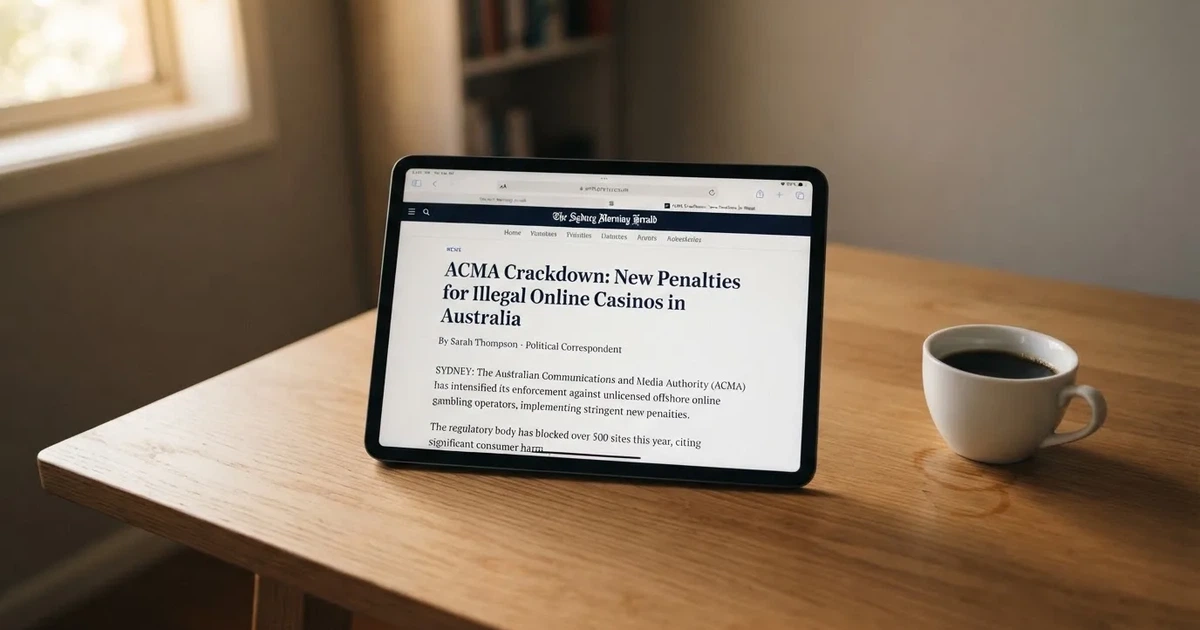
The Australian Communications and Media Authority is the body that turns the IGA from a statute into a wall. Its tools are investigation, formal warning and a request that Australian internet service providers make a domain unreachable from inside the country. As reported in June 2026, the cumulative total since enforcement was strengthened in 2017 had reached 1,751 illegal gambling and affiliate marketing websites blocked, with more than 230 unlicensed services having left the Australian market altogether. The pace is not even — some months produce a list of a dozen domains, others none at all — but the curve has only gone one way. The most recent reported round, on 26 June 2026, added 12 more sites: 7Signs, ChromaBet, Donbet, Duospin, Freshbet, Slots Gem, Jacks Club, Lucky Start, Pointsbetz, Spinrise, Vinyl Casino and Wildsino. Each round has the same shape: the ACMA publishes the notice, the ISPs comply, and an Australian customer who knew the site by name finds a dead page.
Formal warnings, and what they actually are
A formal warning under the Interactive Gambling Act is a written notice that the ACMA considers a service to be providing prohibited interactive gambling to Australians. It is published on the ACMA website with the operator’s legal name and the brand the warning covers. It is not a prosecution and it does not, by itself, take a site offline — but a service that ignores a warning and stays available to Australians is the next stop on the road to a blocking request. The series published since 2022 reads like a chain, because some operators run more than one brand under the same corporate parent. Dama N.V. alone has been warned over Bambet, Dazard, Level Up, Rocketplay, Wild Tornado and Cobra Casinos in May 2022, then over Woo Casino in March 2025 and Spirit Casino in May 2025. TechSolutions was warned over Bizzo Casino in 2022; Consolutetish S.R.L. was warned over National Casino and Bizzo Casino in July 2025. Bamboo Media was warned over Ignition Casino in the same month. EOD Code SRL was warned over Instant Casino in February 2025. Sterplay Holding was warned over Casino Intense in April 2025. Ryker B.V. was warned over Jackbit and CasinOK in April 2026. Pulsup Ltd was warned over RocketPlay in March 2026. Hollycorn N.V. was warned over Sky Crown and Blue Leo in September 2022.

Read across, the warnings show three things at once. First, that the same corporate parent often runs several brands, so a brand change does not put the operation outside the regulator’s reach. Second, that a warning issued in one year does not end the matter — Dama N.V.’s series is the clearest example, with three years and several brands between the first notice and the latest. Third, that a brand which surfaces in a fresh warning is one whose operators have been told, in writing, that the service is prohibited for Australians and have chosen to keep offering it anyway.
How fast the wall is actually moving
Spread across the 79 months between November 2019, when the ACMA issued its first blocking request, and the June 2026 total of 1,751 blocked sites, the average is roughly 22 domains added per month. That is the working figure, and it is the one to keep in mind when a single offshore site markets itself as “still accepting Australians” — the question is not whether a site exists today but whether it will be on next quarter’s list. Some months add nothing; some rounds add more than a dozen at once. The honest reading of the ACMA’s record is a band: about 22 blocked or warned-about services per month on the long-run average, with any given month’s actual count anywhere from zero to a dozen or more.
The arithmetic behind that band is straightforward. The regulator started asking ISPs to block illegal gambling domains in November 2019. By 26 June 2026 the running total of blocked sites had reached 1,751. The number of months between the first blocking request and the most recently reported total is 79. Dividing 1,751 by 79 gives an average rate of roughly 22 sites blocked per month. The assumption that makes the band work is that the ACMA’s record measures blocked sites, not the total number of illegal services operating in any given month — many services operate, get warned, get blocked, rebrand, and return under a new name. The figure describes the regulator’s pace, not the size of the market.
Player wellbeing around VPN-friendly casinos
The Australian safety net for gambling-related harm assumes the gambler is on a service that answers to an Australian regulator. BetStop — the National Self-Exclusion Register — has been live since August 2023 and binds every Australian-licensed online and phone wagering service. A person who registers with BetStop cannot open an account with, or log into, any operator that holds an Australian wagering licence. The mechanism is binding precisely because the licensed operators are connected to the register.

An offshore casino is not connected to BetStop. Self-excluding through BetStop closes the doors of every Sportsbet, Bet365 and Ladbrokes account and every other licensed Australian wagering service. It does not touch a Curacao- or Costa Rica-licensed brand, and the offshore site has no obligation to honour a BetStop entry even if the customer volunteers the information. For someone who has signed up with BetStop because they want to stop, the gap between what the exclusion covers and what they actually use is the most important practical fact on this page.
The Gambling Help line, 1800 858 858, is free, runs 24 hours a day and connects to chat through Gambling Help Online. It is not an offshore casino’s problem and it is not a regulator. It is a service that exists whether or not a person has ever placed a bet, and it is the first place a reader with concerns about their own or someone else’s play should reach for. There is no Australian regulatory complaint body to contact about an offshore casino — that fact is the whole reason offshore complaints go nowhere.
Why a VPN does not extend BetStop
It is worth saying plainly, because the question comes up: a VPN does not put a BetStop-registered customer into a different legal category. Self-exclusion is a behavioural tool layered on top of licensed services, and the offshore site is not part of that layer. The reader who has used BetStop to take a break from wagering, and who is reading this page because an advertisement for an offshore casino slipped through somewhere, is the reader the wellbeing frame is for. The offshore site is not a substitute for the licensed services that BetStop covers, and the support line is reachable whatever the platform someone has been using.
Comparing the public claims, side by side
The table below lays out the eleven brands the ACMA itself has warned under the Interactive Gambling Act for offering prohibited services to Australians. Every row is a brand the regulator has named in writing. The columns carry what is on the public record: the brand name as a person would search for it, the ACMA action and its date, the operator the ACMA named in the warning, and what the regulator’s own record shows about the brand. No column ranks one against another and no column recommends one over another, because the underlying legal status is identical — an offshore casino offering prohibited services to Australians — and ranking them would change nothing a reader can act on.
The fact that one row is empty in the final column is not an omission. It is the record. Research for this article found no published ACMA material linking that brand to the topics the column covers, and the policy on this page is to leave the cell blank rather than fill it with speculation. A cell with a dash is a row that was checked and found silent; a row with content is a row where the ACMA itself has said something. The reader can do what the page does not: assume that silence on a regulator’s file is not, by itself, evidence of innocence.
| Brand | ACMA action and date | Operator named by the ACMA | Subject support |
|---|---|---|---|
| RocketPlay | Formal warning, March 2026 (Pulsup Ltd); earlier warning to Dama N.V., May 2022 | Pulsup Ltd; Dama N.V. | Listed by gambling industry sources |
| Level Up Casino | Formal warning, May 2022 | Dama N.V. | Listed by an Australian bank reference |
| Woo Casino | Formal warning, March 2025 | Dama N.V. | — |
| Spirit Casino | Formal warning, May 2025 | Dama N.V. | — |
| National Casino | Formal warning, July 2025 | Consolutetish S.R.L. | Listed by Australian Payments Plus, AUSTRAC and BetStop coverage notes |
| Bizzo Casino | Formal warning, July 2025 (Consolutetish S.R.L.); earlier warning, 2022 (TechSolutions) | Consolutetish S.R.L.; TechSolutions | Listed by gambling industry sources |
| Ignition Casino | Formal warning, July 2025 | Bamboo Media | — |
| Instant Casino | Formal warning, February 2025 | EOD Code SRL | Listed by an e-wallet service and by PayID coverage |
| Jackbit | Formal warning, April 2026 | Ryker B.V. | — |
| Casino Intense | Formal warning, April 2025 | Sterplay Holding Ltd | Listed by AUSTRAC, BetStop coverage notes and gambling industry sources |
| Sky Crown | Formal warning, September 2022 | Hollycorn N.V. | — |
Three patterns sit inside the table once it is read across. First, several operators have run multiple brands under one corporate parent, so a brand the reader has not heard of may sit beside one they have. Second, a brand can appear on the ACMA list at more than one point in time and across more than one corporate entity — the second warning does not undo it; it adds to it. Third, where the regulator’s file is silent on a topic, the table is silent too, because the column is not the place to dress up silence as evidence.
RocketPlay
RocketPlay carries two formal warnings, the older one issued to Dama N.V. in May 2022 and the newer one to Pulsup Ltd in March 2026 over RocketPlay. A reader sees two corporate names attached to the same brand because the operator behind it changed hands across that interval; what did not change is that the ACMA has, on two occasions, named the service in writing as providing prohibited interactive gambling to Australians. Gambling industry listings have tracked the brand across the change. The site’s own marketing as of 2026 describes itself as offshore and licensed elsewhere; that licence does not extend to Australian customers, because no licence anywhere does for online casino games.
The verdict on RocketPlay is the verdict on every row of this table: the ACMA has named it, the regulator’s own record carries it, and the only thing a reader can do with that information is to weigh it before deciding whether the brand is one they want to use.
Level Up Casino
Level Up Casino was named in the same May 2022 ACMA warning as Bambet, Dazard, Rocketplay, Wild Tornado and Cobra Casinos, with Dama N.V. as the operator across all six. That single warning covers more brands than the table has room to print. A reference on an Australian bank’s gambling-block page notes the brand. The site is reachable today; whether it is reachable tomorrow depends on whether the ACMA’s next blocking round adds it to the list, and the operator’s history of running several brands under one parent makes that a question worth taking seriously.
The verdict on Level Up is that the brand shares an operator with five others on this page and an Australian bank’s own materials treat it as a known gambling brand. That is the totality of what the public record carries.
Woo Casino
Woo Casino was named in a formal warning to Dama N.V. in March 2025. The brand sits inside the same operator cluster as Level Up, Spirit Casino, Bambet, Dazard, Rocketplay, Wild Tornado and Cobra Casinos, and the pattern across those names is what makes a single brand worth reading as part of a group. The public record has no further material on this brand beyond the warning itself; the cell is blank because that is what research found. A reader who sees Woo Casino advertised is a reader looking at a brand the ACMA has named once in the past year and which sits inside an operator cluster that has been warned about repeatedly.
The verdict on Woo is that a fresh warning inside an active cluster is the strongest single signal the regulator’s record carries; the rest is silence.
Spirit Casino
Spirit Casino was named in a formal warning to Dama N.V. in May 2025. It is the most recent of the Dama N.V. warnings in this table and the one issued less than a year before 2026. The cluster around it — the same operator, the same pattern of several brands under one parent — is what the regulator’s record actually shows. Beyond the warning, the public record is silent on this brand.
The verdict on Spirit Casino is that the regulator named it inside the last twelve months, on the same operator that has been named before, and a reader can act on that signal without needing more material than what the table holds.
National Casino
National Casino was named in a formal warning to Consolutetish S.R.L. in July 2025. Coverage notes from Australian Payments Plus, AUSTRAC and BetStop reference the brand. The combination is unusual: most rows in this table have one or the other, not all three. A reader looking at National Casino is looking at a brand that surfaces in three different Australian-institution reference sets as well as on the ACMA’s own warning page. The brand is one of two Consolutetish S.R.L. warnings that month, the other being Bizzo Casino.
The verdict on National Casino is that its public record is the most institutionally cross-referenced on this page. The references do not change the legal position; they show how widely the brand has circulated inside the Australian regulatory and payments infrastructure.
Bizzo Casino
Bizzo Casino carries two warnings. The first was issued to TechSolutions (CY) Group Limited and TechSolutions Group N.V. in 2022. The second was issued to Consolutetish S.R.L. in July 2025. The brand has therefore been named by the ACMA across more than one operator and across more than three years, and gambling-industry listings continue to track it. The 2022 warning was followed by a quiet interval and then the 2025 one, which is the shape of the regulator’s record when a brand has been warned, gone silent for a while and then resurfaced under different ownership.
The verdict on Bizzo is that two warnings on two operators in three years make it a strong instance of the pattern this table is built to expose. A reader who treats the warnings as a one-off may be looking at an older snapshot of the record.
Ignition Casino
Ignition Casino was named in a formal warning to Bamboo Media in July 2025. The public record beyond the warning is silent on the brand. Bamboo Media is not the same operator as Dama N.V. or Consolutetish S.R.L., so Ignition sits as its own entry rather than as part of a cluster. The brand name is one a reader may have encountered in offshore-marketing material; the ACMA’s record on it is a single 2025 warning.
The verdict on Ignition is that the regulator has named it once and has not, on the public record, returned to it. A reader can treat that as a smaller footprint than the multi-warning brands above, and a smaller footprint is not the same thing as a clean one.
Instant Casino
Instant Casino was named in a formal warning to EOD Code SRL in February 2025. The brand surfaces in coverage notes from an e-wallet service and from PayID materials. The combination puts Instant Casino inside both the ACMA’s own warnings and the reference sets of two payments-infrastructure bodies, which is the kind of cross-reference that tends to mean the brand has circulated widely enough to be on the radar of more than one institution.
The verdict on Instant Casino is that the payments-side cross-references matter even though they do not change the legal position. A reader whose bank blocks a transaction to a brand on this list is seeing the same signal the ACMA’s file carries, and the two together describe a brand the Australian payments infrastructure has noticed.
Jackbit
Jackbit was named in a formal warning to Ryker B.V. in April 2026, alongside CasinOK. The brand is the most recent entry in this table. The operator, Ryker B.V., is not the same as any other operator named in the table, so Jackbit stands on its own entry. The public record beyond the warning is silent.
The verdict on Jackbit is that a warning issued inside the last few months before 2026 is the freshest the ACMA’s record on this page carries, and a reader should weigh that freshness against the brand’s lack of further material on the public file.
Casino Intense
Casino Intense was named in a formal warning to Sterplay Holding Ltd in April 2025. The brand is referenced in AUSTRAC, BetStop coverage notes and gambling-industry listings, which puts it in the same institutionally cross-referenced position as National Casino. The combination — a recent warning and several cross-references — is the most complete public footprint on this page for a brand outside the Dama N.V. cluster.
The verdict on Casino Intense is that the brand has both a recent ACMA action and a wider set of institutional references than most entries on this page. That combination is itself information; it does not change the legal status, which is the same as every other row.
Sky Crown
Sky Crown was named in a formal warning to Hollycorn N.V. in September 2022, alongside Blue Leo. The warning is the oldest on the page. Hollycorn N.V. has not appeared in a more recent ACMA warning on this table, which distinguishes Sky Crown from the brands whose operators have been warned repeatedly. The public record beyond the 2022 warning is silent on this brand.
The verdict on Sky Crown is that an older warning with no follow-up action is a different shape of footprint from a brand that has been named twice, and a reader can read that difference without needing more material than the table holds.
The broader landscape of VPN-friendly casinos
The phrase “VPN-friendly casino” is a marketing label, not a regulatory category. It refers to an offshore casino that either publishes instructions for connecting through a virtual private network, declines to block known VPN endpoints, or simply does not geolocate Australian customers aggressively enough to refuse them at the door. The first two are explicit positions the operator has taken; the third is a default that the operator has not announced but accepts. None of the three changes the legal status of the service in Australia, because the legal status is set by what the service offers, not by how the customer reaches it.
What a VPN does change is the technical layer. An Australian customer’s home internet connection hands the casino site an IP address that identifies the connection as Australian. A VPN substitutes an exit node in another country, and the casino site sees the country of the exit node instead. The casino’s automated geolocation check, if it has one, sees a connection from somewhere it considers acceptable and lets the page load. The customer sees the casino as it appears to someone in that other country. That is the whole of what a VPN does in this context.
It is not a small thing. Many offshore casinos will simply refuse to load for an Australian IP, and a VPN is the only practical route past that refusal. It is also not the important thing, because the refusal is a courtesy, not a law. An Australian who reaches the casino through any other route — a different VPN exit, a different device, a coffee-shop Wi-Fi on a roaming SIM — is on the same legal footing as the Australian who gets refused at the door. The IGA prohibits the service, not the means of access. A blocked site can also be reached, in principle, by other means that circumvent the ISP block — the regulator’s blocking request is addressed to Australian ISPs and works at the DNS level; it does not catch every route. The reader who wants the technical picture can read it that way; the reader who wants the legal picture reads it differently.
Why “VPN-friendly” exists as a sales pitch
The pitch exists because the audience it reaches has already been turned away once. An Australian who has tried to open an offshore casino and been shown a “not available in your region” page is the most receptive reader on the internet to a sentence that begins “use a VPN to access…”. The marketing is calibrated to that moment of friction. The phrase does two jobs at once: it solves the immediate technical problem and it implies, without quite saying so, that the legal problem has been solved too. The implication is the part to read carefully. The Interactive Gambling Act does not turn on whether the customer uses a VPN; it turns on whether the service offers prohibited interactive gambling to a person in Australia, and a person in Australia is exactly what the punter using the VPN still is.
What the ACMA’s blocking actually does, and what it does not
An ACMA blocking request is addressed to Australian internet service providers. It instructs the ISPs to make a list of domains unreachable through normal Australian internet connections. Most Australians hit the block at the DNS layer: the domain does not resolve, the browser shows an error, and the site is unreachable without further effort. The block works for the casual user. It does not work for someone who knows how to use a VPN, and it does not work for someone who uses a different DNS resolver. The block is a wall across the most common door; it is not a fence around the building.
The consequence is that the wall changes behaviour at the margin. The casual user gives up; the determined user gets past it. The regulator’s working assumption, visible across the eight-year blocking record, is that the wall moves enough people out of reach that the cost of running an illegal service goes up, and the willingness of new operators to enter the Australian market goes down. The 230-plus services that have left the Australian market since 2017 are the empirical case for that assumption.
The Australian-side payment rails
The payment infrastructure used for deposits at an offshore casino is separate from the regulated Australian system. Licensed operators must use debit cards, bank transfers, PayID, Osko, and BPAY.
| Payment Method | Key Feature |
|---|---|
| PayID | Instant transfers using identifiers like phone numbers |
| Osko | Near-instant transfers between participating banks |
| BPAY | Established bill-payment service for over 140 banks |
| Debit Card | Standard transaction method subject to merchant category blocking |
The Australian banks that issue debit cards carry merchant-category gambling blocks at the card-issuance level: Westpac’s gambling block refuses transactions tagged under the merchant category code for betting and casino gambling on eligible personal cards; ANZ’s block, activated in the ANZ app, blocks gambling transactions made through a digital wallet such as Apple Pay on an eligible card; Commonwealth Bank’s CommBank app gambling lock blocks most gambling transactions on eligible cards. Each bank publishes its own caveat that not every gambling transaction will be blocked and some non-gambling transactions may be blocked in error.
Closing thoughts on a VPN-friendly casino choice in Australia
A reader who has reached this page looking for a way to use an offshore casino from Australia already knows the technical answer. The VPN route works; the offshore site loads; the deposit rail reaches the operator. The legal answer is the one this page has been built to make explicit, because it is the answer the marketing never prints. No licence anywhere covers online casino games for Australian customers, which means no complaints body, no external dispute resolution and no regulator to approach when a balance does not come back. The ACMA’s blocking record shows what happens when a regulator has been told, in writing, that a service is operating in breach and the service has chosen to keep operating: a warning, then a block, then a rebrand, then another warning.
The brands in the table above are the ones the ACMA has named in writing. Reading them across, the patterns are clearer than any single warning: an operator that runs several brands is an operator the regulator will return to; a brand that resurfaces under a new corporate parent after an old warning is a brand that has been told twice; a brand with no Australian-institution reference is a brand whose public footprint is the regulator’s file and the marketing itself. The reader’s decision is not which offshore casino to pick — every one of them sits on the same legal footing in Australia — but whether to use one at all, given what is and is not available to protect a balance once it is on it.
Frequently asked questions
Why would a casino specifically advertise itself as “VPN-friendly” in the first place?
Because the audience the marketing is trying to reach has already been turned away once by an offshore site that refused to load for an Australian IP. The pitch turns a moment of friction into a sales point. “VPN-friendly” is also a way for the operator to position itself as permissive without quite saying it ignores geolocation, which would be a different kind of admission.
Does using a VPN to access an offshore casino change whether the activity is legal for someone in Australia?
No. The Interactive Gambling Act 2001 prohibits the provision of online casino games to a person physically in Australia. A VPN changes the IP address the casino site sees; it does not change the customer’s physical location. The legal position is the same whether the customer is on a home connection, a VPN, a roaming SIM or a coffee-shop network.
How does a VPN change what an offshore casino site can actually see about where a player is connecting from?
A VPN substitutes the exit node’s IP address for the customer’s home IP, so the casino’s automated geolocation check sees the country of the exit node rather than the country of the underlying connection. Anything that depends on the IP — country detection, blocking pages, payment-method availability — responds to the exit node. Anything that depends on the customer’s actual identity — KYC checks on the account, the name on a bank transfer — does not.
What risk does a player take on by using a VPN to reach a casino that’s been formally warned before?
The regulator’s risk attaches to the operator, not the customer. The customer’s risks are the ones that attach to using any offshore casino: no Australian consumer protection, no Australian complaints body, no recourse if a withdrawal is refused, and a balance that has no protected status if the site gets added to the next ACMA blocking round. A warning that has been issued before and ignored is also a signal that the operator has decided to keep offering the service despite the regulator’s notice.
Is a casino that “allows VPN use” any different, technically, from one that simply doesn’t check?
Functionally, no. A casino that publishes instructions for connecting through a VPN is making a marketing decision to be explicit about it. A casino that simply does not geolocate aggressively is making the same decision implicitly. The technical state — a connection that reaches the site despite an Australian IP — is the same in both cases, and the legal position is the same in both cases too.
What should someone consider before treating VPN access as a safe workaround rather than a legal one?
That the legal layer and the technical layer are different. A VPN solves the page-not-loading problem. It does not produce an Australian-licensed casino, because none exists for online casino games. It does not put the operator under the ACMA’s jurisdiction. It does not connect the customer to BetStop, to the Gambling Help line’s referral paths or to any Australian complaints process. The reader weighing the workaround is weighing technical access against the absence of the protections that come with a service that is regulated where they live.