
Melbourne’s Pokies Floor in 2026: The Real Cost Behind the Word “Best”
The cheapest way to find a pokie in Melbourne is to walk into almost any pub or club between the Yarra and the suburbs. The most expensive way is to open an offshore casino site on a phone and try to withdraw what you put in. Both end at a button labelled “spin”, but the first sits inside a system that takes a cut and gives something back, while the second sits inside a system that is unlawful to offer to Australians in the first place. The page below is built around that gap. It walks the licensed Melbourne floor the IGA lets operate, names what a spin actually costs the punter, and lays out the offshore brands the ACMA keeps warning — not as places to play, but as the picture of what the “best pokies in Melbourne” search keeps returning when a reader does not yet know which is which.
Drawn as at 29 October 2026 against the ACMA’s published register of formal warnings and blocking actions, cross-checked against the Victorian regulator’s gaming-machine disclosures.
Table of Contents
- The Legal Frame Around Every Machine a Punter Presses
- What “Responsible Gambling” Actually Means in Victoria
- The Melbourne Pokies Floor in Person
- Payments and Payout Speed: How the Money Actually Moves
- Games, Providers and What “Crown Pokies” Actually Means
- Regulatory Quick-Reference
- The Blocking Rate: How Many Sites per Year
- What “Best” Means When the Floor Is the Same Everywhere
- The Cost of Choosing the Wrong One
- The Melbourne CBD and the Surrounding Suburbs
- Frequently Asked Questions
The Legal Frame Around Every Machine a Punter Presses
The Interactive Gambling Act 2001, tightened by the Interactive Gambling Amendment Act 2017, makes it an offence to provide online casino games, online pokies or in-play wagering to a person physically in Australia. No state or territory licenses that product. What is licensed is pre-event racing and sports wagering, lotteries and keno, and those are licensed, for tax reasons, mostly through the Northern Territory Racing and Wagering Commission — the body the ABC reported in April 2026 has 52 online bookmakers under its banner and meets once a month in Darwin. The takeaway for a Melburnian looking for a machine is straightforward: a pokie on a screen in front of you is lawful; the same game on an offshore website is not.

The enforcement engine is the ACMA. It investigates, it issues formal warnings, and it asks Australian ISPs to block unlawful sites. As at June 2026, the ACMA’s running total since its first blocking request in November 2019 stood at 1,751 blocked illegal gambling and affiliate sites, with more than 230 unlicensed services said to have left the Australian market since enforcement was strengthened in 2017. The June 2026 round alone added twelve names — 7Signs, ChromaBet, Donbet, Duospin, Freshbet, Slots Gem, Jacks Club, Lucky Start, Pointsbetz, Spinrise, Vinyl Casino and Wildsino. The same report, drawing on H2 Gambling Capital’s 2025 figures, put Australian losses to illegal sites at roughly A$3.9 billion a year, and the share of gambling flowing through legal channels falling from 74% in 2021 to 64%.
That is the context every other shelf in this guide sits inside. The licensed venues exist because the law draws them; the offshore sites exist because the law does not reach them across borders.
What “Responsible Gambling” Actually Means in Victoria
“Responsible gambling” tends to arrive on a sign near a cashier. In Victoria it is also a stack of institutions a punter can use, with or without a venue’s cooperation.
The headline support is Gambling Help Online and the National Gambling Helpline on 1800 858 858, free, twenty-four hours a day, with web chat available. Both are funded to work with anyone with a gambling concern, regardless of where they play. The same service handles calls from people worried about a relative as calls from people worried about themselves, and it does not require the caller to be in treatment to ring.
BetStop, the National Self-Exclusion Register, has been live since August 2023. It binds Australian-licensed online and phone wagering services — so it works against a Sportsbet account or a phone betting service. It does not bind an offshore casino, which is not connected to it. The distinction matters because the bulk of a Melbourne punter’s gambling harm, on a national scale, sits inside licensed online wagering rather than inside licensed land-based pokies, and the self-exclusion tool reflects that distribution.
At the state level, the Victorian Gambling and Casino Control Commission runs its own exclusion scheme for Crown Melbourne and the licensed clubs and hotels across the state. A venue in Melbourne that operates electronic gaming machines under a Victorian licence must ask anyone who self-excludes to commit to a minimum exclusion period and may extend that period at the request of the person. The exclusion is tied to the venue, so it travels with the punter only in the sense that the registers are checked on entry.
The reform track continues to move. The Interactive Gambling Amendment (Gambling Reform) Bill 2026 passed Parliament on 19 August 2026, with its advertising and inducement measures commencing on 1 January 2027. For a reader in 2026, that is a law made and not yet in force — a start date that shapes how an operator writes its next twelve months of marketing copy, rather than a rule that changes anything a punter does today.
The Melbourne Pokies Floor in Person
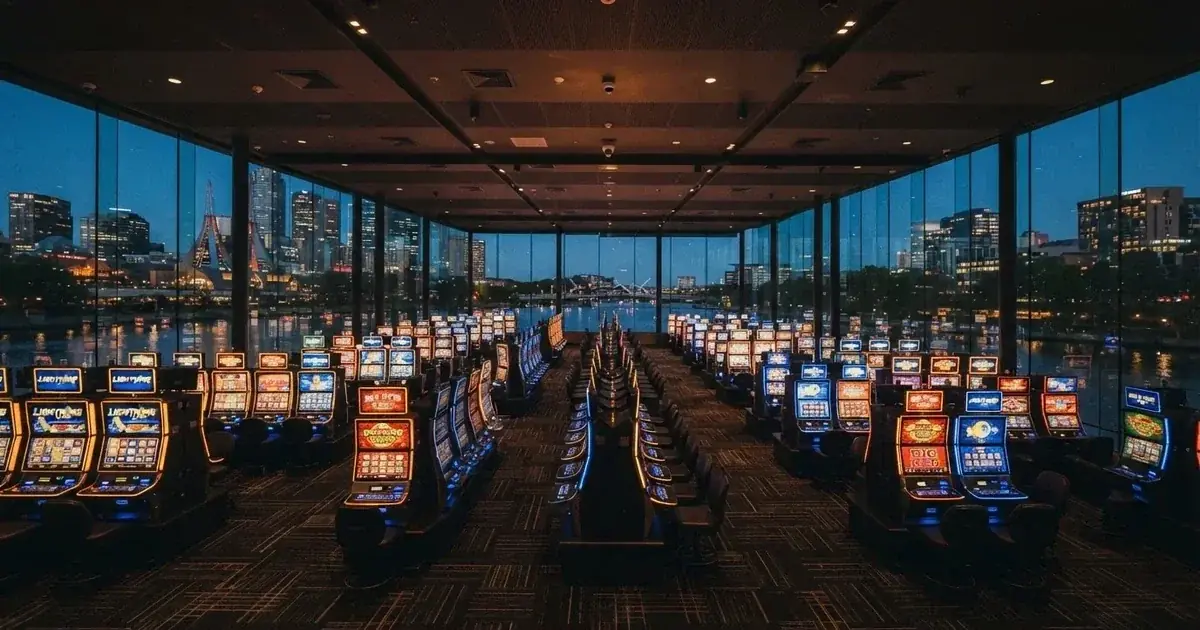
Melbourne’s licensed pokies floor is split between one large integrated resort and the rest of the state, which is a few thousand pubs, clubs and hotels under a cap. Crown Melbourne sits on the south bank of the Yarra, in a complex of roughly 510,000 m² — about two city blocks — opened permanently in 1997 after a temporary opening on the north bank in 1994. Its gaming floor runs to about 220,000 square feet (20,000 m²), with 540 licensed table games — 100 of them poker — and 2,500 poker machines, inside a resort of 1,604 hotel rooms across three towers. It is the largest casino complex in the Southern Hemisphere.
Outside Crown, Victoria had 26,380 gaming machines across 488 venues in 2021–22, operating under a 30,000-machine statewide limit that has not been lifted. The pub-and-club floor is dense across the inner suburbs and the airport corridor, and it carries the bulk of Victorian losses. The Victorian Local Governance Association’s most recent tally put those statewide electronic gaming machine losses at a record A$3.318 billion for 2025–26 — a number that puts the per-machine yield well ahead of comparable machines interstate, partly because Victoria allows larger bets and longer sessions.
Crown itself has been through a regulatory furnace. The Finkelstein Royal Commission into the Casino Operator and Licence concluded in October 2021, finding evidence of money laundering and entrenched ties to organised crime at the venue, and Crown kept its licence only on a two-year review basis under a court-appointed Special Manager. The Victorian Gambling and Casino Control Commission — the new regulator created by the Casino and Gambling Legislation Amendment Act 2021 — fined Crown A$80 million in June 2022 for processing A$164 million in illicit payments, and a further A$120 million in November 2022 for a decade of responsible-gambling breaches that included letting patrons gamble for more than 24 hours without a break. Junket operations were banned at Victorian casinos in the same package.
For a punter on the Crown floor, the practical upshot is that the operator’s house rules now overlap with a regulator’s expectations. The same cannot be said for the suburban pub-and-club floor, where compliance with the same rules is uneven and where the bulk of Victorian losses are now booked.
Payments and Payout Speed: How the Money Actually Moves
A pokie has no payout speed in the legal sense — it returns wins as machine credits, redeemable at the venue cashier. What a Melbourne punter experiences is the time between a button press and a printed ticket, plus any venue-specific limits on how that ticket is paid out.
At a pub or club, the practical ceiling on a single cash payout is set by the venue. Many small venues have a low ceiling because they are not licensed as high-rollers and cannot bankroll a five-figure cashout. The Crown complex, by contrast, settles to a bank account or a cage in higher amounts, and its branded premium gaming rooms sit on the casino side of the casino-vs-club divide. Across Victoria, the statutory minimum return-to-player rate for a gaming machine is 87.5%, and the general maximum bet outside Crown is A$5.00 per spin — a limit that does not apply inside Crown. That A$5 ceiling is one of the reasons the bulk of statewide losses sit in the suburban pub and club estate rather than in the integrated resort.
Inside the Crown complex, the maximum-bet cap on individual machines is set by the machine type and the regulator, not by a flat state ceiling, and the payout ceilings follow the same pattern: bigger because the casino is licensed to absorb bigger wins.
Offshore, the conversation is the opposite. A deposit to an offshore casino arrives through whatever payment rails the offshore operator accepts — and many of those rails are closed to licensed Australian wagering for a reason. Credit cards, credit-related products and digital currency have been banned as payment for licensed Australian wagering since 11 June 2024, with penalties of up to A$247,500 per breach for the operator. Legal deposit routes for licensed wagering are debit card, bank transfer, PayID/Osko and BPAY. A site that asks an Australian for a credit card or a crypto deposit is operating outside the Australian rules regardless of what it says in its footer.
The settlement direction is the harder problem. A withdrawal request from an offshore site is not enforceable under Australian consumer law because the operator is offshore and unlicensed here, and an Australian bank does not have a domestic regulator to complain to. The ACMA can block the site, which has happened more than 1,700 times since November 2019, and a blocked site will not return a balance. That is the cost of doing the payout on the wrong side of the IGA.
Games, Providers and What “Crown Pokies” Actually Means
The phrase “Crown Melbourne pokies” carries weight that the rest of the city’s gaming floor does not have, simply because the venue sits at one end of the regulator’s spectrum. Crown operates roughly 2,500 machines on its south-bank floor, sourced from a mix of manufacturers whose products are approved by the VGCCC, and a punter will see a deeper mix of denomination and volatility than they will in a suburban pub. The same is true at Adelaide Casino (SkyCity Adelaide), where the gaming floor holds 90 tables and 950 gaming machines in a single heritage building on North Terrace — the sole licensed casino in South Australia under the Casino Act 1997.
South Australia’s regulatory environment is materially different from Victoria’s. The state sets a minimum gaming-machine return-to-player rate of 87.5% and a general maximum bet of A$5.00 outside the casino, while Adelaide Casino itself has no maximum-bet limit. South Australian gaming-machine losses outside Adelaide Casino ran to roughly A$0.92 billion in 2022–23 — about A$497 per adult. Adelaide Casino’s table-game monopoly runs to 30 June 2035 under a licence formalised on 11 October 2013.
In Queensland, the comparable picture has just changed. Treasury Casino, operated by Star Entertainment Group, closed on 25 August 2024 to make way for the new Star Brisbane at the A$3.6 billion Queen’s Wharf precinct, which began a staged opening on 29 August 2024. The opening sat amid concerns about Star Entertainment’s licence position at the time. Queensland had 21,122 gaming machines across 351 venues in October 2023, a smaller estate than Victoria’s. For a Melburnian who plays interstate, the practical point is that the rules and the floor mix change at the border, and the same machine configured for the same return can behave differently under different regulatory ceilings.
Regulatory Quick-Reference
| Feature | Requirement |
|---|---|
| Minimum Age | 18 |
| Minimum Return-to-Player (Victoria) | 87.5% |
| General Maximum Bet (Pubs/Clubs) | A$5.00 |
| Online Pokies Licensing | Prohibited |
The Branded Comparison: Eleven Offshore Sites the ACMA Has Warned
The brands below are not a ranking. Each is included because the ACMA itself issued a formal warning over it for offering prohibited online casino services to Australians. None is recommended as a place to play; the value of listing them is to show what an Australian reader actually meets when a “best pokies” search returns an offshore site dressed in Melbourne-adjacent language. The detail each row carries comes from the ACMA’s published register of formal warnings and from the supporting listings the research could verify. The brand page or footer of any of these sites is not a source for any figure in the table below.
| Brand | ACMA action and date | Operator named by the ACMA | Subject support |
|---|---|---|---|
| RocketPlay | Formal warning, March 2026 (Pulsup Ltd); earlier Dama N.V., May 2022 | Pulsup Ltd | — |
| Level Up Casino | Formal warning, May 2022 | Dama N.V. | Listings only — Wikipedia, VGCCC |
| Woo Casino | Formal warning, March 2025 | Dama N.V. | Listings only — Wikipedia |
| Spirit Casino | Formal warning, May 2025 | Dama N.V. | — |
| National Casino | Formal warning, July 2025 | Consolutetish S.R.L. | Listings only — ABC, infrastructure.gov.au |
| Bizzo Casino | Formal warning, July 2025 (Consolutetish S.R.L.); earlier TechSolutions, 2022 | Consolutetish S.R.L. | — |
| Ignition Casino | Formal warning, July 2025 | Bamboo Media | — |
| Instant Casino | Formal warning, February 2025 | EOD Code SRL | — |
| Jackbit | Formal warning, April 2026 | Ryker B.V. | — |
| Casino Intense | Formal warning, April 2025 | Sterplay Holding Ltd | Listings only — ABC, ASGAM, CBS SA |
| Sky Crown | Formal warning, September 2022 | Hollycorn N.V. | Listings only — Wikipedia |
What the table shows, and what no individual row tells the reader, is the spread. The ACMA has acted against eleven different brand families across four operators (Dama N.V. alone appears on three of the rows above, on different dates), and the dates stretch from September 2022 to April 2026. A formal warning is not a block, but a block can follow. The same operator name showing up on later rows is the regulator’s own record of repeated behaviour after a warning — the most useful single fact on the table for a reader who treats a warning as a marketing footnote rather than as evidence.
A reader asking what any of these brands does for them should treat that question as a closed one. Online casino games cannot be licensed in Australia. Whatever licence seal a site displays, whatever “Australian” its marketing copy claims, the IGA is the same and the ACMA is the same. The site can be blocked with a balance in it, the operator is not reachable through Australian consumer law, and the support services listed earlier in this guide will work whether the harm came from a licensed venue or an offshore site.
The Blocking Rate: How Many Sites per Year
The arithmetic that sits underneath the ACMA’s blocking record gives the reader a sense of the scale of the enforcement effort. The first blocking request was issued in November 2019; the running total reached 1,751 blocked sites by June 2026, a span of roughly six and a half years. That works out to a band of roughly 240 to 290 sites blocked per year across the period — not a flat rate, because enforcement has run in rounds and the ACMA has stacked larger batches in some years than in others. The point the band supports is structural: the regulator is not catching up, it is keeping pace with an industry that re-brands faster than it is warned. A reader who treats the blocking rate as the answer to “is this getting better” is missing the question. The question is whether the next site they open is on the list or about to be.
What “Best” Means When the Floor Is the Same Everywhere
A reader searching the headline phrase is usually trying to find the best return, the highest limit, or the closest venue. On a regulated floor the answers do not move much. Victoria’s statutory minimum return-to-player rate of 87.5% applies to every machine in every pub and club, so the return a punter sees on the screen is set by the machine and the regulator, not by the venue. The “best” within that frame is a function of denomination and volatility, both of which the venue displays, and not of the operator’s intent.
Crown sits outside that frame because its regulator is different and its machine cap is different. A punter who wants a higher denomination, a larger bet, or a deeper mix of titles will find what they are looking for at the south-bank complex, and will not find it at the suburban pub a kilometre away. The trade-off is regulatory: Crown’s compliance regime is heavier, and the same punter is observed more closely. The same trade-off cuts the other way for the suburban pub, where compliance is lighter and the regulatory ceiling is lower.
The headline phrase hides a third option, which is the offshore site. That option is not a venue at all, and the cost of using it is the subject of the next shelf.
The Cost of Choosing the Wrong One
The arithmetic that matters for an Australian punter considering an offshore site is not the bonus or the payout percentage — it is the question of whether the offer is even legal to make. The IGA prohibits the offer; the ACMA enforces it; the operator’s bonus page does not undo either.
A “best” comparison on the licensed floor, where two machines pay 87.5% and differ only in volatility, is a comparison of pacing. A “best” comparison that includes an offshore site, where one machine pays an unknown percentage under a regulator no Australian can call, is not a comparison at all. It is a category error, and the page treats it as such.
The same logic applies to payout speed. A licensed venue pays what it owes, in cash, at the cashier. An offshore site pays what its operator chooses to pay, in whatever currency it accepts, on whatever timeline it sets, with no Australian recourse if it chooses not to. The IGA does not need to know the payout percentage to make that clear.
The Melbourne CBD and the Surrounding Suburbs
The “best pokies in Melbourne CBD” question is, in practice, a question about Crown. The south-bank complex is the only venue of its size in the CBD, and the rest of the city’s pokies live in pubs and clubs scattered across North Melbourne, South Melbourne, Port Melbourne, East Melbourne and the western suburbs. A punter asking about “pokies near Melbourne Central” is asking, in most cases, about the venues within walking distance of the central city — which is Crown and a small set of hotels and clubs in the inner ring. A punter asking about “pokies near Melbourne Airport” is asking about the cluster of venues in the airport corridor, mostly in the City of Hume and the City of Moonee Valley, with a mix of denominations and the same 87.5% return ceiling as everywhere else in the state.
The difference between these clusters is not the machine. It is the regulator and the cap. Crown sits under the VGCCC’s premium regime, with a higher machine cap and a heavier compliance footprint. The suburban pubs and clubs sit under the same VGCCC but with a lower cap and a lighter footprint. A punter who plays in both sees the same return and a different ceiling, which is the practical reason the question “where is best” has no single answer on the licensed floor.
Frequently Asked Questions
Which venues in Melbourne are licensed to operate pokies?
Crown Melbourne on the south bank of the Yarra is the largest, with 2,500 machines, and the rest of Victoria’s licensed pokies floor sits in pubs, clubs and hotels under a 30,000-machine statewide cap — 26,380 of those machines across 488 venues sat outside Crown in 2021–22. Every one of those venues is licensed by the VGCCC, and the same minimum return-to-player rate of 87.5% applies across the state.
Are pokies in Melbourne available around the clock?
Hours are set by the venue and the licence. Crown Melbourne runs twenty-four-hour gaming on its main floor, with breaks inserted by the regulator after the Finkelstein Royal Commission found patrons had been allowed to play for more than twenty-four hours without one. Pub and club pokies close with the venue, often around midnight or 1am, and a small set of late venues keep later hours.
What identification do venues in Melbourne require before letting someone play pokies?
A pub or club asks for photo ID on entry to a gaming area, and Crown requires ID at the cashier and at the cage. The minimum age is 18. The identification requirement is not a marketing formality — it is the regulatory hook for the venue’s exclusion register and the state’s responsible-gambling rules.
Can visitors to Melbourne use self-exclusion schemes at local pokies venues?
BetStop, the National Self-Exclusion Register, binds Australian-licensed online and phone wagering services; it does not bind an offshore casino. A visitor to Melbourne can self-exclude from Crown and from the licensed pubs and clubs through the Victorian scheme run by the VGCCC, and a visitor who is already on a BetStop exclusion should expect their home-state exclusion to be checked at the venue.
How does the payout percentage on Melbourne pokies compare with other Australian cities?
Victoria sets a minimum 87.5% return-to-player on gaming machines, the same floor South Australia sets, and pubs and clubs in both states cap maximum bets at A$5.00 per spin. Crown Melbourne and Adelaide Casino itself are not bound by that A$5 cap, which is why their floors hold a different mix of machines. Queensland, with 21,122 machines across 351 venues in October 2023, runs its own regulatory frame.
Is it legal for an online casino to advertise “pokies” in Melbourne the same way a pub or club does?
No. The Interactive Gambling Act 2001 prohibits the offer of online casino games and online pokies to a person in Australia. The ACMA enforces it through formal warnings, blocking requests to ISPs and, in some cases, civil penalty proceedings. The Interactive Gambling Amendment (Gambling Reform) Bill 2026, which passed Parliament on 19 August 2026, will tighten advertising and inducement rules from 1 January 2027. In the meantime, an offshore site advertising pokies to a Melbourne reader is doing what the IGA says it cannot do.